
This week, our Fight Hunger Kid Activist Challenge started. It’s so exciting to see families teaching their kids about the root causes of hunger. We have a bunch of young activists ready to make hunger history!
Do you believe that children are the leaders of the future AND the leaders of today who will tackle some of our toughest problems? If you said yes, this post is for you.
Today I’ll be talking about just what I mean by the term “activist.” I’ll also share a simple action you can take with your kids today. It will only take you about 20 minutes, and it will make a big impact on people who are hungry.


Who can be an activist?
An activist is someone who works to bring about political or social change. When we think about activism, we might picture people who were arrested for trying to change an unjust law. Maybe you think of folks who joined the Women’s March or other protests.
Activism can also include quieter actions that may not make the front page news. When I was a community organizer for an economic justice organization, I learned that lots of people who cared about a living wage weren’t comfortable holding a sign or chanting slogans. And that’s ok! There are so many different kinds of activism that are needed.
If you’ve never been to a protest or a march, but you agree that our world needs some changing, I suggest you start with what you can do right at home, with your kids.
When you engage in activism with your kids, you can also teach them the difference between charity and justice (and why both are needed.)
Related Post: 8 Videos That Help Kids Understand Poverty
Why are kid activists against hunger urgently needed right now?
Too often, we accept the existence of hunger here in the United States and around the globe as inevitable. It’s a topic that doesn’t often make our nightly news.
One in seven Americans struggle to put food on the table. Over 1 billion people around the world live in extreme poverty, trying to survive on less than $1.25 a day.
As a world, we have been making progress in ending hunger. Globally, the rate of people living in extreme poverty has been cut in half since 1990.
But proposed drastic federal budget cuts could reverse that progress. If Congress passes these cuts, it will be devastating for families living in poverty here in the U.S. and abroad.
Right now, just one penny of every dollar the U.S. government spends is used for foreign aid. But as this video shows, that penny goes a long way. President Trump’s proposed budget cuts this already meager amount by 31 percent. It completely eliminates a program that supports education and nutrition and poor countries. It also ends the African Development Fund.
Hungry Families in the United States are at risk too
The proposed budget is just as bad for hungry people here in the United States. SNAP (formerly known as the Food Stamp program) will be slashed by 25% if Congress passes Trump’s budget. Cuts are also expected to WIC (Women, Infants, and Children), which provides vouchers to pregnant women and young children for particular healthy foods.
The video below (made a couple of years ago), shows just how needed child nutrition programs are. You can watch it and the video above about foreign aid with your kids. Even my 5 year old could grasp some of the main points these videos make.
Your child might ask if people like you and me giving food to hungry people could make up for these cuts in nutrition programs.
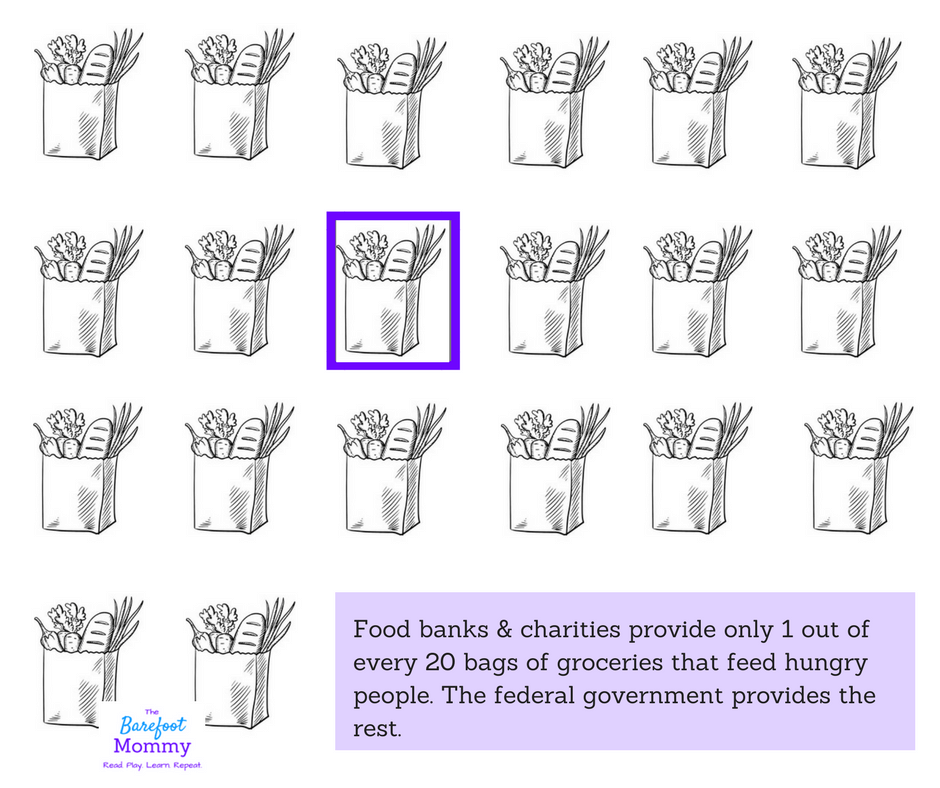
Food banks and charities provide only 1 out of every 20 bags of groceries that feed hungry people in our country. Government assistance provides the rest. So, it’s pretty unlikely that we could make up such a large gap through charitable giving alone.
These cuts affect kids just like mine, and just like yours. I’ve been talking with my 5 year old about how many people are hungry and he instinctively knows “that’s not fair.”
We can help our kids take that message of fairness and compassion to Congress, which has the final say on the budget.
How to write Congress as a family about hunger
Congress is expected to start working on their budget this month (June 2017), so your voice – and your kids’ voices – are urgently needed right now. You can download my family-friendly guide to writing to Congress from my free Resource Library and it will take you step by step through the process.
1. Talk to your child about hunger and the difference government programs make.
Depending on how old your child is, you may want to watch one or both of the videos above. My 5 year old watched the first couple minutes of the video about child nutrition. Though he didn’t make it all the way through, it did give us a chance to talk about kids right here in our city who are hungry, and how government nutrition programs help them.
Do you have an older child who has a decent grasp of numbers? Show them the graphic above about how many bags of groceries the government provides to hungry people.
Let your child know that you’re writing letters to the people that your community or state elected to make laws for us. They have the power to decide how the government will spend its money, including to help people who are hungry.
Explain who an activist is. The way I express this to my child is an activist is someone who works to change things that are unfair in our community and in our world. Tell them that writing this letter is one way that can be an activist and help end hunger.
2. Download and print out my letter form/coloring activity.
You can download my free write to Congress family activity using the form above. Older children may need just a little bit of coaching about how to express their thoughts. I have some specific ideas on what they can say in the download. Younger children can color the groceries pictured on the letter and sign their name. You can ask them what they’d like you to write for them.
3. Write your own letter too
There are a couple of reasons I suggest that you write your own letter. One is that if you put it in the same envelope as your child’s you’ll be able to flesh out the details that they didn’t include in their letters. The second reason is that writing a letter will show your child that you’re an activist too. They’ll know that you care just as much about ending hunger as they now do.
