
Recently the Iranian-American community in our city held its first ever Persian Festival. I was so excited to tell my husband, who is usually a homebody. He used to work for an Iranian professor who introduced him the deliciousness that is Persian food. My hubby put the festival date on his calendar right away.
I knew attending the festival would also be a great chance to introduce our 4 year old to Iranian culture.
We did a lot of talking and activities the week after the festival to help him learn more about Iran, especially the Persian New Year that the festival marked. As I thought about sharing this on the blog, I had a brainstorm. Why not start a Global Citizen Kids Club, where each month we learn about a different country or culture?
Related post: Learn about Colombia with Global Citizen Kids Club


Copyright: paulrommer / 123RF Stock Photo
Disclosure: For your convenience this post contains affiliate links. If you purchase items through these links, I may earn a small commission at no additional cost to you. You can read my full disclosure policy here.
Global Citizen Kids Club: Iranian Culture and the Persian New Year
There are many different ways you can learn about Iranian culture: check out books from your library, look for special events like the festival we attended, eat at a Persian restaurant or make a Persian recipe at home, or learn words in Farsi. In this post, I’ll share a few of the things and some resources to help you get started.
The idea of the Global Citizen Kids Club is to find engaging, simple ways to learn about our world. I found that spreading our activities over a few days increased our 4 year old’s interest. “After school we’re going to learn more about Iran, right Mom?” he’d ask (though he kept calling it “Ha-Ran.”)
The Festival of Nowruz (Persian New Year) and Sizdah Bedar (Nature Day)
Nowruz (prounced “no-rooz“), or Persian New Year, is celebrated in Iran on the first day of spring, March 20th or 21st. It has been observed for thousands of years. It originated in the Zoroastrianism, a religion which is older than Christianity or Islam.
Now the festival is celebrated by most Persians not as a religious one, but simply a festival that’s part of Iranian culture. Nowruz is marked by symbols and acts that are meant to bring good luck in the coming new year, such as giving to others.
One of the Nowruz traditions that we were able to see at the Persian festival was the Haft Seen table.

The beautifully set table is decorated with seven things that begin, in Persian, with the letter “s.” The usual seven items are:
- senjed (dried fruit), representing love
- sir (garlic), protecting from evil and illness
- serkeh (vinegar), ensuring longevity and patience
- sonbol (hyacinth), representing the blooming of spring
- sekkeh (coins), showing prosperity
- sabzeh (wheat or lentil sprouts), representing abundance
If any of these seven items are missing, somaq (sumac berries) or sib (apples) can be substituted. A mirror, candles, and sometimes a lucky goldfish are also part of the Haft Seen table, as well as a copy of Quran or a book of poetry by Hafez.
Be sure to download my free Nowruz activity pack, including a coloring sheet and word search. You’ll also get access to my resource library, which has lots of printables to help you raise a little global citizen.
A related festival that is also part of Iranian culture is Sizdah Bedar, or Nature Day. It’s held 13 days after Nowruz. The festival we attended marked Sizdah Bedar. Iranian families head to parks and wooded areas for outdoor games. It is also the day that the sabzeh (sprouted wheat or lentils) is thrown away, preferably in a stream. This is supposed to rid the home of any sickness or bad luck that accumulated in the first 12 days of the new year.
Related post: Activities to teach kids about Chinese culture
Experiencing Iranian Culture through Persian Food
For my husband, the highlight of the Persian Festival was enjoying koobideh, a grilled kabob made of beef and lamb. If you’re feeling adventurous and want to make your own koobideh for your family, you can find a recipe here.
Unfortunately while my husband, our 18 year old, and I loved the food we tried at the festival, the four year old was unwilling to try any of it. And since the festival was outdoors he just ran away from me when I presented a fork-full of Persian rice.

A few days after the festival, I learned that baklava, or baghlava as it’s called in Farsi, is popular in Iran. We headed to a Middle Eastern bakery so that I could finally get him to try some type of Persian food. It approved, saying it was “kinda juicy and sweet.”
Books About Iranian Culture That We Read

Our library did not have as many books as I hoped related to Iran, but we did find three that we enjoyed.
Another book that we consulted several times was The Barefoot Books World Atlas. I wanted to make sure our four year old knew that Iran was in Asia, and that we found the specific place on the map where it’s located. The Atlas helped us identify some of the important landmarks, such as the Shah Mosque, and animals, such as kestrels, in Iran.

The first book we read was Count Your Way Through Iran by Jim Haskins, Kathleen Benson, and Farida Zaman. In this book, children learn how to count to ten in Farsi, as well as learning about important aspects of Iranian culture along the way. Our son was especially interested in hearing all the names of the other countries, as well as seas, that border Iran. One extension activity for this book that could be fun is practicing writing the Farsi numbers in the Arabic alphabet.
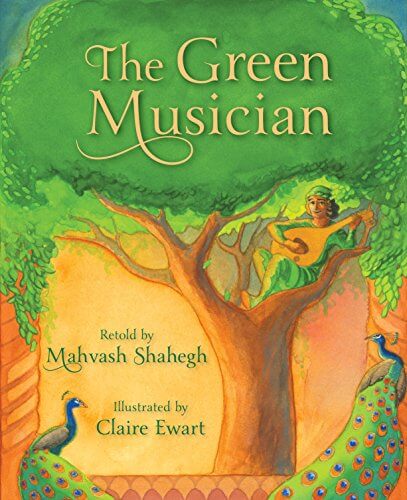
Next, we read The Green Musician by Mahvash Shahegh and Claire Ewart. This 1,000 year old tale tells of how Barbad (a real historical figure) became the minstrel poet to serve in the court of King Khosrow Parvez. Barbad longs to play his enchanting music for the king, but the current court musician keeps him from being able to make an appearance.
To outwit his opposition, Barbad disguises himself in green and hides in the trees of the garden where the king and his family dine. It’s a lovely tale about the power of music and what can happen when we persevere.
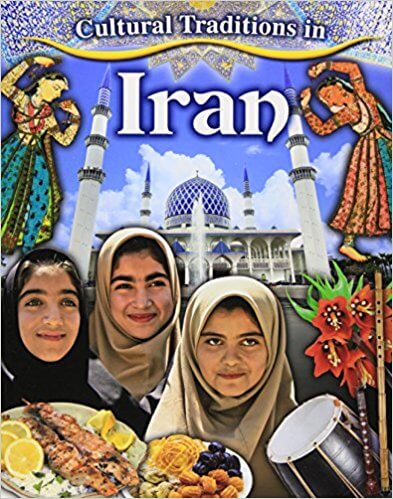
Finally we looked through the pictures and read some of the text in Cultural Traditions in Iran by Lynn Peppas. Most of the book is about various holidays and cultural celebrations. Our four year old knew about Ramadan from another book we had read, but this book gave us more insight into the meaning of Ramadan and other festivals.
Related post: Learn About Kenya: Children’s Books and Activities
More Resources for Little Global Citizens
If you love the idea of helping your child become a little global citizen, be sure to download your free Nowruz activity pack, including a coloring sheet and word search. You’ll also get access to my Resource Library, which includes a printable Global Passport book log and craft. As a subscriber, I’ll let you know when our next edition of the Global Citizens Kids Club is available!
Another resource that has been invaluable to our family in learning about the world and its cultures is Little Passports, a global-themed monthly subscription service. They have several different subscription offerings that are just right for kids ages 3 – 12.
What country or culture should we visit next in the Global Citizen Kids Club? Share your ideas in the comments!

4 responses to “Global Citizen Kids Club: Learn About Iranian Culture”
Thank you for sharing your experience of learning more about Iran and including some great resources and activities for kids! I will be sharing this in our Twitter and Facebook. We also have some great information for kids about Iran and Nowruz since our character, Joy Sun bear, visited there last year and again this year for Nowruz. We share coloring pages, crafts, recipes and more! Hope you check it out and enjoy with your kids. Feel free to share if you like as well, thank you! http://www.joysunbear.com/adventure-to-iran
Thanks so much for sharing! I’ll be adding your post to my Global Learning Activities board on Pinterest!
What a brilliant resource – both of books and information. I didn’t know about the 7 s-words! Thank you for sharing with #diversekidlit.
Thank you Marjorie! Our family certainly learned a lot about Iran.