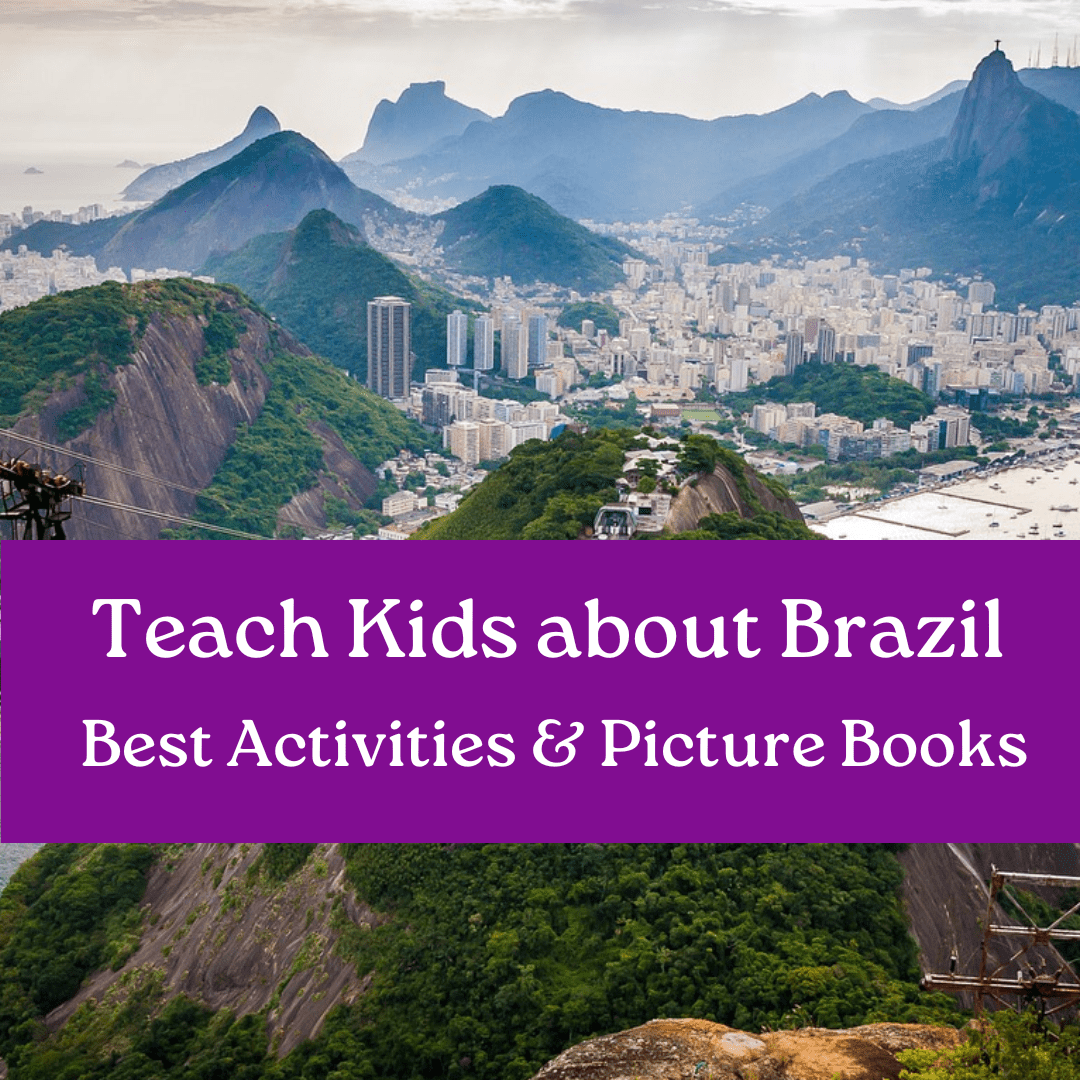
Recently our 5 year old received his Little Passports subscription package about Brazil, and his curiosity has been piqued ever since. Today, I’m sharing our favorite picture books, activities, and resources that teach kids about Brazil and its many cultures.
I’ve also got a brand new free printable activity featuring famous landmarks of Brazil that you’ll definitely want to grab! It can be used as a matching game, as Montessori three part cards, or simply for learning some fun facts about famous sites in Brazil.
Related Post: Best activities and books to learn about Colombia


Watercolor map of Brazil – Copyright: paulrommer / 123RF Stock Photo
Disclosure: For your convenience this post contains affiliate links. If you purchase items through these links, I may earn a small commission at no additional cost to you. You can read my full disclosure policy here.
Teach kids about Brazil: best picture books

The Great Kapok Tree: A Tale of the Amazon Rain Forest by Lynne Cherry
The vast majority of the Amazonian rain forest is located in Brazil. Kids will be inspired to protect it after reading this tale of animals who appear to a logger in his dreams. Each animal has its own reasons for urging the man not to chop down the giantic kapok tree. The lush illustrations give children a sense of how much life is teeming in the dense forest. (Recommended for ages 4 to 10)
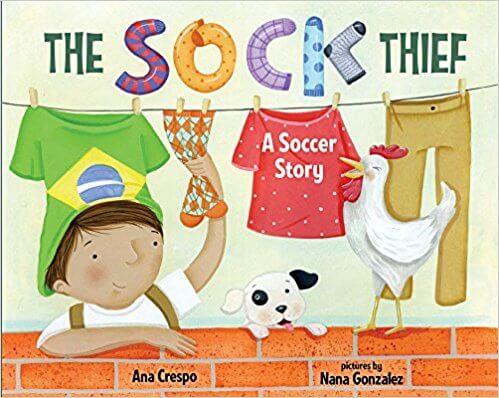
The Sock Thief by Ana Crespo and Nana Gonzalez
Our son has been asking to read this book multiple times a day ever since we got it! Felipe is heading to school early today, taking socks he finds in his neighborhood and leaving a mango for every pair he takes. A noisy dog and rooster threaten to give away his stock stealing secret. Each time he gets a new pair, he stuffs them with newspaper, twists them around the other socks, and tightens. What could he be doing? (Recommended for ages 3 to 7)
Related Post: Best Children’s Books about Guatemala

“Magic in the Rainforest” in The Barefoot Book of Animal Tales by Noami Adler and Amanda Hall
This indigenous Brazilian folktale tells of how a curious jaguar lost his eyes to a cunning snake who practices magic. When poor jaguar lays down under a tree, he’s sure he’ll starve to death now that he can no longer hunt. But the tree takes pity on him and uses its own magic to call another animal to help. (Recommended for ages 5 to 10)
Related Post: Explore Nigeria: Best Children’s Books & Activities
Request access to my resource library to receive my free printable Landmarks of Brazil matching cards!

Capoeira by George Ancona
We first learned about the practice of capoeira (pronounced kah-poh-AY-ruh) in the online activities that came with the Brazil package of our Little Passports World Edition subscription. This non-fiction book is filled with illustrations of pople practicing the art in both Brazil and the United States. Capoeira is part martial art, part dance, and part game. Children demonstrate many different poses in the photographs.
There are also several pages that explain capoeira’s history. Enslaved Africans brought their culture with them to Brazil, including their traditional ways of fighting. Slave owners felt threatened by the slaves’ fighting skills, so enslaved people began disguising their fights with music to make it look like a form of dance. (Recommended for ages 5 to 12)
Related Post: Best Children’s Books Set in South America
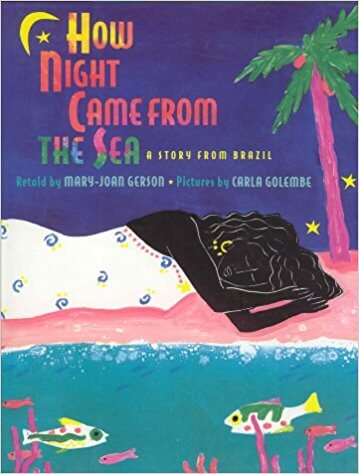
How Night Came from the Sea: A Story from Brazil by Mary-Joan Gerson and Carla Golembe
As we learned in another book we read about Brazil, the goddess Iemanjá (pronounced ee-mahn-ZHAH) is important in Afro-Brazilian culture. This tale explains how Iemanjá’s daughter, who lived with her in the sea, was responsible for bringing the cool of night to the land. Iemanjá’s daughter settled in the land of daylight after she fell in love with a man who lived there.
She loved the shimmering, sparkling sights of the daylight, but eventually her eyes became tired from so much daylight. When she told her husband that night is like a “dark, cool blanket that covers everything,” he sent his faithful servants to ask Iemanjá for some of the night. (Recommended for ages 4 to 10)
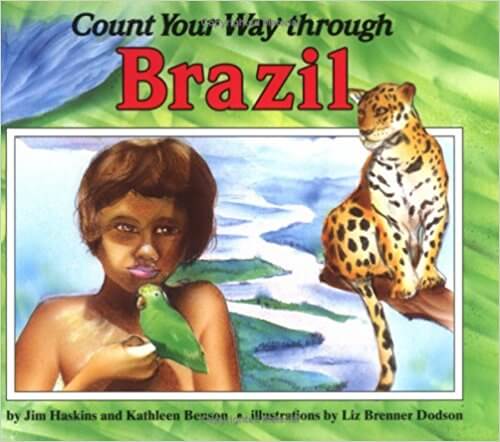
Count Your Way Through Brazil by Jim Haskins, Kathleen Benson, and Liz Brenner Dodson
Use this book to teach kids about Brazil and its culture, as they also learn to count to ten in Portuguese. Children will learn a bit of Brazil’s colonial history, sports, food, geography, and the seven most prominent ethnic groups in Brazil.
I am particular about making sure than my son understands the harm that practics like colonialism and slavery have done to oppressed groups of people. As I often do with children’s books, I found myself pausing and making some of the language in this book more explicit, so that he didn’t receive a whitewashed version of Brazil’s history. (Recommended for ages 4 to 10)

Dancing Turtle by Pleasant DeSpain and David Boston
This indigineous Brazilian trickster tale explains how turtle outsmarts a man who wants to make soup out of her. She’s a most unusual turtle since she sings and dances. She uses this to her advantage by convincing the man’s children to free her from her cage so that she can perform for them. Of course, clever turtle ends up escaping when they are distracted.
The children decide to paint a giant rock to look like the turtle’s shell so that their father won’t know of their mistake. It’s only when the rock shatters their serving plate that the father realizes what has happened. He vows to catch the turtle again, and the readers are left to answer the question of whether we think this is possible. (Recommended for ages 4 to 9)
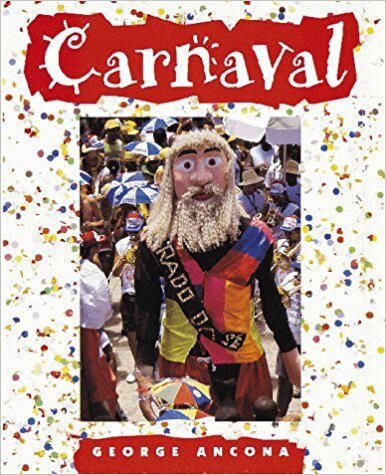
Carnaval by George Ancona
I was looking for a book that would capture the color, meaning, and excitment of Brazil’s most important festival while also being appropriate for children. Carnaval by George Ancona was just right. Its jam-packed with photographs of people of the city of Olinda as they prepare weeks ahead of time for the five day festival.
Children get a behind-the-scenes look at how the gigantic puppets and creative costumes are made, as well as their meanings. It was fascinating for us to see how the history of Brazil’s different ethnic groups influenced Carnaval’s traditions. (Recommended for ages 5 to 10).
Teach kids about Brazil: Resources from Little Passports
My five year old had a Little Passports Early Explorers subscription for almost two years. Recently we started a subscription to their World Edition, which features a different country each month. After his initial package including a colorful suitcase, large wall map, and a passport, Brazil was the first country package he received.

Our little guy is always most excited about the souvenir that’s included, and the real amethyst from Brazil did not disappoint! His package a letter from Sam and Sofia (the characters that travel the world and then send the kids their packages) with a lot of detail about their trip, as well as a postcard of a red uakari monkey.
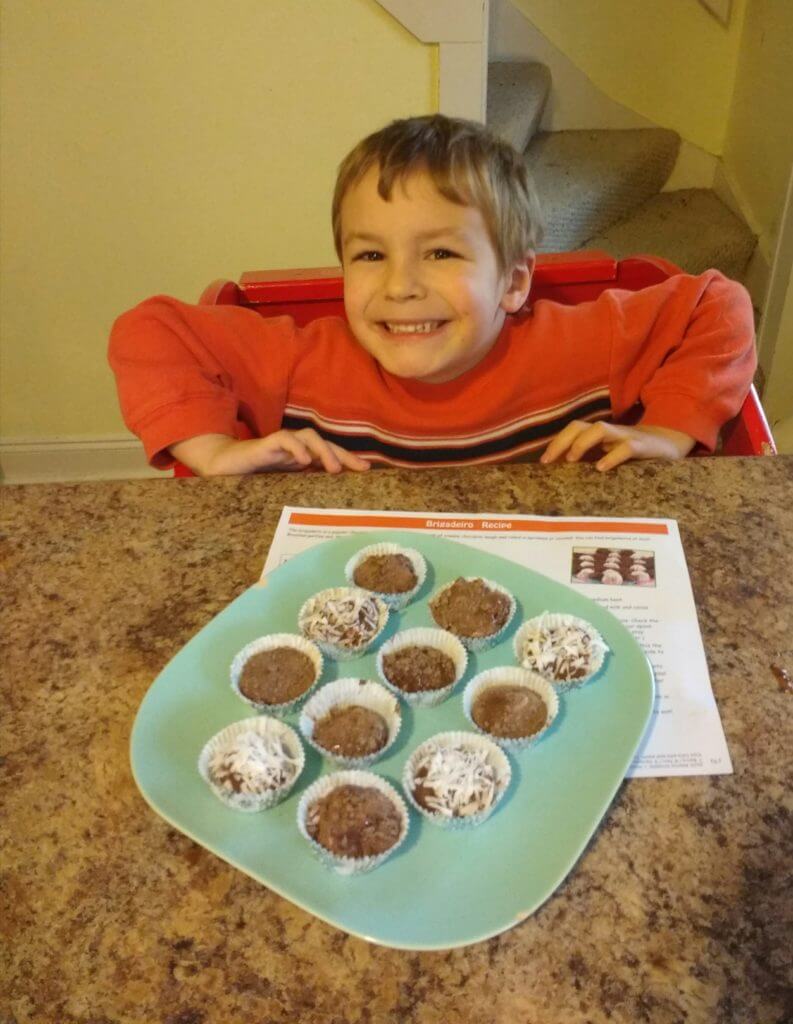
The online activities for the month included an interactive map that allowed us to print postcards from each region of the country. The printed activity guide for the month included a couple of word puzzles and a recipe for the Brazilian treat brigadeiro.
I’m not going to lie – making the brigadeiros was messy, but our son loved them!
Learn about Brazil’s landmarks: Free printable matching cards
Our son loves learning about landmarks around the world, so I created these Montessori-inspired cards about famous sites in Brazil. If you are a Montessori family or teacher, you can use them as Montessori three part cards. They can also be copied front to back, with pictures on the front and facts about the landmark on the back. Or you can use them as a simple matching game.
Just request to join my free subscriber resource library above if you’d like a copy of the landmarks of Brazil cards.
Related Post: Peace Education, The Montessori Way
Teach kids about Brazil: Learn basic Portuguese
Learning Portuguese phrases can be a fun way to experience some of Brazil’s cultures. The Learning Time Fun channel on YouTube has a playlist of 15 short videos that teach phrases and concepts in Brazilian Portuguese. I did think the speed is a bit too quick for some children, so you might want to click on the gear icon (settings) at the bottom of the video to slow it down a bit.
Be a friend to Brazil: How to help the people and animals of the rainforest
You probably live far away from Brazil’s rainforest. But did you know that you’re still connected to it? Rainforests store massive amounts of carbon in the earth, so that we can breathe clean air. Rainforests are home to millions of plants and animals, including those that could lead to future medical breakhroughs.

If you open up your pantry, you’ll probably find another connection to the rainforests in Brazil and in other countries: palm oil. Palm oil is in about half of all processed food, and it’s leading to the deforestation of rainforests.
One thing you can do to be a friend to the animals, plants, and peoples of the rainforest is to look for foods that do not contain palm oil.
Related Post: 9 Ways Kids Can Protect the Planet

2 responses to “Teach kids about Brazil: best picture books & activities”
Thank you so much for this wonderful resource!
Thank you for this. My husband is from Brazil and it’s nice to introduce his culture to our children in ways that are educational and fun.