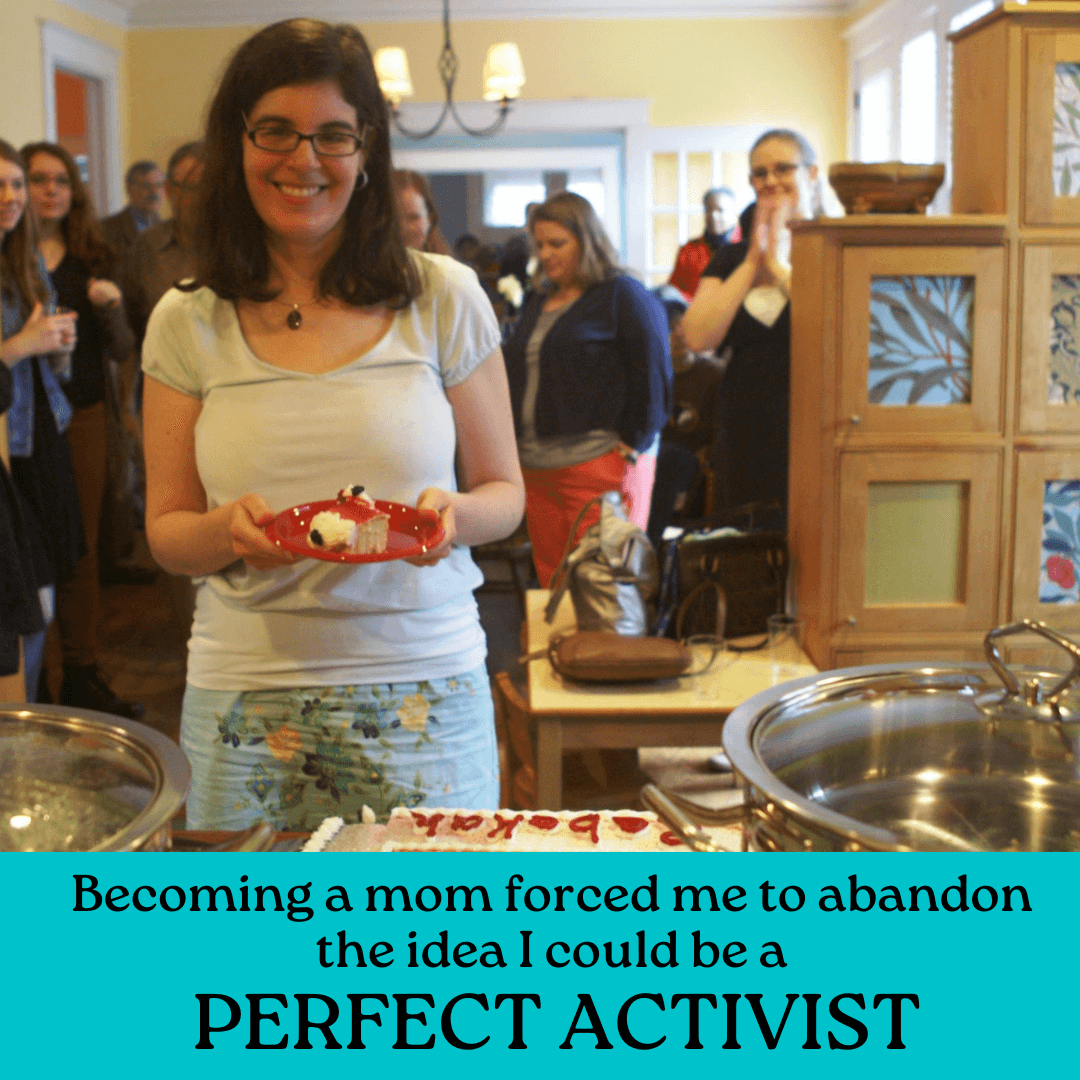
In a recent post about perfectionism and parenting, I shared that the desire to do everything right, all the time, is a huge struggle for me. But it’s not just in my parenting that perfectionism holds me back. Some thoughtful mentors have helped me see how perfectionism hinders my activism for justice too.
I left my paid work as a community organizer when my son was a baby, six years ago. There were a lot of reasons I decided to become a stay at home mom, rather than juggling parenthood with organizing.
For nine months, I’d tried to be a perfect mom and a perfect organizer.
Becoming a parent forced me to face, again and again, that I had limits, that I was not a superwoman. That I was making mistakes, and saying no to more things.
I realized I’d never be able to live up to the impossibly high standards I’d set for myself as an organizer now that I was also in charge of caring for a tiny, oh so needy, human.
I didn’t want to acknowledge that for a whole decade, I’d been living out a really unhealthy pattern in my work. Could I have changed that dysfunctional pattern? Probably, but since I was also battling postpartum anxiety, it seemed like too big a challenge to take on.
So, I quit.
The picture at the top of this post shows me smiling at my going away party. But at that party, I remember thinking that I was letting people down by putting my family’s needs first. Truthfully, I was so burnt out, that I didn’t really feel guilty. I just felt numb.
My connection to activism became quite thin for several years as I was absorbed the early years of motherhood.


Disclosure: For your convenience, this post includes affiliate links. If you purchase items through these links, I may earn a small commission at no additional cost to you. You can read my full disclosure policy here.
A Call to Imperfect Activism
But eventually, I realized that my calling as a follower of Jesus still pulled me towards activism in some form.
Today, I do occasionally make it to rallies, and I’m in touch with lawmakers about justice issues fairly often. I’m part of a small group at my church that’s gotten involved with a new faith based social justice organization.
Most of my social justice efforts now are focused on teaching my kiddo why change is needed and what it looks like, and helping other parents who want to do the same.
I’ve wrestled with whether I should even call myself an activist now.
Here’s the conclusion I’ve come to. There are many forms of activism, from leading community organizing campaigns to movement chaplaincy to voter registration drives to civil disobedience to teaching young people about social change.
I am an activist, though not the kind that I used to be. You might be an activist too (even if you don’t claim that label.)
Going forward, I’m committed to being an imperfect activist.
What does that look like? Here are some thoughts.

Imperfect activism is comfortable with needs and boundaries
Becoming a mother finally forced me to acknowledge my human limits. For years, I had poured almost all of myself into organizing. I regularly skipped meals and missed out on time with friends. I brought home hundreds of fundraising envelopes to address by hand while I “relaxed” watching TV after the official work day ended.
A lot of the time, I was depressed or anxious, overwhelmed, yet still feeling guilty that I wasn’t doing more.
But when I had a baby who woke me up every three hours, I realized there was only so much sleep and food I could go without. There were some phone calls I couldn’t return (including the one I got from a colleague who heard I was on maternity leave and called me while I was in labor.) Some projects weren’t going to get finished.
There were people I needed to ask for help, but at the time, that felt like a weakness.
Before parenthood, I assumed that if I was capable of a task and it needed to be done for the movement, then I had to do it. Just who did I think I was, not to volunteer?
Now, knowing I need to keep some of my mind, body, and spirit for my family and for myself, I pause before raising my hand. I ponder the best way my particular gifts can contribute to movement for justice, and try to focus on offering those.
Related Post: 7 inspiring young activists for social justice

Perfectionism is rooted in white supremacy and capitalism
The first time I heard Jardana Peacock say this, I was confused. (Probably because I was wallowing in my sense of not being a good enough activist because of all of the perfectionist messages flooding my spirit.)
But when she started to unpack it, so much started to make sense for me about how unhealthy perfectionism was not just for me, but for the movement.
White supremacy teaches white people like me that we are right, and have to be right, all the time.
But if we’re honest with ourselves, we know that we don’t have the answers and that we are wrong – a lot.
Since white supremacy doesn’t want us to admit being wrong (especially not in public), coming to terms with our mistakes can bring on waves of shame.
If I can’t admit as a white person that I’m wrong sometimes (especially when a person of color points it out to me), I’m going to do a lot more harm than good in the work of social justice.
Related Post: What to do when injustice threatens to overwhelm you
Capitalism teaches us that individual competition is what’s best for ourselves and for society.
Even in our justice movements, so often we’re busy competing against each other. For organizers, perhaps it’s because we’re competing for the same pot of grant money. As activists, we compete on social media to show who’s the most woke.
What would our movements for justice look like instead if we could lean into community? Who might we be able to bring on board if they weren’t terrified of being publicly attacked for their mistakes?
What could our children learn about how all of us, no matter our age, are still learning and figuring out how to do better?
Related Post: Mega list of anti-racism resources for parents & teachers
Imperfect activism honors our bodies and spirits
In 2016, Michelle Alexander, author of the groundbreaking book The New Jim Crow, announced that she was leaving her position as a law professor to study and teach at Union Theological Seminary. Though she was not raised in the church, Alexander was compelled to make this move because she felt filing lawsuits and organizing voter turnout – by itself – was not enough.
Alexander wrote, “This is not simply a legal problem, or a political problem, or a policy problem. At its core, America’s journey from slavery to Jim Crow to mass incarceration raises profound moral and spiritual questions about who we are, individually and collectively, who we aim to become, and what we are willing to do now.” (Read more here. )
I have always seen activism as a spiritual path.
But when I was locked into a perfectionist version of activism, I feared that spending too much time in silence or prayer could take away the time I needed to use for action.
As a Christian, I also didn’t have much experience (until recently) in spiritual practices that are rooted in the body. Working with Jardana Peacock virtually and with Any Body Yoga locally allowed me to explore yoga and meditation. I reflected on how my body and spirit are far more connected than I’d been able to see.
In the past year, I’ve gone deeper into my own journey of resisting white supremacy. It’s been incredibly challenging and painful. Without yoga, meditation, and prayer, I would’ve run away from things I needed to face.
Related post: Best children’s books about yoga and mindfulness
Resources for imperfect activists
Me and White Supremacy by Layla Saad. I worked through this amazing resource when it was an online download, but it will be available as a print book in early 2020. Layla wrote the workbook for people holding white privilege who want to begin or deepen their anti-racism work. It includes some reflection about spirituality and anti-racism.
Practice Showing Up: A Guidebook for White People Working for Racial Justice by Jardana Peacock. Jardana provides a variety of spiritual practices for activists and reflections on the connections between healing, spirit, and justice.
Rising Strong: How the Ability to Reset Transforms the Way We Live, Love, Parent and Lead by Brené Brown. There are valuable tools in this book for dealing with perfectionism and shame.
“Excommunicate Me From the Church of Social Justice” by Frances Lee. This article reflects out how “aggressive” versions of social justice activism can become dogmatic and drive away people who fear not measuring up.
“I Vow Not to Burn Out” by Mushim Patricia Ikeda. Mushim is a Buddhist teacher and activist who’s designed a “great vow for mindful activists.”