
Most Americans know little about the history, culture, and present day realities of Palestine. Stereotypes of Palestinians abound. Students rarely learn about the complex history of Palestine before and after the creation of the state of Israel.
As adults, sharing children’s books about Palestine with our kids and our students is an important starting point for addressing the huge gaps and frequent biases in our knowledge. Palestinian children also deserve to read and hear their stories at home, in school, and in their community’s libraries.
Table of contents to this post
- My perspective on Palestine
- Picture books about Palestine
- Chapter books about Palestine
- Background info and learning resources for adults
- Lesson plans and learning resources for kids and teens
- Ways to take action


My perspective on Palestine
Especially since I’m sharing not only books but learning resources in this post, I want to say a bit about my own viewpoint when it comes to Palestine. In this post, I hope to center the perspectives of Palestinians.
Since questions of antisemitism often arise when Palestine is discussed, let me be clear that there is no place for antisemitism or Islamophobia in our movements for justice.
Individual Palestinians should not be held responsible for the actions of Hamas; individual Israelis should not be held responsible for the actions of Israel’s government. Criticism of the policies and action of the Israeli government and its military do not constitute antisemitism (unless that criticism draws on antisemitic tropes or hate.)
Related post: Books to help children understand antisemitism
Both Israelis and Palestinians have a right to live and flourish in the region, with their full rights, livelihoods, humanity, and religious faiths protected and respected.
Targeting of journalists
Since the war between Israel and Hamas began in October 2023, journalists from outside Israel and Palestine have been barred from entering Gaza. The International Federation of Journalists has documented how Israel has killed over 138 journalists, or more than 10 percent of those working in Gaza. How can those of us who live in the U.S. and Europe possibly be getting anything close to a full picture of how the war impacts ordinary Palestinians when this is the case?
Furthermore, few news sources in the U.S. provide detailed reporting of perspectives other than those that closely mimic those of Prime Minister Netanyahu. There’s little reporting on the large amount of criticism of Netanyahu by Israelis, let alone news accounts that share Palestinian perspectives.
Every life contains a universe
Hamas’ October 7th attack and the taking of more than 230 Israeli and foreign nationals as hostages was reprehensible, as is Israeli’s disregard for civilians as they have waged war. Each of the 41,000 Palestinian lives and the 1,200 Israeli lives that has been lost during the war, whether Palestinian or Israeli, deserves to be mourned.
Yet, as Jewish Voice for Peace pointed out in their September 2024 newsletter, in the U.S. only some lives are collectively mourned:
As Jews, our tradition teaches us b’tzelem elohim — every life is precious. Every person is an entire world, and every death is a world extinguished.
This past weekend, 106 people were killed in Palestine – 100 of those were Palestinians, and six were Israelis.
We mourn each and every life. That’s why we’ve spent eleven months mobilizing our immense grief into action.
Because every life is precious — equally so — we refuse the systems that treat some lives as more worthy of grief and protection than others. This past weekend, Biden spoke only of six Israeli deaths, and said nothing about the daily genocidal death and destruction the Israeli military is carrying out on Palestinians in Gaza and the West Bank. The mainstream media followed suit. Every life lost is a tragedy — but from reading the news, one would think that the six Israeli hostages were the only people with grieving families.
U.S. military aid to Israel
When we consider the war in Gaza, it’s crucial to understand that it takes place within a context of 75+ years of Israel’s government trampling on the human rights of Palestinians. (After the book reviews, I’ll share some learning resources about that context.)
As an American citizen, I also feel a particular responsibility to speak up about at least 41,00 Palestinians (most of them women and children) have died because of war and Israel’s deliberate blocking of humanitarian aid. I also believe the best chance of freeing the remaining Israeli hostages is through a ceasefire that allows for real negotiation.
The United States has sent hundred of billions of dollars of aid to Israel since 1948, more than the U.S. sends to any other country. Nearly all of the U.S. aid to Israel today is military aid. Despite President Biden’s repeated calls to Israel to work towards a cease fire and stop human rights abuses, none of these words have been accompanied by actual cuts in military aid. To be blunt, my tax dollars are being used to kill Palestinian civilians. How can I not speak up?

This post may include affiliate links. If you purchase items through these links, I may earn a small commission at no additional charge to you. You can read my full disclosure policy here.
Picture books about Palestine
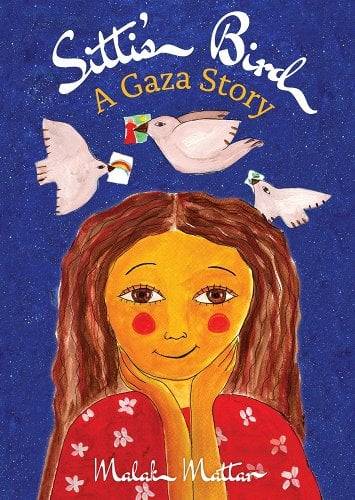
Sitti’s Bird: A Gaza Story by Malak Mattar.
Purchase from Bookshop.org (supports independent bookstores and my business!)
This story is inspired by the author’s own artistic journey as a teen living through the Israeli 2014 assault on Gaza.
Young Malak’s life contains so much beauty as well as fear as she lives through the siege. Watching the beauty of the fish who swim in the sea, eating her Sitti’s maqulouba, and gazing at Sitti’s bird all bring Malak joy.
But when an explosion happens while Malak is at school, she and everyone else must hunker down in their homes for weeks on end. When Malak finds a set of paints she’d forgotten about, she discovers a way to celebrate Gaza’s beauty. (Recommended for ages 6 – 10.)
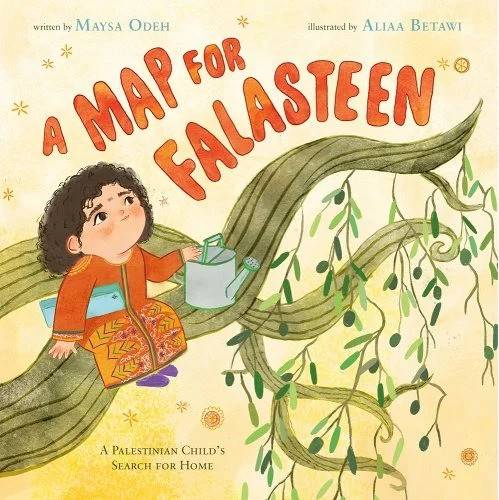
A Map for Falasteen: A Palestinian Child’s Search for Home by Maysa Odeh. Illustrated by Aliaa Betawi.
Purchase from Bookshop.org (supports independent bookstores and my business!)
Inspired by the author’s own childhood desire to learn of her homeland, A Map for Falasteen sensitively portrays the grief, longing, and hope of Palestinian refugee families.
When Falasteen’s teacher asks all the children to find the place their families are from on a map, Falasteen can’t locate Palestine. Speaking perhaps more from ignorance than unkindness, her teacher replies “I think there is no such place.”
At home, Falasteen asks questions of her Jido (grandfather), Teta (grandmother), and mother about their homeland. Jido draws her a map. Teta tells of how her family had to flee their homeland. Her mother reminds her that whatever maps say, Palestine lives inside each of them.
I especially recommend picking up a copy of the book for the thoughtful endnotes, which describe the author’s family story and what has happened to Palestinians since the creation and expansion of the Israeli state. (Recommended for ages 5 – 9.)
Related post: Children’s books for Arab American Heritage Month
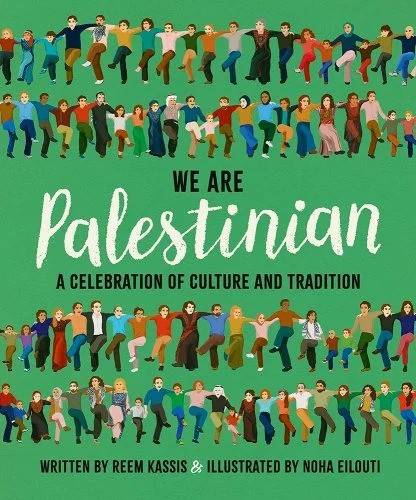
We Are Palestinian: A Celebration of Culture and Tradition by Reem Kassis. Illustrated by Noha Eilouti.
Purchase from Bookshop.org (supports independent bookstores and my business!)
Written by a food critic and cookbook author, this illustrated non-fiction guide to Palestinian culture touches on a wide array of themes. It’s no surprise that food is central, but so are artistic expressions like tatreez (Palestinian embroidery) and dabke dancing.
The 1948 Nakba (disaster) and 1967 Naksa (setback) are also briefly described as well as important places within Palestine. There are short profiles of prominent Palestinians (including Malak Mattar who wrote the first book in this post!) This is a good reference book to read alongside fiction stories about Palestine. (Recommended for ages 8 – 12.)

These Olive Trees: A Palestinian Family’s Story by Aya Ghanameh.
Purchase from Bookshop.org (supports independent bookstores and my business!)
In the refugee camp where Oraib has lived all her life, olive trees and their fruit play a central role. It’s so hard for Oraib to have the patience to wait for the bitter olives to be cured and brined that sometimes she bites into them right after the harvest. Her family, like all Palestinians, use the olives in so many ways, from oil to soap to even lighting fires in the camp.
But one day, Mama surprises her by telling her that they are gathering olives to take with them. War has broken out again, making it unsafe to stay in the camp in Nablus. As Oraib says goodbye to her home and the beloved olive trees that surround it, she takes a moment to plant one last olive pit. (Recommended for ages 4 – 8.)
If you’re interested in learning more about Palestinian’s relationship to olive trees, look for Sitti’s Olive Trees by Ndaa Hassan. It’s out of print, but you may be able to find it at your local library or online used book stores.
Related post: Engaging children’s books starring Muslim characters

Homeland: My Father Dreams of Palestine by Hannah Moushabeck. Illustrated by Reem Madooh.
Purchase from Bookshop.org (supports independent bookstores and my business!)
This is my favorite picture book on the list! As three girls wait for their father to return home for work, they look forward to the stories he’ll tell of their homeland. They have never been to Palestine (and realize they may never be able to visit). Yet their father’s richly detailed stories, sprinkled with irreverent humor (including a farting story) bring the place to life.
Their father remembers his last day in Jerusalem, when his always-busy Sido (grandfather) took him to the family cafe. On their journey, they’re surrounded by sights and sounds that reveal the liveliness and diversity of Old Jerusalem in the 1940s. Finally, Sido takes him to a beautiful gated garden full of pigeons. Though that was the last time their father saw his homeland, he still carries to the key to the garden with him. (Recommended for ages 4 – 8.)
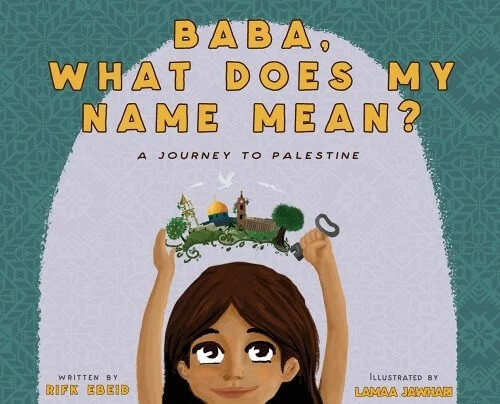
Baba, What Does My Name Mean? A Journey to Palestine by Rifk Ebeid. Illustrated by Lamaa Jawhari.
Purchase from Bookshop.org (supports independent bookstores and my business!)
When classmates ask Saamidah what her name means, she only knows that it’s an Arabic name. When she asks her father to tell her more about it, he tells her that her name means patient and persistent. Her parents chose this name because her Palestinian people must have these qualities as they fight for their rights.
With a special key and a dove of peace to guide her, Saamidah is whisked off to Palestine, where she visits many special places, from the Qubbet Al-Sakhra mosque and the Church of the Nativity, to her Papa’s childhood home from which he was dispossessed. There are many ancient sites, delicious foods, and carefully created items to learn about. Through all her journey, Saamidah is encouraged to believe that one day the Palestinian people will be free. (Recommended for ages 5 – 9.)
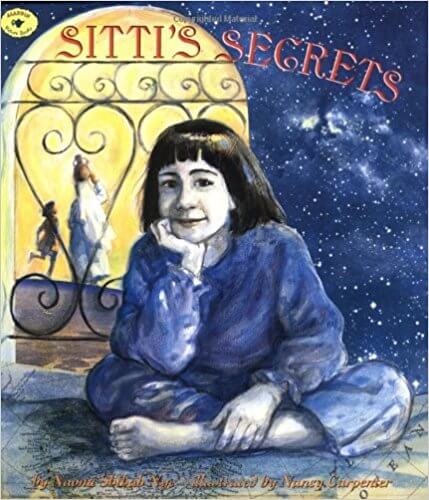
Sitti’s Secrets by Naomi Shihab Nye. Illustrated by Nancy Carpenter.
Purchase from Bookshop.org (supports independent bookstores and my business!)
Mona’s grandmother lives on the other side of the world from her in Palestine. When Mona finally has the chance to visit her, they don’t let language separate them. Soon they are spending hours together, walking to buy fresh milk from a neighbor, baking bread, and hanging laundry, even when Mona’s father is not there to translate.
When it’s time to return to the United States, Mona is heartbroken. She’s comforted by the memories of what her grandmother keeps in her green trunk, including old pictures of their family. Mona decides to write a letter to the President of the United States to tell him about her grandmother. Mona wants him to know that “I vote for peace. My grandmother votes with me.” Though it’s been nearly two decades since Shihab Nye wrote this book, its message is even more urgent today. (Recommended for ages 5 – 9.)
Support internally displaced Gazan families who can’t afford food and basic supplies through Coffees for Gaza. This group of artists and creatives amplifies verified Go Fund Me accounts of families in desperate need and asks you to donate modest amounts. They also create art that expresses the hopes and dreams of Palestinian people.
CFG on Instagram
Shop my Knits for Gaza fundraiser
Get the CFG Email newsletter
Chapter books about Palestine
Questions to Ask Before Your Bat Mitzvah. Edited by Morgan Bassichis, Jay Saper, and Rachel Valinsky.
Purchase from Bookshop.org (supports independent bookstores and my business!)
I was introduced to this unique collection of short essays by Mint and Bloom Learning’s free Palestine curriculum.
Embracing the Jewish tradition of asking questions, the authors encourage teens to reclaim the tradition of the Bat Mitzvah, learn from Palestinians, and unlearn Zionism. The authors of the essays are a mix of secular Jews, religiously-observant Jews, and Palestinians. The section on Palestine includes essays about important symbols and their history, such as the key and the watermelon, as well as an explainer on why many Palestinians are calling for boycotts of companies that do business in Israel. (Recommended for ages 10 +).
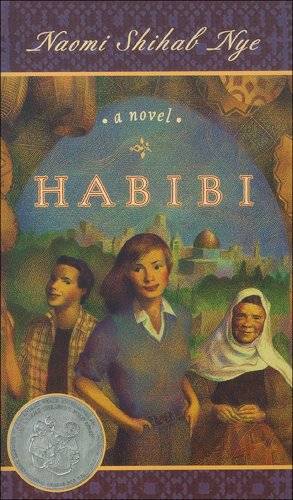
Habibi by Naomi Shihab Nye.
Purchase from Bookshop.org (supports independent bookstores and my business!)
Though her father has always talked about moving back to Palestine someday, 14-year-old Liyana is shocked when her parents announce it will be happening soon. Poppy is feeling more hopeful since the early 1990s Oslo peace process, and wants his children to know not just their American heritage but their Arab heritage as well.
As the family settles in east Jerusalem where Poppy works as a doctor, everyone else seems to be adjusting more easily than Liyana. Her little brother easily bonds with their many cousins in Sitti’s West Bank village through soccer, while Liyana feels the language barrier more. She’s the only non-Armenian at her Armenian school, and wonders how long it will take to make a friend.
Meanwhile, all of the family members are realizing that the peace process has not changed life for ordinary Palestinians that much. When Liyana finally makes a friend, she’s surprised to learn that he is Israeli. Will she be able to tell her family about him?
Shihab Nye’s poetic voice shines through the story, which captures many small moments others might consider ordinary in vivid detail. This book encourages compassion and open-mindedness without minimizing the daily oppression that Palestinians face. (Recommended for ages 11+.)

Ida in the Middle by Nora Lester Murad.
Purchase from Bookshop.org (supports independent bookstores and my business!)
Ida’s main goal as an eighth grader at a new school is to avoid being noticed. She doesn’t want the anti-Arab harassment she faced at her old school to start up again. But right now her biggest worry is that she hasn’t started on her capstone “passion project” for school, despite being an excellent student. What on earth could she be passionate about?
One day when Ida bites into a green olive her aunt cured in Palestine, she suddenly finds herself transplanted from the U.S. to Busara, her parents’ village near Jerusalem. Despite her confusion, all of her family acts like they’ve always lived there. Ida has always tended to tune out when adults go on and on about the troubles in Palestine, but now she’s seeing them firsthand. At the same time, her family seems more close-knit in Busara than they do in the U.S.
As eating olives takes her back and forth from the U.S. to Palestine, Ida learns that Israeli bulldozers are expected in Busara very soon to demolish Palestinian homes. She’s sure there is nothing she can do, yet her dream-like reality will soon show her new possibilities. (Recommended for ages 12+.)
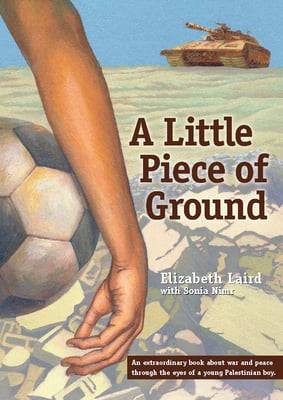
A Little Piece of Ground by Elizabeth Laird with Sonia Nimr.
Purchase from Bookshop.org (supports independent bookstores and my business)
Written in 2006, this eye-opening novel stars twelve-year-old Karim. Karim lives in Ramallah in the West Bank, where the Israeli military frequently imposes harsh curfews that keep his family indoors for days at a time. After one particularly long stretch, his parents decide to visit their grandmother to help her with the olive harvest.
On the journey, Karim witnesses soldiers humiliating his Baba and other Palestinian men by forcing them to kneel in the dirt and strip off their clothes. Karim becomes increasingly angry at the oppression his people are facing. He has a new friendship with his classmate Hopper, who he admires for his daring taunts of the soldiers.
Hopper is a refugee, and the two boys, along with Karim’s Christian friend Joni, decided to clear a rocky, cluttered piece of ground in the refugee camp so that they can play soccer. One day, the boys are so caught up in their project that Karim misses the curfew cutoff and is soon trapped, hiding from an Israeli tank on the makeshift soccer field. Will Karim be able to wait out the tank, or will he be able to flee when the soldiers are distracted? (Recommended for ages 12+)
Background information and learning resources about Palestine for adults
Finding one another again…on October 6th, 7th, and 8th. Essay by anti-bias educator Ali Michael, especially useful for educators and school leaders. Includes themes Michael has observed over the past year and suggestions for conversation.
Visualizing Palestine uses visual data and research to change the narrative about Palestine.
Jerusalem Declaration on Antisemitism. This helpful document provides a detailed definition of antisemitism, particularly in relationship to criticism of the state of Israel. It was “developed by a group of scholars in the fields of Holocaust history, Jewish studies, and Middle East studies to meet what has become a growing challenge: providing clear guidance to identify and fight antisemitism while protecting free expression. Initially signed by 210 scholars, it has now around 350 signatories.”
The West Bank: Last Week Tonight with John Oliver. This fast-paced episode touches on the many forms of injustice that Palestinians in the West Bank face. It’s suitable not only for adults but for older teens as well.
Finding accurate news coverage of Palestine and Israel, especially during the current war, is a major challenge. Consider reading articles by (or following on social media) Al Jazeera (an independent news channel covering the Arab world) for profiles of what daily life is like for internally displaced Palestinians. I also read articles by Haaretz (a liberal Israeli newspaper) to understand criticism within Israel of Netanyahu and his cabinet.
Amnesty International’s call to investigate Israel for war crimes in Gaza. Carefully researched information from a well-respected human rights organization.
5 things you need to know about what’s happening in Israel and Gaza by the American Friends Service Committee.
Lesson plans and learning resources about Palestine for kids and teens
Arts-based lesson set on Palestine for elementary through high school from Mint and Bloom Learning. Designed primarily for homeschoolers, this lesson set includes arts activities inspired by many of the children’s books on this list. There are also helpful video clips curated for each topic. Includes adaptations for each age level.
Resources curated by the Zinn Education Project for teaching about Palestine-Israel. These are primarily resources for middle and high school levels.
Teaching the Seeds of Violence in Palestine-Israel by Bill Bigelow. This high school level mixer lesson series encourages students to examine multiple Israeli, British, Arab, and Palestinian perspectives in the early 20th century, when the area was ruled by the British.
Teach Palestine. This website from the Middle East Children’s Alliance has lesson ideas for multiple ages, including ones based on children’s books reviewed in this post.
Ways to take action
Tell U.S. leaders to support an arms embargo and against Israel
American Friends Service Committee makes it easy for you to write to your members of Congress about this issue.
Donate to support internally displaced Palestinians
American Friends Service Committee has been working in Gaza and the Palestinian Territories since 1948. They are also an excellent group to donate to that is providing humanitarian relief to internally displaced Palestinians right now, as well as organizing activism in the U.S.
Coffees for Gaza started as a group of artists and creatives, now joined by many more people, who raise funds for 22 internally displaced Gazan families, and share these families’ stories with others. I have found participating in this group incredibly meaningful. You can donate to the families they support through their Patreon shop, purchase downloadable prints from the shop, or participate in one of their “Peacetober” draw along sessions with artists including children’s illustrator Hatem Aly of The Proudest Blue.
