
April is Arab-American Heritage Month, so it’s the perfect time for your family or learners to read books starring Arab-American characters. (Though I’ll add the disclaimer I always do about heritage months. This is a time to amplify the learning we should be doing all year round!)
First, it’s important to clarify which groups of people are considered Arab-American. As the Arab-American Anti-Discrimination Committee explains, Arabs are united by Arabic language, culture, and history, rather than by race or religion.
While most Arabs are Muslim, most Muslims are not Arab. (For example, Pakistan is a majority Muslim country, but it is not an Arab country. Yet, I still found many children’s book lists online for Arab-American Heritage Month that heavily featured books about Pakistani-Americans.) There are also significant numbers of Arab Jews and Christians. There are 22 Arab countries, though the majority of Arab-Americans are from Lebanon, Syria, and Palestine.
Now that that’s clarified, let’s dive into these wonderful books!


Disclosure: Disclosure: For your convenience, this post includes affiliate links. If you purchase items through these links, I may earn a small commission at no additional cost to you. All opinions are my own. You can read my full disclosure policy here.
Fiction picture books about Arab-American heritage
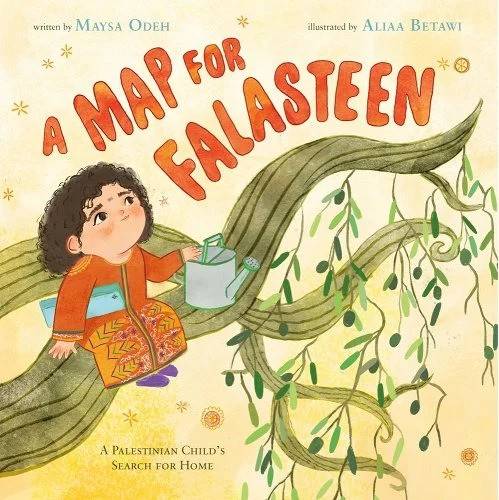
A Map for Falasteen: A Palestinian Child’s Search for Home by Maysa Odeh. Illustrated by Aliaa Betawi.
Purchase from Bookshop.org (supports independent bookstores and my business!)
Inspired by the author’s own childhood desire to learn of her homeland, A Map for Falasteen sensitively portrays the grief, longing, and hope of Palestinian refugee families.
When Falasteen’s teacher asks all the children to find the place their families are from on a map in the classroom, Falasteen can’t locate Palestine. Speaking perhaps more from ignorance than unkindness, her teacher replies “I think there is no such place.”
At home, Falasteen asks questions of her Jido (grandfather), Teta (grandmother), and mother about their homeland. Jido draws her a map. Teta tells of how her family had to flee their homeland. Her mother reminds her that whatever maps say, Palestine lives inside each of them.
I especially recommend picking up a copy of the book for the thoughtful endnotes, which describe the author’s family story and what has happened to Palestinians since the creation and expansion of the Israeli state. (Recommended for ages 5 – 9. Palestinian-American author.)
Related post: Children’s books about Palestine

Halal Hot Dogs by Susannah Aziz. Illustrated by Parwinder Singh.
Purchase from Bookshop.org (supports independent bookstores and my business!)
Musa’s family has a tradition after participating in Jummah Prayer at the masjid. They take turns choosing a special treat to eat together. Lately, the treats other family members have chosen do not meet Musa’s standards, and he’s excited that it will soon be his turn to pick.
When the day comes, one thing after another seems like it might get between him and the halal hot dogs he’s been dreaming of. The laugh-out-loud cartoon illustrations of food mishaps and spot on text describing a kid obsessed with their favorite food will have wide appeal to children and adults alike. (Recommended for ages 4 – 8. Palestinian-American Muslim author.)
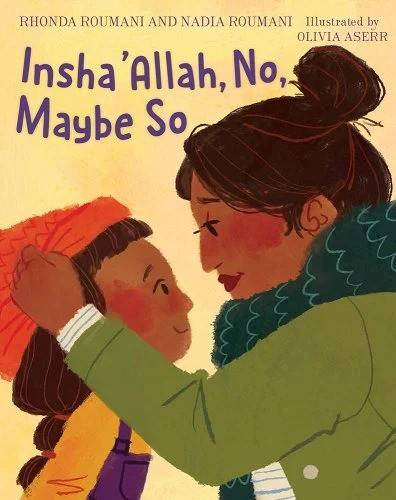
Insha’Allah, No, Maybe So by Rhonda Roumani and Nadia Roumani. Illustrated by Olivia Aserr.
Purchase from Bookshop.org (supports independent bookstores and my business!)
When Rayna asks her mother if they can do things like go to the park or bake cookies, Mama answers (like many Arab parents) “insha’Allah.” Though the phase means “God willing,” Rayna has decided it must mean “no,” since she can think of a string of things they haven’t done after Mama said “insha’Allah.”
Mama explains to Rayna that the phrase isn’t just an excuse; it’s a powerful expression for the things we want but which are out of our control. A thoughtful, love-filled conversation between parent and child about hopes, dreams, and how we communicate with each other filles the rest of the story. (Recommended for ages 3 – 7. Syrian-American Muslim author.)

These Olive Trees: A Palestinian Family’s Story by Aya Ghanameh.
Purchase from Bookshop.org (supports independent bookstores and my business!)
In the refugee camp where Oraib has lived all her life, olive trees and their fruit play a central role. It’s so hard for Oraib to have the patience to wait for the bitter olives to be cured and brined that sometimes she bites into them right after the harvest. Her family, like all Palestinians, use the olives in so many ways, from oil to soap to even lighting fires in the camp.
But one day, Mama surprises her by telling her that they are gathering olives to take with them. War has broken out again, making it unsafe to stay in the camp in Nablus. As Oraib says goodbye to her home and the beloved olive trees that surround it, she takes a moment to plant one last olive pit. (Recommended for ages 4 – 8. Palestinian-American author.)

The Arabic Quilt: An Immigrant Story by Aya Khalil. Illustrated by Anait Semirdzhyan.
Purchase from Bookshop.org (supports independent bookstores and my business!)
Kanzi doesn’t know anyone yet in her new town, and her deepest desire is to not be different. But when Mama shows up at school and calls her “Habibti” (“my love” in Arabic), Molly’s teasing dashes Kanzi’s hopes of blending in.
At home, she comforts herself by writing a poem to her Teita (grandma) while wrapped in the beautiful quilt Teita made her in Egypt. Little does Kanzi know that with her teacher and Mama’s help, the quilt will become a symbol of unity in their classroom. Bilingual families will love the story’s encouragement to be proud of one’s language and culture. (Recommended for ages 4 – 8. Egyptian-American author.)
I also highly recommended Khalil’s follow up book The Great Banned Books Bake Sale, which features the same characters.
Related post: 14 children’s books about immigrants and refugees

Salma the Syrian Chef by Danny Ramadan. Illustrated by Anna Bron.
Purchase from Bookshop.org (supports independent bookstores and my business!)
Note: Salma is Arab-Canadian, not Arab-American, but this book was too good not to share!
Adjusting to their new life in Canada is hard for Salma, but even more so for her mother. They both miss Syria (and Salma’s Papa) so much, and Salma just wants to see Mama smile again. One day as she reflects on happy times back home, she realizes that Syrian food might be just what Mama needs.
With help from adults and other kids at the Welcome Center, Salma goes through the painstaking process of obtaining the ingredients for foul shami. It’s not easy, especially since she doesn’t know the English words for the vegetables. At several points, the process of making the food just seems too hard. Will Salma be able to pull of this gesture of love for Mama? (Recommended for ages 4 – 8. Syrian-Canadian author.)
Related post: Kids’ books and activities for learning about Syrian culture
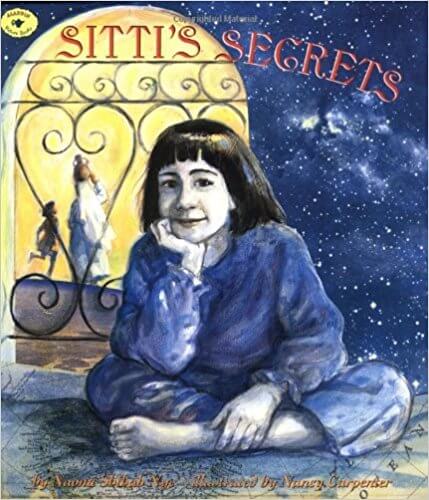
Sitti’s Secrets by Naomi Shihab Nye. Illustrated by Nancy Carpenter.
Purchase from Bookshop.org (supports independent bookstores and my business!)
Mona’s grandmother lives on the other side of the world from her in Palestine. When Mona finally has the chance to visit her, they don’t let language separate them. Soon they are spending hours together, walking to buy fresh milk from a neighbor, baking bread, and hanging laundry, even when Mona’s father is not there to translate.
When it’s time to return to the United States, Mona is heartbroken. She’s comforted by the memories of what her grandmother keeps in her green trunk, including old pictures of their family. Mona decides to write a letter to the President of the United States to tell him about her grandmother. Mona wants him to know that “I vote for peace. My grandmother votes with me.” Though it’s been nearly two decades since Shihab Nye wrote this book, its message is even more urgent today. (Recommended for ages 5 – 9. Palestinian-American author.)
>>>>Help families in Gaza survive: donate to Coffees for Gaza<<<<
I am a volunteer with Coffees for Gaza, an all-volunteer, mutual aid effort that directs donations to 25 families in Gaza who are struggling to obtain food and basic supplies. A donation of any size – even $5 – is a big help to the families we support.
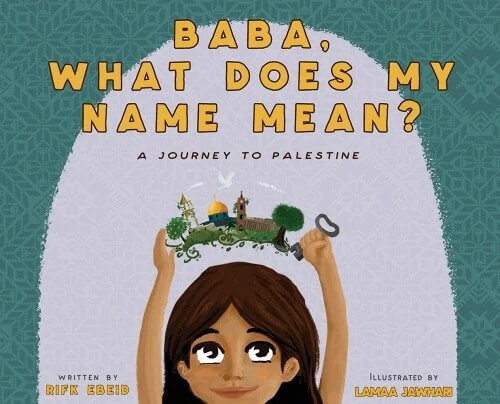
Baba, What Does My Name Mean? A Journey to Palestine by Rifk Ebeid. Illustrated by Lamaa Jawhari.
Purchase from Bookshop.org (supports independent bookstores and my business!)
When classmates ask Saamidah what her name means, she only knows that it’s an Arabic name. When she asks her father to tell her more about it, he tells her that her name means patient and persistent. Her parents chose this name because her Palestinian people must have these qualities as they fight for their rights.
With a special key and a dove of peace to guide her, Saamidah is whisked off to Palestine, where she visits many special places, from the Qubbet Al-Sakhra mosque and the Church of the Nativity, to her Papa’s childhood home from which he was dispossessed. There are many ancient sites, delicious foods, and carefully created items to learn about. Through all her journey, Saamidah is encouraged to believe that one day the Palestinian people will be free. (Recommended for ages 6 – 10. Palestinian-American author.)
Related post: 18 engaging children’s books starring Muslim characters

Mama in Congress: Rashida Tlaib’s Journey to Washington by Rashida and Adam Tlaib, with Miranda Paul. Illustrated by Olivia Aserr.
Purchase from Bookshop.org (supports independent bookstores and my business!)
The story opens on Rashida Tlaib’s first day in Congress, accompanied by her sons Adam and Yousif. As Tlaib tells the children that her job is to “open doors of opportunity and work for justice for all,” Adam shares the many way his mother has worked to open doors throughout her life. The poverty that she endured and the racist stereotypes she faced in childhood helped her see how unequal things were.
Though many thought the odds were against her as a Muslim Palestinian woman when she ran for the Michigan House of Representatives, the potential she would have to open doors for others prompted her to run. Adam details the many types of houses his Mama had to knock on during her race, often with him at her side. Playful illustrations show the boys helping pass out flyers in her later run for Congress, as well as the viral moment when the boys dabbed on the House floor. (Recommended for ages 4 – 9. Palestinian-American author.)
Related post: 12 children’s books about women in politics

Ten Ways to Hear Snow by Cathy Camper. Illustrated by Kenard Pak.
Purchase from Bookshop.org (supports independent bookstores and my business!)
When Lina wakes up, deep snow has covered her entire neighborhood. But that won’t stop her from walking to the building where her Sitti lives, so that they can make warak enab (stuffed grape leaves) together as they planned.
On her walk, Lina notices that snow changes the sounds around her, making them both softer and clearer. She begins to count the sounds the snow makes, from the scraping of a snow shovel to the sound her boots make as they crunch snow into little waffle shapes. When she arrives at Sitti’s, Lina is surprised to hear that Sitti knew there was a blizzard. Sitti cannot see well, so how did she know about all the snow? (Recommended for ages 3 – 7. Lebanese-American author.)
Related post: 20 children’s books about disability that shatter stereotypes

Homeland: My Father Dreams of Palestine by Hannah Moushabeck. Illustrated by Reem Madooh.
Purchase from Bookshop.org (supports independent bookstores and my business!)
As three girls wait for their father to return home for work, they look forward to the stories he’ll tell of their homeland. Although they have never been to Palestine (and realize they may never be able to visit), their father’s richly detailed stories, sprinkled with irreverent humor, bring the place to life.
Their father remembers his last day in Jerusalem, when his always-busy Sido (grandfather) took him to the family cafe. On their journey, they’re surrounded by sights and sounds that reveal the liveliness and diversity of Old Jerusalem in the 1940s. Finally, Sido takes him to a beautiful gated garden full of pigeons. Though that was the last time their father saw his homeland, he still carries to the key to the garden with him. (Recommended for ages 4 – 8. Palestinian-American author.)

Hungry for practical and fun antiracism activities and resources to use with children? In the Antiracist Kids Inspiration Hub, I’ve make it easy for you to cut through the clutter of endless internet searches.
Non-fiction books about Arab-American heritage

A Kid’s Guide to Arab American History: More Than 50 Activities by Yvonne Wakim Dennis and Maha Addasi.
Purchase from Bookshop.org (supports independent bookstores)
If you aren’t Arab American, you’ll likely find this guide just as illuminating as children will! Each section features a particular Arab culture (or grouping of cultures), with facts, biographies of Arab Americans, and hands-on arts and crafts activities. There are also short articles on topics such as stereotypes of Arab Americans, waves of immigration to the U.S., holidays, and diverse religious traditions. (Recommended for ages 8 – 12. (Cherokee/Syrian author; Jordanian author.)

Arab Arab All Year Long! by Cathy Camper. Illustrated by Sawsan Chalabi.
Purchase from Bookshop.org (supports independent bookstores and my business!)
This sunny book shows Arab American families celebrating their culture month by month, from finding the stars with Arabic names to celebrating Eid and Easter. My favorite page spread is for October, where children enjoy fresh pomegranates, as they eat them and splash their juices all over the bathtub! (Recommended for ages 3 – 7. Lebanese-American author.)
Fiction chapter books about Arab-American heritage
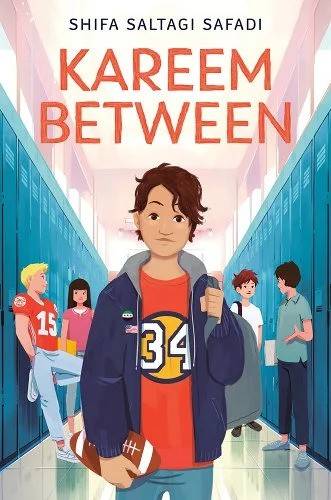
Kareem Between by Shifa Saltagi Safadi.
Purchase from Bookshop.org (supports independent bookstores and my business!)
If I could wave a magic wand, I’d add Kareem Between to every middle school’s reading list, so that children could understand the impact Trump’s 2017 Muslim ban had on real people. But that’s not the only reason this National Book Award-winner will resonate with young readers.
Kareem is relatable mess of a tween who pings back and forth between compassionate and self-centered behavior at both home and school. More than anything, he wants to make the school’s football team, so when the quarterback asks him to do something he knows is wrong, he reluctantly agrees. Unfortunately for Kareem, it turns out to be more than a one-time request.
Kareem’s mother is known as one of the most generous, caring members of their mosque. This means she expects Kareem to befriend Fadi, a newly arrived refugee from Syria. Kareem enjoys talking with Fadi outside of school, but is torn about being seen with him at school. Meanwhile, Kareem’s mother makes an unexpected trip home to Syria to bring her parents to the United States just as Trump makes good on his campaign process to ban Muslims from entering the U.S.
Soon, Kareem will have to find the courage to speak up about who he truly is in order to protect his family and friends. (Recommended for ages 8 – 12. Novel in verse. Syrian-American author.)

Sadiq and the Desert Star by Siman Nuurali. Illustrated by Anjan Sarkar.
Purchase from Bookshop.org (supports independent bookstores and my business!)
As you learn more about Arab American heritage, don’t forget that a number of African countries, including Somalia, are part of the Arab world. The engaging Sadiq series is a great place to start!
Sadiq’s father is getting ready to go on a business trip, which makes Sadiq sad. But when Baba tells him the story of the desert star from Baba’s childhood in Somalia, Sadiq learns that as long as he can see the desert star, Baba is safe. Sadiq is sure his new space club will be able to spot the desert star, but he soon learns that it’s much harder to see when he’s so far from Somalia. Can he and his friends meet this challenge with a creative solution? (Recommended for ages 6 – 9. Somali-American author.)

Farah Rocks Fifth Grade by Susan Muaddi Darraj. Illustrated by Ruaida Mannaa.
Purchase from Bookshop.org (supports independent bookstores and my business!)
In this opening book of this relatable series for intermediate readers, Farah Hajjar or “Farah Rocks” as she’s known at school, struggles with her conflicting desires to protect her little brother and get into her dream school. For the longest time, all she and her best friend Allie have talked about is getting into Magnet Academy.
But when a new student turns out to be a bully who targets not only Farah but her disabled little brother, Farah realizes she can’t leave Samir behind next year. She’s soon caught in a web of deception as she purposefully starts getting bad grades at school so she won’t be accepted to Magnet. After all, the adults she tried to talk to about the bullying swept away her concerns. (Recommended for ages 7 – 10. Palestinian-American author.)
Related Post: 9 diverse chapter book series for independent readers
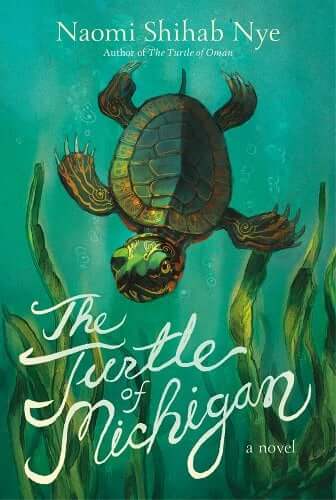
The Turtle of Michigan by Naomi Shihab Nye.
Purchase from Bookshop.org (supports independent bookstores and my business!)
In this humorous and gentle follow-up to The Turtle of Oman, Aref and his mother make the journey from Oman to Michigan that Aref has been dreading. They’ll be reuniting with Aref’s father and living in Michigan for three years, which seems like a lifetime, especially since Aref’s beloved Sidi (grandfather) is still in Oman.
Aref’s inquisitive personality come to life in his lists of all he is learning and experiencing. (For example, his list about Michigan includes “they have pizza!” and also “the yogurt isn’t as good.”) But the longer he’s away from Sidi (who’s struggling to figure out email), the more Aref doesn’t understand why he won’t come visit them in Michigan. Meanwhile Sidi is missing Aref so much that its hard to cope. Can he get over his fear of flying so he can see all the fascinating things Aref describes in his emails? (Recommended for ages 7 – 11. Palestinian-American author.)
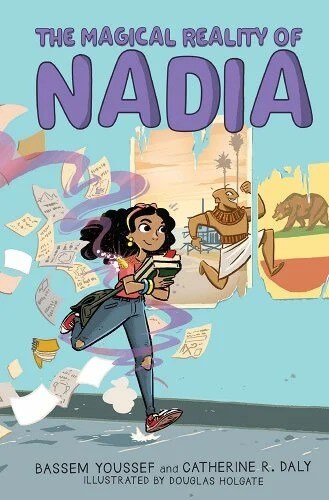
The Magical Reality of Nadia by Bassem Youssef and Catherine R. Daly. Illustrated by Douglas Holgate.
Purchase from Bookshop.org (supports independent bookstores and my business!)
Nadia is interested in facts (especially fun ones), not magic. She has hundreds of fun facts to share, about her home country of Egypt, about history, and just about any other subject. After all, her group of friends, who call themselves the “Nerd Patrol,” did win the school trivia contest last year.
So, when a talking cartoon of a man from ancient Egypt named Titi shows up in her math notebook, it’s a bit of a shock. Nadia and Titi soon discover that he can help solve problems, and Nadia has a big one. Jason, a new kid at school, is constantly making fun of her Egyptian heritage, and even worse, her best friend is laughing along with him. If she follow’s Titi’s advice to “take the power back” from Jason, will it work? (Recommended for ages 8 – 12. Egyptian-American author.)
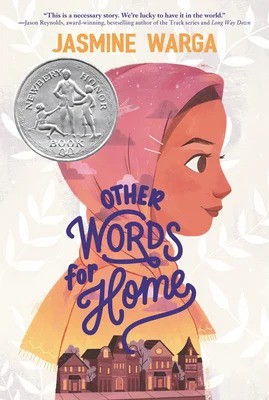
Other Words for Home by Jasmine Warga.
Purchase from Bookshop.org (supports independent bookstores and my business!)
As war takes hold in Syria, Jude’s mother tells her they must leave for America to stay with Jude’s uncle. Mama is pregnant, so it’s especially important they find safety. Baba and her older brother Issa will stay behind. Jude has always relied on her bold older brother, and when they part, he reminds her that she can be brave.
Jude’s bravery takes many forms, from refusing to join her cousin Sarah in stereotyping a friend named Layla who wears hijab, to trying out for the school musical. Because the novel is written in verse from Jude’s perspective, readers gain a depth of insight into her complex experiences, thoughts, and feelings while in Syria and in the U.S. (Recommended for ages 8 – 12. Jordanian-American author.)

Silverworld by Diana Abu-Jaber.
Purchase from Bookshop.org (supports independent bookstores and my business)
Sami loves hearing her Lebanese grandma Teta’s stories about Flickers and Ifrits, magical sprites that can be summoned by dreams and spells. In fact, Sami is the only one who can understand Teta these days, and her mother is sure Teta is slipping into dementia.
Teta has promised to show Sami her spell book when she turns 12, but in her desperation to keep Teta out of a nursing home Sami consults it on her own. Soon she has walked through an ornate Bedouin mirror into Silverworld, which reflects but is very different from her own world.
At first, Sami is laser focused on returning to her home, but the longer she stays the more it seems she might be in Silverworld for a purpose. Could she have a unique role to play in the Flickers’ efforts to save themselves from Queen Nixie’s Shadow soldiers? (Recommended for ages 8 – 12. Jordanian-American author.)
Related post: Diverse fantasy books for ages 7 – 14
