
When my son was three years old, I wrote a post about six lessons my child’s Montessori school has taught me about parenting. Now, my (not so) little guy is six years old. Today was my spring observation time in his classroom. I realized that there are still so many new things I’m learning from watching the Montessori method in action at his school.
Even if your child doesn’t attend Montessori school or you don’t strictly follow the Montessori method at home, I encourage you to read on. You can still find small ways to put these principles into action.


Copyright: lotosfoto / 123RF Stock Photo
Disclosure: For your convenience, this post contains affiliate links. If you make a purchase through these links, I may earn a small commission at no additional charge to you. You can read my full disclosure policy here.
Seven (More) Parenting Lessons I’ve Learned from the Montessori Method
1. Children want to help out in real ways
Sometimes folks think the Montessori method can be a bit extreme about children having real experiences rather than pretend ones. In a Montessori classroom, you’ll see children preparing real food with actual glass dishes and real silverware. You won’t find a play kitchen.
Don’t get me wrong – my 6 year old does a ton of pretend play at home (including in his play kitchen.) But I’m so glad that at school, he’s given real tasks to do. Watching children doing these real tasks reminds me that there’s always more I can do at home to let our son be part of the work that makes our home a home.
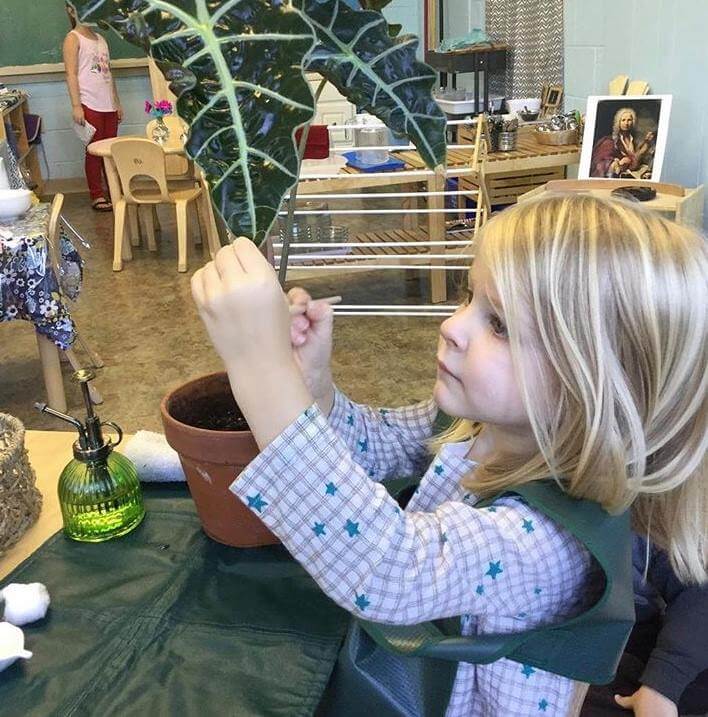
Today, during my one hour observation, one of the four year olds was eager to offer me a glass of lemon water that she poured into a real glass. More than one child asked if I would like to sign the classroom guest book. It was clear that their classroom was their space, and they were eager to make new adults feel welcome there.
2. Children need both flexibility and boundaries
Some people think Montessori classrooms are near chaos because each child does their own work at the same time, and kids are free to move around the classroom. Other people describe the Montessori method as rigid. I believe that when the true spirit of the Montessori method is being followed, neither of these extremes is true.
Instead, there are set boundaries that the children understand everyone will follow. For example, children can’t do a particular type of work until the teacher has carefully presented it to them. And certain types of work needed to be presented in a particular order, so that they make the most sense to the child.
But once the child has had work presented to them, they’re free to choose what they would like to do within the classroom. There are natural limits, such as there being only one of each kind of material in the room. So if your friend is doing the work you want to do, you’ll have to wait.
Related Post: Our Montessori Inspired Peace Corner
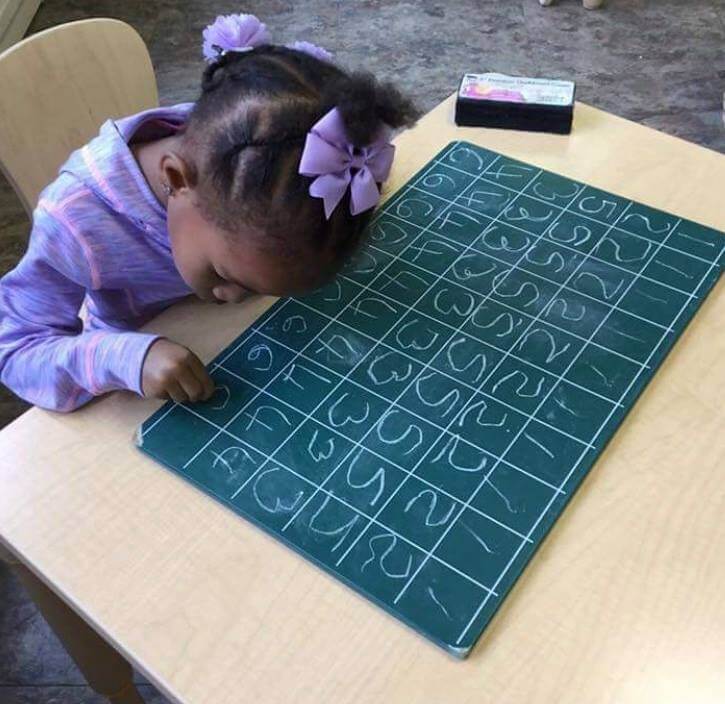
The freedom in the classroom allows my son to focus on the skills he most needs and wants to build right now. His teacher reminded me in a conference recently that when children want to do something repeatedly (even grinding coffee beans), it’s filling a need.
I’m usually eager in my own life to “move on” to the next thing. But as a parent, what my child needs is for me to patiently help him repeat experiences until he’s absorbed all he can from them.
Related Post: Peace Education, the Montessori Way
3. Kids will embrace learning something when the timing is right
A little over a year ago, I wrote about my frustrations over my son resisting writing his name. He’s learning to write in cursive at school, and at the time he found it challenging.
I found myself getting impatient and anxious. So many other kids had been writing their names for years. What was going on? And then, all of the sudden, his practicing paid off. He wanted to write his name – a lot! (Today, one of the pieces of work he wanted to do while I was observing was writing his name over and over.)
Today in the classroom, I really wanted to see him work on spelling words using the moveable alphabet. He didn’t want to show me. I know that most days, his teacher has to encourage him to take this work out. He’s just not enthusiastic about it yet.
But the past has taught me that he’s going to do it in his own time, when he’s ready.
4. I’m almost always rushing my kid
Describing myself as a type A personality is a major understatement. It’s probably more accurate to say I have an addiction to getting things done, and to getting them done quickly.
But every time I sit in his classroom and watch these 3, 4, 5, and 6 year olds moving at their own pace, I’m reminded what a beautiful thing it is. And I notice how the adults in the room adjust their pace as well.
The children don’t work in a linear fashion. A huge percentage of the frustration I experience as a parent is expecting our kiddo to go from point A to point B without interruption. That’s just not what 6 year olds do!
In mainstream education, we often equate learning with productivity. But productivity is not the point of Montessori education. The nurturing of the whole child is the point.
I promise I’m going to remember that the next time I’m asking our son to put on his shoes and coat (a process that often feels endless to me)!
Related Post: Why I Prefer the Montessori Method for Teaching the Alphabet

Explore geography and culture with your Montessori child using Little Passports (my son’s favorite way to learn about the world!)
5. Children love ritual
There’s a reason I chose today specifically for my observation time. I knew that they would be doing his “walk around the sun” birthday ritual, and it’s beautiful to watch.
Our son helped set out the celebration sun and seasons mat, including labelling each season and the months.
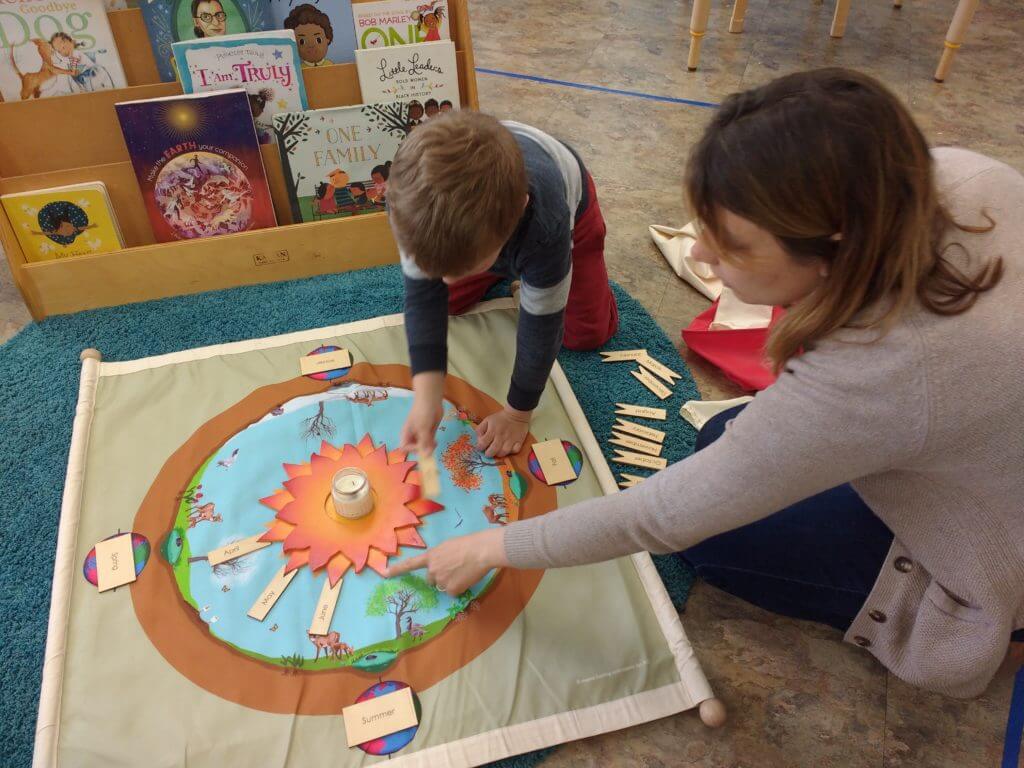
Then, the teacher reads the book On the Day You Were Born. Sometimes the birthday child brings a picture from each year of their life (but oops, Mommy was so busy planning his Godzilla-themed birthday party that I forgot to print out pictures!)
Then the child holds a small globe and walks around the sun mat while the children sing, “The earth goes around the sun and _____ turns 1.” There’s a verse for each year of the child’s life.
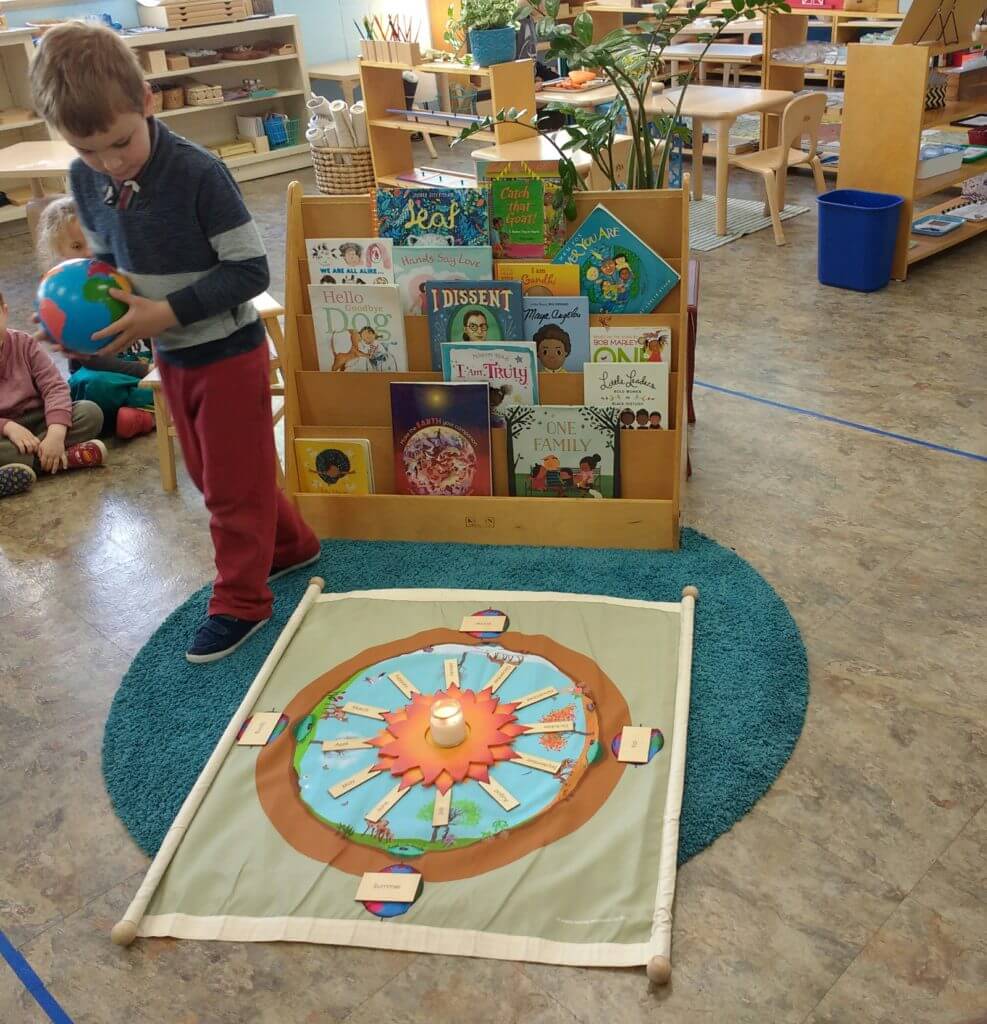
It’s not surprising that the birthday child enjoys this special attention and ritual. What’s so intersting to me is how much all the children like it!
As a minister, I’ve been consciously adding some faith rituals into our daily and weekly family life. I’ve seen what an impression they make on our son.
But any kind of rituals that make a day or season more special can become meaningful when they’re practiced again and again.
6. Kids thrive when they have older and younger peers
When my son started in his Montessori environment (what the classroom is called), he was 3 years old, one of the youngest children. Now at 6, he’s one of the oldest.
There’s a 14 year age difference between my stepson and my son, so in many ways, our 6 year old has grown up as an only child. I’m so thankful that he’s learning to interact with kids of many different ages at his school.

When he was younger, the older children could help him with work that was giving him challenges. Now that he’s older, he has a chance to share what’s he’s learned with his younger classmates.
The children at his school are also really good at solving problems on their own (most of the time.) I think that a big part of this is because children are continually socializing with kids who are not all the exact same age.
Related Post: Brazil Landmarks Montessori 3 Part Cards & Learning Resources

One response to “What the Montessori Method is Teaching Me about Parenting”
A Montessori classroom is a thoughtfully designed environment to offer children opportunities to develop their own capabilities.
Each classroom is filled with developmentally appropriate activities that encourage children to interact with specific learning materials, as well as to work cooperatively with others.