Children’s books are a powerful tool for challenging stereotypes and reducing bias. However, there’s incredibly variety within the designation of anti-bias children’s books. How can you know as a caregiver or educator that your children’s book collection will help children develop inclusive values?
For example, you don’t want all of your anti-bias children’s books to be about history, with nothing set in the present day. That gives the idea that issues of prejudice and injustice only existed in the past. It’s important to include books about current justice issues, but you’ll also want to include books that show children of many backgrounds living their everyday lives. After all, no one’s identity is solely defined by experiencing oppression. There’s so much to think about!
In this post, you’ll get a clear framework for 6 types of anti-bias children’s books that belong in every home or school collection. I consider them to be the essential “building blocks” of an anti-bias book collection.


Disclosure: For your convenience, this post includes affiliate links. If you purchase items through these links, I may earn a small commission at no additional cost to you. You can read my full disclosure policy here.
The 6 building blocks of anti-bias children’s books
Building Block 1: Mirror books that help children develop knowledge, love, and pride in themselves, their families, and their social identities.
Dr. Rudine Sims Bishop first framed diverse books as “windows, mirrors, and sliding glass doors” in 1990. She understood that reading can be a “means of self-affirmation” for children, but only when their identities and experiences are positively represented in books.
But, especially at that time, children of color often had trouble finding many authentic mirror books. The same is often true for disabled children, kids in LGBTQ families, working class kids, and neurodivergent children.

A few of my favorite “mirror” children’s books are:
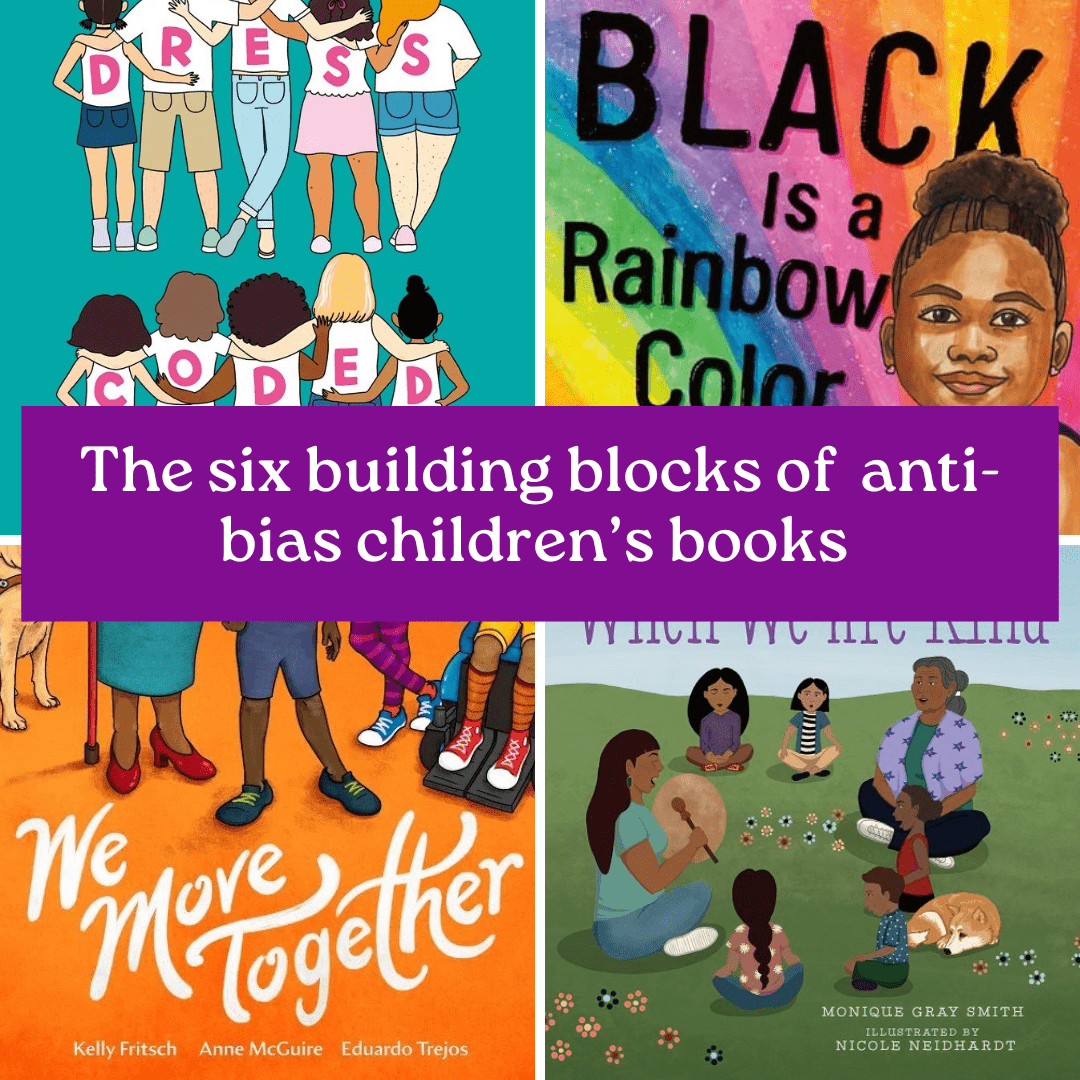
When We Are Kind by Monique Gray Smith. Illustrated by Nicole Neidhardt.
All aspects of kindness and the ripple effects of being kind are explored in this straight-forward and moving book for young children. Examples of being kind to family, friends, Elders, neighbors and the earth are accompanied by bright illustrations of First Nations families and children. (Recommended for ages 2 – 4. Cree, Lakota, and Scottish author.)
Black Is a Rainbow Color by Angela Joy. Illustrated by Ekua Holmes.
Black may not be one of the colors in the rainbow, but it is a color that has a rainbow full of meanings. The book celebrates a variety of images that are the color black and are also expressions of Black culture. (Recommended for ages 4 – 8. Black author.)
The Serpent’s Secret by Sayantani Dasgupta. Illustrated by Vivienne To.
In suburban New Jersey, Kiran and her parents have always stood out. When Kiran’s parents disappear on her 12th birthday, they leave behind a hastily scrawled note warning her not to let a rakkosh demon into the house, and to trust the princes that will be sent to her. Soon the princes arrive, only to reveal that Kiran is actually a princess, exiled from the Kingdom Beyond Seven Oceans and Thirteen Rivers. As they battle demon creatures so that they can locate Kiran’s parents, Kiran must figure out the strange realm she was born in. (Recommended for ages 8 – 12. Indian American author.)
Related post: 15 picture books filled with Black joy
Building Block 2: Window books that help children develop knowledge, love, and respect for people whose identities are different from their own.
This category of anti-bias children’s books is very similar to mirror books, except that they help children see into the worlds of people who have different identities than their own.
For kids who are part of a racial majority (or any other group that has more power), Dr. Bishop points out that “they need books as windows onto reality, not just on imaginary worlds.”
It’s important to root children in mirror and window books that are NOT primarily about injustice and pain. No one’s identity is defined mainly by experiencing suffering, and children’s books should reflect that.

Some of my favorite “window” books include:
Dreamers by Yuyi Morales.
In this inspiring tale, award-winning illustrator and children’s book author Yuyi Morales shares her own tale of immigrating to the United States from Mexico with her infant son. In this strange new place, there was much that was unfamiliar, and “we made lots of mistakes.”
The day that changed their lives in America was when they visited the library. Pages and pages of vivid illustrations show awestruck mother and son exploring piles of books , which helped them find their voices in a new land. (Recommended for ages 3 – 7. Mexican American author.)
The Boy and the Bindi by Vivek Shraya. Illustrated by Rajni Perera.
A young boy is fascinated by his Ammi’s “dot” on her forehead, which she explains to him is a bindi. The beauty of her many bindis draws him in, and when Ammi explains the purpose of the bindi, his connection with it becomes even stronger. Longing to feel “safe and true” like his mother, the child asks for his bindi, which she gladly gives him. The bindi allows him to see within himself, connect with the universe, and ensures that he won’t hide who he is, even when others stare. (Recommended for ages 4 – 8. South Asian Canadian transgender author.)
Too Small Tola by Atinuke. Illustrated by Onyinye Iwu.
Tola may be small, but it’s no indication of her physical and mental strength! She takes after Grandmommy, whose nickname is Mama Mighty. In this delightful chapter book, Atinuke shows children modern day life in the bustling city of Lagos, Nigeria. The story challenges not only gender stereotypes, but stereotypes about Africa as well. (Recommended for ages 7 – 10. Nigerian author.)
Building Block 3: Books about bias & injustice that help children develop understandings of personal prejudice and systemic injustice.
A crucial component of any anti-bias children’s books collection is books that directly talk about oppression, prejudice, and systemic injustice. Look for books that will not only help children understand how these injustices existed in the past (such as Jim Crow segregation) but also how they continue in the present.
As you select age-appropriate anti-bias children’s books about injustice, keep in mind that preschool-age children are better able to grasp personal bias. As you move into the elementary years, begin introducing books about systemic racism, sexism, ableism, etc.

Some of my favorite books about bias and injustice are:
We Move Together by Kelly Fritsch, Anne McGuire, and Eduardo Trejos.
This easy-to-understand story counters ableism in many forms and emphasizes the importance of communities coming together to solve problems. Children and caregivers will want to spend time poring over the illustrations, which reveal the details of the story. The illustrated end notes explain ableism, disability arts, accessibility and more in terms that young children can understand. (Recommended for ages 2 – 5. Disabled author – Fritsch.)
The Cot in the Living Room by Hilda Eunice Burgos. Illustrated by Gaby D’Alessandro.
In this moving story, a family regularly welcomes children to sleep on an extra cot while their parents work the night shift. Their youngest daughter longs to sleep on the cot (instead of sharing a room with her sister). She’s also miffed when her parents offer their nervous young guests special privileges that she doesn’t get.
When the cot is unoccupied one night, she realizes sleeping on it is not quite the experience she expected. The next time a guest arrives, the girl has her own solution to make them feel welcome. (Recommended for ages 4 – 8. Dominican American author.)
Related Post: 42 powerful children’s books about race and racism
Lupe Wong Won’t Dance by Donna Barba Higuera.
Lupe Wong has never been afraid to speak up at school when something isn’t right. Why does she have to choose the Asian or Latino bubble on forms, instead of having a “Mexicanese” or “Chinacan” option? When she finds out that there’s a required square dancing unit in PE class, she tries everything she can think of to stop it. Surely her principal will understand that the tradition is sexist, because boys must be the ones to ask girls to dance. (Recommended for ages 9 – 13. Biracial Mexican and white author.)
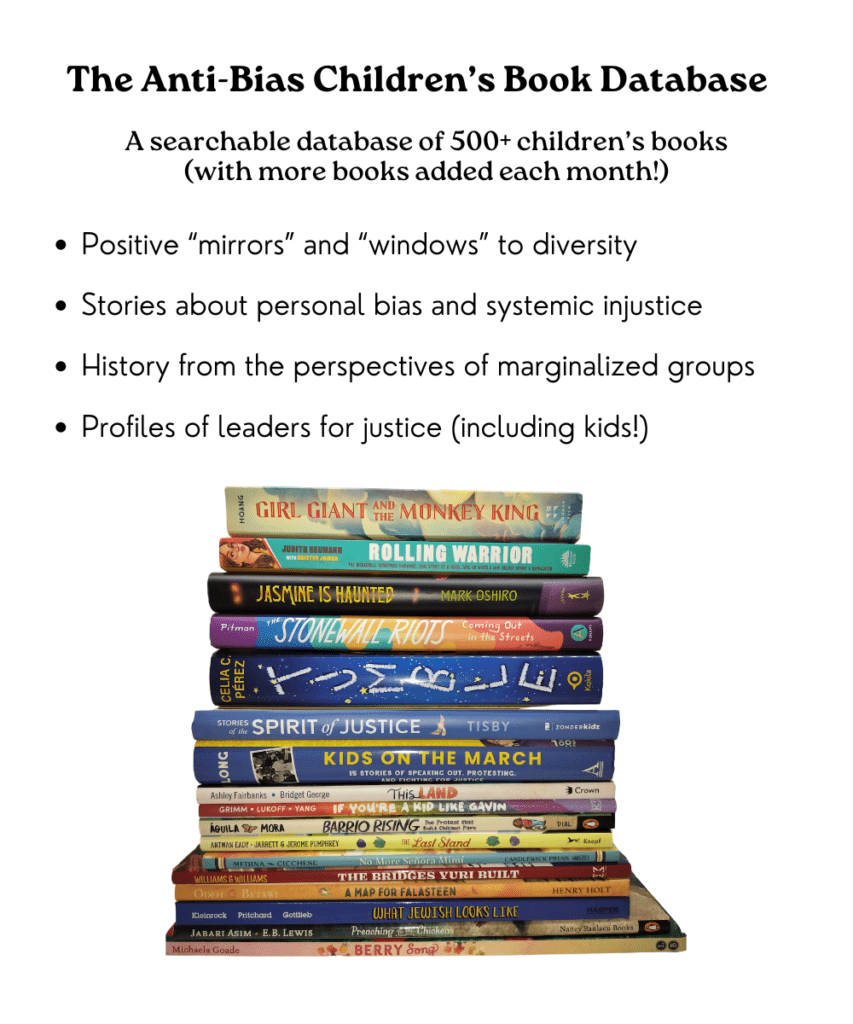
Find anti-bias children’s books for each of the 6 building blocks with my searchable database!
Building Block 4: Books that help children learn accurate history that centers the perspectives of groups that society has marginalized.
One of the reasons that children form biases towards whiteness, maleness, and other privileged identities is because history is usually told from the perspective of people in power.
Whether you call this “peoples history” or “decolonized history,” the focus of this building block is how history has been experienced by People of Color, poor people, LGBTQ people, women, disabled people, and other marginalized groups.
Montclair State University education professor Bree Picower points out that many educators are comfortable exploring and celebrating diversity with learners, but it’s important to also explore “how diversity has been used as a marker for oppression that has differently impacted various groups of people.”

Some of my favorite anti-bias children’s books that share people’s history are:
Grandfather’s Journey by Allen Say.
Allen Say’s paintings shine in this quiet story of his grandfather’s journey from Japan to California, and many decades later, his return to Japan. As Grandfather wades through a sea of wheat and stands in the shadows of factories, readers sense how new and strange America must have felt to him. Though there were many things he loved about California, Grandfather couldn’t stop thinking of home and the places and friends he’d left behind.(Recommended for ages 4 – 8. Japanese American author.)
The Undefeated by Kwame Alexander and Kadir Nelson
The Undefeated is Alexander’s tribute to all the Black leaders, everyday people, and the movements who are too often left out of history textbooks. He seamlessly connects the abolitionist, civil rights, and Black Lives Matter movements. (Recommended for ages 7 – 12. Black author.)
In the Footsteps of Crazy Horse by Joseph Marshall III and James Mark Yellowhawk.
Both white and Lakota classmates alike tease Jimmy McLean. With blue eyes and light brown hair, some question whether he’s really Lakota. Jimmy’s grandfather tells him that there was once a great Lakota leader who also had brown hair and light skin: Crazy Horse. Grandpa suggests that they take a journey this summer, to visit all the important places where Crazy Horse made history. (Recommended for ages 10+. Lakota author.)
Building Block 5: Books about social movements and leaders who have acted to address systemic injustice and threats to the environment.
Stories of how groups have worked together for change, in the past and in the present, are vital in inspiring young people to work for change.
As you read social justice books, look for ways to focus on the larger movements represented, rather than just the most famous individual leaders.

A few of my favorite anti-bias children’s books about justice movements and their leaders include:
Finish the Fight! The Brave and Revolutionary Women Who Fought for the Right to Vote by Veronica Chambers and the staff of The New York Times.
This is one of the best children’s books about the women’s suffrage movement , because it tells the complicated story of how racism divided the movement, and uplifts the contributions of suffragettes who are Women of Color and/or Queer. Each chapter tells the story of a different leader, such as Mary Church Terrell, Mabel Ping-Hua, Jovita Idár, and how their work advanced the overall suffrage movement. (Recommended for ages 10+. Black woman author.)
I Am Farmer: Growing an Environmental Movement in Cameroon by Baptiste and Miranda Paul. Illustrated by Elizabeth Zunon.
As a child, Tantoh Nforba loved plunging his hands into the squishy dirt in his grandmother’s garden. He loved asking questions, whether it was about how things grew or how weather and biology worked. Nforba’s classmates nicknamed him Farmer as an insult, but turned the nickname into his own personal badge of honor.
In college, he learned about the importance of clean water not only in his lessons, but when he contracted typhoid. In the seven years it took him to recover, Nforba decided that he would dedicate himself not only to farming, but to farming in a way that will bring clean water to people. (Recommended for ages 4 – 8. White author and St. Lucian American author.)
Undocumented: A Worker’s Fight by Duncan Tonatiuh.
Juan, a Mixtec man born in a small Mexican village, points out that “you don’t know our names but you’ve seen us…We may not have documents, but we all have a story and we all have a name.” Juan scrapes by for many years working at a restaurant, where the owner tells him he’s “doing him a favor” by hiring him since he’s undocumented.
When his Chinese co-worker Li takes him out for happy hour after work, she helps Juan understand just how unfair their working situation is. When Juan’s wife announces a baby is on the way, he realizes that something has to change, and agrees to go with Li to a workers’ center to learn about how they can organize. (Recommended for ages 7 – 12. Mexican American author.)
Related Post: 15 books to help kids and teens understand that Black Lives Matter
Building Block 6: Books about young people’s activism that help kids imagine how they can engage in action against personal prejudice, systemic injustice, and threats to the environment.
This building block expands on block 5 by focusing on ways young people have worked for change in the past and present. Try providing a combination of biographies, realistic fiction, and non-fiction guides to taking action on issues the children in your life care about.

Some of my favorite books about young people working for change include:
Lubaya’s Quiet Roar by Marilyn Nelson. Illustrated by Philemona Williamson.
Activists come in many personalities and action can take many forms. Lubaya is a quiet dreamer who prefers making art to talking in class discussions. Her parents have participated in protest marches before and brought posters home from them. When Lubaya finds the posters she covers the backs with drawings of her vision of how the world should be.
After viewing breaking news (which isn’t specific, likely in order to protect sensitive young readers from reports of violence), Lubaya’s family needs the posters once again. But this time, it is Lubaya’s art on the backs of the posters that garners the most attention. (Recommended for ages 4 – 8. Black author.)
Alejandria Fights Back!/¡La lucha de Alejandria! By Leticia Hernández-Linares and the Rise-Home Stories Project Illustrated by Robert Liu-Trujillo.
Alejandria’s neighborhood is changing. Her friend Julian has to move out of their apartment complex because the landlord raised the rent, and more for sale signs are going up every day. When Mami gets a letter than their rent is going up too, she doesn’t want Alejandria to worry about it. Still, she can’t stop thinking about her abuela Tita’s stories about how they stood up against injustice in Nicaragua.
When Alejandria urges her family to do something, Tita agrees with her. Mami, however, is worried that speaking up could make things worse. (Recommended for ages 6 – 10. Salvadoran American author.)
Dress Coded by Carrie Firestone.
Under a school administration obsessed with enforcing a strict dress code, the girls of Fisher Middle School face body shaming and distractions from their studies on a daily basis. When the principal cancels a promised 8th grade camping trip because Olivia wore a tank top at school, Molly decides she’s had enough.
Molly starts the Dress Coded podcast because she wants other students who are furious at Olivia to know what really happened. Other students start to come forward to talk about the many ridiculous reasons they were dress coded and how it affected them. Molly’s podcast becomes a school movement for change, which also gives Molly confidence at home to deal with her often-cruel, vaping-obsessed older brother. (Recommended for ages 10 – 14. White woman author.)
One quick way to find anti-bias children’s books for each of the six building blocks? Use my searchable database!
Maybe you’re thinking “those are good criteria to think about Rebekah, but I just don’t have time to do this kind of background research.”
I hear you!
That’s exactly why I’ve created an affordable resource for finding the best anti-bias books – fast – based on children’s ages and interests. It’s my Anti-Bias Children’s Books Database, a searchable resource that organizes books by age level and the 6 anti-bias building blocks.
Each month I add new books to the database, making it an even more valuable resource over time.
How you can use the database for my home or classroom:
- Families: find your next great read by searching with keyword topics that match your child’s interests. (I’m compiled more than 400 topics, so there’s sure to be something that every child will love.)
- Educators: Bring your history and literature lessons to life with a huge array of historical fiction and engaging non-fiction books, and find age-appropriate books for your social-emotional learning activities.
- Inspire young readers with stories of both adults and youth who have worked for peace and justice.

One response to “6 essential types of anti-bias children’s books”
These are wonderful recommendations (we love Baby goes to market!). Just a note to consider more books from beyond the US (ie looking at diversity beyond borders as well). A few Canadian Indigenous books we love are the board books by Roy Henry Vickers and Robert Budd (literally the most beautiful board books I’ve ever seen),Richard Van Kamp’s We Sang You Home, and We all Count (we’re also keen on multilingualism in our home). We’ve also got some wonderful Indigenous stories from Australia, and I’m working on collecting more books from Southern Africa (there’s a gorgeous one from Botswana illustrated by San artists), and East Asia (there are some fantastic Japanese board books).