
In the early 20th century, Harlem became the epicenter of an explosion of Black culture, arts, and philosophy during what’s now called the Harlem Renaissance. Learning about the leaders and intellectual and artistic movements of this era is a rich and meaningful way to explore Black history with children. Read on to discover 12 culturally-rich books about the Harlem Renaissance and the artists of all kinds who made it possible.


Children’s books about musicians of the Harlem Renaissance

Ella Fitzgerald: The Tale of a Vocal Virtuosa by Andrea Davis Pinkney. Illustrated by Brian Pinkney.
Purchase from Bookshop.org (supports independent bookstores and my business!)
In four “tracks” describing the career highlights of jazz and be-bop legend Ella Fitzgerald, Scat Cat Monroe (an actual cat) speaks in poetic rhythms that reflect Fitzgerald’s style. As a child in Yonkers, Fitzgerald taught her self to tap-dance and performed on street corners. Neighbors told her to make her way to Harlem, where she could truly shine. There, it was her voice and distinct musual style that propelled her to fame. (Recommended for ages 6 – 10. Black author.)
Related post: Children’s books and resources for learning Black history all year round
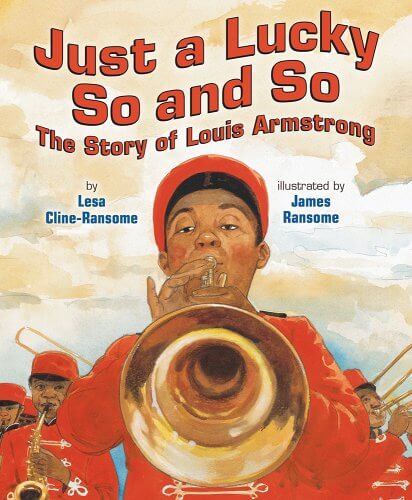
Just a Lucky So and So: The Story of Louis Armstrong by Lesa Cline-Ransome. Illustrated by James Ransome.
Purchase from Bookshop.org (supports independent bookstores and my business!)
Though this picture book biography ends before Armstrong joined in the Harlem Renaissance, it’s a warm and lively introduction to his life and work. Armstrong was born into poverty, but Cline-Ransome quickly demonstrates how he was surrounded by the richness of family love and New Orleans music.
Ransome’s expressive watercolor illustrations give young readers a feel for the liveliness of the musical performances Armstrong watched from the sidewalks, and later led as a young band leader. Joyful quotes from Armstrong are scattered over a number of the illustrations. (Recommended for ages 5 – 9. Black author.)
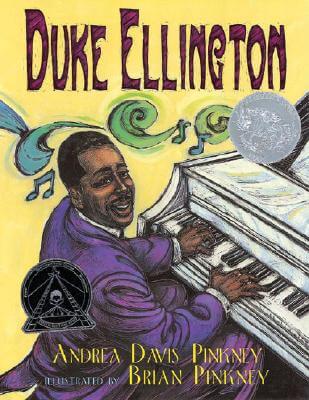
Duke Ellington: The Piano Prince and his Orchestra by Andrea Davis Pinkney. Illustrated by Brian Pinkney.
Purchase from Bookshop.org (supports independent bookstores and my business!)
Children might be surprised to learn that Harlem Renaissance legend Duke Ellington resisted taking piano lessons as a child. The traditional approach (read boring approach) his teacher took didn’t interest Ellington. But when he was introduced to ragtime music, Ellington became eager to take up the piano again.
In Harlem, Ellington’s performances not only wowed fancy places like the Cotton Club. His radio performances pulled in ordinary people who couldn’t afford to go to clubs. Davis Pinkney not only spotlights Ellington’s genius, but also describes the musical style of each of the leaders of his orchestra. (Recommended for ages 6 – 10. Black author.)
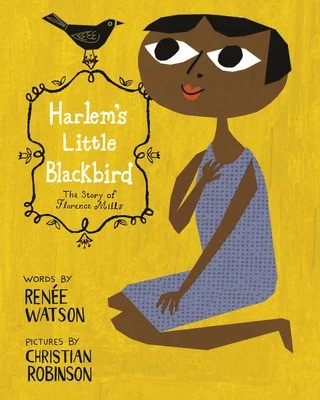
Harlem’s Little Blackbird: The Story of Florence Mills by Renée Watson. Illustrated by Christian Robinson.
Purchase from Bookshop.org (supports independent bookstores and my business!)
Florence Mills discovered her powerful voice as a child, singing along with her mother as rainstorms shook their tiny, frail house. As a schoolgirl, she discovered that her gift for mastering new dances like the cakewalk was unmatched.
When Florence began to perform, she used her voice not only to mesmerize audiences, but to stand up for herself and other Black people when they experienced discrimination. Her career soon took her to Harlem, and then on to London, where she faced both acclaim and racism. (Recommended for ages 5 – 9. Black author.)
Related post: Great children’s books about Black women leaders
Picture books about visual artists of the Harlem Renaissance
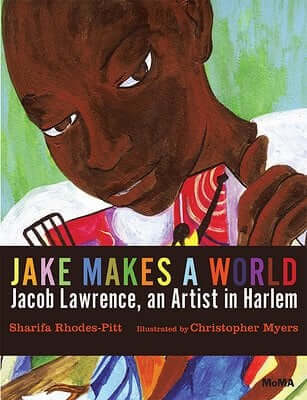
Jake Makes a World: Jacob Lawrence, an Artist in Harlem by Sharifa Rhodes-Pitt. Illustrated by Christopher Myers.
Purchase from Bookshop.org (supports independent bookstores and my business!)
This striking account of painter Jacob Lawrence’s childhood gives readers an understanding of how he became an artist, while also painting a vivid picture of the Harlem of his childhood. Lawrence took in the sights, sounds, and personalities of his vibrant neighborhood and learned how to incorporate them into art at the Utopia Children’s House.
For example, a thoughtful teacher at Utopia recognized that the style of one of Jake’s paintings was similar to an African mask. After showing him a mask, Jake immediately tackled making his own version out of paper bags. Endnotes include pictures of some of Lawrence’s most famous paintings. (Recommended for ages 4 – 8. Black author.)
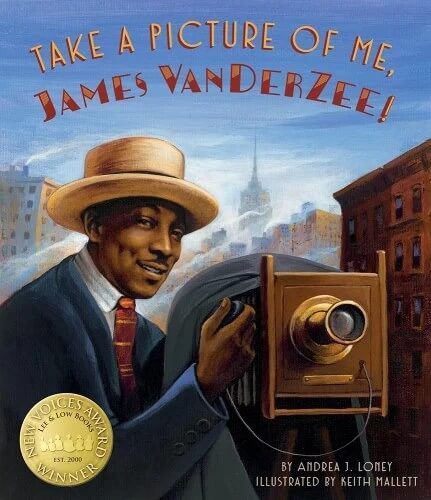
Take a Picture of Me, James VanDerZee! by Andrea J. Loney. Illustrated by Keith Mallett.
Purchase from Bookshop.org (supports independent bookstores and my business!)
Many children will find it hard to believe that there was a time when having your picture taken was an exciting and rare event. In this biography of legendary Harlem photographer James VanDerZee, readers will learn why people became so eager to have VanDerZee in particular take their portraits.
After moving to Harlem and getting a job in a photography studio, it was still a long time until James got to take portraits. But when his white boss went out of town, VanDerZee finally got his chance. Because he took the time to let people prepare to be photographed, and he knew how to touch up the photos and even make composites, he became popular enough to open his own studio.
Soon, legendary leaders like Marcus Garvey and Mamie Smith were calling on VanDerZee to take their portraits. There are several pages of historical notes after the story that include some of VanDerZee’s real photographs. (Recommended for ages 6 – 10. Black author.)
Related post: 12 children’s books about Black scientists and inventors
Children’s books about leading writers of the Harlem Renaissance

There Was a Party for Langston by Jason Reynolds. Illustrated by Jerome Pumphrey and Jarrett Pumphrey.
Purchase from Bookshop.org (supports independent bookstores and my business!)
Before I read the author’s note, I thought that wordsmith Jason Reynolds was imagining a party that was held by influential authors in honor of Langston Hughes. A photograph of Maya Angelou and Amiri Baraka dancing together reveals this was, in fact, an actual party!
Reynolds doesn’t stop at describing Hughes as “the king of letters.” He reveals how the poet made specific words like America “look like two friends making pinky promises, to be cool, to be true.” The delightful illustrations repeatedly show words themselves dancing, as a host of Black authors gaze onto the dance floor from the spines of their books. I can’t recommend this book enough! (Recommended for ages 4 – 9. Black author.)
Related post: 15 picture books filled with Black joy

Legacy: Women Poets of the Harlem Renaissance by Nikki Grimes.
Purchase from Bookshop.org (supports independent bookstores and my business!)
Nikki Grimes is one of my favorite poets for children. In this unique collection, she first presents a poem by a Harlem Renassiance woman poet with one or more lines presented in bold text. On the following page, Grimes writes a poem on a similar theme, using a word from the bolded text of the Renaissance poem in each line.
A variety of outstanding Black women illustrators, including Ekua Holmes, Elizabeth Zunon, and Vanessa Brantley-Newton bring the poems to life with their pictures. Some of the poems are celebrations of nature and family, while others cry out against injustice, racism, and sexism. (Recommended for ages 8 – 12. Black author.)

Jump at the Sun: The True Life Tale of Unstoppable Storycatcher Zora Neale Hurston by Alicia D. Williams. Illustrated by Jaqueline Alcántara.
Purchase from Bookshop.org (supports independent bookstores and my business!)
Zora Neale Hurston’s fearless personality practically leaps off the pages of this picture book biography. The lively illustrations and the humorous dialect made me feel like I was sitting across from Zora as she told one of the tales that attracted her “like mosquitoes to skin.”
Though Zora’s strict religious father disapproved of her fascination with stories, her mother protected her. Her mother encouraged Zora to “jump at de sun,” and as the writer’s own story unfolds, the sun keeps calling to her. This is a joyful and inspiring book that will delight future writers. (Recommended for ages 5 – 9. Black author.)

Schomburg: The Man Who Built a Library by Carole Boston Weatherford. Illustrated by Eric Velasquez.
Purchase from Bookshop.org (supports independent bookstores and my business!)
When he was a child growing up in Puerto Rico, Arturo Schomburg’s fifth grade teacher told him that people of African descent had no history or heroes worth learning about. He knew she must be wrong. Arturo discovered Black inventor and astronomer Benjamin Banneker’s almanac of America, and a lifelong quest to document Black history began. His research not only unearthed Black leaders whose work is now well known. He also discovered that history had often been whitewashed. (For example, I certainly didn’t know that Beethoven was often described as a mulatto or a Moor.)
Schomburg’s enormous collection of Black history books eventually crowded out the living space in his home. His wife demanded that the books find a more public home. They were purchased for the New York Public Library, where they now make up the Schomburg Center for Research in Black Culture in Harlem. (Recommended for ages 8 – 12. Black author.)
Related post: 12 engaging chapter books about Black history
Children’s books that give an overview of the Harlem Renaissance

Harlem Renaissance Party by Faith Ringgold.
Purchase from Bookshop.org (supports independent bookstores and my business!)
With her trademark combination of fantasy and history, Ringgold envisions a party invitation written in the sky that draws young Lonnie and his Uncle Bates to the Harlem Renaissance.
When they arrive, Uncle Bates not only makes sure that Lonnie encounters legends like political leader Marcus Garvey and entreprenuer Madam C.J. Walker. He also emphasizes the ways that the Harlem Renaissance was a fight for freedom through creating literature, art, music, and dance. Ringgold’s glossary includes a comprehensive list of well-known and lesser-known leaders. (Recommended for ages 5 – 9. Black author.)
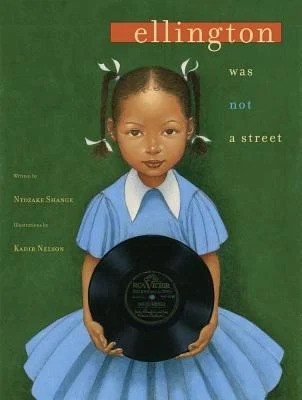
Ellington Was Not a Street by Ntozake Shange. Illustrated by Kadir Nelson.
Purchase from Bookshop.org (supports independent bookstores and my business!)
This poem from playwright Ntozake Shange reminds readers of all ages that the Harlem Renaissance as not so long ago. Paul Robeson greets a little girl in the entry of her home, and later her father guides W.E.B. DuBois up the family’s staircase. Nelson’s detailed illustrations spotlight the creativity and scholarship that sparkled in both homes and public places to life. There are notes at the end of the book that describe more about each of the leaders who are portrayed in the book. (Recommended for ages 6 – 10. Black author.)
Find even more Harlem Renaissance children’s books on my Bookshop.org list below!
