
It’s time for another edition of Global Citizen Kids’ Club! This month we’re learning about Greece. My best friend lived in Greece for a time, and she just got back from taking her 6 year old daughter there for her first visit. It seemed like the perfect time for our family to learn more about modern Greece, as well as ancient Greek culture and history.
I’m sharing some of our favorite children’s book finds (both picture books and chapter books), a fun craft, a recipe, and several more ideas for hands-on learning activities.
You may also want to visit our past editions of Global Citizen Kids’ Club, where we learned about Kenya, China, Colombia, and Iran.


Copyright: paulrommer / 123RF Stock Photo
Disclosure: For your convenience this post contains affiliate links. If you purchase items through these links, I may earn a small commission at no additional cost to you. You can read my full disclosure policy here.
Children’s books about Greece
When I want to help my 5 year old learn about new places and cultures, we usually start with books. Outside of the magic of travel itself, I think this is the best way to help children develop a sense of connection with people in another country.
I’ll be honest: it was a lot easier to find children’s books about ancient Greece and Greek mythology than it was to find books about modern Greece. But I did find a few!
Echo Echo: Reverso Poems About Greek Myths by Marilyn Singer and Josee Masse

I was more than a little surprised that my 5 year old fell in love with this book of poems about Greek myths. It’s intended for a bit older audience, but he was intrigued. Each page has two poems about the same Greek myth, each written from the perspective of one of the main characters. What makes the poems especially remarkable is that they are reverse versions of one poem.
I appreciated that at the bottom of each page, there was a short description of the myth, because my memory was often rusty! The gorgeous illustrations also help children perceive the different ways these myths can be understood. (Recommended for ages 7 – 12).
Greek Myths: Three Heroic Tales by Hugh Lupton, Daniel Morden, and Carole Henaff
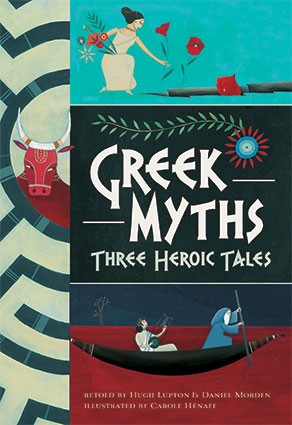
This trio of tales provides a more in depth exploration of Greek myths for an older elementary child. The volume includes re-tellings of Demeter and Persephone, Theseus and the Minotaur, and Orpheus and Eurydice. As someone who can easily lose track of characters, I appreciated that each tale includes an illustrated “cast of characters” page. It also includes an extensive family tree of Greek gods, and a map of ancient Greece.
One of the hallmarks of Barefoot Books is that they don’t believe in over-simplifying classic tales for children. The violence in Theseus and the Minotaur, for example, is not glossed over. That’s one of the reasons I recommend this book (and The Adventures of Odysseus below) for older children. (Recommended for ages 10+).
The Adventures of Odysseus by Hugh Lupton, Daniel Morden, and Christina Balit

This adaptation of Homer’s Odyssey introduces children to the epic’s most famous events, without overwhelming them with too many details. Christina Balit’s full-color illustrations for the book are truly works of art. Readers accompany Odysseus on his harrowing journey home after the end of the Trojan War, where he encounters gruesome creatures like the Cyclops and a 6 headed dragon.
Ancient Greece (DK Eyewitness Books) by Anne Pearson

While this DK Eyewitness Book refers to Greek mythology often, I appreciated that it includes many other aspects of ancient Greek history and culture. It includes sections about pottery, science and medicine, wine and food, politics, beliefs about the afterlife and more. I was disappointed (but not surprised) that only the lives of privileged Greeks, and not the many Greeks who were enslaved, were reflected in the material. (Recommended for ages 6 – 12).
Mr. Semolina-Semolinus: A Greek Folktale by Anthony L. Manna, Christodoula Mitakidou, and Giselle Potter

Apparently there are many folktales in the Mediterranean about the power of love to bring an inanimate object to life. In Mr. Semolina-Semolinus, Princess Areti is unsatisfied with her many suitors. So, she makes a man out of almonds, sugar, and semolina. After 40 days of prayer, God brings him to life. He is soon known for being five times as beautiful and ten times as kind as other men.
When a scheming queen from a faraway kingdom traps him, Areti must go to the ends of the earth to save him. She travels so far that she wears out three different pairs of iron shoes. She must use her wits, courage, and magical gifts from the Sun and the Moon to bring him back to her. (Recommended for ages 5 – 9)
I Have an Olive Tree by Eve Bunting and Karen Barbour
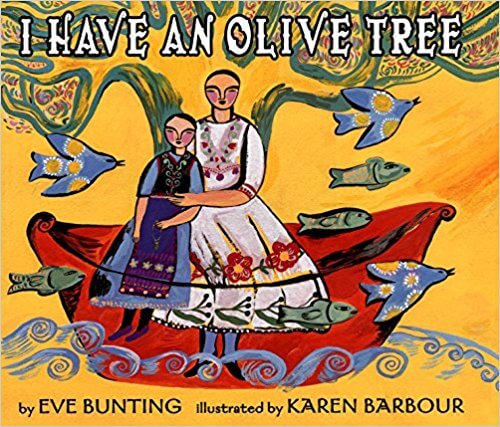
When Sophia is seven, her grandfather tells her he’s giving her an olive tree. It’s not one that she can see and touch, because it’s located on the Greek island where her grandparents once lived. When he dies, her mother tells her that her grandfather saved money so that the two of them could travel to Greece to see her tree. He’s given her the sacred task of her grandmother’s beads on the tree.
This lovely story is a testament to the lasting power of culture and a homeplace within a family, long after a family has moved away from their land. (Recommended for ages 5 – 9).
My First Book of Greek Words by Katy R. Kudela
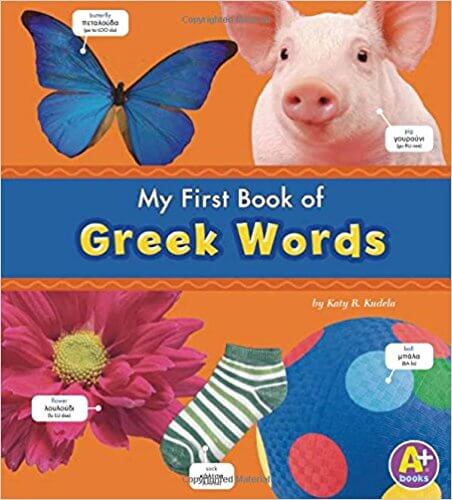
This illustrated picture book dictionary is perfect for children of Greek heritage, families who plan to visit Greece, or any child who wants to learn a little Greek. Each word is written in English, in the Greek alphabet, and in phonetic Greek. Topics covered include family, the body and clothing, food, toys, the home, colors, and more. (Recommended for all ages)
Interested in children’s books set in other European countries? Read this post.
Craft: Make a flag of Greece
The Greek flag contains a cross in top left corner because Greek Orthodoxy is the official religion of the country. I realized that making a flag would be right up my 5 year old’s alley. I knew the orderly blue and white lines would appeal to him!

For this craft, all you need are:
- pair of scissors or paper cutter
- glue stick
- 1 sheet of blue construction paper
- 1 sheet of white paper (preferably cardstock)
- A flag of Greece to refer to (to make sure you get the colors in the right order)
Step 1. Measure out 4 squares of blue construction paper that are 2 inches by 2 inches to form the cross. I marked off the measurements and let my son cut the squares on a paper cutter.

Step 2. Measure and cut 3 blue strips of paper that are 1 inch high by 6.5 inches wide. These will be the stripes for the top half of the flag (next to the cross.)
Step 3. Measure and cut 2 blue strips of paper that are 1 inch high by 11 inches wide. These will be the stripes for the bottom half of the flag.
Step 4. Glue down the blue squares to make the cross on the top left corner of your white paper. Leave about a half inch of white space between the blue squares to form the cross.
Step 5. Glue down the shorter three blue strips next to the cross, starting and ending with blue.

Step 6. Under the cross, leave 1 inch of white paper showing. Glue 1 long blue strip, leave another inch of white paper showing, and glue down the final blue strip.
Recipe: Make koulourakia (Greek Easter cookies)
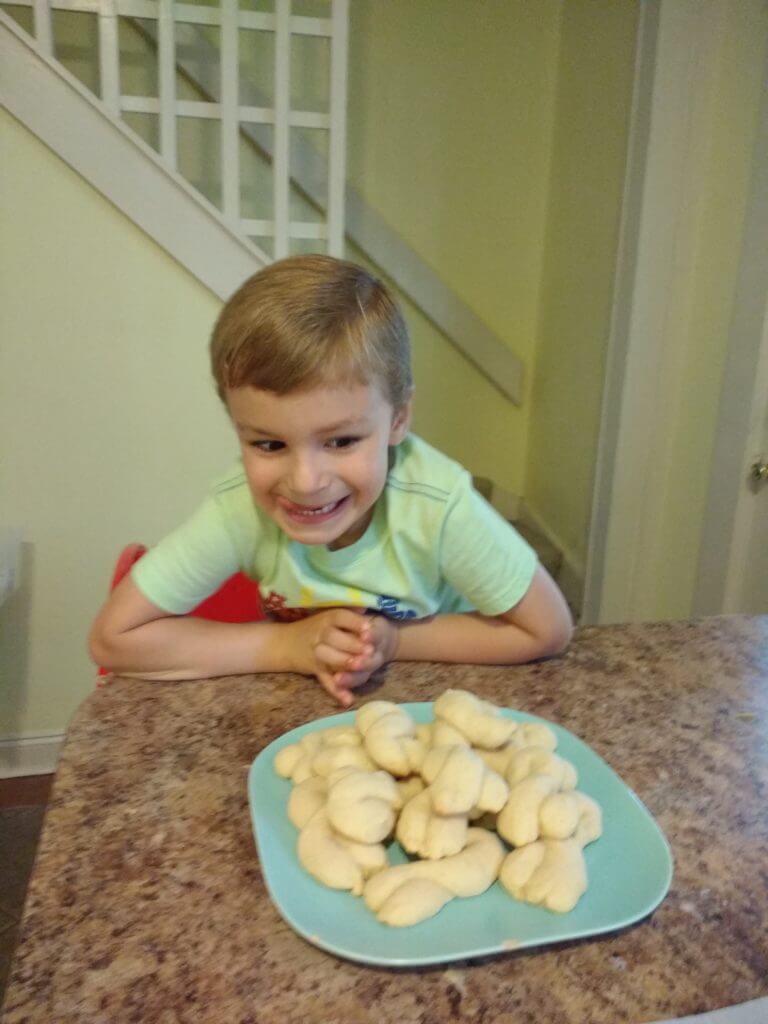
Our little eater is so picky that when I want to try a recipe from another country or culture, we almost always choose sweets. I thought he would especially enjoy making koulourakia (Easter cookies) because of getting to twist the dough.
Funny story about the recipe. I started off using a recipe in a children’s book (which shall remain nameless) about Greek food. As we were gathering ingredients, I thought was strange that the recipe didn’t include eggs. I should have known something was off when it also called for vegetable oil instead of butter.
It was only after the little guy had measured and mixed everything that I realized the recipe was not going to work. I sent my husband off to Google while I tried to clean my hands. Sure enough, every single koulourakia recipe he found included eggs. Time for take two of our cookie project!
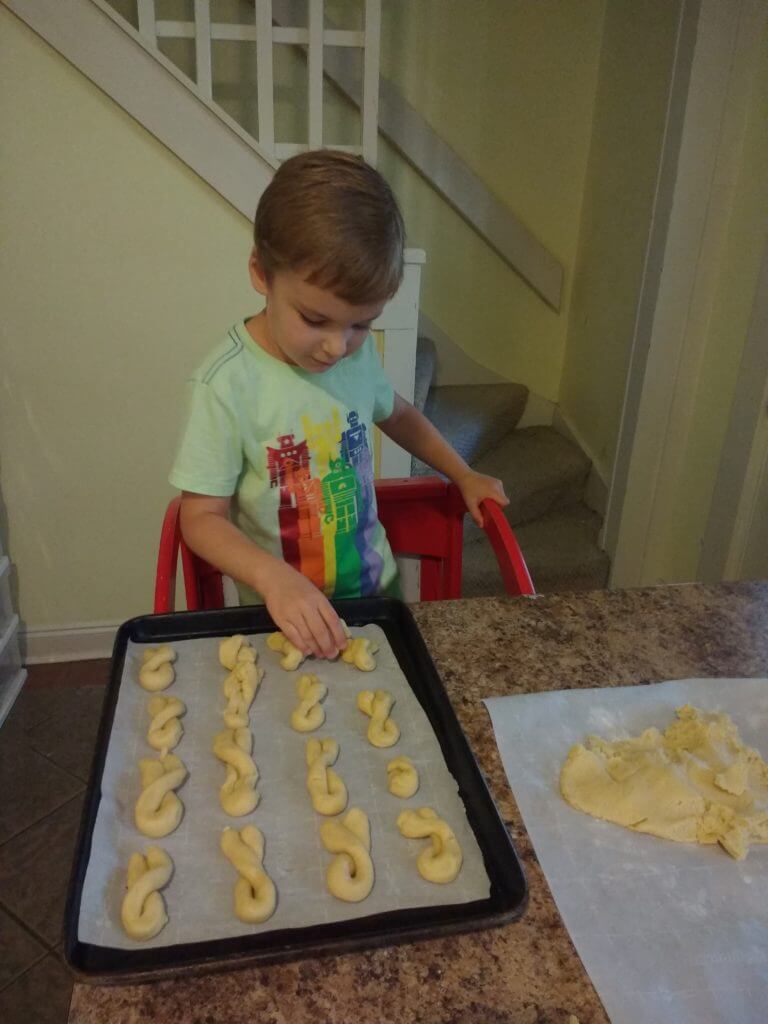
So, we ended up using this recipe, which turned out delicious. Our twists don’t look as nice as hers. I didn’t do the egg wash because I couldn’t find my pastry brush. But it really does make them look lovely, so if you’ve baking for company, don’t skip that step!
Interesting facts about Greece
- Family relationships are highly valued in Greece. Children often live with their parents in Greece, even after they’ve gotten married.
- The majority of Greeks now live in cities.
- The first Olympic games were held in Greece in 700 B.C. to honor Zeus, the king of the gods.
- There are thousands of islands that are part of Greece.
- In Greek culture, raising your hand and waving is generally considered very rude.
How to Learn More About Greece and Be a Friend to Greece
Find a Greek penpal
One of the best ways for children to learn more about Greece is to develop a relationship with another kid like them. Becky Morales from Kid World Citizen has a great post about safe ways to find a penpal for your child or your students.
Learn more about Greece with Little Passports: World Edition
My 5 year old is a huge fan of Little Passports, a monthly subscription service for kids focused on global learning. We receive the Early Explorers packages, which focus on themes, for younger children.
But we’ll soon be switching to the World Edition, which focuses on a different country each month for kids ages 6 – 10. One of the countries that’s included in the series is Greece.
After the first month (when kids receive their world map and suitcase), your child will receive souvenirs, activity sheets, photos, stickers for their map and suitcase, and access to more activities online.
Visit a Greek Orthodox church or attend a Greek Festival in your community
Eastern Orthodox churches are usually filled with beautiful icons of saints, making a visit a very visual experience for kids. If there is a Greek Orthodox church in your community, contact them to find out if there are times where it would be appropriate for you to visit. Many Greek churches also sponsor Greek heritage festivals. These are excellent opportunities to sample Greek food and learn about Greek culture.
Another way to learn more about the Eastern Orthodox faith through a child’s eyes is through the lovely picture book Catherine’s Pascha by Charlotte Riggle.
Be a friend to refugees living in Greece
Right now, approximately 62,000 refugees, most from Syria, Afghanistan, and Iraq, are living in Greece. With many other countries closing their borders, people fleeing violence remain stuck in Greece in temporary camps.
This story of two teenagers who bonded in a refugee camp over their love of dance could be a good way to introduce the refugee crisis to children. If your children are moved to do something, they could have a lemonade stand or donate their birthday to the International Rescue Commission or another organization working with refugees in Greece.
