
What kinds of things is a smart child able to do? If you surveyed people on the street, they might mention things like being able to read above grade level or figure out difficult math problems.
These basic subjects are a crucial part of learning. Increasingly though, educators and employers who are examining what it takes to succeed in our world are also talking about social and emotional skills as well.
This means a smart child is also able to empathize with others, and understand perspectives that are different from her own.
The official term for this is “social emotional learning,” and its a hot topic right now in the world of education.
As a parent, I’m interested in what I can do to help our son become “smart at heart” because it’s a crucial part of being human. It’s a bonus if it also prepares him for the 21st century workforce!


Copyright: pat138241 / 123RF Stock Photo
Disclosure: For your convenience this post contains affiliate links. If you purchase items through these links, I may earn a small commission at no additional cost to you. You can read my full disclosure policy here.
Our Favorite Games and Activities for Boosting Social and Emotional Learning
1. Create an “All About Me” Book
I know what you might be thinking. Aren’t we trying to help children learn to care about other people?
Yes, we are! But that has to start with children learning about and understanding themselves. An “All About Me” book is a good opportunity to talk about how we all have different preferences, families, appearances, and more.
2. Practice the Right Way to Say “I’m Sorry”
In my opinion, the best time to practice how to apologize is not when your child is in the middle of heated emotions. Try a time that’s calm and isn’t directed at something specific your child has done. For young children, role-playing with puppets or stuffed animals who’ve hurt each other’s feelings can work well.
Children (and many adults I might add) also need help understanding that the words “I’m sorry” don’t constitute an apology by themselves. Kids need help thinking through why they acted they way they did and what they can do to make the situation right.
I love this suggestion from Joellen at Cuppacocoa. Teach kids to apologize by saying:
I’m sorry for _______
This is wrong because _________
In the future, I will ____________
Will you forgive me?
3. Make Appreciation Cards
There are few things my 4 year old enjoys as much as sending and receiving mail!
A great way to introduce the idea of appreciation cards is for you to make one for your child telling her what you like about her. Ask if she’d like to make a card or two for someone else, telling that person what she appreciates about him.
4. Play “If You Really Knew Me”
Help children learn to listen with the “If You Really Knew Me” game, played in pairs.
Flip a coin or use some other method to decide who in the pair will talk first. Child A gets to talk about important things he wants Child B to know about himself for 60 seconds, while Child B listens silently. With young children you may want to shorten the time period. Then the roles are reversed and Child B talks about what is important to know about her for 60 seconds.
5. Identify Feelings in a Picture Book
The next time you’re reading a book with your child, pause when it’s appropriate and ask what your child thinks a character is feeling based on what the picture looks like.
It’s easy for us to forget this as adults, but young children need help learning to read facial expressions and understand emotions.
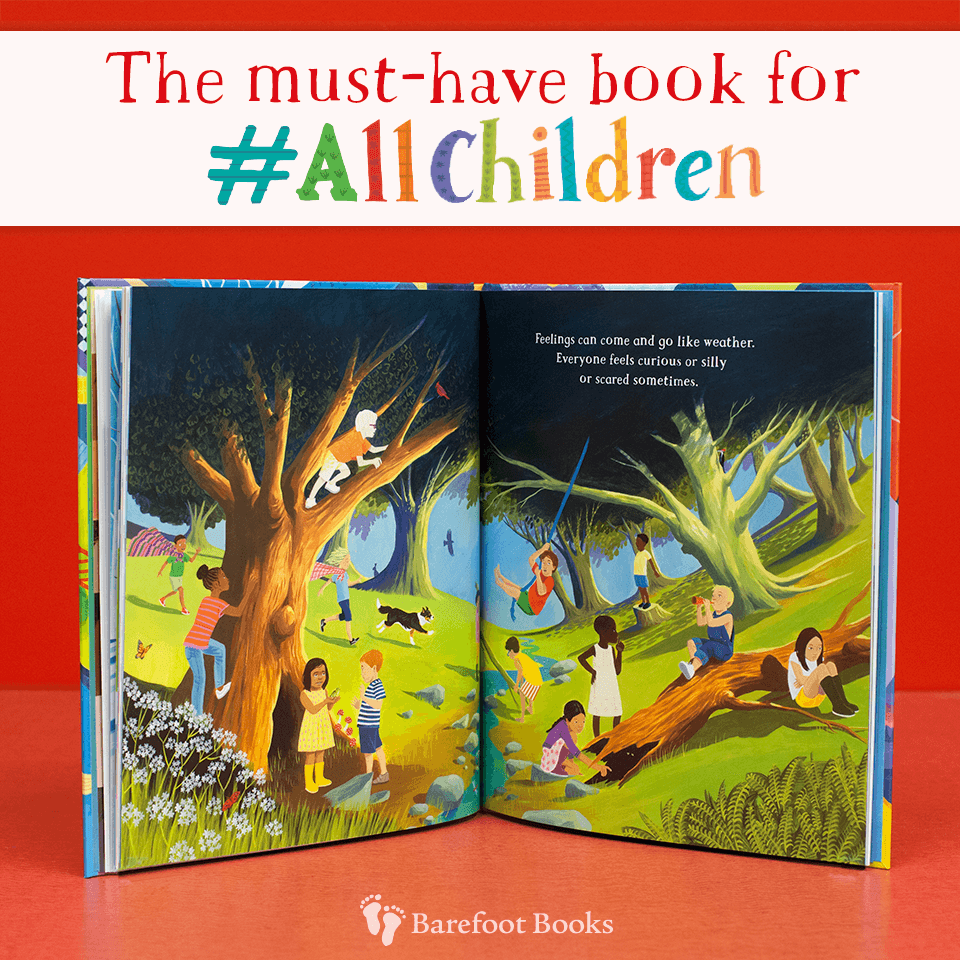
For two and three year olds, I recommend My Big Barefoot Book of Wonderful Words for this exercise. There is a page spread in the book of children making all kinds of faces with corresponding emotions written underneath. You can have your child guess a few of the feelings and then tell them what the others are.
For children ages 4+, The Barefoot Book of Children includes this more subtle spread on feelings.
6. Play “I Love Myself Because…”
The blog Kiddie Matters has a fun game for building children’s self-esteem. All you need is a square tissue box and her printable of fill in the blank sentences to paste on the tissue box.
Elementary aged-children can roll the tissue box die and fill in whatever sentence they land on. For example, one sentence says “I am great because…”
For preschool aged children, she recommends rolling the die and seeing what number it lands on. Then ask your child to say that same number of reasons he loves himself.
7. Make a Courage Book
Talk with your child about what helps her have courage when she is scared. For example, a nightlight to feel brave in the dark, or having a family member nearby.
Fold several sheets of paper together to make a small booklet and write down the ideas your child has shared. Invite her to illustrate the words. Ask her where she would like to keep her special courage book to remind her of things that can help her is scared.
8. Practice Cooperation with a Hula Hula Challenge
For elementary aged children (or older), invite kids to form a circle and hold hands. Place a hula hoop over two people’s interlocked hands. Tell the group that the object of the game is to pass the hula hoop entirely around the circle without breaking hands. Encourage everyone to cheer each others’ efforts on. When the game is over, talk about what worked well and what was challenging.
For preschool children, try the game first as each child simply passing the hula hoop over himself and handing it to the next child (without holding hands.) After doing this several times, try the variation of children holding hands as described above.
9. Make a Favorite Things Quilt
Provide your child with squares of construction paper of many different colors (make sure they are large enough for your child to draw a picture on.) Invite your child to draw pictures or write words of his favorite things. Show him how to tape or glue the pieces of patchwork together on the back to make a quilt.
10. Explore Mixed Emotions with a Color Your Feelings Chart
Creative Social Worker has several free printables available for this activity, including a “What’s in Your Heart?” printable and a “Color Your World” activity. Invite your child to write out a list of feelings in her life. These could be in general or related to a specific situation.
Ask your child to pick a color that goes with each of those feelings. Then fill in the picture/chart with colors to show how much of each emotion they are feeling.
What are your favorite activities for helping kids become “smart at heart?” Share in the comments!

4 responses to “10 Fun Activities To Help Kids Become Smart at Heart”
Hi there! I have some questions for you about becoming a Barefoot Books Ambassador, but I cannot find a contact page or email address for you on your website here. Can you email me? Thank you!
Hi Shannon I’d love to answer your questions! You can reach me at barefootinmemphis[at]gmail[dot]com
Such great ideas and perfect for creating a caring child #PracticalMondays
Thank you Fiona!