
Talking to children about justice issues is no easy task, but it’s such an important one. Reading and discussing picture books about social justice is a perfect way to start a conversation.
When I want to explain something that is unjust to our four year old, I often find myself reminding him of the books we have read. It makes it easier to unpack the real life situations he comes into contact with.
These stories also help me to explain why our family does the things we do to protest injustice and support human rights.
Today I’m sharing 15 of the best picture books about social justice, human rights, and the power of organizing against injustice.
Note: Originally, this post recommend the book Harvesting Hope: The Story of Cesar Chavez. I have removed this recommendation after relevations that Chavez sexually assaulated multiple girls and women.


Disclosure: For your convenience this post contains affiliate links. If you purchase items through these links, I may earn a small commission at no additional cost to you. You can read my full disclosure policy here.

Steamboat School by Deborah Hopkinson and Ron Husband
This fictional account is inspired by the real life of Reverend John Berry Meachum who established a school on a steamboat because of a law against educating Black children. Missouri passed a law in 1847, saying that neither enslaved or free Blacks could be taught to read or write. Because of this, Meachum moved his school onto a steamboat in the Mississippi River, which was federal property.
The story follows James, who begins attending Rev. Meachum’s first school (on land) before the law is passed. He is not enthusiastic about school at first. Yet when the school closes, he begins practicing reading and writing on his own. When the steamboat school is opened, he can’t wait to tell the other children.
The last line of the story is particularly powerful. James tells us “being brave can sometimes be a small thing, like lighting a candle, opening a book, or dipping an oar into still, deep water.” (Recommended for ages 5 – 10).
Related Post: 5 Young Activists Who Will Inspire Kids

“Amrita’s Tree” in The Barefoot Book of Earth Tales by Dawn Casey and Anne Wilson
This tale is based on a true story from the Bishnoi tribes of India. Amrita has a special tree in the forest where she daydreams, plays, and rests in peace. One day the peace is disturbed by the terrible sound of axes. The Maharajah’s woodcutters are cutting down the forest.
Amrita runs back to her village, determined to protect her tree. Amrita and her mother gather all the women and children of the village to confront the woodcutters. Amrita’s mother tells them that without these trees, their fields and homes will be washed away in the monsoon rains.
When no one will listen to their pleas, Amrita wraps her body around her special tree. Despite orders from their leader, the woodcutters cannot bring themselves to chop down the forest in the face of such resistance. (Recommended for ages 5 – 10).
Related Post: 18 thoughtful children’s books about the environment
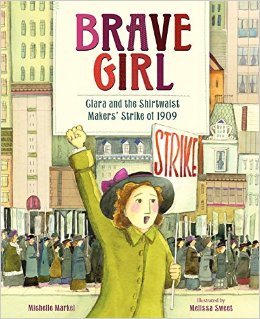
Brave Girl by Michelle Markel and Melissa Sweet
This biographical tale tells of how Clara Lemlich, an Ukranian immigrant to the United States, became a leader of New York City’s garment workers in the early 1900s. As a child Clara goes to work sewing clothes for just a few dollars a month because no one will hire her father.
Clara quickly becomes angry at the terrible treatment she and the other girls face. She hears from some of the men that they’ve been thinking of going on strike, but they don’t think the women are tough enough to participate.
Through tireless organizing that results in Clara being repeatedly fired, arrested, and even beaten, Clara shows just how brave girls can be. At a huge union meeting, when the men are cautious, it is Clara who stands up and calls for a general strike. (Recommended for ages 5 -9).
Related Post: 19 children’s books that challenge gender stereotypes
Teach kids about the history of the voting rights struggle – and that the struggle isn’t over yet!

Grandfather Gandhi by Arun Gandhi, Bethany Hegedus, and Evan Turk
There are other children’s books that deal more directly with Gandhi’s organizing for freedom and peace. I chose Grandfather Gandhi because it can give children insight into the inner work that must accompany work for justice and peace.
Written by one of Gandhi’s grandsons, Arun Gandhi, the book tells of when Arun arrived at Grandfather Gandhi’s ashram. Silence and peace seem to come easily to others, yet Arun repeatedly finds himself filled with anger. He thinks everyone else must be wondering “how could he, a Gandhi, be so easy to anger?”
After an incident on the soccer field in which he loses his temper, Arun runs to his grandfather and confesses his troubles. Grandfather tells him not to be ashamed, because we all feel anger. Grandfather explains to him how anger, like electricity, can be channeled for good or bad. Anger can be used to fuel the desire for lasting change. (Recommended for ages 5 – 10).
Related Post: Peace Education: The Montessori Way

La Frontera: El viaje con papá/My Journey with Papa by Deborah Mills, Alfredo Alva, and Claudia Navarro
This is a true story of how Alfredo Alva and his father immigrated from Mexico to the U.S without papers. We learn from Alfredo what life was like in his village when both his father and grandfather worked in the pine forest. But when his grandfather becomes too old to make the daily 5 mile trip to the forest, Alfredo and his brothers start to go hungry.
His father decides that he and Alfredo must go to America where he can earn more, while the other children will stay behind with his mother. During their journey, we not only experience their hardships. We also see how Alfredo’s father encourages him with warmth and humor through their difficult journey.
The book includes several pages of illustrated educational notes that help children explore important questions about why people immigrate and what their experiences are like. (Recommended for ages 6 – 12).
Related post: 11 illustrated collections of social justice poetry for children
Related Post: How to talk to kids about race – a guide for white parents

Passage to Freedom: The Sugihara Story by Ken Mochizuki and Dom Lee
This remarkable book tells the true story of Chiune Sugihara, a Japanese consul serving in Lithuania during World War II. With the encouragement of his wife and children, Sugihara disobeyed his superiors’ orders so that he could write thousands of visas for Jewish refugees fleeing Nazi violence.
The story is told from the perspective of 5 year old Hiroki (who also offers an afterword to the book.) Hiroki doesn’t understand why, one day, there are hundreds of people, including many children, standing outside their gate. When his mother explains that they need her father’s assistance or they may be killed, Hiroki pleads with his father to help.
Several times, his father asks his superiors to allow him to write visas for all the refugees, and he is refused. Chiune brings the entire family together to ask what he should do. When they are all in agreement that he must help them despite orders, he begins writing hundreds of visas, which eventually become thousands.
When the family is forced to leave Lithuania by train because of the Soviet takeover, little Hiroki sees crowds of refugees watching him, promising to never forget his father or what he has done. (Recommended for ages 7 – 12).
Related Post: 21 powerful books about race and racism for kids and teens

Separate Is Never Equal: Sylvia Mendez and Her Family’s Fight for Desegregation by Duncan Tonatiuh
While most Americans have heard of the Supreme Court case Brown v. Board of Education, far fewer of us know that a lawsuit by Sylvia Mendez’s family nearly a decade earlier paved the way for this historic decision.
When Sylvia’s family moved to Westminster, California, they were told that Sylvia and her brothers had to attend “the Mexican school,” not the one closest to them.
Sylvia begins attending Hoover Elementary (“the Mexican school”), which has no playground and where children must eat lunch on the ground outside next to a cattle field. Many of the teachers expect the children to drop out. Mr. Mendez knows this is not right, and begins organizing other Mexican-American parents who want change.
A truck driver connects Mr. Mendez with a lawyer who had helped force the integration of public pools in the area. When the lawsuit goes to court, Sylvia hears school officials tell lies, such as testimony that most children at the Mexican school are inferior academically and in other ways.
Though Sylvia is not called to testify, she’s ready to tell the truth. When the judge rules that school segregation is illegal, Sylvia is able to attend the local school. Though some of the children are mean to her, Sylvia remembers her mother’s advice to hold her head high, knowing what her family has fought for. (Recommended for ages 6 – 10).
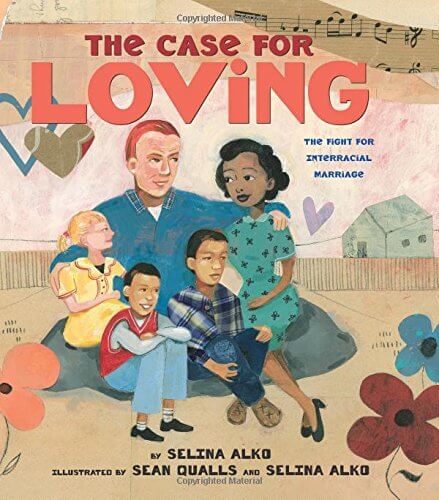
The Case for Loving: The Fight for Interracial Marriage by Selina Alko and Sean Qualls
Mildred Jeter and Richard Loving fell in love like many young couples do, and wanted to get married. But they lived in Virginia in 1958, where people of different races were not allowed to marry.
They crossed state lines to be married legally in Washington, D.C. Not long after they return to Virginia, police burst into their home in the middle of the night. Richard and Mildred were locked up in jail, because Virginia police don’t consider their marriage valid.
The Lovings moved to D.C., where they had three children. But they wanted to return home. So in 1966, in the midst of the civil rights movement, they filed a lawsuit. It went all the way to the Supreme Court, where a message from Richard was read: “Tell the Court I love my wife, and it is just unfair that I can’t live with her in Virginia.”
Their court victory paid for the way for the many multiracial couples who have married since. (Recommended for ages 4 – 8).
Related Post: 12 unsung social justice activists (and the children’s books that tell their stories)

Voice of Freedom: Fannie Lou Hammer, Spirit of the Civil Rights Movement by Carole Boston Weatherford and Ekua Holmes
Fannie Lou Hamer is one of the most inspiring and under-appreciated heroes of the Black Civil Rights Movement, so I was thrilled when Voice of Freedom was published. The book tells her life story in free form verse with stirring collage illustrations.
Hamer grew up in a sharecropping family in Mississippi, where she saw that race meant the difference between having enough and poverty. When she asks her mother why she isn’t white, so that she could have enough, her mother tells her that being Black is not bad. Her mother soon buys her a Black doll, telling her “if you respect yourself enough, other people will have to respect you.”
As an adult, Hamer was one of the first Black Mississippians to try to register to vote. After she failed the literacy test, she and her husband were evicted from their land and home. Hamer continued her work for voter registration, and became known for the spirituals she led at meetings and marches.
She continued her work even after she was brutally beaten and imprisoned, determined that she was “marching toward the Promised Land.” When her Mississippi Democratic Freedom Party was denied seating at the national Democratic convention, Hamer made sure that the delegation didn’t give in to deals aimed to silence them. (Recommended for ages 8 – 12).
Related Post: 18 Children’s Books about Poverty and Hunger

Si, Se Puede! Yes, We Can! Janitor’s Strike in L.A. by Diana Cohn and Francisco Delgado
Carlitos’ mama is one of the many hard-working janitors who clean the tall glass office buildings of Los Angeles at night. One day, his mother sits him down to explain that she can’t take care of him and his grandmother like she wants too. That’s because even after her work as a janitor, and her weekend work cleaning houses, her wages are too little for basic necessities.
That’s why his mother is joining with other janitors to go on strike. Carlitos wants to help his mother, but he’s not sure how. At school, he discovers that there are other children whose parents are on strike. He has an idea that he shares with his teacher. Together his class makes signs for those who are on strike.
Carlitos is proud to surprise his mother with his sign: “I love my Mama! She is a janitor!” (Recommended for ages 3 – 7).
Related Post: Worker Rights Reads: Best Children’s Books to Read on Labor Day

Dreams of Freedom in Words and Pictures, Amnesty International UK
A variety of artists collaborated on this picture book which shares illuminating quotes about human rights. Nobel Peace Prize winner Aung San Suu Kyi writes that “the only real prison is fear, and the only real freedom is freedom from fear…” Illustrator Alexis Deacon accompanies the quote with a picture of a brave but cautious mouse moving forward in a forest full of unfriendly faces.
On another page, Armando Valladares, who was a prisoner of conscience, writes that “wings will grow some day. On my wheelchair I will be able to fly over parks carpeted with children and violets.” Ros Asquith has brought the quote to life with a striking picture of a man in a wheelchair with boldly colored, enormous wings.
The book provides children with many different examples of what freedom means, with quotes from heroes including Anne Frank, Nelson Mandela, the Dalai Lama, Malala Yousafzai, and more. (Recommended for ages 4 – 10).
Related Post: Teaching about Native Americans in Preschool and Kindergarten: Do’s and Don’ts

A Is For Activist by Innosanto Nagara
A Is For Activist is a delightfully unusual alphabet book, introducing children to words like abolitionist, co-op, environmental justice, feminist, trans, and union. While the justice and human rights issues the book points to are quite serious, the book also has a playful tone. Its rhymes and examples of things children will love (like the demand for healthy hot dogs) keep the book from becoming too heavy. There is also a cat hidden on each page, adding an interactive element. (Recommended for ages 2 – 6).
Related Post: 11 anti-bias and social justice podcasts for kids

Swimmy by Leo Lionni
On the surface, Swimmy is a book about a plucky little fish. It’s also a story that can teach children the power of organizing together against injustice.
Swimmy is the lone black fish in a school of happy little red fish. One day, a fierce tuna swallows the entire school. Swimmy is the only fish who escapes. Though Swimmy is scared and sad as he swims alone, he soon discovers many amazing sea creatures.
So when he happens along another school of fish just like the one he lost, he wants them to come and play and “SEE things!” with him. The red fish protest that the big fish will eat them.
In a sudden brainstorm, Swimmy realizes that they can all swim in a formation together that will make them look like a big fish. The red fish form the body, and Swimmy is the fish’s black eye. Their plan works, and they chase the big fish away as they explore the sea. (Recommended for ages 3 – 6).
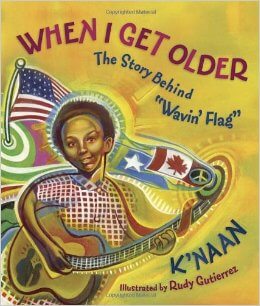
When I Get Older: The Story Behind “Wavin’ Flag” by K’Naan and Rudy Gutierrez
In When I Get Older, poet, rapper and singer-songwritter K’Naan shares how he came to write the now world famous song “Wavin’ Flag,” starting in his home of Somalia. While many Westerners are only familiar with the heartbreaking war in Somalia, K’Naan describes Mogadishu as “a city that was like a sparkling jewel.”
When war breaks out, his grandfather, a famous poet, helps him write a poem to comfort himself: “When I get older, I will be stronger. They’ll call me freedom, just like a waving flag.” When he must flee the violence with his siblings and mother, but without his grandfather, his grandfather reminds him that “poems will be your courage.”
Being a refugee in Canada is difficult and confusing, but K’Naan meets other children at his school who also had to leave their homes far behind. When the teacher announces that the class must sing a song in front of the entire school, K’Naan offers his grandfather’s poem. “I wasn’t afraid anymore,” he writes. “Grandfather was right. Music had made me safe.” (Recommended for ages 5 – 9).
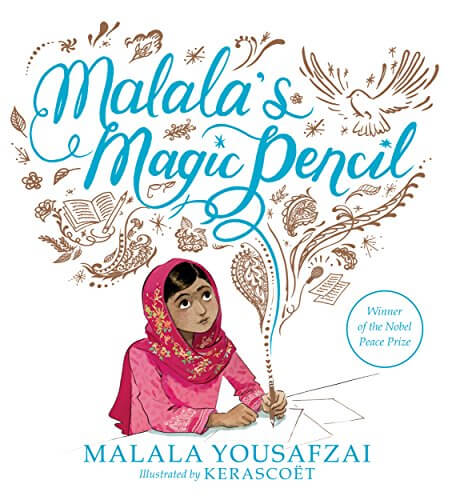
Malala’s Magic Pencil by Malala Yousafzai and Kerascoet
Malala Yousafzai tells her own true story of fighting for girl’s education in Pakistan and around the world.
As a young girl in Pakistan, Malala wished for a magic pencil that give her an extra hour of sleep or create a lock on her bedroom door. When she learned that many girls like her could not go to school in her country, her wishes changed and she discovered the power of writing with an ordinary pencil. (Recommended for ages 4 – 10)
What are your favorite children’s books about social justice and human rights? Share in the comments!
Shop this list of children’s books about social justice and human rights on Bookshop.org. Your purchase supports independent bookstores!

3 responses to “15 Picture Books about Social Justice and Human Rights”
GREAT list on a super timely topic. Shared to Pinterest and Twitter. Stopping by from the CMS linky up 🙂
Thank you so much for sharing Becky! These books certainly gave me a lot to reflect on as I participated in the Women’s March this weekend.
Awesome post.