
As someone who tries to live in alignment with social justice values, I spend a lot of time thinking about money. I also think a lot about what it means to parent for social justice. Lately, I’ve been reflecting on how I can do more to teach my kids about money in a consumer society with a growing gap between rich and poor people.
Our older son has graduated college and is looking for his first professional job. Our younger son has reached an age where everything he wants is a pricey video game or gaming system. It feels like “now or never” time to go deeper in teaching them about money that’s driven by our values.
If you’re a social justice parent who wants to teach your kids about money, try these four practices I’ve learned about from other parents and our own family’s experience.


This post may include affiliate links. If you purchase items through these links, I may earn a small commission at no additional charge to you. You can read my full disclosure policy here.
1. Design your allowance system to teach children your values around money
Many parents are unsure about how to set up an allowance system for their children. They wonder about what age to start, how much they should give kids, and how often the allowance should be distributed. These are important questions to think about, but even more important is a bigger question. What do you want your children to learn about money through receiving and spending an allowance?
Last year, I attended an excellent workshop led by Graeme Seabrook at the online Parenting Decolonized conference. Graeme shared so many ideas about parenting with economic justice and feminism in mind. I particularly appreciated her approach to her children’s allowance.
Graeme chooses not to tie her kids’ allowance to chores. The children do chores, but she and her partner communicate often that this is because “everyone in this family takes care of each other.”

(We used to tie our younger son’s allowance to chores, but we stopped a while ago. I noticed that our old approach it led to a lot of resentment and arguing. It also led to my husband and I threatening to take away his allowance, which communicated to our kiddo that money is about other people having power over him. Not a value I want to teach him!)
Related Post: Do’s and Don’ts for Community Service Projects with Kids
Graeme instead gives her kids an allowance because she believes that everyone should have the money they need to live, and money that they can choose how to spend. She also gives an allowance so that her kids can understand how money works at the larger level.
When Graeme’s kids receive their allowances, they know that they must sub-divide it into four jars: spending, special, savings, and community. Spending is everyday items. Special is a larger goal a child is saving up for, like an expensive Lego kit. Savings is for a long term goal many years away. Community is what most folks would think of as charity. The children get to decide how to sub-divide their allowance, as long as something goes into each jar.
I’m planning to adopt this allowance approach soon with our younger son. For a while, I tried telling him he had to divide his money into categories of spend, save, and give. But because I was dictating how much, the system had little meaning to him. I’m eager to see whether letting him have more say will shift his perspective.
2. Model conscious consumerism for your kids by being intentional about which businesses you patronize
In her new book Raising Antiracist Children: A Practical Parenting Guide, Britt Hawthorne includes a section on conscious consumerism. Her family has chosen to be deliberate about spending money with Black-owned, People of Color-owned, women-owned, immigrant-owned, disabled-owned, queer-owned, and neighborhood businesses.
So much of what we teach kids about money is indirect. They watch how and where we spend our money. They absorb whether we follow the consumerist trends of the dominant culture, buying what is cheapest and fastest from large corporations, or whether we shop with our community and people who are marginalized in mind.
As a Montessori educator, Britt also does an excellent job of using questions that spark discussion, rather than lecture, to teach her kids about money. During the early pandemic they stopped at a big box store to get some essential supplies. When one of her children asked for a snow globe, Britt asked him a lot of questions. First she asked if the store they were in was Black-owned. After he answered that, she asked if the store was a local business.
Related Post: Using the Montessori approach to child development to raise antiracist kids at every age
Once he answered those questions, he wanted to know why those things mattered. Britt was able to use his curiosity to talk about how the pandemic had the greatest impact on Black-owned businesses, followed closely by Latine and Asian-owned businesses. “The decision to support businesses owned by people of the global majority was to center those most impacted by the pandemic,” Britt writes. This discussion helped her child understand so much more than a simple “no” to the snow globe would have.
Britt’s book has a number of guides and prompts activities and actions to teach kids about money and the economy; I highly recommend it!

3. Let your children see you freely recirculating your money, goods, and skills with others in your community
Right now I’m participating in a remarkable course on “abundance culture” in the My Reflection Matters Village. Our facilitator, Vanessa Molano, reminds us that money is meant to be circulated, and communities thrive when we live by that principle. When we have less than we need, we should be able to ask without shame. When we have more than we need, we should give without pride or fear over whether we’ll have enough.
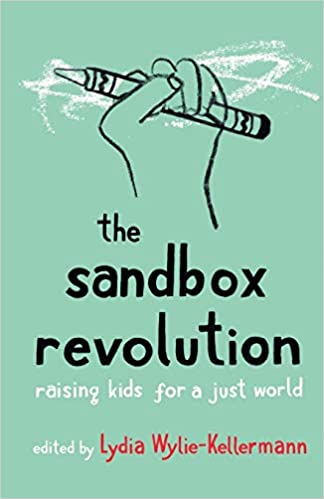
I was reminded us of this when I was reading an essay by Susan Taylor in the book The Sandbox Revolution: Raising Kids for a Just World. Susan asks:
“Are we who have more than enough willing to actively redistribute from our surplus? Or go even deeper and redistribute what we feel we need? Are we in community with people whose economic lives look different from ours, not as “helpers” and “receivers” but as co-creators of an economy with enough for all? An economy that lives within Earth’s limits? An economy of justice, rooted in genuine peace?”
When our children see us sharing our gifts of time and money with others, and asking for the help we need, they learn that “all flourishing is mutual.” (This is my new favorite phrase and one of the guiding principles behind the book Braiding Sweetgrass by Robin Wall Kimmerer.)
This may sounds idealistic and theoretical to you, so let me give one practical example. During the early months of the pandemic, I impulsively bought a sewing maching, thinking that I’d start sewing masks. This was an especially bad idea because: 1) I hadn’t used a sewing machine in 26 years and 2) I was already stressed and overwhelmed.
You can probably guess that I never used the sewing machine. Two years later, it still sat in its box. A request popped up in our local Buy Nothing group. A mother of five children who had recently arrived in our city as a refugee wanted a sewing machine to make clothes for her kids.
Related post: 10 multicultural children’s books about generosity
Giving her the sewing machine was an easy decision for me. But when our younger son saw I was giving it away, he was reluctant. I shared with him who would be receiving it, and how much more she could use it than us.
I assured him that if either of us decided to learn to sew, my mother could help us on her machine. Eventually, we could get our own if either of us developed our sewing skills. But at this moment, the sewing machine was surplus that we didn’t need, and someone else could put it to use right away. Once the machine was out of the house, he promptly forgot about his interest in sewing.
4. Practice media literacy skills to help kids perceive consumerist messages in advertising
Kids are a marketers’ dream (which makes advertising a nightmare for social justice parents.) If we don’t address marketing in its many forms, we’re leaving out a crucial piece of teaching kids about money.
While it takes time and practice to see through the ways advertising messages exploit us, parents can help kids start developing these skills with questions.
I suggest starting with ads that are not for something your child wants so that you can introduce the skill without a power struggle. Later, you can use the questions below to also look at ads and product placements for things that your child does want.
Have conversations with your kids sparked by questions like:
- What is the ad saying this product will do?
- Does the product meet a want or a need?
- Are there other ways you could meet that want or need without spending money?
- How do you think the person who made the ad wants you to feel?
- Did you feel that way before you watched the ad?
- What evidence is there that you should trust what the advertiser is saying?
- Is the ad trying to make you feel bad about your body or someone else’s body?
Staying silent about money doesn’t serve our kids
No matter what practices you are using now or in the future to teach kids about money, I hope you’ll remember one important thing. Avoiding talking about money does not serve our kids, and it doesn’t serve our communities.
Kids are exposed to the dominant culture’s values about money through so many sources. They need to hear about justice-rooted approaches to money, and experience real-life examples, in order to even know that another way of relating to money is possible.
