
Tomorrow is the 101st anniversary of the Tulsa Race Massacre. Whether you’re a parent or an educator, talking to children about hard history is, well, hard. Yet, as our children grow older, it’s important that they know this history happened.
Today’s post is about something that I used to neglect when I talked to my younger son about hard history. It’s crucial that as we teach about traumatic events, we uplift the many ways folks engaged in resistance to the injustice they faced.
While I’ll be discussing the Tulsa Race Massacre in particular, know that centering oppressed people’s resistance to injustice is important anytime we talk about racism, transphobia, sexism, ableism, and more.


This post may include affiliate links. If you purchase items through these links, I may earn a small commission at no additional charge to you. You can read my full disclosure policy here.
Children’s books that guided our discussion of the Tulsa Race Massacre
In talking about the Tulsa Race Massacre with my 10 year old, I used two picture books.
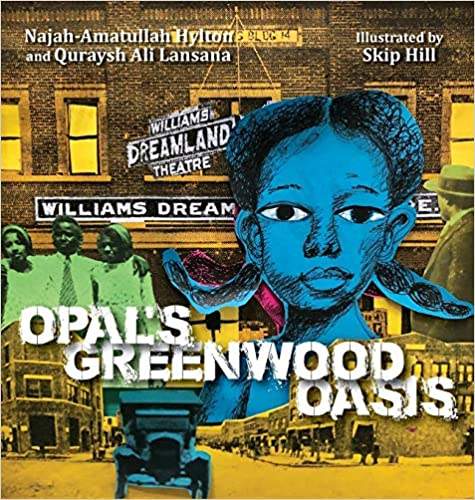
First, we read Opal’s Greenwood Oasis, which focuses on the sense of safety, closeness, and pride that came from living in a neighborhood where Black people were able to get everything they needed from each other. While the book hints at the event that sparked the massacre, it doesn’t discuss it directly. This makes it a good choice for younger or more sensitive children. I recommend it for ages 6 – 10.
Purchase Opal’s Greenwood Oasis from Bookshop.org (supports independent bookstores)

Then, we read Unspeakable: The Tulsa Race Massacre, which is also a Caldecott Honor Book. The first half of the book uses the phrase “once upon a time in Greenwood,” to tell the story of how Greenwood came to be. Striking illustrations show the elegance of people walking down Black Wall Street and the pride of people standing by their homes and churches.
The second half of Unspeakable addresses the events of the massacre, and the ways the residents of Greenwood resisted this horrific attack.
I recommend Unspeakable for children ages 8 – 12. Educators can find a guide to teaching the book here.
Purchase Unspeakable from Bookshop.org (supports independent bookstores)
I also read through this excellent article by the author of Opal’s Greenwood Oasis to deepen my understanding of the history of the neighborhood.
Why it’s crucial to uplift resistance to injustice when teaching about traumatic events
Too often when adults talk to children about history like enslavement or Jim Crow segregation, we use a white perspective. Black people and other people of color are painted simply as victims. This feeds a sense of superiority in white children, and feelings of inferiority or embarrassment in children of color.
The truth is that people of color and other marginalized groups have always found ways to resist the injustices heaped on them by society.
When we center that resistance, we tell the truth to children. We present people from history in their full humanity. We show kids that they do not have to ignore injustice that exists today.
I’ve learned so much about this by participating in the My Reflection Matters Village, a BIPOC-led community for liberation-minded classroom and home educators. Founder Chemay Morales-James recently shared one of the practices she uses in her family to talk about traumatic events.
“For every difficult racial story you discuss,” Chemay wrote, “always start and end with two affirming or liberatory stories. I believe every difficult story needs more than double of the opposite energy to counterbalance the emotional impact it has on a person…
I like to think the 2-1-2 approach helps to avoid BIPOC youth from internalizing inferior ideas about themselves and white youth from internalizing ideas of superiority. The 2-1-2 rule allows you to have a real conversation about difficult events affecting our communities while giving space for young people to imagine brighter possibilities.”
Related Post: 15 picture books filled with Black joy
Six ways to point to resistance to injustice (using the Tulsa Race Massacre as an example)
Marginalized groups creating safe spaces is a form of resistance
The Greenwood neighborhood of Tulsa was created for Black people by Black people. Some were descendants of Black Indians; others arrived as “Exodusters.” As Black businesses cropped up on Greenwood Ave., they attracted even more. Soon the street was called by the nickname “Black Wall Street” because it was bursting with entrepreneurs.
In Opal’s Greenwood Oasis, Opal describes all the things that her neighborhood has. Then she remarks, “it might surprise you to know that everyone looks like me.”
While reading the book, I asked my white 10-year-old son how he thought Opal felt in Greenwood. He said he didn’t know, and then wondered if she felt nervous or scared. When I dug deeper I discovered this is because he’s used to learning about all the ways that African-Americans faced danger. It took some more discussion for him to understand that the Greenwood neighborhood made Opal feel safe, because everyone looked out for each other.
Cultural pride is a form of resistance to injustice
One of my favorite pages in Unspeakable shows finely dressed men and women walking down Greenwood Avenue with their heads held high. The text reads “there were also several libraries, a hospital, a post office, and a separate school system, where some say Black children got a better education than whites.”
While segregation laws may have led to Greenwood being all-Black, it’s clear that the residents view being an all-Black community as a strength, not a deficit.
Related post: Why social justice education starts with self-love
In Opal’s Greenwood Oasis, she tells us that some of the mothers wash and cut hair at Madam CJ’s. This gave me an opportunity to talk with my son about Madame CJ Walker’s impact on African-American women, and why her story is such a point of pride.
Self-defense as a form of resistance
The typical approach to teaching Black history, especially by white parents and educators, is to focus primarily on Dr. Martin Luther King, Jr. This usually involves watering down his message of non-violent resistance to imply he wanted people to be doormats.
In 1921, the residents of Greenwood were out-gunned and outnumbered by the white mob, aided by police, that attacked them and set their neighborhood on fire. This doesn’t mean that they didn’t take every measure they could to defend themselves.
Indeed, when a newspaper headline indicated that a young Black man would be lynched, thirty residents of Greenwood marched to the jail to rescue him. They selflessly risked being attacked themselves to protect a young man and the larger community.
Related Resource: Anti-Bias Children’s Book Calendar
Rebuilding as a form of resistance to injustice
While some of Greenwood residents lost everything and did not return to Tulsa, others stayed to rebuild and recover their neighborhood. While white intimidation had changed the community forever, it didn’t lead to the death of the neighborhood.
In the 1960s, urban renewal and other factors caused the neighborhood to decline again. Decades later, the neighborhood was rebuilt once more.
Truth-telling as a form of resistance
Floyd Cooper, Unspeakable‘s illustrator, wrote that growing up in Tulsa, few people talked about the massacre. Everything he knew about the event came from his grandfather. “Not a single teacher at school ever spoke of it,” he wrote in a note at the back of the book.
There’s now evidence that police and government officials in Tulsa aided the white mob that attacked Greenwood. So, it’s not surprising that for many years, local government did everything it could to hide this history.
When the event was discussed, it was usually called the “Tulsa Race Riot.” Many African-Americans pushed for it to instead be called a massacre. Cooper points out that the word “riot” is used to blame people for the injustice that was carried out against them. Calling it a riot also meant that insurance companies didn’t have to pay for damaged homes and businesses.
At the closing of Unspeakable, we see an image of Tulsa’s Reconciliation Park. The park is rooted in truth-telling, because there can be no reconciliation if people don’t first face the truth.
