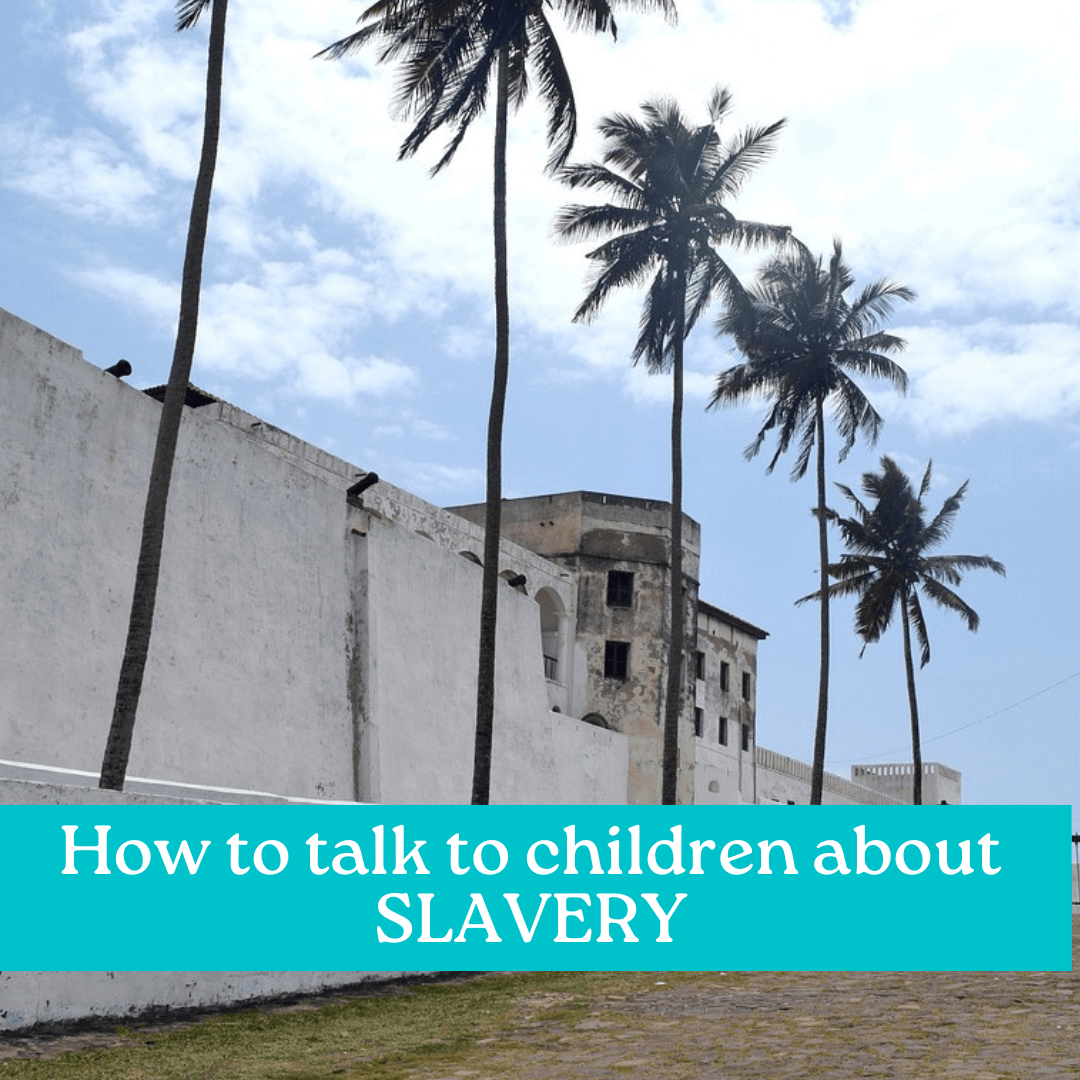
Are you a parent or educator concerned about social justice? Then you’ve probably wondered about how to talk to children about slavery, a painful and complicated topic.
At what age should we start the conversation? What steps should we take to prepare before we talk with children about slavery?
What factors make these talks different if we have them at home versus in a classroom?
In this post you’ll find tips for when and how to have these conversations, approaches to avoid, and a list of recommended books to help you talk about slavery with elementary aged children.
Table of contents
- Questions to answer before you begin talking with children about slavery
- Tips and resources for talking with children about enslavement
- Recommended children’s books about slavery for elementary learners


Disclosure: For your convenience, this post contains affiliate links. If you purchase items through these links, I may earn a small commission at no additional cost to you. I received a free copy of I Lay My Stitches Down from the publisher in exchange for my honest reivew. All opinions are my own. You can read my full disclosure policy here.
Questions to answer before you talk with children about slavery
How much time have we spent talking about race in general?
Slavery is a complicated, painful subject that is best introduced after you’ve had plenty of other conversations about race, skin tone, physical differences, and prejudice.
Start having those conversations now, if you’re not already having them in your home or classroom.
And make sure that White kids understand race and skin tone are something that all of us have, not just People of Color. These kinds of conversations help children develop a positive identity for themselves and respect for others.
Resources:
How to talk to White children about race resource guide
Language matters: When discussing racism makes Kids of Color feel ashamed
Mega List of Anti-Racism Resources for Parents and Teachers
Teaching Young Children about Race: A Guide for Parents and Teachers
What have I taught my children (or students) about Africa and Black history so far?
Sadly, in many U.S. classrooms the first time students hear any mention of Africa is during lessons on slavery. This contributes to stereotypes and negative images about African cultures and histories.
Make sure that you are regularly reading books set in African countries and learning about African cultural traditions, art, and history (including pre-colonial history) before you start talking about slavery.
Resources:
African history resources for kids
Engaging children’s books by African authors
5 Websites that teach African history
Similarly, children need to learn about Black leaders and Black history throughout the year, including Black history that’s about topics beyond oppression.
(This also seems like a good time to point out that slavery is American history. It is White history just as much as it is Black history, and should be taught as such.)
Especially if you’re a White educator, think about the embarrassment Black students might feel if the first mention in the classroom of Black experiences is slavery.
Think about the stereotypes White and other non-Black students could develop about their Black peers if you don’t lay a foundation about Black history first before discussing slavery.
Resources:
Children’s books about Black scientists and inventors
Engaging chapter books about Black history
Best Children’s Books about Black Women Leaders
Black History: More than Slavery and Civil Rights
How old are my children (or students)?
I am not an educator, and I think about this issue primarily as a parent.
But Teaching for Change, a source I trust greatly, provides several cautions for attempting to teach preschoolers about enslavement. In a helpful article, anti-bias educators Louise Derman-Sparks and Julie Olsen Edwards offer questions for educators and parents of preschoolers to think about.
Preschool age children can’t really make distinctions between the recent past (yesterday) and 150 years ago.
So in depth conversations about enslavement run the risk of confusing very young children. Especially in a classroom, where there’s less opportunity for children to talk one-on-one with an adult about what they’re feeling, there’s a risk of traumatizing very young children.
There’s also the danger that parents and educators of young children will over-simplify or sugercoat the experience of enslavement.
For example, the picture book A Birthday Cake for George Washington (NOT recommended) caused an uproar among justice-minded educators and parents. The book portrayed a happy “servant” named Hercules who’s honored to get to make a cake for the President.
By the early elementary years (1st or 2nd grade), children are more likely to be developmentally ready to talk about slavery. By middle school, youth can have in-depth discussions that examine the far-reaching role slavery played in the United States’ economy and society.
Resource: It’s Not So Black and White by Dr. Beverly Daniel Tatum
That said, as a parent you know best what your child is ready for. It’s also important to answer young children’s questions honestly when they ask them.
I did mention slavery to my son when he was about 4 years old, and we read at least one picture book about the Underground Railroad when he was a preschooler. I don’t think this experience harmed him, but I’m also not sure it had much positive lasting impact.
Your child’s age, personality, and the racial makeup of your family will likely influence when you decide to have a first conversation about slavery.
I appreciated parent Tanith Rice-Harris’ approach of answering her 4 year old son’s basic questions about slavery without going into details that could frighten him.

Tips and Resources for Talking with Children about Slavery
Educate yourself
Chances are, what you learned in school about the system of slavery was incomplete and inaccurate. Teaching Tolerance has provided an excellent framework for teaching about U.S. slavery in middle and high school.
If you’re the parent of an elementary aged child, I recommend reading through the framework and using some of the short resources to educate yourself.
Now, you won’t be able to share some of this complex info with a 7 year old. But reading it helps ensure that you understand how slavery operated, what resistance looked like, and how enslavement’s impact still lingers today.
Additional Resources to Educate Yourself
The African Americans: Many Rivers to Cross by Henry Louis Gates, Jr.
Incidents in the Life of a Slave Girl by Harriet Jacobs
Runaway Slaves: Rebels on the Plantation by John Hope Franklin and Loren Schweninger
Think about the language you use
I’m still working on this myself, but whenever possible, talk about “enslaved people” rather than just saying “slaves.” If you feel like your child won’t understand that, you could say “people who were made slaves.”
Why does this language matter? It does two things. First, it emphasizes the humanity and free spirit of people who suffered through enslavement.
Secondly, it reminds us that slavery didn’t happen by accident. For there to be people who were enslaved, there had to be people (and systems) who put them into slavery and kept them there.
You’ll likely be talking to elementary children about heroes like Harriet Tubman, Sojourner Truth, or Frederick Douglas at some point during the school year.
As you do, you can remind kids that even though these brave individuals were enslaved, in their hearts and minds, they knew they were supposed to be free.
Related Post: Talking about microaggressions with kids
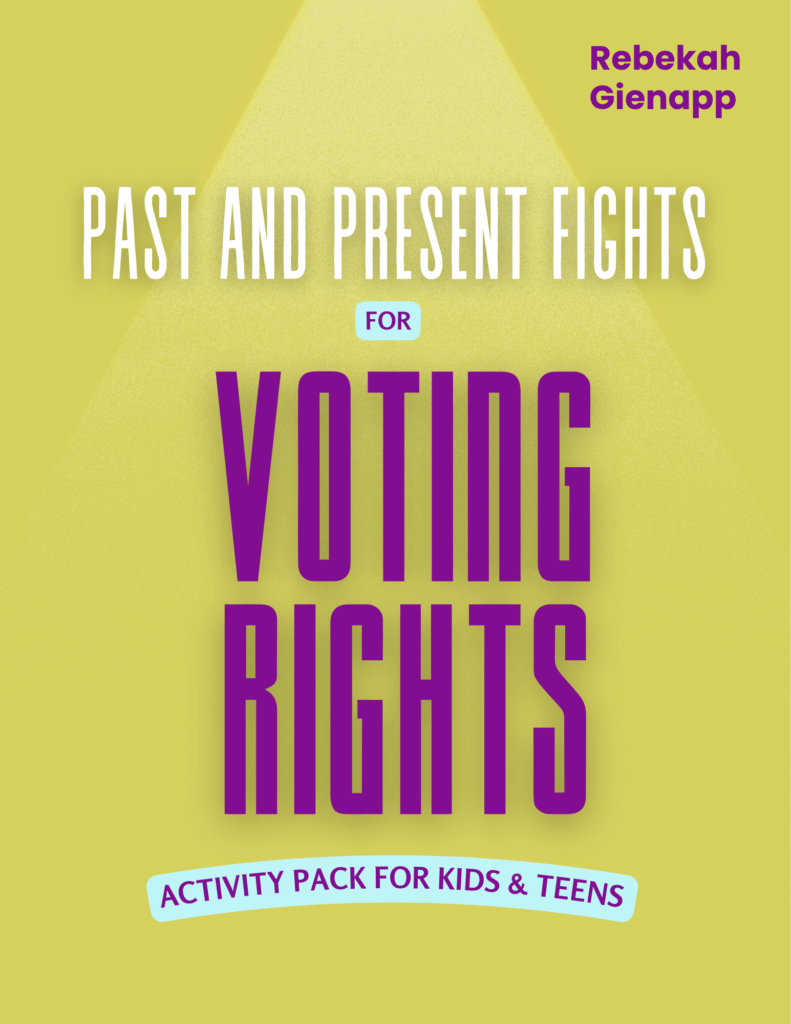
Teach young people about the history of the voting rights struggle – and that the struggle isn’t over yet!
Emphasize resistance to enslavement
It’s easy for kids to fall into “might makes right” type thinking. This can lead kids to make all kinds of wrong assumptions.
They might think that some slave owners “treated their slaves like family.” (I’m so angry that some historical sites that receive taxpayer funds are teaching this lie to children.
Children might also think that enslaved people just accepted the abuse that was heaped on them. We can prevent this misunderstanding by teaching kids about the widespread ways that enslaved people resisted and attempted to escape slavery.
Dr. Beverly Daniel Tatum encourages educators and parents to tell children about ways Africans resisted their victimization. She also recommends giving “concrete examples” of how some Black resisters found support from White allies.
Related Resource: How to uplift resistance to injustice when we teach about hard history
Dr. Tatum recommends the picture book Aunt Harriet’s Underground Railroad In the Sky for this purpose.
Faith Ringgold’s moving picture book shows brave enslaved people taking great risks. It shows both White people who enslaved them and White people who were hosts on the Underground Railroad. This helps communicate to kids that working against racism can be part of what it means to be a White person.
At the same time, White parents and educators have to be careful not to exaggerate the role that White allies played. We should emphasize the leadership of free Blacks in the abolitionist movement.
For older elementary children, it’s important to acknowledge that some White abolitionists didn’t fully support the rights of Black men and women. The book Stamped (for Kids) by Ibram X. Kendi, Jason Reynolds, and Sonya Cherry-Paul can help you have this conversation.
Take time to talk about feelings
Let children know that you understand they may feel angry, sad, or upset as you talk about enslavement. Share how you’re feeling, whether that’s angry, guilty, or something else. This gives children permission to talk about discomfort, guilt, shame, or sadness that they may be feeling during your conversation. Kwame Alexander’s book An American Story can support these kinds of conversations.
Related Post: 7 inspiring ways that kid activists are challenging racism
Approach simulations with caution
Some educators feel like simulations where children pretend to go through experiences that enslaved people had can help children empathize with their plight.
But there’s a big risk that children, especially Black children, can be traumatized by these simulations. And unless those who lead the simulations are highly trained and experienced, it’s easy to reinforce stereotypes.
Resource:
Classroom Simulations: Proceed with Caution
Carefully select books to help you talk with children about slavery

I recommend the following books to encourage conversations about slavery at home or in the classroom. Keep in mind that many of these books may not be appropriate to read to preschool aged children; be sure to preview them before reading to young children.
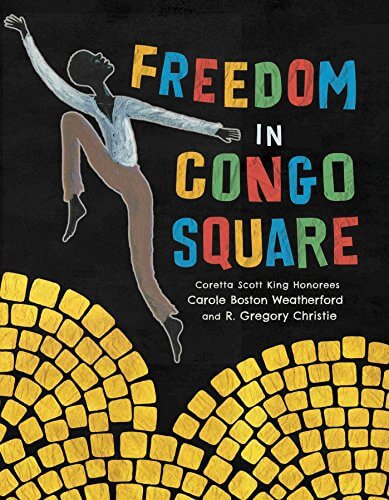
Freedom in Congo Square by Carole Boston Weatherford and R. Gregory Christie
Find on Bookshop (supports independent bookstores)
As a French, and later, Spanish colony, Sundays in New Orleans were considered a day of rest, even for enslaved people. By 1817, there was only one place in the city that enslaved and free Blacks were permitted to gather on that day: Congo Square.
Carole Boston Weatherford’s poetic book tells children of how through the six days of cruel work, people’s hearts longed for Congo Square. When Sunday arrived, the park’s air filled with the sights and sounds of African music, news, dance, in a world apart that was “freedom’s heart.” (Recommended for ages 6+. Black author.)
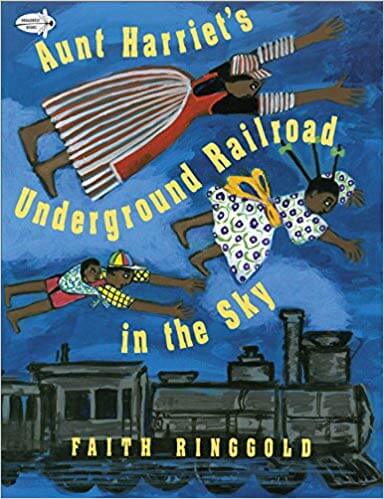
Aunt Harriet’s Underground Railroad in the Sky by Faith Ringgold
Find on Bookshop (supports independent bookstores)
When young Cassie’s brother Bebe hops onto a train flying through the sky, Cassie panics. The conductor of the train, Harriet Tubman, introduces herself. She tells Cassie that not once did she lose a passenger as she carried hundreds of people to freedom.
Now, every 100 years, the old train follows the route of the Underground Railroad, so that no one will forget what freedom cost. Along the route, Cassie sees the dangers that are possible, but also the courage of those who sought their freedom, and the kindness that some strangers offer. (Recommended for ages 7+. Black author.)

William Still and His Freedom Stories: The Father of the Underground Railroad by Don Tate
Purchase from Bookshop (supports independent bookstores)
Young William Still grew up hearing about the life of enslavement his parents had escaped. They were haunted by the children who couldn’t escape with them, and as an adult Still decided to work for the abolitionist cause. His pioneering work of collecting enslaved peoples’ stories helped countless families find their long missing relatives. (Recommended for ages 6 – 10. Black author.)
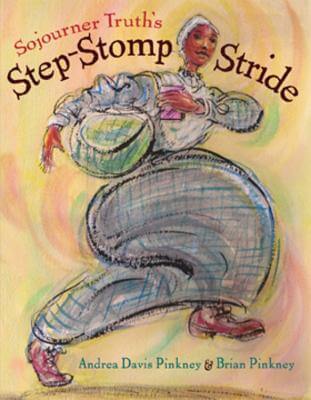
Sojourner Truth’s Step-Stomp Stride by Andrea Davis Pinkney. Illustrated by Brian Pinkney.
Purchase from Bookshop.org (supports independent bookstores)
The Pinkneys bring Sojourner Truth to life for children as a brave woman “meant for speaking. Meant for preaching. Meant for teaching the truth about freedom. Big. Black. Beautiful. True. That was Sojourner.”
As children learn her life story, it’s clear that Sojourner’s physical strength, great as it was, was outshown by her mental and spiritual strength in the face of a society that wanted to confine Black women to narrow, small spaces. (Recommended for ages 7+. Black author.)
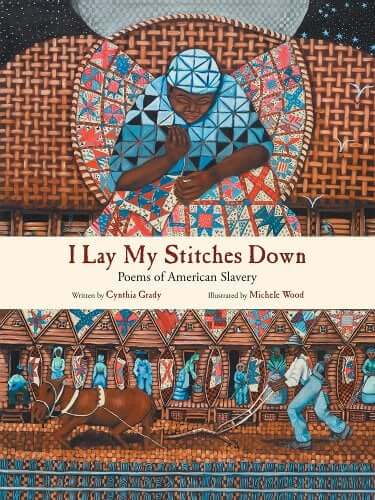
I Lay My Stitches Down: Poems of American Slavery by Cynthia Grady. Illustrated by Michele Wood.
Purchase from Bookshop.org (supports independent bookstores)
Drawing on the quilting traditions of enslaved women, each poem in this unique volume is named after a traditional quilt pattern. Some of the ten line poems shed light on the backbreaking labor and severe hardships enslaved people endured, while others focus on the often-secret but powerful ways they resisted against their enslavers. Grady has added notes that explain the historical, musical, and spiritual references made in the poems.
Wood’s intricate illustrations are stunning renditions of quilt blocks that bring the poems and the history behind them to life. They merit close study by readers, both to appreciate their beauty and to find details that may go unnoticed at first glance. (Recommended for ages 8 – 12. White author.)
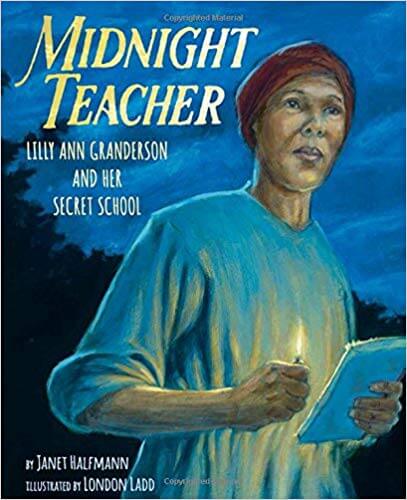
Midnight Teacher: Lilly Ann Granderson and Her Secret School by Janet Halfmann and London Ladd
Find on Bookshop (supports independent bookstores)
During slavery, it was against the law for enslaved people in Mississippi to learn to read. Lilly Ann Graderson, an enslaved person herself, knew how powerful a tool literacy could be. After all, she’d taught herself to read as a child.
As a teenager, she read in a newspaper that there were places in the North where slavery had been abolished. Freedom was possible.
Granderson knew that she risked being whipped 39 times if she was caught teaching. Still, she knew she must teach other enslaved people to read and write. She carefully planned a secret, midnight school where she taught 12 students at a time. Many of those she taught went on to teach others. (Recommended for ages 8+. White author.)
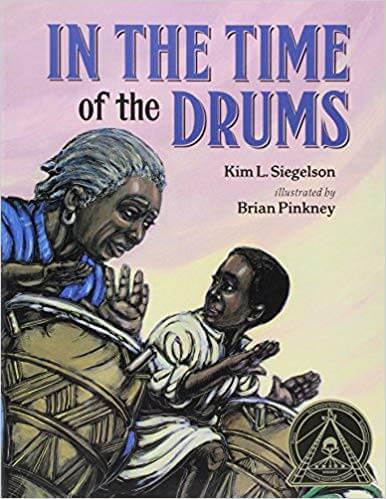
In the Time of Drums by Kim L. Siegelson and Brian Pinkney
Find on Bookshop (supports independent bookstores)
“Takes a mighty strength not to forget who you are. Where you come from. To help others remember it, too.” This is the message that Grandmother Twi, an enslaved woman who has not forgotten Africa, has for young Mentu.
Twi does all she can to prepare Mentu for the time he will need to be “strong strong,” including teaching him ancient Igbo songs. One day when a slave ship arrives carrying people from Benin in chains, Twi hears an undeniable call to seek her freedom. (Recommended for ages 8+. White author.)
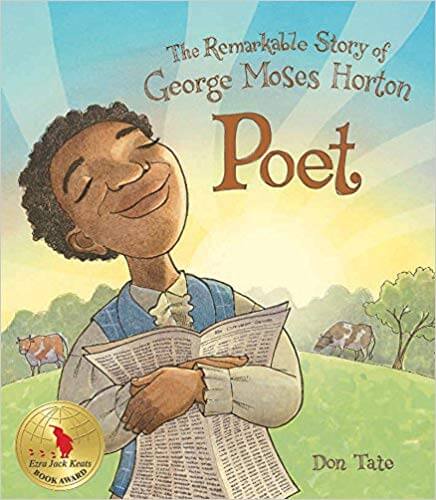
Poet: The Remarkable Story of George Moses Horton by Don Tate
Find on Bookshop (supports independent bookstores)
George Moses Horton was the first Black writer in the South to be published, and Don Tate’s powerful biography tells his unusual story. When Horton taught himself to read, he quickly fell in love with poetry. As a young man, he frequently had to travel to the University of North Carolina campus to sell his enslaver’s produce.
It was there that he began reciting his poetry. Though the college students made fun of him at first, once they heard his poetry, many were awestruck. Horton began selling his love poems to students, allowing him to make money of his own. But he still was not free. Even when he became a full-time writer (paying his enslaver for his time), he still could not purchase his freedom. How will he realize his dream? (Recommended for ages 8+. Black author.)
(Teachers, be sure to consult the resources at the end of the book, including where to find Horton’s poetry online.)

Pink and Say by Patricia Polacco
Find on Bookshop (supports independent bookstores)
This moving and heartbreaking book tells a story that has been handed down for generations in Polacco’s family. Her ancestor, Sheldon Russell Curtis was a young White Union soldier who was rescued by a Black Union soldier named Pinkus Aylee.
While Pink is eager to return to the battlefield so that he can fight “the sickness” of slavery, Say has run away because he’s scared to die in battle. Pink agrees to hide them in his home until Say gets better. But Pink knows he’s putting his mother at risk of violence from roving marauders.
As he heals, Say learns more about what life has been like for Pink under slavery. When Say admits that he wishes he knew how to read like Pink, Pink promises to teach him one day. Both of the young men are captured, and Pink never gets to make good on his promise. Though Say suffers as a prisoner of war, Pink was killed right away because he was Black.
Polacco ends the book by asking readers to say the name of Pinkus Aylee and remember him always, since he has no living descendants to do that for him. (Recommended for ages 8+. White author.)
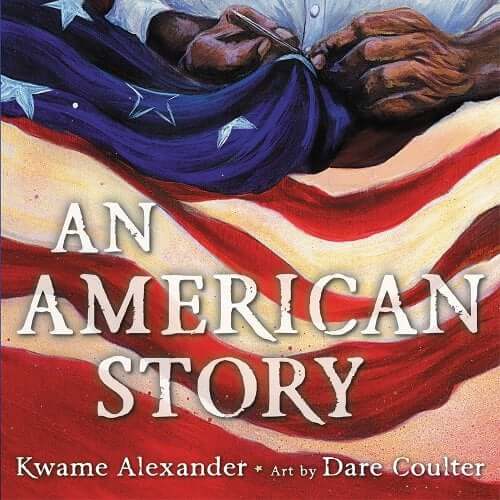
An American Story by Kwame Alexander. Illustrated by Dare Coulter.
Purchase from Bookshop.org (supports independent bookstores)
With thoughtful, poetic questions and gripping acrylic and clay sculpture illustrations, An American Story addresses the pain, anger, and frustration a group of present-day children and their teacher experience as they grapple with the legacy of slavery. As Ms. Simmons tries to convey the terror, loss, and despair that enslaved people experienced, while also paying tribute to their strength and pride, she becomes uncertain if she can continue the story that she began.
While this book is challenging, it’s the most moving story I’ve encountered for grappling with the pain that arises from learning about enslavement. (Recommended for ages 9+. Black author.)
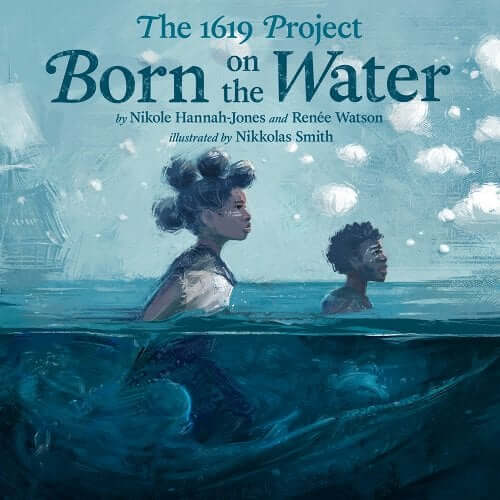
The 1619 Project: Born on the Water by Nikole Hannah-Jones and Renée Watson. Illustrated by Nikkolas Smith.
Purchase from Bookshop.org (supports independent bookstores)
Born on the Water opens with a young Black girl who is frustrated by her school assignment to trace her family’s ethnic roots. When she tells her grandmother that she’s ashamed by how little she knows. Grandma is ready to tell her about the rich and powerful history of the Kingdom of Ndongo.
After she has set this important foundation, she tells her granddaughter about the treacherous journey her ancestors were forced to make to America. Despite the horrors, “people planted dreams and hope, willed themselves to keep living, living…” Finally, Grandma tells her about her ancestor William Tucker, a “child of the new people formed on the water.” (Recommended for ages 9+. Black authors.)

Box: Henry Brown Mails Himself to Freedom by Carole Boston Weatherford. Illustrated by Michele Wood.
Purchase from Bookshop.org (supports independent bookstores)
Celebrated poet Carole Boston Weatherford brings her signature touch to the true story of Henry Brown, who wrote the story of his life after he mailed himself to freedom in Philadelphia in a large wooden box. After years of paying his wife’s enslaver not to sell her, Brown tragically lost his wife and children. Once he didn’t know where his family was, he felt he had nothing left to lose as he took such a huge risk. (Recommended for ages 10+. Black author.)
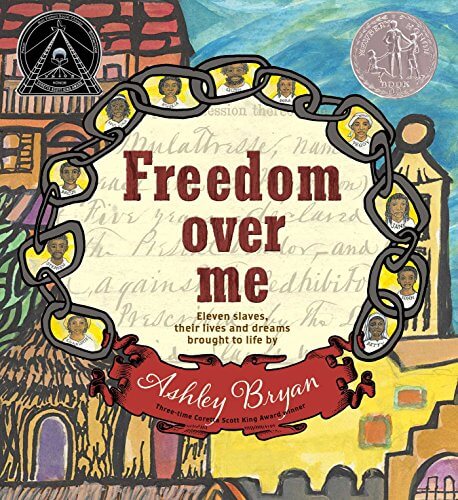
Freedom Over Me by Ashley Bryan
Find on Bookshop (supports independent bookstores)
In this unusual book, poet Ashley Bryan imagines the lives and dreams of eleven real enslaved people who were placed at auction when their plantation owner died. Each person’s story is told in one poem, followed by another poem describing their dreams.
Many of them speak of the talents, stories, and family details that they keep secret from the plantation owners. As Athelia writes “as slaves, we do what our owners expect and demand of us. As human beings, our real lives are our precious secret.” (Recommended for ages 10+. Black author.)

Eliza’s Freedom Road: An Underground Railroad Diary by Jerdine Nolen
Find on Bookshop (supports independent bookstores)
When young Eliza’s mother is sold away, she’s left with only her mother’s stories and her quilt to remember her by. Abbey the cook looks after Eliza as best she can. When Eliza overhears the Master say that she may be traded in a slave auction, she knows she must try to escape.
She follows the advice of Old Joe on how to find a safe house, so that Harriet can help her find her way to freedom. As she makes the journey from slavery to freedom, she keeps a diary that will open children’s eyes to the risks and hopes that pursuing freedom brought. (Recommended for ages 10+. Black author.)

Biddy Mason Speaks Up by Arisa White and Laura Atkins. Illustrations by Laura Freeman.
Purchase from Bookshop.org (supports independent bookstores)
This unique book brings the story of Bridget “Biddy” Mason to life through a combination of poems and historical artifacts related to her life and the larger history of enslavement in the United States. Historians know that Mason, a midwife, herbalist, and enslaved woman, won her freedom when her enslavers attempt to move her from California back to a slave state. However, as the authors point out, “the record we call ‘history’ does not tell everyone’s story,” so much of the details of Mason’s life had to be imagined.
Not only will young readers learn about Mason’s fight for freedom, they will also understand the value of her specialized skills and the role that people in the free Black community played in her life. This is an excellent book to use in the classroom and homeschool settings. (Recommended for ages 11+. Black author – Arisa White and White author – Laura Atkins.)
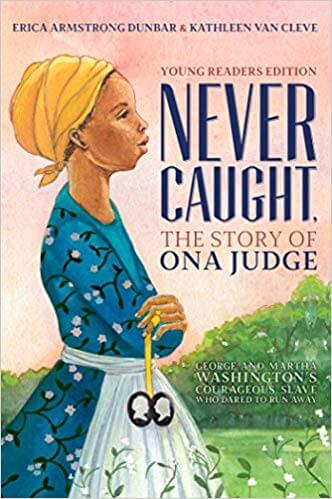
Never Caught: The Story of Ona Judge (Young Readers Edition) by Erica Armstrong Dunbar and Kathleen Van Cleve
Find on Bookshop (supports independent bookstores)
More than 50 years before Harriet Tubman escaped slavery, and years before the Underground Railroad began, Ona Judge did something remarkable. This enslaved young woman, who was First Lady Martha Washington’s personal attendant, escaped to freedom.
Even after President Washington sent associates to find her in New Hampshire, Judge calmly told one that “I am free now and choose to remain so.” Judge then temporarily went into hiding to protect herself and her infant daughter from being captured.
This outstanding book not only tells middle school readers Judge’s courageous story. It also clearly explains the national debate over slavery as the United States began, and how that debate was changing. This book also adds much needed complexity to how the story of President Washington is usually told to students. (Recommended for ages 11+. Black author.)

2 responses to “How should we talk with children about slavery?”
Thanks so much for including my book, “Midnight Teacher: Lilly Ann Granderson and Her Secret School,” as a resource for talking with kids about slavery. I am so honored to have had the opportunity to share the story of this brave and dedicated teacher with the world!
Thank you for writing such an important book Janet!