
I have vivid memories of reading The Little House on the Prairie series over and over as a child. We had been gifted a hardback set from a church member that I treasured. I was intrigued by the stories shared in the books, and how different Laura and Mary’s lives were from my own.
As an adult though, I decided not to read the Little House books to my son. I remembered the distinctly racist depictions of Indigenous people in the book. Someone else reminded me that in one book Pa puts on blackface. Finally, the repeated “pull yourself up by your own bootstraps” messages in the books trouble me, with their emphasis on rugged individualism over community.
Want to help children understand what life was like for many different groups of people in the United States as the country expanded west? These engaging books are great alternatives to the Little House series, and most of them are by authors of color.


Disclosure: Disclosure: For your convenience, this post includes affiliate links. If you purchase items through these links, I may earn a small commission at no additional cost to you. I received a free copy of One Big Open Sky from the publisher in exchange for my honest review. All opinions are my own. You can read my full disclosure policy here.
Best middle grade series to read instead of Little House on the Prairie: The Birchbark House series by Louise Erdrich.

Many people have heard of or read the first book in this series, The Birchbark House. But if you haven’t read the other books, you are missing out! Louise Erdrich based these on her own family history. The books begin in her family’s Ojibwe homeland on what is today called Madeleine Island in Lake Superior, and the other books gradually take the family west into the Great Plains. I’m including a short description of each book, which can either be read on their own or in the series order. All of the books are recommended for ages 8 – 12. Ojibwe author.
The Birchbark House (1847)
The first part of the book is a great introduction of what Ojibwe life was like in the early 1800s, before growing numbers of white settlers pushed Anishinaabe communities out of their homelands. Eight-year-old Omakayas helps her family prepare for the changing seasons, each of which involves a variety of work that will sustain them throughout the year. But when smallpox arrives, life changes forever for Omakayas and her family.
The Game of Silence (1850)
When a group of distant relatives stumble into Omakayas’ community, her family learns that chimookomanag (white people) are pressing closer to their homelands and want the Ojibwe to move west. While the families in her village continue fishing, ricing, hunting, and building canoes, they must also decide what to do about the growing threat to their way of life.
The Porcupine Year (1852)
At age twelve, Omakayas is on the verge of entering womanhood. Early on in the book, her family decides it will be best for them to head north to find a new place to live among Omakayas’ mother’s family. When a family member betrays them, they lose almost all their possessions just as winter is setting in. Like all the books in the series, this one blends humorous incidents children will delight in with serious issues that will invite them to think.
Chickadee (1866)
Omakayas is now an adult and the mother of twin sons, Chickadee and Makoons. When Chickadee is kidnapped by an unscrupulous (and ridiculous) pair of brothers, their entire extended family travels west in search of him. As the family spends months in what is today called North Dakota, life on the plains is very different from what they are used to.
Makoons
As the story opens, Makoons is struggling to recover from the deep illness he fell into while Chickadee was kidnapped. Now that he is safely with his family, Chickadee does all he can to entertain and help his brother heal. Makoons tells Chickadee of a vision he had, that his family will not leave the plains but instead learn how to make a new life there.
Related post: Eight middle grade books by Native American authors
Stand-alone chapter books that are great alternatives to The Little House on the Prairie
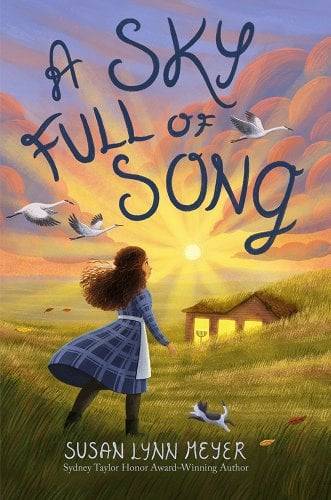
A Sky Full of Song by Susan Lynn Meyer (1905)
Purchase from Bookshop.org (supports independent bookstores and my business!)
Shoshana’s Papa and older brother left Ukraine for the American prairie nearly three years ago. Now that the antisemitic violence of the Russian pogroms has become stronger, Mama has decided it’s time for the family’s four girls and her to make their home in North Dakota as well.
There are so many changes to get used to in their new home. First, there’s life in the cramped dirt-packed dugout home that will have to do until they can afford lumber for a wood house. Second, Shoshana must figure out how to make friends at school and speak English at the same time. The family’s nearest Jewish neighbors live many miles away, and they likely won’t see them until the high holidays.
As Shoshana and her older sister Libke discover that their new classmates’ attitudes about Jews range from “friendly” pressure to convert to Christianity to hateful stereotypes, the two sisters have different responses. Libke is determined not to betray her religious and cultural traditions, while Shoshana wonders if she should try to fit in more by minimizing how she’s different. Soon the sisters aren’t speaking to each other, even as Shoshana needs her sister most. (Recommended for ages 10 – 14. Jewish author.)

One Big Open Sky by Lesa Cline-Ransome (1879)
Purchase from Bookshop.org (supports independent bookstores and my business!)
This moving novel-in-verse brings Black women’s voices to the forefront of the story of Exodusters, Black families who moved from the South to the Midwest in search of land they could call their own.
Letty and her family live in southern Mississippi, and her father Thomas has decided the only way they will ever be able to have land they own (not work for a White man), is by heading to Nebraska. Letty doesn’t want to leave her home and her best friend, and her mother Sylvia is devastated to leave her own family.
Still, Thomas is determined, and the family is soon part of a small wagon train of other Black families who share their goal. The journey is harrowing, with the threat of danger from disease, wildlife, and possible attacks by White people. Because there’s so little room in the wagon, most of the family must walk the twenty or so miles a day.
Most of the poems are written in Letty’s voice, with a smaller number from Sylvia’s perspective. A third character, a single woman who needs to get to Nebraska to become a teacher, voices some of the poems. There is so much to be learned from the story about both Black experiences generally and Black women’s experiences particularly. (Recommended for ages 10 – 14. Black author.)
Related post: 12 engaging chapter books about Black history
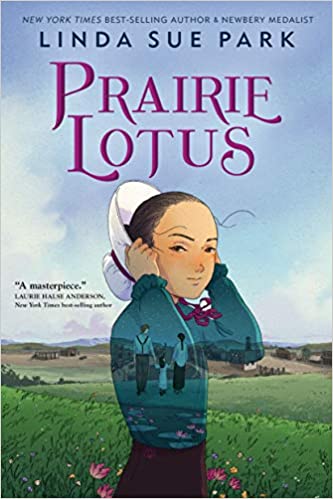
Prairie Lotus by Linda Sue Park (1880)
Purchase from Bookshop.org (supports independent bookstores and my business!)
When Hanna and her father arrive in Dakota Territory, they’ve been traveling for a long time by covered wagon. Ever since Mama died a few years back, Papa has been searching for a new home for them. Often, because of the racist hostility Hanna faces for being half-Chinese, they’ve had to move on.
But perhaps here in LaForge, Hanna can finally attend school, make at least one friend, and realize her dream of becoming a dressmaker. Her father is gruff and protective, wanting to shield Hanna from the troubles her mother faced. While Hanna knows that she’ll always have to deal with racism, she also knows that Mama told her to fight unfairness where she could. (Recommended for ages 8 – 12. Korean-American author.)
Related post: 34 children’s books about Asian American and Pacific Islander heritage

Riding Freedom by Pam Muñoz Ryan. Illustrated by Brian Selznick. (1820s to 1870s)
Purchase from Bookshop.org (supports independent bookstores and my business!)
This fictional account is based on the real life of Charlotte “Charley” Parkhurst, a legendary stagecoach driver who disguised herself as a man. Charley was also the first woman to vote in a U.S. presidential election.
Children who love horses or fiercely determined characters will be drawn to this account of Charley’s life. Muñoz Ryan doesn’t shy away from how harsh Charley’s early life in an orphanage was. After the orphanage owner forbids Charley from working in the stables, she runs away with the help of Vern, the formerly enslaved stable master.
Once she’s on her own, Charley convinces the owner of a small stagecoach company to let her work for him. He sees her potential to do more than care for the horses, and takes Charley under his wing. (Recommended for ages 8 – 12. Mexican-European-American author.)
Related post: 31 children’s books for Women’s History Month

In the Footsteps of Crazy Horse by Joseph Marshall III (alternates between present day and 1850s – 1870s)
Purchase from Bookshop.org (supports independent bookstores and my business!)
Both white and Lakota classmates alike tease Jimmy McLean. With blue eyes and light brown hair, others question whether he’s really Lakota. Jimmy’s grandfather tells him that there was once a great Lakota leader who also had brown hair and light skin: Crazy Horse. Grandpa suggests that they take a journey this summer, to visit all the important places where Crazy Horse made history.
Along their road trip, Grandpa shares stories about Crazy Horse from the Lakota oral tradition that help Jimmy understand his history and himself in news ways. Marshall doesn’t sugarcoat the violence of this history, but he also tells these stories in a way that’s appropriate for tweens and teens. (Recommended for ages 10 – 14. Sicangu Lakota author.)

The Prairie Thief by Melissa Wiley. (1882)
Purchase from Bookshop.org (supports independent bookstores and my business!)
If you’d like to mix a bit of magic into your historical fiction, The Prairie Thief is the pioneer era book for you!
When cranky neighbors Mr. and Mrs. Smirch show up and accuse Louisa’s Pa of stealing from them, Pa is shocked by their accusations. After digging around, the Smirches find each missing object in a remote building on Pa’s property, but Louisa and Pa have no idea how this happened.
Pa is soon hauled off to jail and Louisa is forced to live with the abusive neighbors who’ve falsely accused her father. When another young girl who lives with the Smirches (but isn’t their daughter) starts talking about seeing a strange little man on the farm, Louisa assumes she’s just making up stories.
Could it be that is wasn’t just people like Pa who immigrated from Scotland, but some of the wee folk as well? Determined Louisa is soon trying to track down the little brownie so she can find out what he knows, all while trying to free her Pa and avoid Mrs. Smirch’s abuse. (Recommended for ages 8 – 12. White author.)
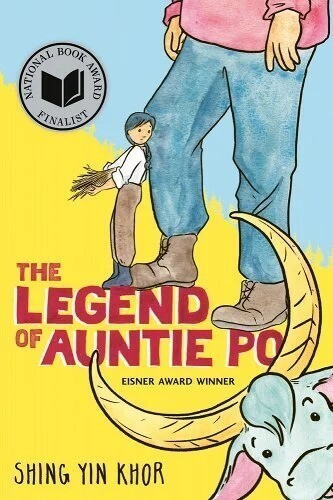
The Legend of Auntie Po by Shing Yin Khor (1885)
Purchase from Bookshop.org (supports independent bookstores and my business!)
In this unique graphic novel, Mei spends much of her time making pies for the logging camp where her father Hao is the highly skilled head chef for all the workers, both White and Chinese. In the evenings, she often entertains the children of the camp with her imaginative stories.
When the racist effects of the Chinese Exclusion Act begin to afffect life in the camp, Mei begins telling stories about Auntie Po, whose strength exceeds that of Paul Bunyan. As she tells stories about how Auntie Po will protect them, Mei starts to actually see the god she has created in the camp.
When a dangerous logjam happens, will Auntie Po be able to save them all? (Recommended for ages 10 – 14. (Recommended for ages 10 – 14. Queer Malaysian-Chinese-American author.)
Related post: 12 diverse and inclusive graphic novels for ages 7 – 12.

Paul Bunyan: The Invention of an American Legend by Noah Van Sciver, Marlena Myles, Lee Francis IV, and Deondre Smiles. (1914)
Purchase from Bookshop.org (supports independent bookstores and my business!)
This short graphic novel and accompanying essays pairs nicely with both The Legend of Auntie Po and Chickadee.
Paul Bunyan and his blue ox Babe are beloved characters to many Americans, but few people know they were invented as an advertising ploy for lumber companies that were rapidly clearing forests from the Midwest to the West.
The graphic novel takes place in 1914 Minnesota on a train. When the train breaks down, people begin gathering around to tell stories about famous lumberjacks. When an advertising executive begins telling tales of Paul Bunyan, many in the crowd are entertained. But a couple of people who’ve seen the harm logging has done to Minnesota call his tales hogwash.
Essays and art by Indigenous writers after the story help young people understand the larger historical context of the displacement of Native American nations and the harms that large scale logging caused. (Recommended for ages 10 – 14. White and Indigenous authors.)
