
I try to pay close attention to conversations about race in our culture (though I don’t always succeed!) In the past year or so, I’ve heard the phrase white fragility being used a lot. I knew that it had something to do with why it’s hard for white people to talk about racism.
It seemed like something I needed to learn more about, as a white person on an anti-racist journey, and as a parent. White fragility was probably having an impact on my experiences as a parent. It was time to understand how it affects me and my kids.
Disclosure: For your convenience, this post contains affiliate links. If you purchase items through these links, I earn a small commission at no additional cost to you. You can read my full disclosure policy here.
I made the time to read White Fragility: Why It’s So Hard for White People to Talk about Racism by Robin Di’Angelo. I highly recommend her book for white folks who want to understand the role we play in maintaining racism. Di’Angelo breaks down how we do this not just as a group, but through our individual behaviors.
Her book has given me a lot to work on in many different areas of my life. In this post, I’ll be focusing on how I see white fragility impacting my parenting, and changes that I want to make.


What is White Fragility?
Di’Angelo coined the term white fragility to explain why and how white people are generally unable or unwilling to tolerate racial stress. In an article she wrote prior to her book, she says that “White Fragility is a state in which even a minimum amount of racial stress becomes intolerable, triggering a range of defensive moves.”
When confronted with discussions of racism in general, white fragility comes out. But it’s especially powerful (and harmful) when a person of color points out to a white person that something they said or did is racist. White fragility can be expressed as emotion (anger, fear, or guilt) or actions (crying and fleeing the room, arguing and defensiveness, or the refusal to speak any more.)
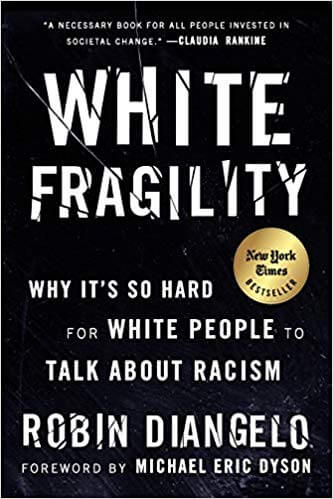
I’m so glad I read White Fragility because Di’Angelo’s many examples helped me to see where I’ve let white fragility determine my thoughts and actions. I want a commitment to anti-racism to lead what I say and do, but I saw myself in a lot of the stories she told. Some of the incidents I reflected on were from my past, and some are ways I continue to struggle.
I can’t expect to help my children become anti-racist if I’m not honest about racism that still exists in me. It’s embarassing and painful to think about.
But as Di’Angelo points out, it’s envitable that racism will shape white people because we live in a white supremacist culture. (And white supremacy is not limited to people who march with torches chanting “blood and soil.”)
Instead of reacting with shame and defensiveness, we need to receive feedback about our racism with graciousness. Next, we have to reflect on how we will change because of that feedback.
Related Post: Racism and Dr. Seuss: What Caregivers Need to Know

Three Ways White Fragility Has Impacted My Parenting
1. I’ve unconsciously been teaching our kids that racists are bad people and we are good people
A few years ago, I helped lead a series on racism in my adult Sunday School class. We were reading the book Set Free: A Journey Toward Solidarity Against Racism. I remember saying to one defensive class member that we all inevitably have racism in us, because it’s the air we breathe in, day and day out. Pointing out a racist comment isn’t saying someone is a morally bankrupt person. It’s cause for reflection and change.
I mentioned to the class that I’ve often had thoughts that alarmed me. Almost immediately, I’d think “crap, that’s messed up. That’s so racist, and I just thought that. I still have more work to do.”
But when I think back about how I’ve talked to my kids about racism, especially our 6 year old, I’ve been using more narrow ideas about what racism is.
I’ve been falling into what Di’Angelo calls the “good/bad binary.” (This is one of the most helpful concepts that she unpacks in great detail in White Fragility.)
This binary is one of the reasons white people find it so hard to face their inevitable racist thoughts and actions. Di’Angelo explains that since the civil rights movement, society has seen racists as bad, immoral, mean-spirited people who intentionally set out to harm people of color. So, if you are progressive, educated, open-minded, with good intentions, society has said you’re a good person who cannot be racist.
(Can you think of how often you’ve heard a white person defend something they’ve said or done by “I didn’t intend any harm?” This is because they’ve absorbed the idea that you must be intentionally hateful in order to perpetrate racism.)
Related Post: Seven Ways to Raise Race Conscious Kids
In my conversations with my little guy, I’ve often pointed out extreme examples of racism from the past and the present. We’ve talked about Jim Crow. I’ve also shared more modern examples like a local leader of Black Lives Matter who was arrested for complaining to a restaurant about the poor customer service her party had received.
I’m not sorry we’ve talked about these things.
But I need to spend time giving more subtle examples, including things that I’ve thought, said, and done.
I’ve been giving him the idea that there are a lot of racist white people out there, but that our family is exempt from racism.
2. I’ve wanted to shield our youngest son from being in situations where white people are not the majority
Friends, this one is so hard for me to admit. I attended public schools from 1st through 12th grade that were majority Black, and I’ve often told people what a good experience that was for me.
(And I meant it. But as I look deeper at myself, I see the insidious power that racism has on me and all white people. We can and do hold contradicting beliefs at the same time.)
My stepson, now in college, attended the same majority Black middle and high schools that I attended.
But until recently, I haven’t been able to admit that racism has influenced where our youngest is enrolled in school. It’s also shaped our choice of neighborhood. Where we play. The groups we’re part of.
As a child, I remember a few times when I was the recipient of some prejudiced comments from Black classmates. Not many, but a few.
(And let me be clear, prejudice is not racism. I was not a victim of racism. Only white people can perpetrate racism. If you need help understanding the difference between prejudice and racism, read White Fragility or the book Why Are All the Black Kids Sitting Together in the Cafeteria?)
These comments hurt at the time, but no more than other ways kids are mean to each other.
The potential impact of similar comments on our son became outsized in my mind. Even though I’ve trusted that our son could become resilient in other situations, I worried that he would be hurt too much by prejudice. That he is too fragile to handle it, or to handle a child of color pointing out to him when he has said something racist.
Related Post: How I failed to be an anti-racist parent in the grocery store parking lot
3. I haven’t done enough to help my young white child see himself in racial terms
Our racist culture teaches white people that race is something people of color have, not us.
This idea that we don’t have race reinforces racism in so many ways. To give just one example, if we’re in racially stressful situations, we’re likely to blame people of color for that situation. That blame shift keeps us from having to accept, or even consider, our responsibility for racism.
I probably talk to our 6 year old about whiteness more than the average white parent.
But especially now that he is getting older and his reasoning ability is growing, I need to go deeper with him. I’m still figuring out how I can help him understand the ways whiteness is shaping him and his experiences.
We need to talk about how racism has taught us a lot of lies about ourselves as white people, and about people of color. I want to model for him what it looks like to: 1) realize when something I’ve done is racist, and 2) do what I can to make amends in that situation.
Related Post: Mega list of anti-racism resources for parents and teachers
For me, one of the most helpful aspects of White Fragility is Di’Angelo modeling how she has received feedback from people of color about her racist behavior. Even with years of working in anti-racist settings, Di’Angelo still finds herself making mistakes and perpetrating racism.
Over time, she has learned how to develop her racial resiliency. This allows her to learn from feedback about her racism, rather than focusing on defending herself.
I want to develop a similar resiliency. I want to become more willing to be uncomfortable in conversations about race. I will inevitably say or do something racist, because I’m a white person living in a white supremacist society.
But I want others to feel like it’s worth the effort of pointing out my racism to me. And as I work on myself, I want to model receiving feedback (and changing because of that feedback) for my family.
Related Post: What the word racism actually means (and how to explain it to kids)
3 responses to “How White Fragility Impacts Parenting”
Thank you for this honest and vulnerable post (and bigger journey). I hope it will inspire more people to stop and look more deeply at their roles, biases, and responsibilities in shaping a better world for all of us.
Thank you Janine. Like all white folks, I still have so much work to do in address racism within myself and within our world.
The Liberal Religious Educators Association, the professional working group of the Unitarian Universalist Association of Congregations, has found Robin Di’Angelo’s ongoing research invaluable in confronting white supremacy culture within our system. Thanks for sharing it in this context!