
My family is not Latino, but I’ve wanted to learn Spanish for at least two decades. For the past year I’ve been making slow and steady progress using the app Duolingo. I’ve also been introducing my younger son to Spanish through short homeschool lessons. But what I’ve found works best with him is reading engaging children’s books with Spanish vocabulary sprinkled throughout the story.
Even if he’s never fluent in Spanish, I want him to recognize and understand words that are important to Latino culture. We live in an increasingly multilingual country, and all of us, whether we have Hispanic heritage or not, can benefit from learning Spanish vocabulary.
Below you’ll find 13 delightful children’s books with Spanish words and phrases that celebrate Latino and Hispanic cultures.


Know someone looking for children’s books with Spanish vocabulary? Why not share this post with them!

This post may include affiliate links. If you purchase items through these links, I may earn a small commission at no additional charge to you. You can read my full disclosure policy here.
Must read picture books that teach Spanish vocabulary

¡Vamos! Let’s Go Eat by Raúl the Third and Elaine Bay
Purchase from Bookshop.org (supports independent bookstores
This Pura Belpré Award winning book is a riotous celebration of food trucks and the spectacle of lucha libre wrestling. The characters’ names are the Spanish words for animals, so the repetition allows kids to absorb this vocabulary. As you might expect from the title, the story is also chock-full of Spanish vocabulary related to food.
Little Lobo has an important job at the lucha libre match. The luchadores have asked him to deliver lots of food before the fights begin. They order all kinds of food and drink, from aguas frescas to tamales and burritos “the size of your head.” Figuring out which food trucks can provide the perfect dishes turns out to be quite the adventure. (Recommended for ages 4 – 8. Mexican-American author.)
Related Post: 12 engaging children’s books about Mexico

La Princesa and the Pea by Susan Middleton Elya and Juana Martinez-Neal
Purchase from Bookshop.org (supports independent bookstores
The playful rhymes and expressive illustrations of Peruvian characters in La Princesa and the Pea make this children’s book an absolute delight to read. The grumpy reina doesn’t want her son to wed, so she hides a tiny guisante under the twenty mattresses the prince’s love will sleep on.
While there isn’t a glossary, readers will be able to figure out the meaning of the Spanish vocabulary from context. I especially enjoy the passages where the rhyme depends on Spanish. For example, “The girl stretched her brazos and yawned with her boca. But the bed felt so lumpy, like there was a roca.” (Recommended for ages 3 – 7.)
Related Post: 12 fairytales for young feminists

Mice and Beans by Pam Muñoz Ryan and Joe Cepeda
Purchase from Bookshop.org (supports independent bookstores
Rosa María isn’t going to let the fact that her house is small stop her from throwing a huge birthday party for her youngest grandchild. After, all her mother used to say “when there’s room in the heart, there’s room the house, except for a mouse.”
As she makes her daily preparations, she sets out a mouse trap each night, only for it to disappear. Other items start to vanish, to which Rosa María simply says “no importa.” She has no idea that the ratones are secretly at work, and that their work might actually help her. (Recommended for ages 4 – 8. Mexican-American author.)
Related Post: 20 Engaging Children’s Books Starring Latino characters

Feliz New Year, Ava Gabriela! by Alexandra Alessandri and Addy Rivera Sonda
Purchase from Bookshop.org (supports independent bookstores
When Ava Gabriela’s parents take her to Colombia to meet her Abuelita, tías, tíos, primas, and primos, they feel like strangers to her, not familia. She’s so quiet that Tío Mario wonders if the mice have nibbled her tongue. Even when she wants to play with her primos and primas, she finds it hard to speak.
Ava Gabriela wishes she weren’t so shy, but her mother let’s her know that there’s nothing wrong with taking time to warm up. As they make preparations for the Año Nuevo celebration, she wonders if her voice will come out in time for midnight.
There’s so much to love about this book, from the Spanish vocabulary and Colombian culture it introduces, to the affirmation of quiet children. (Recommended for ages 4 – 8. Colombian-American author.)
Related Post: Children’s books about Colombia

Mi Casa Is My Home by Laurenne Sala and Zara González Hoang
Purchase from Bookshop.org (supports independent bookstores
I love this sweet children’s book with Spanish vocabulary related to homes and family. Young Lucia welcomes us into her cozy, friendly, multigenerational casa, where Spanish and English are intermingled. Things are very busy, from the sala where she builds blanket forts to keep out the light (and the hermanos) to the cocina where Mamá performs cooking milagros. (Recommended for ages 4 – 8. Puerto-Rican and Spanish American author.)
Related Post: 12 comforting picture books about home
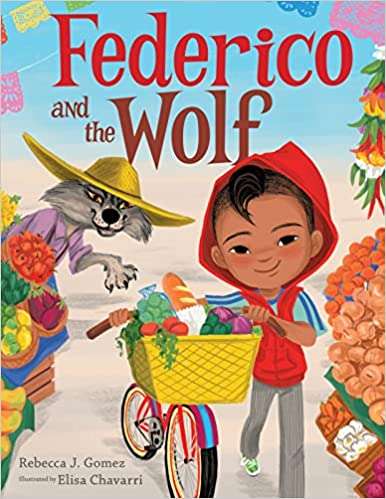
Federico and the Wolf by Rebecca J. Gomez and Elisa Chavarri
Purchase from Bookshop.org (supports independent bookstores)
What if little red riding hood was a boy on his way to Abuelo’s shop to help him make a super spicy salsa? After Federico picks up all the romas, peppers and onions at the market, un lobo stops him in the forest asking for a snack.
Federico tells the lobo where he’s headed, and when he arrives at Abuelo’s store, Federico soon realizes he’s in danger. Could his salsa provisions save the day?
While this children’s book doesn’t have as much Spanish vocabulary words as some of the others in this list, it’s still a very fun read. (Recommended for ages 3 – 7.)
Related post: 12 middle grade books for Latino/Hispanic Heritage Month


Dinner on Domingos by Alexandra Katona and Claudia Navarro
Purchase from Barefoot Books (supports a small woman-owned publisher)
Inspired by the author’s memories of Sunday dinners at her Ecuadorian grandma’s house, this charming children’s book uses Spanish vocabulary to capture the warmth and playfulness of family and food.
Alejandra loves visiting her abuela and her “huge extended family,” even when things become a bit chaotic. When Abuelita can’t take the growing noise, she yells “Basta” (enough) and turns on the music so they can dance together. Though Alejandra sometimes can’t understand Abuelita’s Spanish, they can always communicate in the language of home. (Recommended for ages 4 – 8. Ecuadorian-American author.)
Engaging chapter books with Spanish words and phrases

Sofia Martinez: Abuela’s Birthday by Jacqueline Jules and Kim Smith (series)
Purchase from Bookshop.org (supports independent bookstores)
It’s rare to find early reader children’s books with Spanish vocabulary. That’s probably because these books aim to use words that are easily decodable. The Sofia Martinez series uses 1 – 2 Spanish words per page, which are highlighted in pink. There’s a glossary children can use in the back if needed.
In Abuela’s Birthday, Sofia is building a piñata because “no one is too old for a fun birthday party.” But a flour spill and a frisky gata could detour the party (especially when Tía Carmen finds out what Sofia did!) (Recommended for ages 6 – 8.)
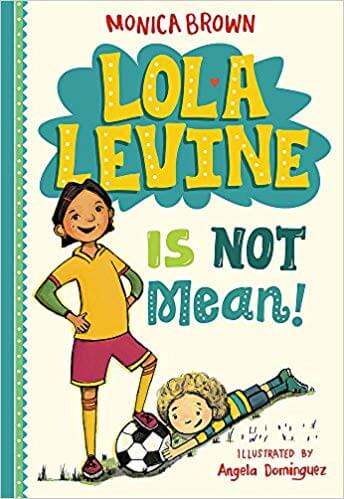
Lola Levine Is Not Mean! by Monica Brown and Angela Dominguez (series)
Purchase from Bookshop.org (supports independent bookstores)
The Lola Levine series was a huge hit with my kid. There’s so many reasons to love this spunky heroine. She embraces both her Peruvian and Jewish heritage, with her diario containing both Spanish and Yiddish words. Lola defies gender stereotypes; she enjoys soccer and her best friend is a boy. And she always finds creative solutions to the problems she gets herself into.
In Lola Levine Is Not Mean, Lola doesn’t mind that she doesn’t fit in with many of the girls at school. But she certainly does mind when kids start calling her “mean Lola Levine” after she accidentally hurts a classmate on the soccer field. How can she show everyone that she’s sorry about what happened? (Recommended for ages 6 – 9. Peruvian-American author.)
Related Post: 19 children’s books that defy gender stereotypes
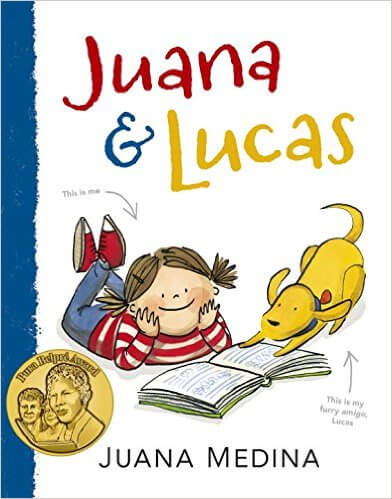
Juana and Lucas by Juana Medina (series)
Purchase from Bookshop.org (supports independent bookstores)
Juana is a spunky little girl who lives in Bogotá, Colombia with her best friend and dog Lucas. Kids will easily relate to Juana’s trials and joys, all while they get introduced to her city. She’s an opinionated kid who is also hilarious (often without realizing that she’s being funny.)
Spanish words and phrases are sprinkled throughout, in contexts that are easy to figure out. The series is a kind of hybrid between a chapter book and a graphic novel, so if your child loves comics, check this out. (Recommended for ages 5 – 9. Colombian-American author.)
Related Post: 12 diverse and inclusive graphic novels for ages 7 – 12

Stella Díaz Never Gives Up by Angela Dominguez (series)
Purchase from Bookshop.org (supports independent bookstores!)
Stella loves ocean animals more than anything. When she learns that she’s been accepted into a special summer camp at the Shedd Aquarium, she knows it going to be an amazing summer. Then, her mother surprises her with a trip to Mexico, where she sees the ocean for the first time! She’s of course excited about the trip, but she also worries her Spanish won’t be good enough.
During the trip, Stella quickly learns that her beloved animals are under threat because of human pollution. She wants to save the oceans, but she knows it’s too big a job to do alone. Can she work through her shyness to get others to ditch plastic and join her ocean conservation cause? (Recommended for ages 7 – 10. Mexican-American author.)
What are your favorite children’s books that teach Spanish vocabulary and celebrate Hispanic and Latino cultures? Share in the comments!