
A growing number of educators realize they need to teach using an anti-bias anti-racist (ABAR) framework. But elementary and middle school educators are often puzzled by how to implement anti-bias education in subjects like science, math, and technology.
One of the reasons that anti-bias teaching techniques are crucial in these subjects is the lack of diversity in STEM fields. Women, people of color, queer people, and disabled people are under-represented, and the contributions to their fields have often been ignored or appropriated.
Science, technology, engineering, and math can also either be used to uphold injustice or to dismantle injustice. They are not neutral subjects, as some of the examples below will show.
If you’re an educator who wants to teach for diversity in STEM subjects and encourage all your learners to embrace science and math, try some of the 7 teaching strategies below.


This post may include affiliate links. If you purchase items through these links, I may earn a small commission at no additional charge to you. You can read my full disclosure policy here.
1. Use a DEI (diversity, equity, and inclusion) planner as you tackle Common Core standards for math and science.
If you teach 2nd – 8th grade, here’s my best tip for teaching for diversity in STEM. Grab a copy of Liz Kleinrock’s practical manual Start Here, Start Now: A Guide to Antibias and Antiracist Work in Your School and Community. It
The book includes a section dedicated to anti-bias approaches to STEM. (If you’re on Instagram, I also recommend following Kleinrock there.)

In the STEM section, Kleinrock shares an example of how she plans for diversity in STEM subjects while still meeting Common Core standards.
Next to each standard, she has a diversity column, which answers questions about who is being represented as she teaches this standard. She notes diverse individuals and groups’ contributions that she can use in her lessons.
Next is an equity column, which asks how, when this topic has been applied, it’s been used to either promote equity or inequity.
Finally, the inclusion column asks what strategies she can use to meet the needs of all her learners.
The concrete examples she gives on this chart for each of the subjects are so useful!
Another helpful source for finding ideas for the diversity and equity columns of your lesson plans is the annual planner book put out by Rethinking Schools and the Education for Liberation Network.
2. Draw on indigenous knowledge as you teach STEM subjects
Too often, children are taught that indigenous peoples of the Americas were “primitive” until Europeans arrived to change them. Native peoples’ paths to knowledge that have been practiced for centuries are ignored or ridiculed.
Fortunately, there are a growing number of teaching resources that celebrate diversity in STEM, not just with scientists of today, but with indigenous STEM experts of the past.
Related Post: 9 ways to observe Indigenous Peoples Day with children
I homeschool my 10-year-old, and one of our favorite studies this year has been learning about the engineering feats of the Inka Empire. Thanks to this extensive resource from the National Museum of the American Indian, we’re discovering how engineers of today can learn from the sophisticated and environmentally sustainable practices of the Inka.
Today, rural Quechua people who are the descendants of the Inka still use these practices to make a suspension bridge connecting two of their mountain communities.
You can search all of the Museum’s Native 360 learning plans for STEM-themed projects.
Another resource for teens celebrating indigenous scientific wisdom will be available soon. A young adult version of the ground-breaking book Braiding Sweetgrass: A Guide to Indigenous Wisdom, Scientific Knowledge, and the Teaching of Plants will be released in the fall of 2022.
3. Connect fractions and percentages to justice issues.
Math topics like fractions, percentages, and decimals can seem like dry, dull topics to students if we don’t connect them to real life issues.
In Rethinking Schools magazine, third-grade teacher Ilana Greenstein shares how she taught bar graphs and explored wealth inequality at the same time. She gave each group of learners bags of 100 macaroni pieces, which they first divided into five equal parts. As the lesson continued throughout the week, they used this tactile tool to guess how wealth is distributed in the U.S. Then they learned about how it’s actually distributed, and discussed how the children thought it should be distributed.

Find more lesson ideas for connecting equity and justice with math on Radical Math’s website.
4. Promote diversity in STEM by expanding students’ ideas of who are mathematicians, scientists, and engineers
Liz Kleinrock describes so many practical activities in Start Here, Start Now. One of my favorites is her invitation to draw a picture of a mathematician or scientist. Though her classroom each year is racially diverse, most of the students draw men who look like Albert Einstein.
Later, Kleinrock displays a portrait gallery of people from many different times, ethnicities, and identities. She asks students to guess what these people have in common. As you might have guessed, they’re all leaders in STEM fields.
Later in the year, students are invited again to draw a scientist or mathematician, and the results are very different!
Related post: 6 ways to involve parents in your anti-bias teaching
Here are a few picture book biographies you can use in your classroom to help learners celebrate diversity in STEM fields:

Classified: The Secret Career of Mary Golda Ross, Cherokee Aerospace Engineer by Traci Sorell and Natasha Donovan. This biography not only celebrates Ross’s contributions to math and engineering. It also highlights how Cherokee values influenced her learning. Find on Bookshop.org
Mario and the Hole in the Sky: How a Chemist Saved Our Planet by Elizabeth Rusch and Teresa Martínez. Mario Molina is a Mexican-American chemist who discovered how CFCs were creating a hole in the ozone layer. This engaging account shows kids the power for change (both good and bad) that chemistry can create. Find on Bookshop.org
The Secret Garden of George Washington Carver by Gene Barretta and Frank Morrison. Long before he impressed a previously-hostile Congressional audience with his insights about the power of peanuts, George Washington Carver built his knowledge in the woods and in his secret garden. Find on Bookshop.org .
Related post: 12 children’s books about Black scientists and inventors by Black authors
Queen of Physics: How Wu Chien Shiung Helped Unlock the Secrets of the Atom by Teresa Robeson and Rebecca Huang. Chien Shiung’s groundbreaking insights into atoms helped her scientific partners win the Nobel Prize 3 times (though she herself never received this recognition, which many knew she deserved.) Her work was so important that Newsweek magazine once dubbed her the “Queen of Physics.” Find on Bookshop.org
Related Post: 29 children’s books about Asian American history and cultures.
Hidden Figures: The True Story of Four Black Women and the Space Race by Margot Lee Shetterly and Laura Freeman. Mathematicians Dorothy Vaughan, Mary Jackson, Katherine Johnson, and Christine Darden’s contributions to NASA are celebrated in this picture book. The racist and sexist obstacles laid down by white male colleagues are also addressed with honesty. Find on Bookshop.org
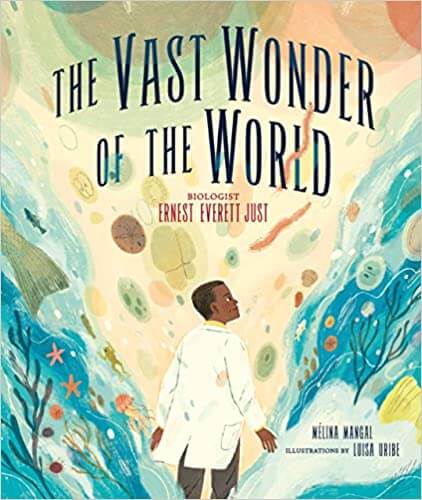
The Vast Wonder of the World: Biologist Ernest Everett Just by Mélina Mangal and Luisa Uribe. Biologist Ernest Everett Just was unusual among scientists of his time. That’s because he was interested in the whole of cells, not just their individual parts. His work was foundational for cell biology today. Find on Bookshop.org
Find more diverse STEM biographies in this list from Carissa Taylor.
5. Make time to explain STEM terms to your students, even if they seem like common knowledge to you.
Kleinrock encourages educators to reflect on whether they are “teaching the language of math with the same precision that we use in teaching reading and writing?” She points out that this is especially important with emerging bilingual students.
Kleinrock makes time to explain that “equal” means “the same as,” along with exploring synonyms for words related to addition and subtraction.
Educator José Vilson uses Spanish words as he teaches his Latinx students about math. For example, when talking about place value, he prefers to use real money. Using the Spanish word “centavo,” he relates this easily to the English word “cent” and explains how it’s a penny. From there, he reminds students that one hundred cents makes a dollar. After this explanation, students can also connect the word “cent” with “percent.” Teaching the place value concepts then becomes easier.
6. Connect your learners with a community-based group to carry out math projects.
Radical Math stresses the importance of using math to teach children not just about the problems in communities, but also the solutions.
Could your students partner with a community organization to poll neighbors about how they feel about an issue? Compiling the results will help them practice key math skills, as well as explore what people in the community think and why.
7. Examine times when scientific research contributed to oppression
It’s also important to explore times when scientists have behaved unethically and upheld racial and social injustice.
Eighth-grade students at KIPP Bridge Charter School in Oakland, California created a hip hop video that tells the story of Henrietta Lacks. Lacks was a Black woman whose cells have contributed to numerous scientific advances, including many that were quite lucrative. Her cells were taken without her consent and her family has not been compensated for them.

High school science teacher Gretchen Kraig-Turner has taught units both on Henrietta Lacks and the Tuskegee Syphilis Study. You can find her accounts of both of these teaching plans in the compilation Teaching for Black Lives. Kraig-Turner wants her students to understand how race influences what medical care people receive, which diseases are studied, and who is included in research groups.
