
The United States, and many individual states, observe Columbus Day on the 2nd Monday in October. But a growing number of cities and states are refusing to honor a man whose committed genocide. Instead they are marking the date as Indigenous Peoples Day.
There are many ways children of all ages can observe Indigenous Peoples’ Day. In this post, I share 9 options that can be used with preschool, elementary, and middle school age kids.

Disclosure: For your convenience, this post includes affiliate links. If you purchase items through these links, I may earn a small commission at no additional cost to you. You can read my full disclosure policy here.


1. Read We Are Still Here! to give children an overview of Native American history and resistance
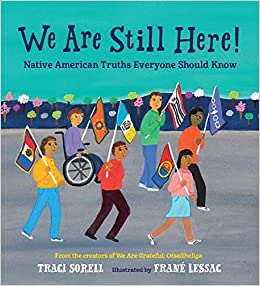
In their new book, Traci Sorell and Frané Lessac introduce children to Indigenous Peoples’ Day as a class completes a project for the holiday. Each child presents an important aspect of Native American history, most of which children will not learn about in mainstream textbooks. Wenona talks about the era of assimilation and boarding schools. Chase shares fairly recent history of termination, when the U.S. government stopped honoring treaties with Native nations in the 1950s.
My favorite presentation might be Jessie’s: tribal activism, which includes pictures of activists taking over Alcatraz Island in the 1970s. Each presentation is kept simple enough for a picture book, while still communicating what was most important about this time.
Even when the history shared is painful, Native Nations proclaim after each presentation, “we are still here!” refusing to be silent or be erased. (Recommended for ages 8 – 12.)
Sorell and Lessac have created an activity guide to accompany the book that will be especially useful to educators.
Sign up for my free Resource Library to get my guide to evaluating children’s books for Native American stereotypes.
2. Learn about the present day life and culture of a particular Native American nation or Indigenous people.
Focusing on present day life is a great option for observing Indigenous Peoples’ Day. Why? First, there’s a huge problem in the United States with non-Indigenous people talking about Native American nations as if they only existed in the past.
Professor Sarah Shear examined k – 12 curriculum standards for all 50 states. She found that 87% of the references to Native Americans portrayed them as only existing prior to 1900. She says that her college students were entering her classroom “believing that all Indians are dead.”
Second, if your child is a preschooler or kindergartner, it’s important to focus on the present day because of their developmental stage. Young kids often can’t separate the past from the present. For example, what happens if you ask a non-Native 4 year old what kind of house a Native American might live in? They’re to say a tipi because of all the stereotypes they’re exposed to.
Related post: Uplifting resistance to injustice when we teach kids about hard history
It’s also important to tell children the particular Native American nation you are learning about and where there homelands are. Let kids know that every nation its own language, cultural traditions, and history.
Try reading one of these books with 4 – 14 year olds. (I created this list last year, but I just updated it to add some new favorites.)
Related Posts:
15 Indigenous children’s books set in the present day

20 #ownvoices First Nations and Native American picture books
Professor Debbie Reese’s amazing blog has a wealth of book reviews (including books that should be avoided because of stereotypes): American Indians in Children’s Literature.
Explore the beautiful photographs at Project 562 to show kids the diversity within Indigenous peoples’ living in the United States. Artist Matika Wilbur , who is Swinomish and Tulalip, spends almost all her time on the road. That’s because she’s committed to visiting and photographing all 562 of the sovereign Native American territories within the U.S.
3. Listen to greetings from Indigenous language speakers from around the world
There are an estimated 7,000 Indigenous languages spoken worldwide. Through the Celebrating Indigenous Languages project, children can listen to greetings recorded by 50 Indigenous language speakers. I love that kids can also look at a picture of each language speaker and learn a little bit about what she appreciates about her language.
My kid loves playing with electronic maps, so I know this interactive experience will be a hit in our house.
Related post: Teaching kids about gratitude with the Haudenosaunee Thanksgiving Address
4. Watch an episode of Molly of Denali
I am pretty choosy about children’s television. (Even a lot of “educational” programs don’t measure up in my book.)
But I absolutely love the PBS show Molly of Denali. The show expertly shows how Molly’s Native Alaskan culture and history are a crucial part of her life. Molly also plays basketball, vlogs, and has snowball fights with her friends.
The show’s producers have involved more than 60 writers and cultural advisers who are Alaska Natives, First Nations, or indigenous to ensure that the cultural content is accurate and meaningful.
My favorite episode of Molly of Denali is the first one: “Grandpa’s Drum.” The story skillfully and sensitively introduces young children to the history of Indigenous boarding schools in an age-appropriate way. I’ve watched the episode three times, and each time Grandpa remembers the song he hasn’t sung sing childhood, I tear up.
For podcast fans, you can find episodes of the Molly of Denali podcast here. My 7 year old was riveted!
5. Teach kids about the history of the people whose land you live on
My family lives on land that belonged to the Chickasaw and Quapaw nations. Both tribes were forcibly removed to Indian Territory (present day Oklahoma) in the 1830s. I feel angry that even though names including the word Chickasaw are plastered all over our city, the only things I learned about their history was the Trail of Tears.
You can get a peek into how my family has learned some of the Chickasaw Nation history we missed in school here, and get ideas of how to teach your children about the particular nation whose homelands you live in.
6. Share an example of Indigenous activism with children
One of my passions is introducing kids of all ages to activism. Indigenous Peoples’ Day is the perfect time to talk about one of the many movements for indigenous rights, from the present or the past.
For preschool and younger elementary children, you could pick one of these examples of Native American activism from the 1960s to the present, presented by the Zinn Education Project.
Upper elementary and middle school aged kids could look at the entire timeline for themes. They could also dive deep into one of the present day movements described in this Yes! magazine article, The Spirit of Standing Rock on the Move.
To teach younger kids about Standing Rock, my favorite resource is Young Water Protectors. Aslan Tudor, a child who participated in the movement, wrote this picture book (with some help from his mom.)

7. Learn about the Taino people
While children and youth learn the name Christopher Columbus early on in school, how many ever learn anything about the Taíno people that Columbus misnamed Indians?
The Zinn Education Project refers to this as a “curriculuar genocide – erasing the memory of the Taíno people from our nation’s classrooms.
As the article notes, one important thing to share with children is that the Taíno people still live on. Around the time that many non-indigenous people were celebrating the 500th anniversary of Columbus’ arrival, descendants of the Taíno began concerted efforts to revive their language and traditions.
My friend Frances has shared about how she taught their son about his Taíno ancestry when he was young. (See additional posts she created for her Taíno ancestry series here.
Native Knowledge 360, a project of the National Museum of the American Indian, has lessons on Taíno history and identity for grades 4 – 12.
Rethinking Columbus, an excellent resource for elementary and secondary school teachers, includes a section of articles of the Taínos. The book is available in both PDF and print versions.
I’m also eager to check out History Smashers: Christopher Columbus and the Taíno People. Though I haven’t read this book yet, my family has used other books in the History Smashers series and found them quite helpful.
8. Unpack myths about Christopher Columbus
One of the activities in Rethinking Columbus that’s available for free online is a mock trial, The People vs. Columbus. (It’s intended for middle and high school students, but it includes tips on how to adapt the roleplay for an elementary setting.)
[EDIT to original 2019 post]: I originally recommended Nancy Schimmel’s song “1492” as a way to question what young children may have already learned about Columbus. I’m thankful to Autumn Morning Star for her feedback that this song is potentially trivializing to the horror that the Taíno and Arawak peoples experienced at the hands of Columbus. Therefore, I no longer view it as a helpful resource for young kids.
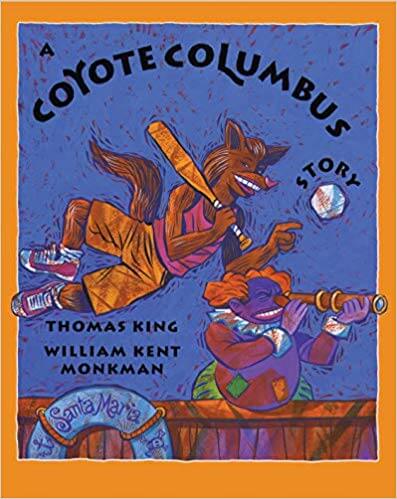
For 1st through 5th graders, I recommend the irreverent and bold picture book A Coyote Columbus Story, by Thomas King. It’s an unusual book, so I definitely recommend that adults read through it once before they read it to kids. This will give you an idea of what you might want to say before and after reading the story.
With our 7 year old, I took some time to tell him who Columbus was. I shared how many non-Native people celebrate him even though he did many bad things to Indigenous people. We stopped periodically in the book to talk more about what was happening in certain pictures. Sometimes we talked about what the author might be wanting us to feel while reading a particular passage.
9. Join the campaign to replace Columbus Day with Indigenous Peoples’ Day
Abolishing Columbus Day celebrations is just one step in addressing the violence against, and erasure of, Indigenous people. But I think it’s an important one, especially in our schools. Continuing to observe Columbus Day makes it impossible to teach our children history as it really happened.
The Zinn Education Project has a toolkit of resources for people who want to abolish Columbus Day at the school district, university, city, and state levels.
10. Call on sports teams to stop using images of Native Americans as mascots
A growing body of psychological research shows that the use of Native-themed mascots negatively impacts the mental health of Indigenous youth.
The use of these mascots also reinforces and deepens stereotypes that non-Indigenous children are likely to hold about Native peoples.
You can find resources for calling on your school or other organization to end the use of Native-themed mascots on the Illuminative website.
The Penobscot Nation also has useful talking points they and other Native nations used to successfully push schools in Maine to stop using Native mascots.
11. Learn the creation story of a specific Native nation
As you read or listen to a story, remember that these are sacred stories. Remind children that the story you are learning is from a group of people who still exist today. Whenever possible, look for a creation or other sacred story that has been recorded by people of that nation. Here are a few suggestions to get you started:
The Haudenosaunee Creation Story (from the website of the Oneida Nation)
The Sea-Ringed World by Maria Garcia Esperon contains sacred stories of Indigenous nations throughout the Americas.
Additional lesson plans and resources for teachers
There are many great resources for lesson plans and activities which I’ll share below.
But first I’ll make a plea to teachers of young kids about what NOT to do.
Most “Native American” crafts that you’ll find online are highly problematic. They play into stereotypes that non-Native people have about Indigenous people. The crafts are often non-specific to a particular nation, or mix up elements of different nations. Too many of these crafts incorporate items that are sacred (such as feathers) and therefore don’t belong in a children’s craft.
If you are an early childhood teacher, please read my post:
Do’s and Don’ts for teaching preschoolers and kindergartners about Native Americans.
One Indigenous-authored resource that includes crafts that I highly recommend is A Kid’s Guide to Native American History by Yvonne Wwakim Dennis and Arlene Hirschfelder. Be sure to study the history and cultural information with children that corresponds to the particular craft you are doing.
Additional resources and lesson plans for preschool and elementary teachers
Dear Teacher: An open letter about images of Indians (American Indians in Children’s Literature)
Finally, because Thanksgiving will soon be here, I encourage parents and teachers alike to take a look at my tips and resource roundup for unpacking myths about “the first Thanksgiving.”
There are a huge variety of lesson plans for different subject matter and grade levels found at Native 360, a project of the National Museum of the American Indian.
Illuminative also has a great variety of lesson plans for different ages in their resources section.
Mint and Bloom Learning has a free set of Indigenous Peoples Day elementary lessons on their website.
Kelly Tudor, a Lipan Apache homeschooling parent (and mom to kid author Aslan Tudor) offers history classes on Outschool.

4 responses to “11 ways to observe Indigenous Peoples’ Day with children”
I was hoping to find some good ideas here, but I can see you are misinformed about Christopher Columbus. Was he a perfect man? No. But was he the man people nowadays have twisted him to be? No. You should try reading his own words. I can see I won’t be interested in frequenting this page in the future.
Question: do you have a link or a suggestion for Native Canadian content? Thanks.
I have some books about First Nations peoples in Canada on this book list: https://www.rebekahgienapp.com/2018/10/native-americans/
Thank you for these amazing resources. My child’s montessori sent home a painted mayflower and a head piece with feathers. As a native american I was deeply offended to see the story re-told to my 2 year old. I am grateful for these resources on your website. We must re-tell the story accurately.