One of my most popular posts shares 5 contemporary youth activists that children should know about. But it’s also important for young people to know that kid activism has a long history in the United States! So today, I present 5 kid activists from history that you can teach children about.
I’m including videos about each activist or movement, as well as related children’ books. Let’s get inspired, shall we?


Copyright: stevanovicigor / 123RF Stock Photo
Disclosure: For your convience, this post contains affiliate links. If you purchase items through these links, I may earn a small commission at no additional cost to you. You can read my full disclosure policy here.
Five Kid Activists from History to Inspire Children
Kid Blink and the Newsies (1899)
During the summer of 1899, hundreds of children and teens who sold newspapers for two major papers went on strike. They were children of immigrants whose meager pay meant more food on their family’s tables.
When Randolph Hearst and Joseph Pulitzer decided to start charging the children a penny more to buy the papers they sold, Kid Blink and other “newsies” quickly realized that would mean less money for their families. They mobilized to protest the increase with racous rallies and a strike. They won so much support from readers that the papers went from printing 350,000 copies a day to only 125,000!
Learn more about Kid Blink and the Newsies
1) Read Kid Blink Beats the World. This engaging picture book captures the determined spirit of these kid activists in a way that will hold children’s attention.

Just be aware that not everything the newsies did is considered “appropriate” behavior (such as throwing rotten tomatoes at deliverymen during the strike.) But that gives you an opportunity to talk about what happens when people – especially kids – face opression. (Recommended for ages 7 – 12)
2) Watch the feature film Newsies. This is a Disney movie, so it’s inspired by true events rather than being fully historically accurate. For example, the main character, Jack Kelly is a combination of Kid Blink and another real life newsie, Morris Cohen. But nonetheless, this can be a good way to get kids interested in the true story!
Related Post: 15 Picture Books about Social Justice and Human Rights
Clara Lemlich and the Shirtwaist Makers (1909)
The early 20th century was a huge time of labor unrest in the United States and around the world. Kids may be surprised to learn that many of those who labored in dangerous factories were teenagers and sometimes even children.
Clara Lemlich is most famous for a fiery speech that she made at age 23, convincing her fellow (mostly female) seamstresses to go on strike in the face of terrible pay and dangerous working conditions. Yet she clearly had the firey spirit of an activist from even younger age, before she immigrated to the United States from the Ukraine.
Clara was 17 when she came to America and began sewing in the factories. It didn’t take long for her to become outraged at the treatment. She was also frustrated with the male dominated union which attempted to go on strike without the women. She repeatedly led her fellow women on strike against the men’s objections.
Learn more about Clara Lemlich and the Shirtwaist Makers
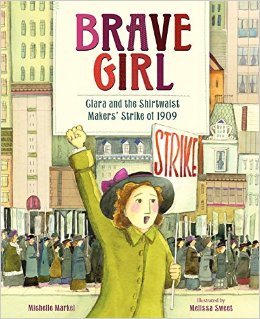
Read Brave Girl: Clara and the Shirtwaist Makers’ Strike of 1909. Above, you can watch the trailer for this book, which is sure to spark curiosity among future kid activists. Children will follow Clara from the day she arrives in America all the way through the victories won after the strike Clara helped start (Recommended for ages 5 – 10)
Related Post: Helping Kids Understand Immigration
Sylvia Mendez and the Fight for School Desegregation
You probably know about Brown v. Board of Education and how it led to school desegregation. But have you heard of Mendez v. Westminster School District (which happened seven years earlier?)
When the Mendez family moved to Westminster, California, they were told that Sylvia and her siblings had to attend “the Mexican school” rather than the school that was closest to them. Sylvia’s father was unwilling to accept this. Even as Sylvia, Jerome, and Gonzalo had to be taught by teachers who didn’t believe they could succeed, in a school building that was basically a shack, Mr. Mendez resisted.
When most of the other Latino parents were afraid to speak up for fear of losing their jobs, Mendez decided to sue the school district. The Mendez family’s eventual victory in California helped pave the way for the Supreme Court’s decision that school segregation is inherently unequal.
Learn more about Sylvia Mendez:
1) Read Separate is Never Equal. This picture book starts from Sylvia’s point of view once her case has been won and she’s finally admitted to the Westminster School. When a white student shouts at her “go back to the Mexican school! You don’t belong here,” Sylvia no longer wants to go to Westminster.

Her mother reminds her that this opportunity for a quality education is what they fought for. We’re then taken back to their arrival in Westminster. Children will understand why Sylvia and her family engaged in years of struggle, so that all the Mexican-American children of their community could receive a good education. (Recommended for ages 6 – 10)
2) Read Sylvia and Aki. This chapter book brings to light another fascinating aspect of Sylvia’s life and a tragic chapter in U.S. history. The reason that the Mendez family moved to Westminster in 1941 is that they were leasing a farm from the Munemitsu family. Like over 100,000 other Japanese Americans, the Munemitsus were forced into a relocation camp during World War II.
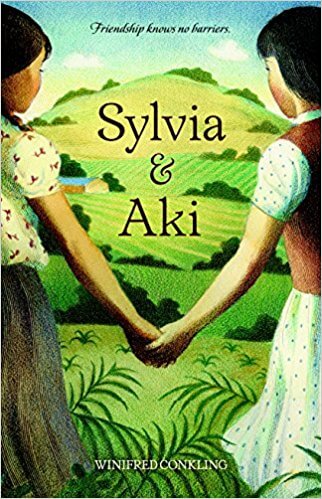
Aki, who once attended the Westminster School that Sylvia was being denied admittance to, now must live in a crowded tar-paper building in a camp bordered with razor wire. Sylvia and Aki’s stories are told side by side, including how they became pen pals until the Munemitsu family was released at the end of the war. (Recommended for ages 10+)
Claudette Colvin and the fight for desegregation in Montgomery (1955)
Another kid activist who is too often overlooked in the history books? Claudette Colvin, who was arrested at age 16 for refusing to give up her bus seat to a white woman in Montgomery, Alabama.
While Rosa Parks actions’ nine months later were widely celebrated in Montgomery’s Black community, Claudette was told by many adult leaders that she wasn’t fit to be a role model.
That didn’t stop her from again taking action by becoming one of four plantiffs in the important busing desgregation case Browder v. Gayle. Thankfully the lesser known stories of the civil rights movement, including Colvin’s, are beginning to be told more often.
Learn more about Claudette Colvin
Read Claudette Colvin: Twice Toward Justice. This detailed biography for teens is based on extensive interviews wtih Colvin. It gives today’s youth an in-depth look at the harmful effects of segregation, as well as an understanding of where Colvin’s bravery came from.

For example, Claudette realized as a teenager that “we seemed to hate ourselves,” often buying in to beliefs that lighter skin and straight hair were beautiful. (Recommended for ages 12+. Includes frank language about the abusive treatment from whites that Colvin and others received.)
Related Post: Best Children’s Books about Black Women Leaders
The Birmingham Children’s Crusade (1963)
Massive school walkouts by kid activists have happened repeatedly in the past several decades. The Birmingham Children’s Crusade is one of the most famous. Dr. Martin Luther King Jr. visited Birmingham in May 1963, urging people to join a civil disbodience campaign to segregate Birmingham. But many adults feared that they would lose their jobs if they were arrested.
More than 1,000 teens and children left their classes so that they could march in the adults’ place. On May 2 “D-Day,” 973 young marchers had been arrested by the day’s end. As protests continued, many of the children who participated in marches were expelled (though a judge later overturned the expulsions.)
Later that summer, in large part because of continued action by youth and kid activists, the city of Birmingham withdrew its segregation ordinance.
Learn more about the Birmingham Children’s Crusade
1) Read Let the Children March. This moving picture book is narrated by an unnamed young woman who participated in the Children’s Crusade. I loved how the art so often focuses on the children and adult’s facial expressions, capturing everything from fear to pride and assurance.

As the book mentions, Dr. King was not sure about letting young people risk going to jail. He too was a father, but he also trusted their ability to stand up for themselves and for freedom. (Recommended for ages 4 – 10)
Related Post: 15 Children’s Books about the Civil Rights Movement
2) Read The Yougest Marcher. Audrey Faye Hendricks was the youngest child known to be arrested during the civil rights movement, and this book tells her remarkable story. At age 9 she wanted to heed Dr. King’s call to fill the Birmingham jails so that segregation would end. (Recommended for ages 6 – 12)

