
Ethiopia has an incredibly rich history, and it’s the second most populated country in Africa. Yet all I remember ever learning about Ethiopia in my 1980’s childhood was about the tragic famine that happened during that time. I want to make sure that my son learns a lot more about Ethiopia, a country that’s often referred to as the “cradle of humankind.” Keep reading to discover 7 of my favorite children’s books that help kids learn about Ethiopia. I’m also including some additional resources and fun facts.


Disclosure: For your convenience, this post contains affiliate links. If you purchase items through these links, I may earn a small commission at no additional cost to you. You can read my full disclosure policy here.
Learn about Ethiopia with 7 Excellent Children’s Books

Ethiopian Voices: Tsion’s Life by Stacy Bellward and Erlend Berge
11 year old Tsion tells us all about her family and daily life in this book filled with striking photographs. Each page also teaches children a word or phrase in Amharic, the official language of the country. We learn about each of her family members and the work that they do. Tsion teaches us about her Orthodox Christian faith and takes us to her school. She also introduces kids to one of Ethiopia’s most important ways of showing hospitality: the coffee ceremony. (Recommended for ages 5 – 10)
Related Post: Explore Nigeria: Best Children’s Books and Activities
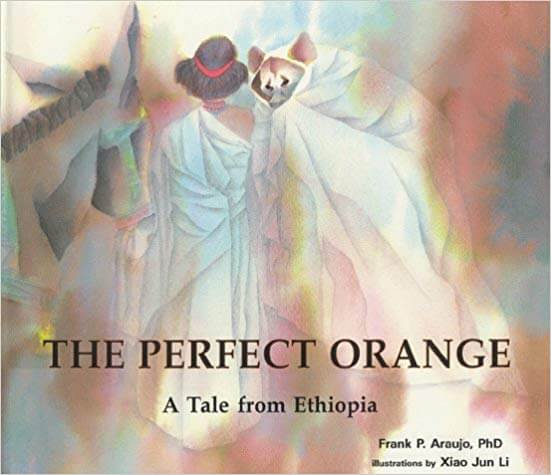
The Perfect Orange: A Tale from Ethiopia by Frank P. Araujo and Xiao Jun Li
The author learned this folktale about wisdom, greed, and generosity when he worked in Ethiopia. A generous-hearted orphan girl named Tshai is loved by her neighbors for her sincerity. One day she finds the most perfect orange she has ever seen. Tshai decides immediately that she should take it to their ruler the Nigus.
On her journey, Ato Jib (Lord Hyena) mocks Tshai’s gift, telling her that the ruler only wants ornate things like a gold cross or a rare jewel. Tshai ignores him and presents her gift to the Nigus, who understands its beauty. When Ato Jib sees how the Nigus generously rewards the girl’s simple gift, his greed motivates him to visit the royal palace as well. Will the Nigus see into Ato Jib’s heart and know his true intentions? (Recommended for ages 6 – 10)


Omer’s Favorite Place by Ifeoma Onyefulu
I’m a huge fan of Onyefulu’s books, which help preschool age children see what they have in common with children in different African countries. Omer, an Ethiopian preschooler, shows us around his home and all the places he likes to play. Many of the places Omer wants to play are where other family members are busy working. But behind the couch, Omer can play for as long as he wants! (Recommended for ages 2 – 5)
Related Post: Gift Ideas for Global Kids

Only a Pigeon by Jane Kurtz, Christopher Kurtz, and E.B. Lewis
When you read this book to a child, take a moment to read the short, poetic introduction about Ethiopia. I love the picture its paints of Ethiopia’s history and how it challenges Westerners’ stereotypes. Ondu-ahlem is the oldest of three brothers, and he rises early each day to check on his beloved pigeons. A mongoose’s footprints confirm that he needs to be extra vigilant to protect the birds.
When Ondu-ahlem sets out to school, his puts his younger brother in charge of protecting the pigeons and their eggs. After school, Ondu-ahlem and his friends start a competition between their birds. Can one pigeon persuade the others to fly to its coop rather than go back to its home? Will Ondu-ahlem’s pigeon remain loyal, or will his lose the bird that is most precious to him? (Recommended for ages 5 – 9)
Jane Kurtz, who grew up in Ethiopia while her parents served as missionaries there, has also written a number of early reader English-Amharic books about Ethiopia through a partnership with Ready Set Go books. Many of them are available for free to Kindle Unlimited members (if you’ve never used the service a 30 day free trial is available.)
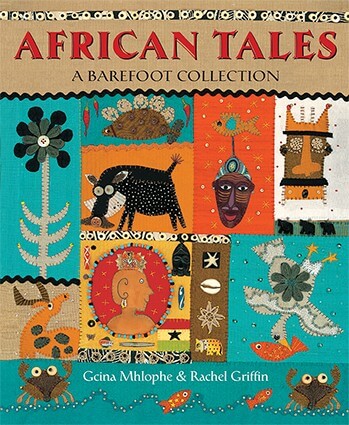
“Everything Changes, Everything Passes” in African Tales: A Barefoot Collection by Gcina Mhlophe and Rachel Griffin
This short story is one of eight tales, each from a different African country, included in African Tales. There is also a short introduction before every story with information about each nation’s history and culture.
When a merchant is passing through the Ethiopian countryside, he sees a farmer cruelly treating a man he has enslaved. When the merchant begins to cry for him, the man tells him not to cry, because “everything changes, everything passes, and my suffering will pass too.” The years pass, and the merchant goes through the region repeatedly. On each visit, he sees how true the man’s words were. (Recommended for ages 8+)
Related Post: Learn about Kenya: Best Children’s Books and Activities

The Storyteller’s Beads by Jane Kurtz
I learned a lot about Ethiopia’s history and religious traditions in this moving middle grades novel set during the 1980’s famine in the country. Both Orthodox Christianity and Judaism have ancient roots in the country, but the Jewish minority has long struggled against discrimination.
When the drought brings drastic changes to their neighboring communities, Sahay (who is Orthodox Christian) and Rahel (who is Jewish) must leave their homes. Rahel’s family has been told that now is finally the time when her people will be able to return to Israel, while Sahay’s uncle wants her to just find a place to survive.
When both girls become separated from their families, they must depend on each other. Sahay has been surrounded by prejudice against Jewish people all her life, and does not want to trust Rahel. Rahel has been told she can only trust her own people. But both girls must learn to overcome what they’ve been taught to survive the crisis that faces their nation. (Recommended for ages 10+)
Related Post: Global Passport: Best Children’s Books about Africa
Note: The story of Ethiopian Jews migrating to Israel during the famine through “Operation Moses” is an important one. I also read the picture book Yuvi’s Candy Tree in preparation for this post, thinking it might tell the Operation Moses story for a younger audience. However I do NOT recommend Yuvi’s Candy Tree because of a scene of blatant white saviorism in the book. When Yuvi meets volunteers at the airport, she says “They were the first white people I had ever seen, and I thought they were angels.” She asks “the white angel” if she is in heaven. When the volunteer says they are going to Israel, Yuvi asks her if she has wings. The volunteer says “yes!” flapping her arms. Children do not need more stories of white “angels” saving poor Africans from starvation.
Related Post: 9 Children’s Books about Passover
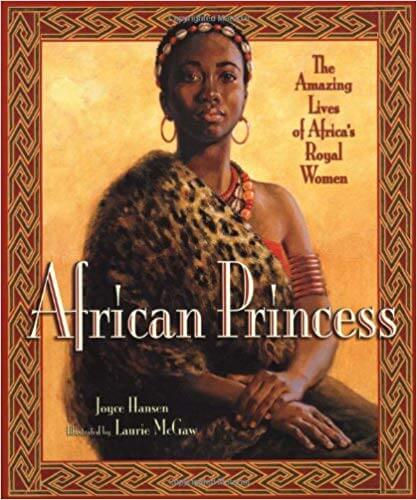
African Princess: The Amazing Lives of Africa’s Royal Women by Joyce Hansen and Laurie McGaw
This beautifully illustrated non-fiction book tells the true stories of 6 royal women from African history, including Queen Taytu Betul of Ethiopia. In a time when women had little formal power, Taytu used her education and clerverness to save Ethiopia from Italian attempts to colonize Ethiopia.
After Taytu discovered that a treaty between the two countries was worded differently in Amharic than it was in Italian, war broke out between the two countries. Ethiopia defeated Italy, making it and Liberia the only two nations in Africa that were never colonized by a European nation. Later, when her husband’s health began to fail, Taytu actually ran the country even though a cabinet of men was selected to direct the government’s affairs. (Recommended for ages 10+)
Two more books our family re-read to learn about Ethiopia
I’m a big fan of Africa Is Not a Country, which contains short vignettes about children living in 25 different African nations. We re-read the page on Ethiopia, in which Deehab and Makonne go to the visit the “Lucy” exhibit at the National Museum. Especially for children who are interested in science, studying about Lucy (one of the oldest fossils of a human ancestor ever found) is a great way to discover why Ethopia is sometimes called the cradle of humankind.
Ethiopia has the largest Orthodox Christian population outside of Europe; about 42 percent of the nation is Orthodox. Our family has learned about the different ways that Orthodox Christians celebrate Easter in the book Catherine’s Pascha. The storybook includes pictures of Orthodox churches around the world, including the Church of Our Lady Mary of Zion in Axum, Ethiopia.
Related Post: Learn about South Africa: Best Children’s Books and Activities
More ways for kids to learn about Ethiopia
Becky Morales of Kid World Citizen has beautiful and interesting pictures of her family’s trip to Ethiopia posted on her blog.
This post from Helen Iglar about teaching children art in Ethiopia is full of pictures of food, homes, historical sites, and more.
I love trying new foods from other countries, but my kiddo is a fairly picky eater. I think he’d love this spris drink, a layered juice that looks very easy to make.
Weaving on hand looms has a rich history in Ethiopia. Kids’ Activities Blog has some weaving practice ideas, inspired by Rachel’s trip to Ethiopia to adopt their children.
Eskista is a type of dance from Amharic Ethiopian culture that primarily involves moving the shoulders. Watch the video below to see children dancing eskista.
Interesting facts for kids about Ethiopia
- Ethiopia is only one of two nations in Africa that was never colonized by Europeans (Liberia is the other.)
- Ethiopia follows the Julian calendar, so there are 13 months in a year.
- One of the oldest skeletons of a human ancestor were found in Ethiopia, nicknamed “Lucy” by anthropologists. (Older kids can find out more about the discovery in Lucy Long Ago.)
- Coffee is extremely important in Ethiopian culture, and it’s considered impolite to refuse a cup of coffee.
- Ethiopia is thought to be the first country where Christianity was adopted as the official religion.
- Meat and dairy are generally not eaten on Wednesdays and Fridays for religious reasons.
- The Queen of Sheba, mentioned in both the Bible and the Quran, was Ethiopian. It is believed that the Queen’s encounters with Solomon are what brought Judaism to Ethiopia.
- The Mercato in Addis Ababa is the largest open air market in all of Africa.
- One of the most common foods in Ethiopia are injera (a bread made from the grain teff, that looks like a large pancake) . The second is wat (a spicy stew that can be made with a variety of different ingredients.)
- Amharic is the official language of Ethopia, but the country is very diverse ethnically, with more than 80 languages spoken.
- Amharic is written in the Ge’ez script, one of the oldest in the world.
- New Year is called Enkutatash and is celebrated in September. Enkutatash remembers three important events: the Queen of Sheba returning from Jerusalem, the start of the new farming year after the rainy season, and the life of the Christian Saint John the Baptist.
2 responses to “Let’s learn about Ethiopia: best children’s books & resources”
Your date for the Ethiopian New Year is incorrect
This is a useful and excellent share. Will definitely share it with people I know.
Please check my blog about Five Important Books About Ethiopia
Hope this will help. Thank you.