
So many kids are being introduced to mindfulness in their elementary schools. Many parents are also discovering the power of mindfulness practices to calm children, help them focus, and open their hearts to others. But did you know that there are ways to teach kids as young as age 2 about mindfulness? Keep reading to discover 7 ways to practice mindfulness with young children, at home and in the classroom.
If you’re new to mindfulness, you may not know that there’s a growing body of research that shows all kinds of benefits to children. So why not get started when they are young?


Disclosure: For your convenience, this post includes affiliate links. If you purchase items through these links, I may earn a small commission at no additional cost to you. You can read my full disclosure policy here.
1. Explore the calming power of touch by making a “starfish hand”
We can help toddlers and preschoolers calm their “big emotions” through the power of touch, combined with breathing. In his book on practicing mindfulness with children, Planting Seeds, Thich Nhat Hanh shares the starfish practice.
Ask your child to make one of their hands like a starfish by spreading out their fingers. Invite them to slowly trace each finger of their starfish hand, using the pointer finger of their other hand.
The combination of calming touch plus concentration is a powerful one. While it’s best to introduce this practice to children while they’re calm, once they know it, you might find them using when they’re upset or anxious.
2. Find ways to explain what we mean by “breathe”
When we practice mindfulness with young children, they’ll need some extra help understanding what we mean when we tell them to breathe.
Lie down together, and give each child a stone to place on their belly. First, invite them to simply watch the stones going up and down on their tummies. Then ask them to try something. How slowly can they make the stone go up, and then back down? Do this for several breaths. Then ask how quickly they can make it go up and down.
After each type of breathing, ask “how does your body feel right now?”
Another simple way to explore the breath is to just ask children to place a finger under their noses, so that they can feel the warmth of their breath on their fingers.
Let them know that our breath changes when we are excited, worried, or angry. Slowing down how fast we are breathing can help us calm our bodies down faster.
Related Post: Our favorite mindfulness for kids resource
3. Take a tummy ride
I love Barefoot Books’ Mindful Tots board books set, which help kids as young as age 2 practice mindfulness. In Tummy Ride, little ones discover that their breath moves like the waves of the ocean. This is a soothing book to read just before bedtime.
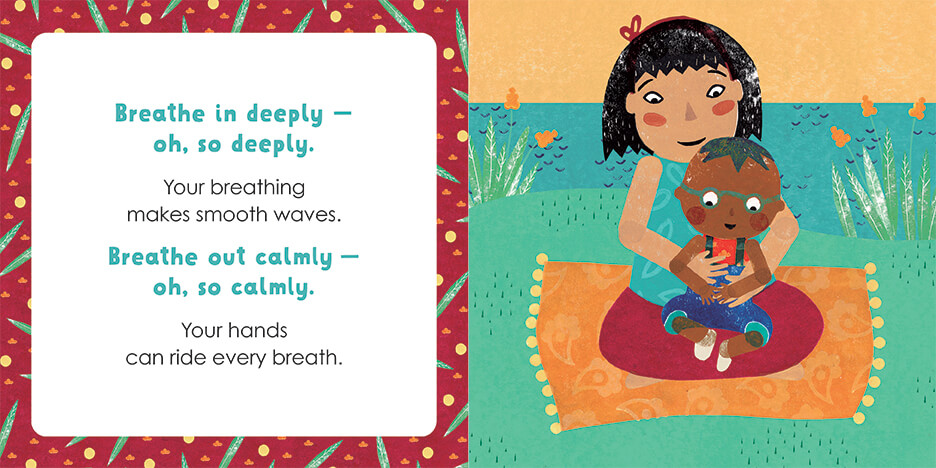
Loving kindness meditation is my favorite mindfulness practice, so I love that the second book in the set is titled Loving Kindness. It shows toddlers how we can share happiness, calm, and love with each other.
4. Use a simple silence ritual to bring calm to a group of young children
I recently started volunteering in the nursery at a new church we’ve been attending. I was delighted to discover that the children do a silence/mindfulness ritual at the same time that the adults are practicing silence in the worship service.
The ritual is short and physical, and it also helps calm and center the children before storytime. After the leader rings a chime, he tells the children “God’s light is in you.” The children respond “I carry the light of the world,” while reaching their arms out like a sunburst.
Both of these lines and the sunburst motion are repeated one more time. Then the group takes three deep, mindful breaths together.
Finally everyone says together “Love myself,” while hugging themselves, and “I open my heart,” while opening their arms. The ritual closes with the chimes ringing one more time.
For educators working in a non-religious setting, the beginning of the ritual could be changed to something like “Love is inside you,” to which the children could respond “I carry love in my heart.”
Get a free Mindful Kids activity pack with 3 activities that help children explore feelings and develop compassion. Just subscribe to my free Resource Library using the quick form below.
5. Use yoga poses during storytime
Another way to practice mindfulness with young children is through playful yoga poses, including during storytimes. You can use a book that already has yoga poses built right in, such as My Daddy is a Pretzel or Good Morning Yoga.
If you’re reading a book about animals, there’s a good chance you can find a matching yoga pose, since so many are named after animals.
You can find a wealth of storytime ideas that include yoga poses on the blog Kids Yoga Stories.
Related Post: Best children’s books about yoga and mindfulness
6. Use chimes to meditate
The set of Tibetan chimes in my son’s favorite thing in his peace corner.
Let your child ring the chimes a few times to explore the sound. Then tell them you’re going to ring the chimes, and you need them to listen very carefully. Ask them to raise their hand the moment they can’t hear the sound of the chime anymore.
Related Post: 13 diverse and inclusive #ownvoices books for toddlers
7. Practice mindfulness with young children by respecting their natural rhythms
If you’ve practiced mindfulness as an adult, you know that one of its tenets is being present in this moment, rather than looking forward to the future or back towards the past. Toddlers and preschoolers are very good at this, but often as adults we rush them to fit our needs and desires.
Look for ways to create a bit more space in your schedule so that young kids can move at their natural pace.
Getting up a few minutes earlier on school days could mean you won’t have to stop your 3 year old from staring intently at a dandelion in the front yard.
Related Post: How mindfulness makes me a better mom
