Teach your kids to “be a pain:” the connection between peaceful parenting and social justice
I love discovering family music about social justice issues. So, when I discovered Alastair Moock‘s song “Be a Pain,” I started playing it on repeat. The song tells kids about people like Rosa Parks and the Parkland High School activists. The chorus tells kids that when they see something that’s wrong, they should:
Be a pain, be a pain, shout about it and complain
Ignore the crowd and go against the grain
Don’t be polite, raise your voice and do what’s right
Be a pain, be a pain, be a pain.
What was interesting was watching our younger son’s reaction to the song. It made him uncomfortable. He told me “I don’t think you’re supposed to be rude and bother people.”
As I reflected on his discomfort with the song’s message, I realized that I needed to work on my peaceful parenting skills, so that he could see the value in things like expressing conflict openly and arguing with people in power (even if that includes me, his parent.)
I knew this was important because of my own experience as a young activist for social justice. When I was a community organizer, participating in delegations where we confronted employers about their abuse of their workers, I often felt conflicted.
I knew that what we were doing was right and just. But there was often a nagging feeling inside my head that also told me what I was doing was wrong. I was not being “nice,” and I was not following the rules that my upbringing as a white, middle class, Christian, Southern young lady had taught me.
If I had learned to speak up for myself more often as a child, I have a feeling I wouldn’t have hard that pesky, nagging voice in my head. (Or at least I wouldn’t have heard it as often.)
Disclosure: For your convenience, this post contains affiliate links. If you purchase items through these links, I may earn a small commission at no additional cost to you. You can read my full disclosure policy here.


Six peaceful parenting practices that encourage children to act for justice
1. Encourage your kids to express their big feelings and allow them to argue with you.
Often as adults, we encourage children to suppress their feelings in order to make us more comfortable. It’s upsetting to see our kids upset, and that can lead to remarks like “it’s not that bad” or “you have to stop crying now.”
For many of us, nothing is more triggering than a child expressing anger (especially if we were afraid to do so with our own parents.) Some of us grew up with a “no back talk” rule that was swiftly enforced. Others got more subtle messages that it wasn’t okay to be in conflict with family members.
It’s been helpful to me to explore how a fear of open conflict is a characteristic of white supremacy culture. If I teach my children to suppress their anger or become impatient when they argue, that will carry over into the wider world.
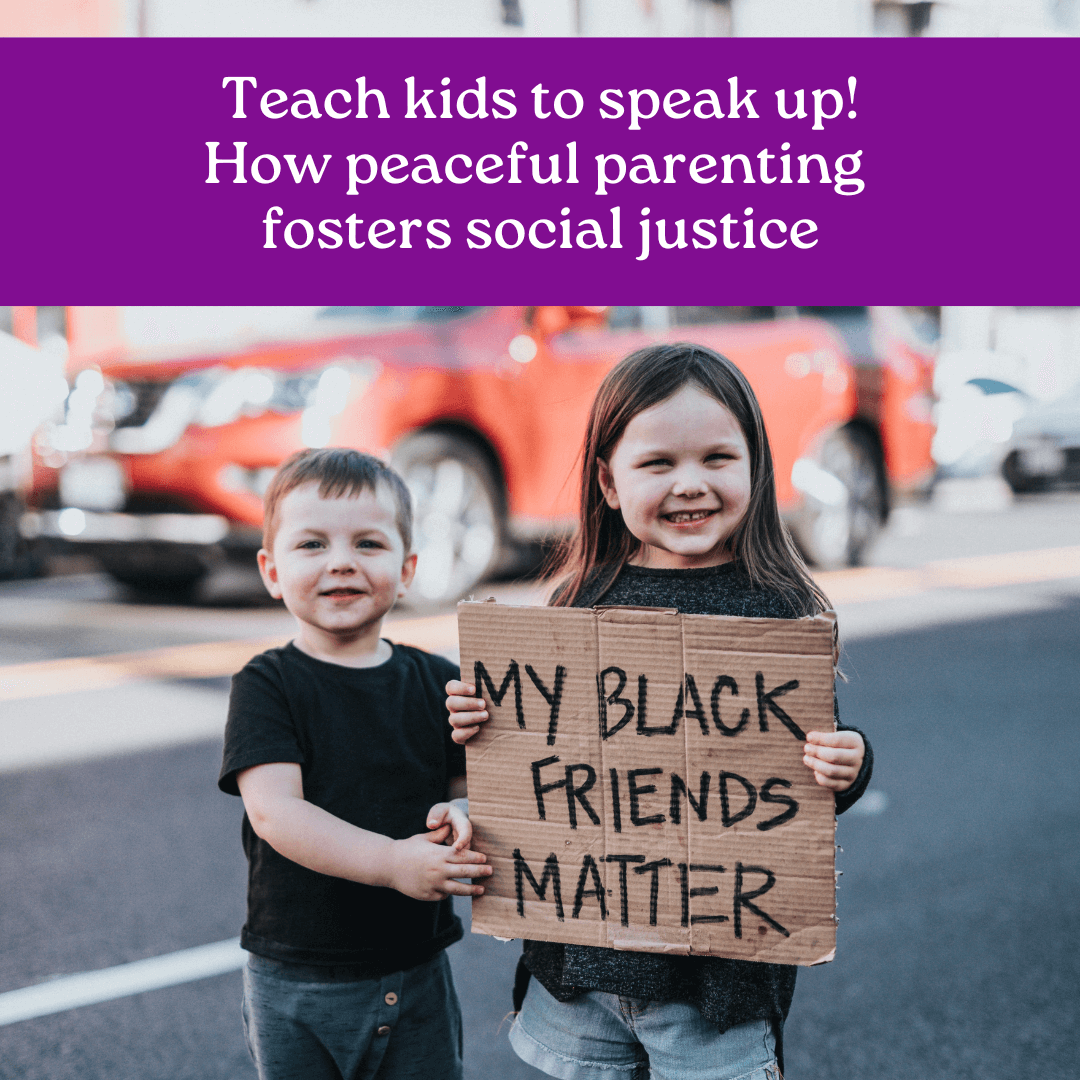
It leads to disdain for activism because it makes people in power uncomfortable. For example, how many times have white people complained about Black Lives Matter activists’ tactics? This pretends that there is a polite way to convince people who are oppressing you that they should stop doing so.

2. When injustice happens, share some of your feelings and reactions happening in your body.
As a white person, I’ve been taught to intellectualize racial and social injustice. It’s much more comfortable for me to approach these topics by talking about their historical roots or bad policies than it is to be vulnerable about my feelings.
But we cannot understand the impact of these systems of oppression, on ourselves and on others, if we don’t engage our emotions and our bodies. (If you’re not sure how to go about this, I highly recommend Resmaa Menakem’s book My Grandmother’s Hands: Racialized Trauma and the Pathway to Mending our Hearts and Bodies.)

Last year, Ali Michael (a white antiracist trainer who works with educators) shared in a workshop that she believes if white people could really sit with and experience our feelings about racism, we would have all the motivation we needed to stay in the fight for racial justice.
When something happens in our neighborhoods or on the news, we can model to our kids expressing our feelings and noticing what’s happening in our bodies. We can support children who have trouble naming their own feelings by asking about how their stomachs or shoulders or jaws feel. This is helpful in all kinds of situations, including during painful times in your own family.
3. Learn about people who have “been a pain” as they challenged injustice, including kids
While it’s certainly inspiring and helpful for children to learn about adults who were leaders for justice, it’s even more powerful to find leaders who are kids and teens.
Talk about their stories. Notice the different ways to act for justice. Not everyone’s talents are the same, and our personalities vary too. I love the picture book Pies from Nowhere, which tells how Georgia Gilmore helped fund the Montgomery Bus Boycott through elaborate bake sales. Not everyone has to be an inspiring public speaker or on the front line of a march.

In This Book Is Anti-Racist, Tiffany Jewell helps tweens and teens identify their unique superpowers that can be used for anti-racism.

Here are some more resources to get you started with kid activism:
7 inspiring kid activists against racism
The Alphabet Rockers (hip hop music videos and an antiracism mini course for kids)
12 unsung social justice activists and the children’s books that tell their stories
Marley Dias’ lessons for kid activists
“Raising Kids for a Just World” (podcast episode by Cindy Wang Brandt)
4. Don’t make excuses for adults who treat children disrespectfully
Peaceful parenting requires that we confront and challenge adultism when it shows up in ourselves and in others.
John Bell describes adultism as
behaviors and attitudes based on the assumption that adults are better than young people, and entitled to act upon young people without their agreement. This mistreatment is reinforced by social institutions, laws, customs, and attitudes.
(I learned this definition in Iris Chen’s book Untigering: Peaceful Parenting for the Deconstructing Tiger Parent. It’s an incredible, practical resource on peaceful parenting that makes lots of connections to social justice.)

When an adult demands a hug or tickles a child without asking first, the child may understandably get upset. (If you’re not sure why, imagine someone doing this to you. It would be socially unacceptable.)
What happens if we make excuses for that adult, instead of helping our child speak up about their feelings? For one, we’re showing our children that we’re siding with a more powerful person (the adult) than with them. That damages trust.
It also (unintentionally) teaches kids to doubt the claims of injustice made people who have less social power. Whether it’s sexual harassment or a racist comment made at school, I want my children’s first impulse to be to honor the courage of the person who has spoken up. (Or to honor their own courage if they’re the ones who have broken the silence.)
Related Post: Parenting practices that seek justice with our kids and for our kids
5. Apologize when we make mistakes and look for ways to repair the harm we’ve caused
Since adultism is rampant (but mostly unquestioned) in society, it can feel awkward when we first start apologizing to our children. But even the most conscious parent will sometimes lose their temper or do something that in hindsight is unfair.
When we apologize, we’re of course strengthening our bond with a child. We’re also modeling making amends, because there are also times when they will need to do that with us or with peers.
But there’s also a larger pattern that can start with adults apologizing, especially when that apology is accompanied by an attempt to make things right. We’re showing our kids an alternative to denying and being defensive when confronted with larger patterns of harm, like racism and homophobia. Admitting mistakes and repairing harm are important parts of antiracism and other social justice work.
6. Find other parents who share your commitment to peaceful parenting and social justice
Peaceful parenting and standing up for justice both go against the grain of mainstream society. If we don’t find community with others who share our commitments, we’ll end up exhausted and burnt out.
If you’re not sure where to find local community, let me recommend two virtual communities that have been hugely helpful to me.
The first is the Conscious Parenting for Social Justice Collective, organized by Yolanda Williams of Parenting Decolonized and parenting coach Domari Dickinson. In the collective, we use monthly themes like “parenting beyond the binary” and “understanding our biases” to get really practical about how social justice and peaceful parenting intersect (or don’t) in our lives.
The second resource is especially good for liberation-minded educators and homeschooling families. The My Reflection Matters Village is a virtual co-learning community for primarily BIPOC families who are committed to raising free people (white co-conspirators are welcome as well.)