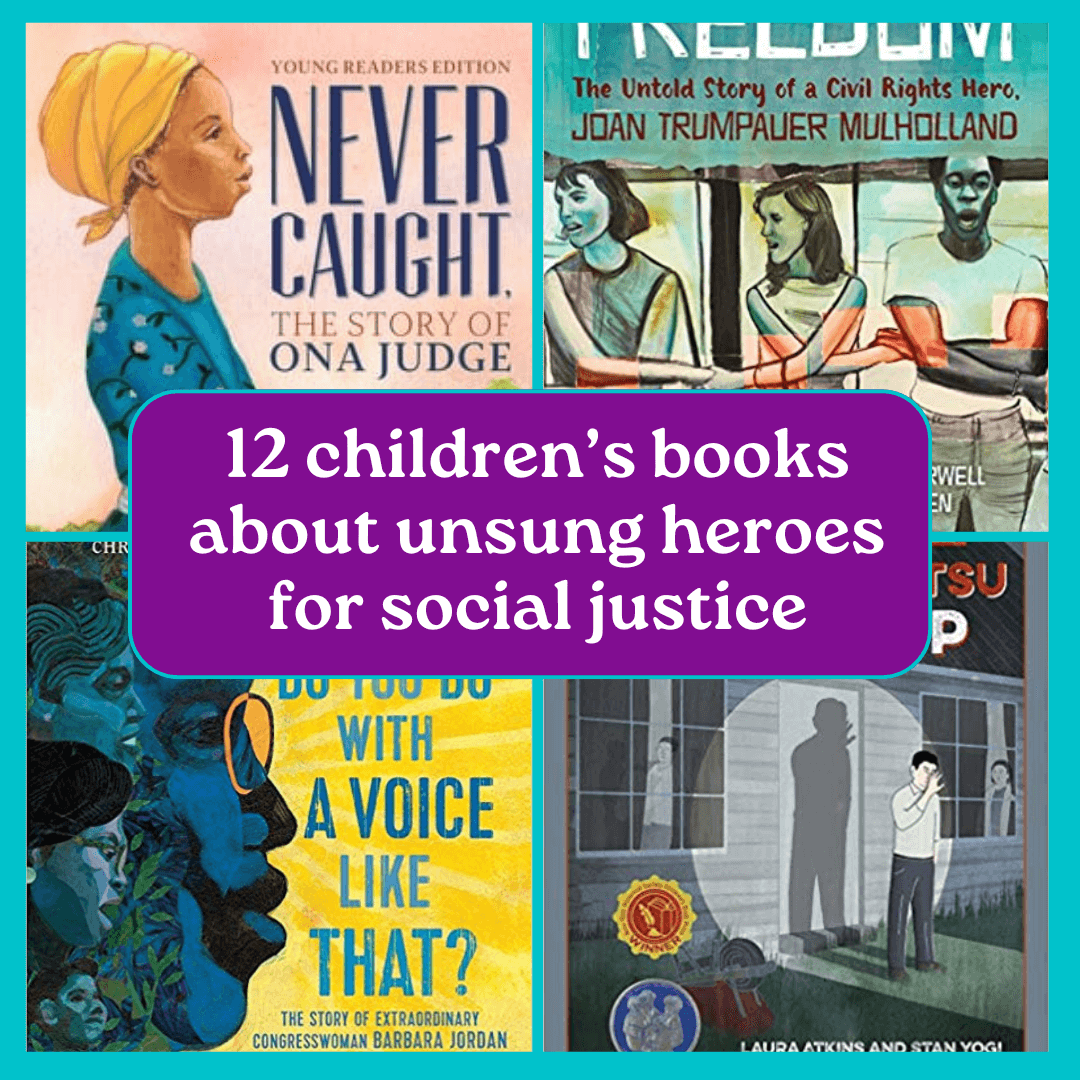
If you’re a regular reader of this blog, you’ve probably told kids about at least a few social justice activists. Maybe you’ve read them a book about Harriet Tubman, Martin Luther King, Jr., or Malala Yousafzai.
But have you told them the story of Ona Judge, the courageous slave who ran away from George and Mary Washington? Or Pura Belpré, the librarian who revolutionized outreach to Spanish speaking families at a time this was unheard of?
There’s so many reasons to introduce children to these unsung social justice activists.
For one, their stories are inspiring. These activists teach kids so much about the challenges and opportunities we have to make our world better.
Secondly, telling the stories of less famous activists shows kids their own potential. All of us, not just those who make it onto the evening news, can work for justice.
Read on to discover unsung leaders, and the children’s books that tell their stories of these social justice activists who’ve changed the world.


12 children’s books that tell the stories of unsung social justice activists

Disclosure: For your convenience, this post includes affiliate links. If you purchase items through these links, I may earn a small commission at no additional cost to you. You can read my full disclosure policy here.

Someday Is Now: Clara Luper and the 1958 Oklahoma City Sit-Ins by Olugbemisola Rhuday-Perkovich and Jade Johnson
Are you familiar with the major events of the civil rights movement? If yes, you probably know about brave students in Greensboro, North Carolina who desegregated lunch counters in their city.
But did you know an Oklahoma elementary school teacher – and some of her young students – did the same thing in Oklahoma 2 years earlier? As a teacher, Luper frequently told her students that you couldn’t just “sit there on your constitutional rights.” You had to take action.
After Luper took her students on a trip to New York City and Washington, D.C., they felt the insults of segregation even more strongly. She taught the children the four steps of nonviolence: investigation, negotiation, education, and demonstration.
Luper and her students used these four steps to desegregate lunch counters at the Katz drugstore chain, even as white people threw food at them. She worried that her students’ spirits might be crushed by the hatred they had faced on the first day of the demonstration. Instead they came back, bringing more friends with them to protest. (Recommended for ages 7 – 10)
Related Post: More Than Martin: 15 Children’s Books about the Civil Rights Movement

Planting Stories: The Life of Librarian and Storyteller Pura Belpré by Anika Aldamuy Denise and Paola Escobar
Who are libraries for? Today, most of us who quickly say “everyone!” But in 1921, when Puerto Rican immigrant Pura Belpré applied for a job at the New York City public library, many Spanish-speaking families did not think the library would welcome them.
As a bilingual assistant, Belpré was eager to share the Puerto Rican folktales her grandmother told her as a child. She filled children with delight as she recounted the tales during library story hours. This creative librarian even began making her own puppets to make the stories even more captivating.
Yet when she looked on the shelves of the massive library, there were not any children’s books in Spanish.
She wrote her own children’s book, so that she could keep planting story seeds. Soon she was traveling far beyond the library and even across the country, to tell the stories that were so precious to her. (Recommended for ages 3 – 7)
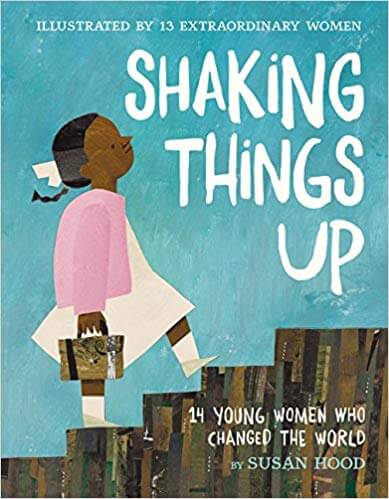
Shaking Things Up: 14 Young Women Who Changed the World by Susan Hood
There are many remarkable women’s stories told in this book, including several social justice activists. The one I was surprised and delighted to find was Frances Moore Lappé.
Lappé is an anti-hunger activist who made a big impact on my life when I was a college student. Reading her book Diet for a Small Planet was one the first things that nudged me into a life of activism.
During the 1970’s, some prominent thinkers claimed that world hunger was inevitable. Lappé’s careful analysis found that “hunger is human made.” If Americans and other wealthy people would eat less meat, there would be more than enough to feed everyone.
Her work started a revolution for both the planet and its peoples that continues today. (Recommended for ages 6 – 10)
Related Post: 7 Inspiring Young Social Justice Activists


Fred Korematsu Speaks Up by Laura Atkins, Stan Yogi, and Yutaka Houlette
Fred Korematsu’s life was turned upside down in 1942. He, along with tens of thousands of Japanese Americans, was ordered to report to an internment camp. But Korematsu knew that the internment order was morally wrong, so he went into hiding.
He was caught, jailed, and then sent to the same internment camp where the rest of his family had been forcibly relocated. He continued his resistance to this injustice by suing the government. His case went all the way to the Supreme Court. Korematsu lost, but decades later this social justice activist was a leader in winning restitution for Japanese Americans who were interned.
This book tells Korematsu’s story through a combination of poems, photographs, paintings, and informational text. The book also asks children questions that help them identify with his story. (Recommended for ages 9+)
Related Post: 15 Children’s Books for Asian American and Pacific Islander History Month

Emmanuel’s Dream: The True Story of Emmanuel Ofosu Yeboah by Laurie Ann Thompson and Sean Qualls
When Emmanuel Ofosu Yeboah was a baby, many people dismissed what he could do. That’s because he was born with only one strong leg. But Emmanuel’s mother had faith that he could still find a way to make his way in the world, despite all the obstacles for disabled people in Ghana.
As a child, Emmanuel figured out how to do many things other children did, from playing soccer to even riding a bicycle with his one strong leg.
When his mother became ill, he knew that he must travel to the city to earn money for their family. He often met people who assumed he only wanted to beg from them. But Emmanuel was determined to show them that “being disabled did not mean being unable.”
And so, Emmanuel decided to make an incredible journey, riding his bicycle for 400 miles across Ghana, in just 10 days. His activism continues to challenge many people’s ideas about what people with physical disabilities can do. (Recommended for ages 4 – 8)
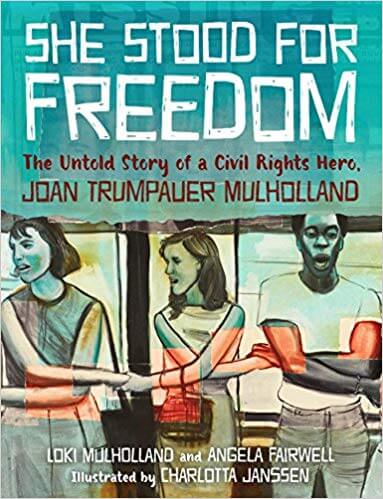
She Stood for Freedom: The Untold Story of a Civil Rights Hero, Joan Trumpauer Mulholland by Loki Mulholland, Angela Fairwell, and Charlotta Janssen
As a white child growing up in the South, Joan Trumpauer Mulholland realized Black people weren’t treated as equals. She promised herself she would do something about that.
She joined the civil rights movement while in college, and quickly had to leave segregated Duke University because of it.
Joan knew that many of her family members might cut her out of their lives because of her activism, but she joined the lunch counter sit-ins anyway.
Even after Joan was sent to the notorious Parchman Prison for participating in the Freedom Rides, she continued to speak up and take action. Because her activism spanned so many important events of the civil rights movement, this book is a great introduction to its history for older elementary children. (Recommended for ages 8 – 12)
Related Post: 7 inspiring ways that kid activists are challenging racism

What Do You Do With a Voice Like That? The Story of Extraordinary Congresswoman Barbara Jordan by Chris Barton and Ekua Holmes
Even as a child growing up in Houston, Barbara Jordan’s voice made people take notice. As a high school student, Jordan decided that being a lawyer was the best way she could use her voice. Not many Black women had done that in the 1950’s, but Jordan believed she could.
Yet once she was a lawyer, she found the political process inspired her far more than practicing law. She believed her voice as a social justice activist would make a greater difference than working in the law office. As a Texas state senator, her voice advocated for changes like better pay for farmworkers.
Not long after she was elected to the U.S. Congress, the Watergate scandal happened. Jordan made a compelling, clear speech about it that captured the attention of the nation. During her years in Congress, she spoke up often for those who had less power.
What might Jordan do next? Run for Senate, or even the Vice Presidency? What people didn’t know is that Jordan was struggling with multiple sclerosis. So she decided that the best place to use her voice was back home in Texas, where she inspired thousands of students as a college professor. (Recommended for ages 6 – 10)
Related post: 11 illustrated collections of social justice poetry for children
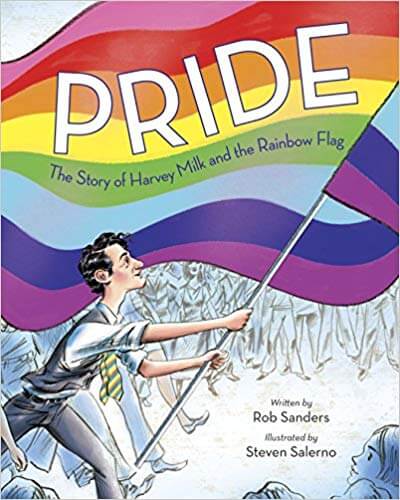
Pride: The Story of Harvey Milk and the Rainbow Flag by Rob Sanders and Steve Salerno
Since attending our city’s Pride Festival last year, my 7 year old has loved the rainbow flag. This children’s book tells the story of how the rainbow flag became a symbol that gave LGBTQ people hope that tomorrow would be better.
When Harvey Milk was elected to be a supervisor for the City of San Francisco in 1977, he became one of the first openly gay Americans to hold public office. At a time when California still had many discriminatory laws against gay people on the books, Milk won a San Francisco law that banned discrimination based on sexual orientation in housing, public accommodations, and employment.
Harvey asked artist Gilbert Baker to help him come up with a symbol that could be used at an upcoming march against laws that hurt gay people. As the story continues, children get to see how people have used the rainbow flag in many different ways, by social justice activists all around the world.
Caregivers should be aware that while the book does not go into detail, it does mention that Harvey Milk and George Moscone were assassinated. (Recommended for ages 6 – 10)
Related Post: 12 LGBTQ Affirming Picture Books for Kids
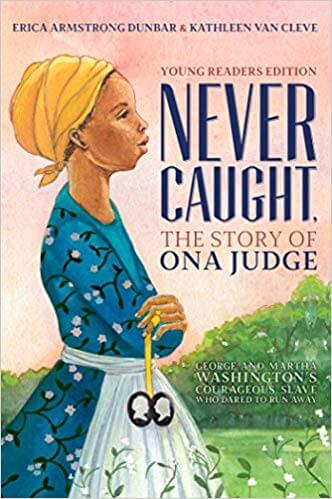
Never Caught: The Story of Ona Judge (Young Readers Edition) by Erica Armstrong Dunbar and Kathleen Van Cleve
More than 50 years before Harriet Tubman escaped slavery, and years before the Underground Railroad began, Ona Judge did something remarkable. This enslaved young woman, who was First Lady Martha Washington’s personal attendant, escaped to freedom.
Even after President Washington sent associates to find her in New Hampshire, Judge calmly told one that “I am free now and choose to remain so.” Judge then temporarily went into hiding to protect herself and her infant daughter from being captured.
This outstanding book not only tells middle school readers Judge’s courageous story. It also clearly explains the national debate over slavery as the United States began, and how that debate was changing. This book also adds much needed complexity to how the story of President Washington is usually told to students. (Recommended for ages 11+)
Related Post: How should we talk with children about slavery?
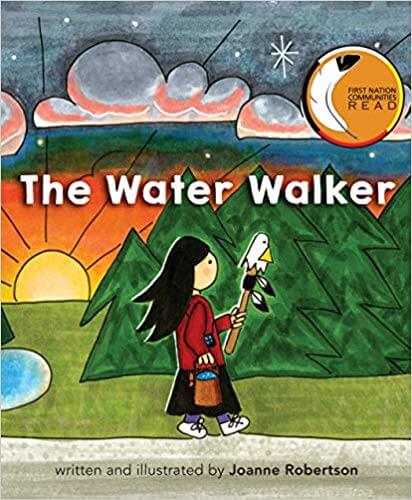 The Water Walker by Joanne Robertson
More people should know the name of water walker and environmental activist Josephine Mandamin. Thankfully, The Water Walker tells the story of this Anishinabek elder who is widely acknowledged as the pioneer of the water walk movement. Before Mandamin passed away earlier this year, she walked more than 25,000 miles as she advocated for water ways.
In the book, a young girl listens as her Nokomis (grandmother) learns their water is at risk. She watches Nokomis gather her sister and her friends to walk along the Great Lakes and the St. Lawrence River. Nokomis begins speaking in the media about the pollution they are seeing on their water walks.
Soon, people from other Native American nations are joining in their movement. The book shows Nokomis giving thanks for the water, but also asking the young readers a question. What will they do about what is happening to the water? (Recommended for ages 4 – 8)
Related Post: 9 ways kids can protect the planet, on Earth Day and every day

Carter Reads the Newspaper by Deborah Hopkinson and Don Tate
You’ve heard of Black History Month. But have you heard of social justice activist and historian Carter Woodson, who founded Black History Month?
Before he earned a PhD in history from Howard University, Woodson was a coal miner. The son of parents who had been enslaved, he wasn’t able to start high school until he was 20 years old. But before he started school, he educated himself by reading the newspaper, and researching the questions the paper didn’t answer.
At Harvard, a professor told Woodson that Black people had no history. Woodson knew that “no people lacked a history,” and spent the rest of his life proving his professor wrong. In 1926, he started Negro History Week, which later became Black History Month. He worked tirelessly to build the movement by sending out pamphlets to schools, churches, colleges, women’s organizations, and newspapers.
Woodson changed the way people thought about history, by reminding us that true history includes all people. (Recommended for ages 5 – 9)
Related Post: 60+ Children’s books and resources for learning Black history all year round

I Am a Farmer: Growing an Environmental Movement in Cameroon by Baptiste and Miranda Paul and Elizabeth Zunon
As a child, Tantoh Nforba loved plunging his hands into the squishy dirt in his grandmother’s garden. He loved asking questions, whether it was about how things grew or asking countless questions in school about topics like biology and weather.
Nforba’s classmates nicknamed his Farmer as an insult, but turned the nickname into his own personal badge of honor. In college, he learned about the importance of clean water not only in his lessons, but when he contracted typhoid.
In the seven years it took him to recover, Nforba decided that he would dedicate himself not only to farming, but to farming in a way that will bring clean water to people. While some laughed at his efforts, many more people joined his movement. Because like Tantoh Nforba, they believe that “water is life.” (Recommended for ages 4 – 8)