
If there’s one thing I’ve learned in my antiracism journey with children, it’s that we adults have to do our own work. This work is life-long; we can never say that we’re finished. Whether you’re just getting started with antiracist education or have engaged for a long time, here are seven ideas for deepen your own learning.
First, though, let me share my thoughts on pacing yourself. As I write this post, educators have finished an incredibly hard year of pandemic schooling. I believe that rest is a form of resistance to oppression, so I hope you’re finding ways to engage in rest and joy this summer.
Also for those of us who are white, it’s common to dive in with a sense of urgency that can be counterproductive in the long run. We may try to make up for a lifetime of unawareness or silence with a sudden sprint of learning that soon burns us out. What’s needed is a long-term commitment.
So I recommend that you choose one idea from this post (or one book, one website to explore, etc), and dive deep into that resource. Because antiracist education is so important, we must go slowly and deeply.
Going slowly creates room for us to apply what we’re learning, so that we can change ourselves and our classrooms. Remember that transformation is the goal, not acquiring knowledge for its own sake.


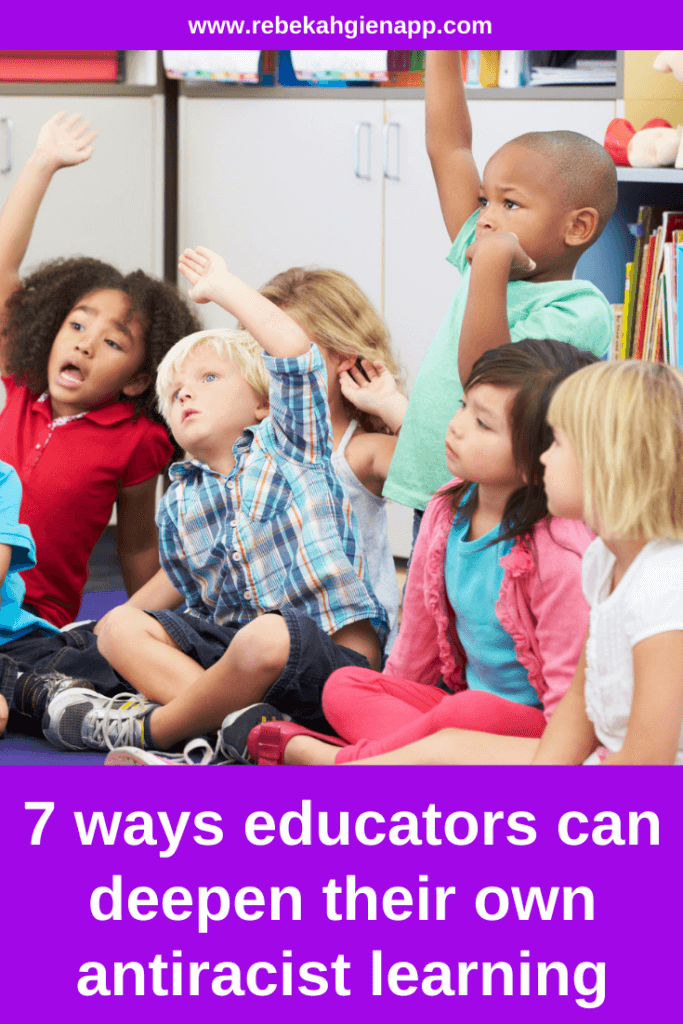
7 ways teachers can engage in their own antiracist education
Disclosure: For your convenience, this post includes affiliate links. If you purchase items through these links, I may earn a small commission at no additional cost to you. You can read my full disclosure policy here.
1. Learn about racial identity development
Black psychologist Dr. Janet Helms pioneered the field of racial identity development to describe how white and Black individuals understand what it means to be white or Black in a race conscious society.
I learned about her work through Dr. Beverly Daniel Tatum’s excellent book Why Are All the Black Kids Sitting Together in the Cafeteria? And Other Conversations About Race. (Tatum also outlines how racial identity typically develops in different groups of people of color who are not Black.)
The goal of racial identity development is to arrive at a positive racial identity that includes resistance to racism. Of course, the path to positive identity is different for people of color and for white people. The forms that resistance to racism take will also look different depending on our race.
This tool is so helpful for me in understanding why I’ve reacted in certain ways to racist incidents, and how I can begin to change my reactions when they’re not helpful. It’s also helped me be empathetic toward white people who are just getting started on their journeys of understanding race, instead of pushing them away.
Of course, this tool only works if you apply it to your own life! I recommend journaling on this topic or talking it over with a friend who is your same race. Here are some resources to support you:
- Dr. Tatum’s discussion guide for her book.
- Racial identity development worksheet packet developed by Dr. Sandra “Chap” Chapman (includes worksheets for a variety of racial groups. Click on the button that says “full packet racial-ethnic id models.”)
- For white people: Dr. Jennifer Harvey’s book Raising White Kids includes a chapter on what it means to help white children develop a positive racial identity
- I wrote more about how racial identity development impacts white kids in this blog post.

2. Audit your classroom library or required reading list
High quality diverse books are a key part of antiracist education for children.
In the middle of the hustle and bustle of the school year, it can be hard to zoom out and look at the big picture of what resources you’re offering students. Summer is a great time to look at your overall classroom library (or the list of books you assign for reading).
Which people and what stories are missing? What messages or unintended stereotypes might your book collection be communicating to students? This audit might mean removing some books from your collection, as well as making a wish list of books you’d like to add to your library.
I’ve curated a printable list of my favorite diverse books for each year of life, from age 2 to 12. I also include books to avoid (or at least unpack with children rather than leaving out on the bookshelf for students to look at without guidance) because of racist content. Get your free copy by filling out the form below.
I also describe how to do a book audit with children’s participation (good for the home or classroom) in my book Raising Antiracist Kids: An age-by-age guide for parents of white children.
Related Post: 5 types of anti-bias children’s books that belong on your shelf
3. Explore how social emotional learning and antiracist education can be practiced together
Social emotional learning (SEL) is a key component of antiracist education, but only if SEL is developed with an explicitly antiracist lens.
Social emotional learning that ignores the effects of racism (and other forms of bias) upholds oppression. Antiracist education that focuses only on imparting information about race, without addressing how racism continually shows up in our minds and bodies, is ineffective.
Find out more about this topic in my post “why social emotional learning must be antiracist.” I include plenty of tools and resources from educators and SEL experts to help you.
4. Journal or talk with a friend about how your racial biases or how racism impacts you
For those of us who are white: it’s time to be honest with ourselves. Society encourages us to proclaim we’re not racist and point the finger at others. But as Beverly Daniel Tatum says “racism is like smog.” We can’t help but breathe it in and be influenced by its pernicious beliefs.
But white folks can reduce our racial biases by facing them. Talking with another white person who’s on the path to antiracism can be transformative. (Please do not burden your friends or colleagues of color with talk about your biases unless they’ve invited you to do so. This can be re-traumatizing for people who already face racism every day.)
If you’re a person of color looking for community with other educators and parents committed to liberation and antiracism education, I recommend My Reflection Matters Village. Not only does the Village offer a variety of speakers and resources, it’s also a great place for honest, compassionate conversation. (White co-conspirators are also welcome, as long as we recognize that the village is a place to center the voices of Black and Brown people.)
5. Learn about white supremacy culture and examine how it shows up at school
The phrase “white supremacy” often conjures up images of the Klan and neo-Nazis. But the truth is that we all live in a society rooted in white supremacy, and it impacts us all. Facing this, and figuring out how to change it, is a crucial piece of antiracism education.
Years ago, Tema Okun and Kenneth Jones developed a list of ways that white supremacist ideas show up in our culture. Many of the characteristics on their list might not seem to be about race at first glance. It sometimes takes deeper reflection to see how practices like perfectionism, individualism, and a fear of open conflict are rooted in white supremacy.
Recently Okun, in collaboration with many others, launched a wonderful site full of resources to help people understand white supremacy culture and how to divorce ourselves from it.
After exploring the site, dive deeper into one or two of the characteristics. How does it show up in your habits, in your relationships with students and colleagues, and in your school climate? How can you embrace some of the recommended antidotes? Who else at your school might want to help develop these antidotes?
6. Read a book about antiracist education
Before I share a few antiracist books I recommend for educators, remember my advice at the beginning of this post? The goal is not to read (or accumulate) a huge pile of books for its own sake. Read and reflect at a pace that you can actually implement change in your life!
Books for beginners:

Start Here, Start Now: A Guide to Antibias and Antiracist Work in Your School and Community by Liz Kleinrock. Purchase from Bookshop.org (supports independent bookstores!)

Raising Antiracist Kids: An age-by-age guide for parents of white children by Rebekah Gienapp. (Written with parents in mind, but lots of good info for educators too.) Find purchase options here.
Books for folks who beyond the beginner stage:

Teaching for Black Lives by Rethinking Schools (especially good for middle and high school, though there are some elementary resources.) Purchase from Bookshop.org (supports independent bookstores!)
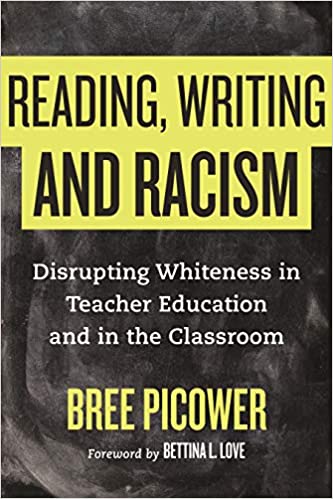
Reading, Writing, and Racism: Disrupting Whiteness in Teacher Education and in the Classroom by Bree Picower. Purchase from Bookshop.org (supports independent bookstores!)
7. Contact lawmakers about bills banning critical race theory in the classroom
Currently there are a slew of bills being passed or debated in state legislatures that restrict how educators can teach about racism (or “critical race theory,” which actually has a very specific meaning) in the classroom.
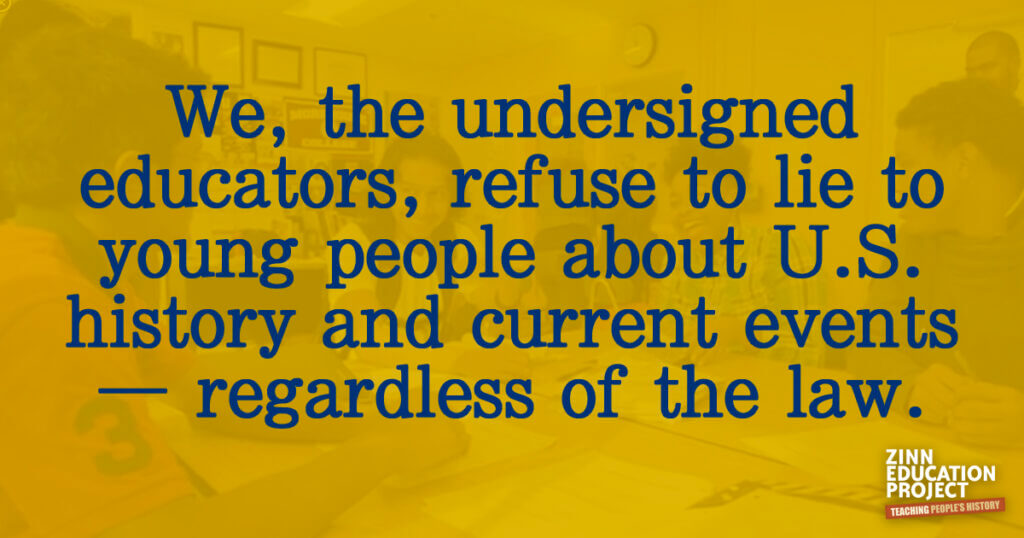
The Zinn Education Project is asking teachers to sign a pledge to teach the truth about racism in history, despite these state bills. After signing the pledge, consider writing an individual email or letter to your state legislators, which will have even more impact.