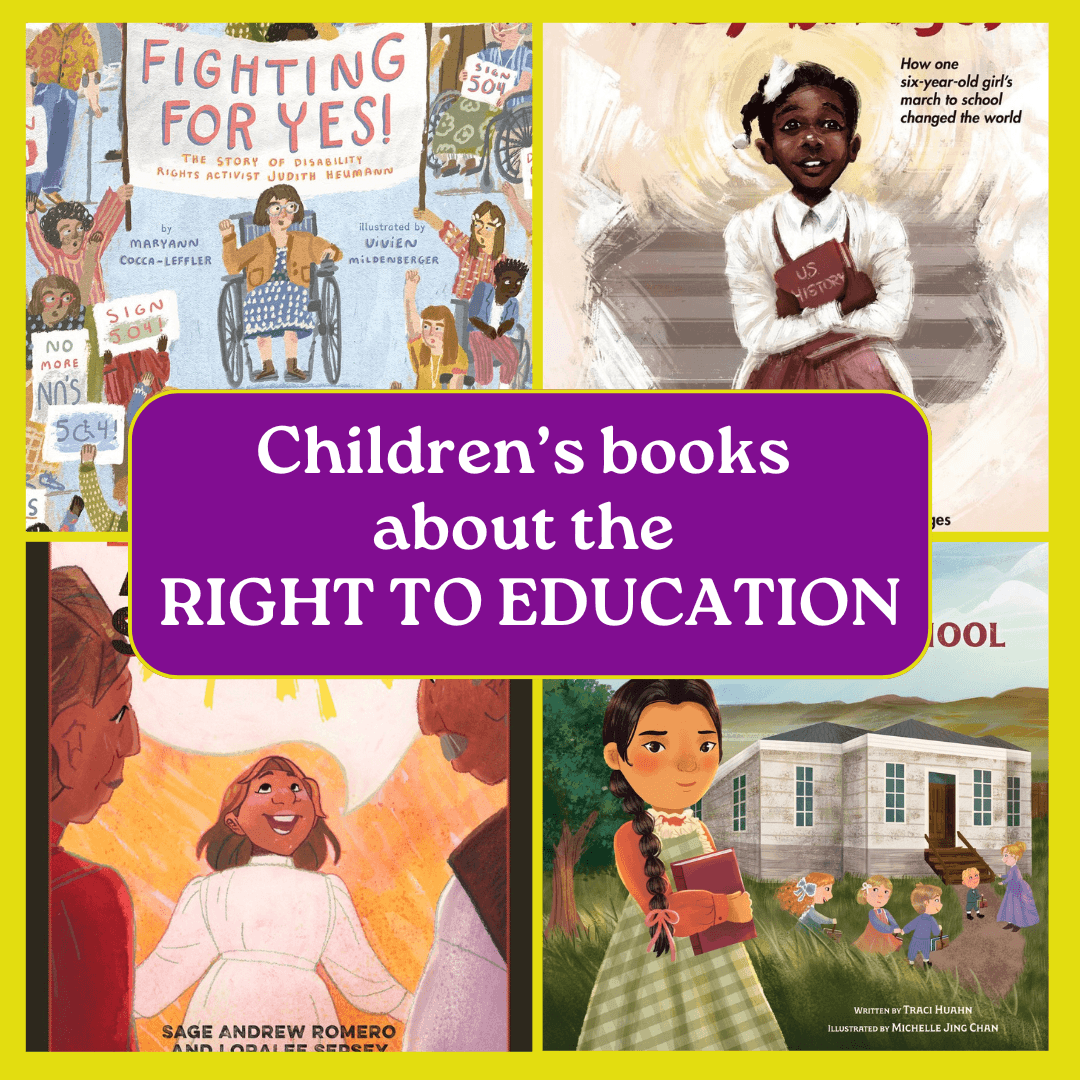
Today, many take it for granted that all children’s right to education will be respected, regardless of race, disability, or immigration status. (Given the realities of de facto school segregation and recent attacks on the rights of disabled and immigrant students, I’d argue we shouldn’t assume these rights will always be respected.)
It’s important to share with children the stories of how Black, Native American, Latine, Asian, disabled, and undocumented immigrant communities fought for the right to education for their children. In this post, I share picture and chapter books from a wide variety of time periods about kids who have fought for a quality education.


This post may include affiliate links. If you purchase items through these links, I may earn a small commission at no additional charge to you. I received a free digital review copy of Alice Piper Speaks Up! in exchange for my honest review. All opinions are my own. You can read my full disclosure policy here.
Picture books about the right to education for all children

I Am Ruby Bridges by Ruby Bridges. Illustrated by Nikkolas Smith.
Purchase from Bookshop.org (supports independent bookstores and my business!)
There are a number of children’s books about Ruby Bridges (including several she has written herself). What makes this account unique is that Bridges decided to write it from the perspective she had as a 6-year-old.
When Ruby’s parents enrolled her in New Orleans’ William Frantz Elementary School in 1960, she didn’t understand much of what was happening. When she began attending a Black school, her main concern was whether other kids would think the name “Ruby” sounded ancient, like she did. Her parents told her she’d be taking a test to attend a school with more opportunities. She didn’t know what it meant when people kept talking about her being “the first.”
When her classroom at her new school was empty (except for her teacher), she assumed it was because the test she passed must have been really difficult. She gradually grasped what was happening and began to imagine what her classroom would be like once it was filled with both white and Black students.
Smith’s expressive illustrations convey both swirls of motion and emotion. Bridges’ unique perspective in retelling this story will help children connect with this historic event in a new way. (Recommended for ages 4 – 8. Black author.)
Related post: Children’s books about the civil rights movement

Mamie Tape Fights to Go to School by Traci Huahn. Illustrated by Michelle Jing Chan.
Purchase from Bookshop.org (supports independent bookstores and my business!)
In the 1880s, racist discrimination against Chinese Americans was rampant. Mamie Tape’s parents were determined to enroll her in their local San Francisco school, even though the law didn’t allow Chinese children to attend school.
Using the refrain “the journey of 1,000 miles begins with a single step,” Mamie and her parents are shown fighting for her right to education in every possible way. When turned away by the principal, they approached the school superintendent. After that didn’t work, they hired a lawyer and pursued a court case. While the court ordered that Mamie must be allowed to attend school, the principal continued to make excuses for why she couldn’t attend. Eventually the school board decided to open a separate Chinese school to meet the court’s orders, which Mamie and her brother attended.
It’s important for children to know that most struggles for justice last a very long time and aren’t easily won. Even though the Tapes’ fight didn’t end with the just outcome they wanted, their refusal to accept racism and injustice should be celebrated. (Recommended for ages 5 – 9. Chinese American author.)
Related post: Children’s books about Asian and Pacific American history and heritage

We Want to Go to School! The Fight for Disability Rights by Maryann Cocca-Leffler and Janine Leffler.
Purchase from Bookshop.org (supports independent bookstores and my business!)
While legal cases establishing the right to education for all children regardless of race were decided by the 1950s, cases about the rights of disabled students came later.
It’s difficult for most children today to imagine, but just a few decades ago, many disabled children were not allowed to attend public school. Co-author Janine Leffler, who has cerebral palsy, opens the story by sharing how valuable her time in school was. However, if she had been born even a decade earlier, she might have been one of the children who was denied an equal education.
It’s thanks in part to the tireless fight of seven Black school-age children and their families in Washington, DC during the early 1970s that today all disabled children are entitled to equal public education. With specific examples and expressive cartoons, children will be drawn into this important history. (Recommended for ages 5 – 9. Disabled co-author.)
Related post: Children’s books that shatter stereotypes about disability

Free to Learn: How Alfredo Lopez Fought for the Right to Go to School by Cynthia Levinson. Illustrated by Mirelle Ortega.
Purchase from Bookshop.org (supports independent bookstores and my business!)
The right to education for all children, including undocumented immigrants, was established by the Supreme Court in the early 1980s. Still, many state legislatures (including my own) are trying to deny this right. That makes this fictionalized account of Alfredo Lopez’s 1977 case in Texas a particularly relevant one to learn about with children.
Alfredo had attended school in Tyler, Texas the year before, but a new state law barred undocumented children from attending school. While Alfredo’s younger brother was born in the United States, he and his parents did not have papers. Despite their fears of retribution, his parents agreed to fight in court for Alfredo’s right to attend school.
With parallel sets of illustrations at the beginning and end of the story, readers see Alfredo wondering what he’s missing at school and then experiencing life with his classmates once the case is decided. The story book has a strong emphasis on fairness and the sacrifices that Alfredo’s family made for their children. I recommend this book with a couple of caveats. First, the author uses the phrase “you are illegal” when describing the discriminatory Texas law, and she doesn’t provide any pushback or context for young readers about why this phrase is hurtful. Second, she only portrays the hardship of Alfredo’s life in Mexico. I recommend that adults spend a bit of time talking about the word “undocumented” vs. “illegal” after reading the book. (Recommended for ages 5 – 9. White author.)
Related post: Children’s books about immigrants and refugees

Carlotta’s Special Dress: How a Walk to School Changed Civil Rights History by Carlotta Walls LaNier with Lisa Frazier Page. Illustrated by Vanessa Brantley-Newton.
Purchase from Bookshop.org (supports independent bookstores and my business!)
In Carlotta’s Special Dress, the author tells her story of what it was like to be one of the “Little Rock Nine” desegregating Central High School in 1957. When her Uncle Em gave the family $20 to buy Carlotta a special dress for the first day of school at Central, the dress became a symbol of both the hope and disappointment she experienced as the students fought to be admitted.
In their first attempt to enter the school, Carlotta proudly donned her beautiful black print dress. She and the other Black students walked together, flanked by white and Black clergy who hoped to calm angry crowds of protestors. But after Arkansas National Guardsmen turned them away from the school doors, the dress started to remind her that dreams of attending Central and becoming a doctor might be out of reach. When President Eisenhower sent soldiers to escort them into school, Carlotta decided to choose a different dress to wear, hoping that one day that treasured outfit would feel special to her again. (Recommended for ages 6 – 10. Black author.)
How did ordinary people experience and shape United States history? Help kids and teens understand the stories of people who the powerful have tried to silence with my children’s literature guide, From the Margins to the Center.


Separate Is Never Equal: Sylvia Mendez and Her Family’s Fight for Desegregation by Duncan Tonatiuh.
Purchase from Bookshop.org (supports independent bookstores and my business!)
While most Americans have heard of the Supreme Court case Brown v. Board of Education, far fewer of us know that a lawsuit by Sylvia Mendez’s family nearly a decade earlier paved the way for this historic decision.
When Sylvia’s family moved to Westminster, California, they were told that Sylvia and her brothers had to attend “the Mexican school,” not the one closest to them. Sylvia attended Hoover Elementary (“the Mexican school”), which had no playground and where children had to eat lunch on the ground outside next to a cattle field. Many of the teachers expected the children to drop out. Mr. Mendez knew this wasn’t right and began organizing other Mexican American parents who wanted change. (Recommended for ages 6 – 10. Mexican American author.)
Shop this entire list on Bookshop.org! (Supports independent bookstores and my business.)

When the Schools Shut Down by Yolanda Gladden with Dr. Tamara Pizzoli. Illustrated by Keisha Morris.
Purchase from Bookshop.org (supports independent bookstores and my business!)
As a young child, Yolanda Gladden sometimes heard that her Mama and Aunt Dorothy protested segregated and unequal schools as high school students. By the time Yolanda was ready to start school in 1959, the state of Virginia was supposed to finally be implementing integration. Instead, all schools in her home of Prince Edward County shut down – for 5 years – to prevent a single Black student being allowed to attend a white school.
Part of a strong church and civic community, this didn’t mean that young Yolanda went without an education during those years. Volunteers banded together to provide learning centers and temporary schools for Black children in people’s homes and in church basements. They worked with the materials they could find, and teachers encouraged students to be proud of their history.
I recommend this book and enjoyed reading it, though the way it skips around to different points in history might be confusing to some children. (Recommended for ages 6 – 10. Black authors.)

Fighting for Yes! The Story of Disability Rights Activist Judith Heumann by Maryann Cocca-Leffler. Illustrated by Vivien Mildenberger.
Purchase from Bookshop.org (supports independent bookstores and my business!)
This in-depth picture book biography tells the story of how Judith Heumann became a disability rights activist and the important laws and statutes that the movement she was part of forced governments to pass.
A bright and sociable child, Judith was denied entry to school and many other activities, with officials claiming her wheelchair was a fire hazard. It was not until high school that Judy was permitted to attend school with non-disabled peers. As a young adult, she fought back when New York tried to deny her a teaching license.
Soon after winning this fight, she joined with others to create Disabled in Action. For years, this group and many others fought to make Section 504 a reality. The proposed regulation required programs and groups that received federal funding to give people with disability equal access. Yet it took years of advocacy, demonstrations, and disabled activists taking over a federal building for 20 days for the regulations to become law. (Recommended for age 7 – 11. Non-disabled author.)
Chapter books about the fight for the right to education

Alice Piper Speaks Up by Sage Andrew Romero and Loralee Sepsey. Illustrated by Morgan Thompson.
Purchase from Bookshop.org (supports independent bookstores and my business!)
With a blend of free verse poems and short essays, this inspiring book tells the story of 1920’s Indigenous civil rights trailblazer Alice Piper. At age 13, Alice, a Numu (Paiute) student, began fighting for her right to attend the white school in Big Pine. She had to travel nearly 40 miles to attend the Indian day school, which focused on training students to be manual laborers, as well as stripping them of their culture. Alice knew that with a stronger education, she could have many more choices for her life as an adult. While Alice and her parents knew how difficult their fight to enroll Alice would be, they were determined to move forward.
Romero and Sepsey skillfully situate Piper’s story within larger struggles for the right to education for people of all races. Romero, who was part of a lengthy community effort to have Piper’s legacy recognized, uses the brief essays to ground readers in issues of Numu history and culture, as well as larger struggles for Indigenous sovereignty. The essays also include numerous features educators will appreciate, such as vocabulary, timelines, and thought-provoking discussion questions. (Recommended for ages 8 – 12. Numu authors.)
Related post: Middle grade books by Indigenous authors

A Sea of Lemon Trees: The Corrido of Roberto Alvarez by María Dolores Águila
Purchase from Bookshop.org (supports independent bookstores and my business!)
In this powerful novel in verse, Águila imagines what it was like for 12-year-old Roberto Alvarez when he became the plaintiff in a 1931 school segregation case in Lemon Grove, California. In what has been named the “Lemon Grove incident,” the local school board attempted to move all the Mexican American students to a separate school, housed in a barn. Alvarez’s parents were key to local resistance to the racist effort. The incident took place in a time when anti-immigrant hostility was rapidly rising, and hundreds of thousands of Mexican Americans, including many citizens, were deported to Mexico.
Readers see Roberto’s parents trying to shield him from news of raids and anti-Mexican hostility, even while Roberto becomes the plaintiff. The adults in his life tell Roberto that he’s too young to hear the full truth about what Mexican Americans are experiencing. But Roberto already sees the connection between deportation raids and what’s happening in Lemon Grove.
Roberto is confused by the gap between the messages of equality he’s always heard and all that his community has to do to “earn” their equality. He’s frightened by the attempts that white leaders in town make to try to break their resistance. Will the community be able to stay united in the face of threats? (Recommended for ages 8 – 12. Mexican American author.)
Related post: Middle grade books about Latine/x heritage

Rolling Warrior: The Incredible, Sometimes Awkward, True Story of a Rebel Girl on Wheels Who Helped Spark a Revolution by Judith Heumann with Kristen Joiner.
Purchase from Bookshop.org (supports independent bookstores and my business!)
Judith Heumann, along with her parents, knew from a young age that her disability wasn’t a problem. The barriers society put up that prevented disabled people from exercising their civil rights were the problem. Disabled by polio as a young child in the 1940s, Judy’s parents were nonetheless determined for her to attend school.
As a young adult, Judy also refused to obey rules and regulations that attempted to bar her from becoming a teacher. Judy’s bravery attracted media attention, which connected her with others who were part of a budding disability rights movement in California.
In Rolling Warrior, middle grade readers get an in-depth look into a nearly month-long sit in by Heumann and other disabled activists to get new regulations signed that would make a big difference in disabled people’s ability to live independently and fight discrimination. Her writing makes clear that disabled people are capable of acting and thinking for themselves, and must be treated with the same dignity, respect and justice as their non-disabled peers. (Recommended for ages 9 – 13. Disabled author.)

This Promise of Change: One Girl’s Story in the Fight for School Equality by Jo Ann Allen Boyce and Debbie Levy.
Purchase from Bookshop.org (supports independent bookstores and my business!)
In this emotional, fast-paced free verse book, Boyce tells her own story as one of the twelve Black students who integrated Clinton High School, a small town in eastern Tennessee, in 1956.
School officials were complying with a court order, and at first Jo Ann and the other Black students did not face much open hostility. When white supremacists who didn’t live in Clinton showed up to agitate, quiet complaints about desegregation among Clinton’s white residents became an open, violent, roar. Jo Ann found herself speaking to reporters and telling their story on the national news. Her optimism that she could make friends at her new school faded, but her determination to stay at the school did not. (Recommended for ages 9 – 13. Black author.)

Fire from the Rock by Sharon M. Draper.
Purchase from Bookshop.org (supports independent bookstores and my business!)
It’s 1957, and Little Rock resident Sylvia Patterson cannot wait for high school to start. When her hot-headed activist older brother announces that he wants to be chosen as one of the Black students who will desegregate Central High School, she supports him. She’s shocked when her teacher wants to place Sylvia, not Gary, on the potential list of students.
If she’s accepted to Central, Sylvia will have to give up a lot. Yes, she’ll be attending a more respected school and breaking ground for the Black students’ right to education. Along the way, she’ll have to give up the chance to be part of any clubs or teams and the chance to date. She may not have teachers and fellow students who will encourage her to succeed, which she has right now. In the months before school starts, danger and threats mount, both for Sylvia’s family and her friend Rachel, who is Jewish. At church, some people encourage Sylvia to represent her community at Central, while others urge her not to abandon the Black schools they have supported.
Draper’s work of historical fiction adds importance nuance and complexity about what was gained and lost to this often-discussed case of school desegregation. (Recommended for ages 13+. Black author.)
