
Few things can change a child’s life as dramatically as having a new sibling. Whether a baby is born or adopted into the family, or a child has a new stepsibling, the change brings lots of complicated feelings. Below, you’ll find books for toddlers through elementary age children that can help ease children through this major transition.


Disclosure: For your convenience, this post includes affiliate links. If you purchase items through these links, I may earn a small commission at no additional cost to you. I received a free copy of Sona Sharma: Very Best Big Sister? from the publisher in exchange for my honest review. All opinions are my own. You can read my full disclosure policy here.
Board books and picture books about having a new sibling

Mummy, What’s In Your Tummy? by Bernadita Romero
Purchase from Barefoot Books (supports a small, woman-owned publisher)
This sweet and funny board book features a toddler with many guesses about what’s growing in Mummy’s tummy. While the child’s ideas are silly, they know that it must be something very special inside that’s growing inside Mummy. (Recommended for ages18 months – 3 years old. Chilean author.)
Related Post: Diverse toddler books by diverse authors

The New Baby at Your House by Joanna Cole and Margaret Miller
Purchase from Bookshop.org (supports independent bookstores)
This non-fiction picture book is a practical guide for children about what it’s like to have a baby sibling. With photographs of real families, it covers many different topics, from what may happen when it’s time for the baby to be born, ways the baby eats (with both breastfeeding and bottle feeding shown), and what babies can and can’t do with you. It’s also reassuring to older siblings that their parents always love them, and that it’s okay to have “mixed up feelings” about the baby. (Recommended for ages 3 – 6. White author.)

My Mei Mei by Ed Young
Out of print: Check your local library
This story is based on Young’s experience with his two daughters, both adopted from China. Antonia, the older daughter, longs so much to be a Jieh-Jieh (big sister), that she pretends her Baba (father) is a baby and changes his diaper. (Note: the painting of this is hilarious!) She invents a Mei Mei (younger sister) who is her constant companion and playmate.
But when Mommy and Baba take her to China to bring home her real Mei Mei, the baby “was not what she ought to be.” She can’t even walk or talk, let alone play! Gradually, we see the two sisters’ special relationship grow as Antonia accepts her real sister, rather than an imagined one. (Recommended for ages 3 – 7. Chinese-American author.)

The Ring Bearer by Floyd Cooper
Purchase from Bookshop.org (supports independent bookstores)
Jackson’s Mama is getting married to Bill, and he worries about what it will be like. Is his supposed to call Bill “Dad” now? Will he have to share his stuff with Sophie, his new little sister? But most of all he’s worried about messing up his job at the wedding: carrying the rings. Grandpop gives Jackson and Sophie advice about their jobs as ringbearer and flower girl, but Sophie’s too excited to listen. Jackson knows he won’t trip walking down the aisle, but what about Sophie?
This heart-warming book is a lovely story about a child growing into their new family role of older sibling. (Recommended for ages 3 – 7. Black author.)
Related Post: 18 inclusive picture books about loving families in many forms

When Aidan Became a Brother by Kyle Lukoff and Kaylani Juanita
Purchase from Bookshop.org (supports independent bookstores)
The first few years of Aidan’s life, he often felt misunderstood. People thought he was a girl, but Aidan knew he was a boy. Eventually, Aidan and his parents figured out just what kind of boy he was, and what made him happy.
So when his parents tell him that Mom is going to have a baby, Aidan knows his job as a big brother is to make sure his future sibling feels understood. But when the time comes for the baby to arrive, Aidan starts to worry. What if the baby doesn’t like the clothes and the nursery decorations he helped to choose? With his parents’ support, he starts to understand that being a good big brother doesn’t have to mean doing everything right. (Recommended for ages 5 – 9. Transgender author.)
Related Post: 17 LGBTQ affirming picture books
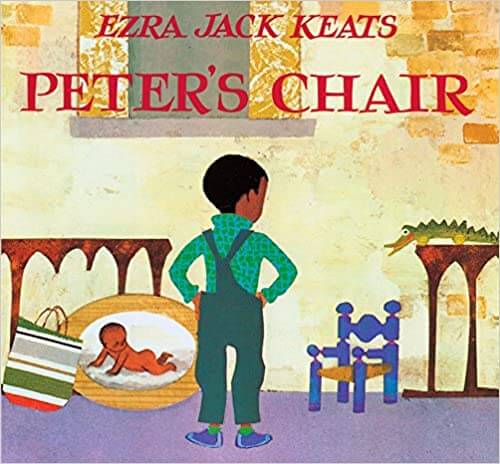
Peter’s Chair by Ezra Jack Keats
Purchase from Bookshop.org (supports independent bookstores)
Peter (of A Snowy Day fame) has to be one of my favorite characters in children’s literature. In Peter’s Chair, he has a baby sibling, so he’s always being shushed. He’s not happy when he finds his parents painting his baby furniture pink for the baby. So he grabs the only thing they haven’t touched yet – his blue chair – and makes a run for it, followed by his dog Willie.
Fortunately for his parents, Peter only runs away to the sidewalk in front of his house. When he tries to sit in the chair, he discovers he doesn’t fit anymore. Soon, Peter is reconsidering his plans, and discovers a new way to get his parents’ attention. (Recommended for ages 3 – 7. White author.)


Lola Reads to Leo by Anna McQuinn and Rosalind Beardshaw
Purchase from Bookshop.org (supports independent bookstores)
Even before her baby sibling is born, Lola is planning what stories she will read the baby. When she meets baby Leo, she gives him a soft book he can keep in his crib. Lola discovers that Leo cries a lot, giving her many opportunities to comfort him by reading to him.
Lola takes her job of being big sister very seriously. But her parents still have time to “baby” her each night with her own story. (Recommended for ages 2 – 5. White author.)

Real Sisters Pretend by Megan Dowd Lambert and Nicole Tadgell
Purchase from Bookshop.org (supports independent bookstores)
The conversations between two sisters in this book sounds exactly like the way kids talk to each other in real life! In this multi-racial family with two moms, outsiders sometimes ask the girls if they are “real” sisters.
During a rowdy game of pretending to be princesses (hiking princesses, the older sister clairifies), the younger sister suggests they pretend that they’re sisters. The older sister quickly and lovingly reminds her that they are real sisters, through adoption that made them a forever family.
The ways the girls’ describe the younger sister’s adoption ceremony in court made me laugh out loud. This is a beautiful affirmation of adoption that explains things to kids without being the least bit boring. (Recommended for ages 4 – 8. White queer author.)
Related post: 14 picture books about multiracial families

Nine Months Before a Baby Is Born by Miranda Paul and Jason Chin
Purchase from Bookshop.org (supports independent bookstores)
This unique book is ideal for the future big sibling who wants to understand what the baby looks like inside the womb. On the right side of each page spread are paintings of two parents and a young girl getting ready to welcome a new baby, accompanied by poetic text. On the left side are detailed illustrations of the fetus for each month it’s in the womb, with descriptions of what is happening biologically. A must have for curious kids! (Recommended for ages 4 – 8. White author.)

Pecan Pie Baby by Jacqueline Woodson and Sophie Blackall
Purchase from Bookshop.org (supports independent bookstores)
This laugh-out-loud picture book features a young girl who is not at all excited to meet her future sibling. In fact, Gia doesn’t think of the baby “my sister.” Instead she calls her “that ding-dang baby” (but only when Mama can’t hear.) The ding-dang baby is going to mess everything up, coming between the cozy pair she and Mama have always been.
All anyone wants to talk about, from her classmates to her aunties and uncles, is that ding-dang baby. When the baby talk gets to be too much during Thanksgiving dinner, Gia has an outburst that gets her sent to her room. But the conversation she and Mama have there reveals that Gia isn’t the only one who will miss the “good old days” of just her and Mama. (Recommended for ages 5 – 9. Black author.)
Chapter books and graphic novels about new siblings
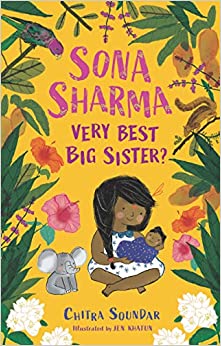
Sona Sharma, Very Best Big Sister? by Chitra Soundar
Purchase from Bookshop.org (supports independent bookstores)
As her Amma’s (mother’s) pregnancy is in its final weeks, Sona is anxious that there’s not enough love to go around. Amma tells Sona that families are like the sky; they stretch to make room for new stars. Sona doesn’t feel like she can stretch, especially as family members want her to give her old things to the baby.
But when she learns that she can play a special role in the baby’s naming ceremony, Sona becomes determined to find the perfect name. There’s so much humor and heart (plus a wonderful view into Indian culture) in this short chapter book. (Recommended for ages 6 – 10. Indian-British author.)
Related Post: Best children’s books about India
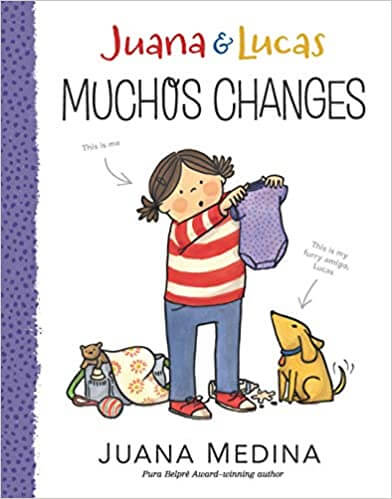
Juana and Lucas: Muchos Changes by Juana Medina
Purchase from Bookshop.org (supports independent bookstores)
The Juana and Lucas series follows a Colombian girl and her dog in their often hilarious daily lives. They’re early reader chapter books, although they feel a bit like graphic novels because of the humorous picture diagrams in each chapter. In Muchos Changes, Juana’s Mami has two sorpresas (surprises) she isn’t happy about. The first surprise is that a baby’s on the way. The second is that Mami has signed Juana up for skate camp.
At skate camp, Juana’s fellow campers let her in on all the ways a baby sibling will change things. Juana explains this in a helpful diagram titled “Babies make everything complicado. EVERYTHING!” And things get even more complicado when Mami has to go on bed rest for the remainder of the pregnancy. This book takes on changes that can be scary with a light-hearted, reassuring touch. (Recommended for ages 6 – 9. Colombian-American author.)
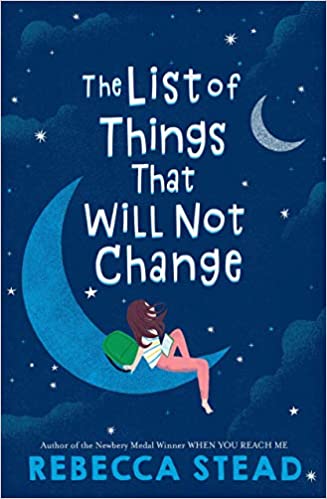
The List of Things That Will Not Change by Rebecca Stead
Purchase from Bookshop.org (supports independent bookstores)
12 year old Bea has been through a lot of changes in the past few years. When she was 8, her Mom and Dad had a family meeting to tell her they were divorcing because her Dad is gay. She had to adjust to living in two places (her inconsiderate cousin nicknames her “Ping Pong” because she goes back and forth so much.) Bea develops anxiety, but her relatable therapist Maxine is a wise guide along the way.
Two years later, when Dad announces he’s marrying his partner Jesse, Bea couldn’t be happier. When she learns that Jesse’s daughter will be coming from across the country to stay over vacations and summers, she can’t wait to have a sister her same age. Sonia’s feelings are a lot more complicated, and Bea’s often left guessing what she thinks. As Bea goes on to tell the reader about choices she made around her Dad’s wedding, we realize that Bea’s feelings, and behaviors, are more complicated than she first wants to admit. (Recommended for ages 8 – 12. White author.)
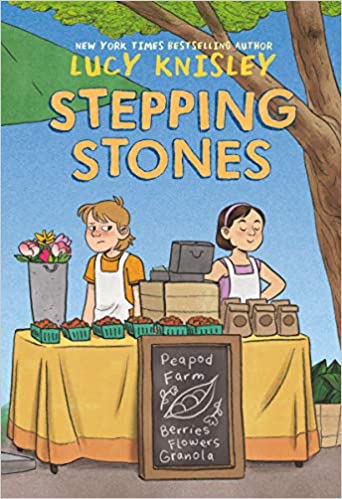
Stepping Stones by Lucy Knisley
Purchase from Bookshop.org (supports independent bookstores)
In this semi-biographical graphic novel, young Jen has to make a lot of changes she does not want to when her parents divorce. Her mom moves them to the country to live out her dream of being a farmer, while Jen longs for the city. Her mom’s new boyfriend Walter is insensitive (and remains so throughout the story). When his daughters come to stay on the weekend, Andy immediately rubs Jen the wrong way with her know-it-all ways.
Jen’s Mom and Walter gives her responsibilities she doesn’t want (responsibilities which Andy is eager to show she is better at.) Gradually, the girls make some breakthroughs in their relationship and Jen finds things she likes about country life. At the same time, the book is realistic about children often having to endure things (and people, like Walter) that they don’t like. (Recommended for ages 8 – 12. White author.)
Related Post: Twelve diverse and inclusive graphic novels for ages 7 – 12