
I started off the school year with high hopes for distance learning. My son’s charter Montessori school indicated there would be flexibility and lots of options for hands on learning. But six weeks into the process, my 8 year old was miserable. His day was filled with worksheets and copying down writing from a screen, which he dreaded. I decided it was time for us to homeschool. In this post, I’m sharing some of the principles and tools that are guiding us in our Montessori-based, social justice homeschooling.
Before I dive in, I want to add: I don’t blame my kid’s teacher for what happened. The school shifted to a remote learning option last minute, and I don’t think teachers are getting the support and resources it will take to make remote learning work better. There’s also getting lots of pressure from our state government to structure school in a way that’s not best for children’s mental health. Sending big love to all the teachers and administrators out there – I know how hard you are working!

Disclosure: For your convenience, this post includes affiliate links. If you purchase items through these links, I may earn a small commission at no additional cost to you. You can read my full disclosure policy here.


1. Our homeschooling is Montessori-based.
We love Montessori, and it’s the only approach to learning my 8 year old has experienced. That’s a big part of what made distance learning so hard. There was none of the hands-on work that was tailored to the individual needs and interests of a child.
I’m incredibly privileged to have a Mom who’s a retired lower elementary Montessori teacher. She’s leading my child’s learning one day a week, as well as being a huge resource for all my questions for the other 4 days of the week!
But even if you don’t have a trained Montessori guide in your life, you can still honor many of the key ideas of Montessori. Montessori learning follows the child, introducing concepts as they are ready. It also allows for deeper dives into topics that spark your child’s interest.
As a Montessori parent, observing my child is just as important as the lessons I present to him. There have been surprises – like how interested my kid is right now in learning the parts of speech! (This is partly because he gets to use tangible symbols to label the sentences he works on.)
Related Post: What the Montessori method is teaching me about parenting
He hasn’t liked some of the hands on multiplication work we’d be doing. So, we’re going to shift to working on fractions for a while to see if that catches his interest more. Then, we’ll circle back to multiplication a little later.
Peace education, as well as learning about cultures from many places and times is an important part of Montessori. That makes it easy for me to combine Montessori with my commitment to social justice homeschooling.
One of my favorite aspects of Montessori elementary is what’s calmed cosmic education. Children are introduced to the beginning of the universe, the coming of life, the coming of humans, and more through a series of stories and related timelines, experiments, and other hands-on work.
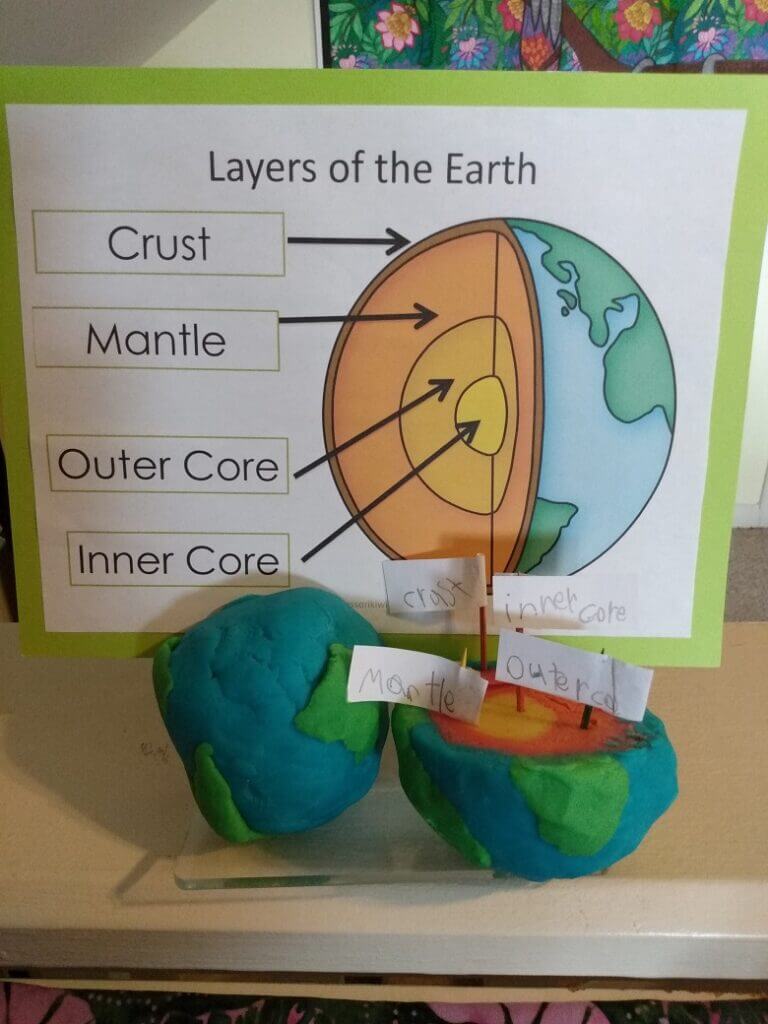
I can already see my child’s sense of wonder and imagination coming alive again after several months of it being dimmed.
Finally, Montessori emphasizes hands on learning. Dr. Montessori once said that “what the hand does, the mind remembers.”

2. Our social justice homeschooling emphasizes learning accurate history.
Almost all mainstream curriculum I’ve seen in elementary schools sanitizes and over-simplifies history for children. One of my last acts of resistance when we were still doing distance learning involved a lesson on the 19th amendment. The simplified worksheet he was given didn’t acknowledge that women of color didn’t win the right to vote with the 19th amendment. So, we pulled out Finish the Fight and read excerpts of the book to help my kid get a more picture coverage of women’s suffrage in American history.

So what does history look like in our social justice homeschooling plan? Many days, the read aloud book that I use in our morning meeting is about a history topic. Here are a few books we’ve been using so far, or will in the near future:
Chickasaw Adventures: The Complete Collection by Tom Lyle. (We live on stolen Chickasaw land, so learning history from a Chickasaw perspective is a big priority for us this year.) Bookshop.
Thanks to Frances Perkins: Fighter for Workers’ Rights by Deborah Hopkinson and Kristy Caldwell. Bookshop.
Many Thousand Gone: African Americans from Slavery to Freedom by Virginia Hamilton, Leo Dillon, and Diane Dillon.Bookshop.
History Smashers: The Mayflower by Kate Messner and Dylan Meconis. Bookshop.
Heart and Soul: The Story of America and African Americans by Kadir Nelson. Bookshop.
We don’t always read about events in the order they happened, so we’ve also made a big timeline on graph paper that we’re marking each event on.
Related Post: 12 unsung social justice activists kids should know about (and the children’s books that tell their stories)
As we get further along in our geography work, we’ll be learning about how different ancient cultures met their fundamental human needs. As part of our commitment to social justice and diversity, we’ll be learning not only about the Greeks and Romans, but also about the Mississippian period peoples (who lived in present day eastern U.S.) and ancient Zimbabwe.
3. Social justice homeschooling and social emotional learning go hand in hand.
As this article explains, antiracism education for white children must also incorporate social emotional learning.
Raising kids to be empathetic includes helping them understand their own feelings and needs, as well as the emotions and needs of others.
Social emotional learning is also at the heart of our homeschool because my kid, like most kids, is struggling during the pandemic. There are lots of big feelings, and we try to make space for them.
What does that look like in our house?
We start our morning meeting with both of us identifying our emotions at the moment on a feelings chart.
Once a week, we use the exercises in his Big Life Journal. This has been especially helpful since my kid has been so frustrated with himself when he makes mistakes. We also enjoy the stories in the Big Life Journal podcast.

When he’s getting frustrated or tired during the school day, I ask him in he needs time in the calm down area, a dance party break, or a daydreaming break.
Related Post: A playlist of social justice songs for kids
4. Our homeschooling aims to spark wonder and a love for nature.
One of the things that’s been hardest for me during the pandemic was seeing my child go from loving outdoor time to refusing to go outside. He’d often tell me there was no point in going outside since he couldn’t play with his neighborhood friends.

But I’ve known my kiddo was an “outdoor person” his whole life. When he was a 3 month old baby, he would cry until I opened the front door so he could see the outdoors!
Montessori learning emphasizes time in nature, and it’s easy to incorporate with our science and geography lessons.
Right now, we’re learning about biomes, starting with our home biome. We took a nature walk through an old growth forest. The same kid who has acted like walks are torture told me “this is actually pretty cool!” He also agreed to go on a longer walk in the future at a nearby state park.
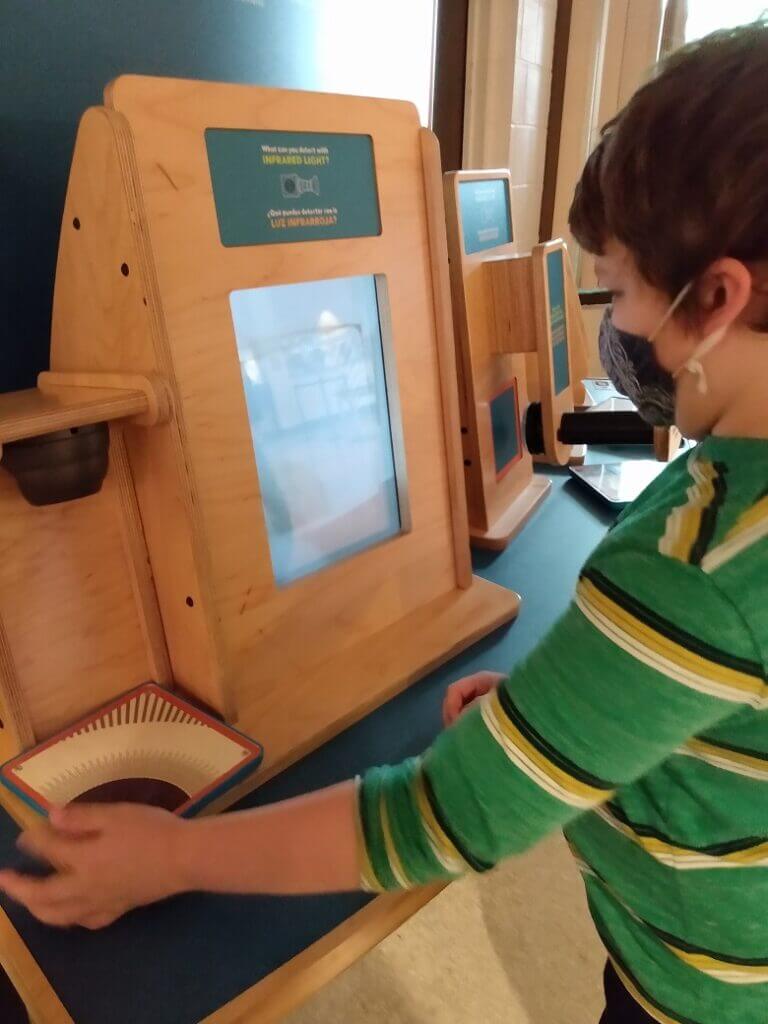
We’ve also been using field trips to local museums to build on his love of science and nature. (We go at times when there are few people – one of the side benefits of homeschooling!) He’s especially interested in anything and everything about space right now.
5. Our homeschooling is literacy and arts-rich.
While we do have some DK visual encyclopedias on a few topics as a research resource, we don’t use textbooks.
There’s still lots of reading and writing in our day though. Because my kid understandably got burnt out on writing from all the copywork he used to have to do, this is tricky.
I’ve found that having him journal about a topic once a day, without me editing his work, is helping some. (We’re using this list of prompts right now, which is huge!)
A couple of times a week, my Mom or I give him sentences with mistakes in them to correct, so that he can improve his spelling and grammar outside of his journal time. That’s because the journal is more about enjoying writing and getting his thoughts down.
And of course, we spend lots of time reading. There’s time each day for fiction reading, plus reading that’s involved in the different Montessori presentations for the day.
Related Post: 8 diverse chapter book series for early readers
My kiddo is showing a growing love for drawing, so that’s part of the school day several time a week. He also draws pictures to go with his journal entries.
I’m also working in some art appreciation and art history when I can. It’s been a bit more challenging to find diverse resources for this (so much art history for kids is Eurocentric.)
A wonderful Montessori teacher shared art appreciation cards she created from artists around the world in the Montessori for Social Justice Facebook group. (If you’re part of the group, search for “art appreciation.”)
I’m also enjoying using A Journey Through Art: A Global History by Aaron Rosen.
Would you like to hear more about our homeschooling journey in the future?
I’m trying to gauge interest among my readers. If you want me to post more about Montessori, social justice homeschooling, let me know in the comments.
7 responses to “How we started Montessori, social justice homeschooling”
I’d love to hear more about this topic! We are struggling with distance learning and are considering a switch to homeschooling, although it makes me feel very sad to think about leaving our school community.
You up for a 2nd student joining you virtually?! I love all of what you have shared! My issue is my own mental and emotional bandwidth to work full-time and have patience with our 8yo.
Gratefully, we have an education major helping out 4 mornings per week.
As for our current virtual setup, everything is prerecorded, and the kiddo rarely engages with anyone through a live online meeting.
Laura, I have heard good things about the interactive nature of virtual classes and social groups on Outschool. You might take a look and see if there’s any topic your 8 year old might like to explore outside of virtual school.
I definitely felt sadness about saying goodbye to our school community.
This was all very helpful as a virtual school parent. I could imagine it clearly. The field trips and nature walks are some of the things we sorely miss and could benefit from. You are an inspiration to me, Rebekah!
Do you think when (whenever in the future that may be) school resumes in person in your community you will send your child back? While I completely understand that remote learning does not work for many children, it would be surprising to me that someone so committed to social justice and raising empathetic and culturally competent children would choose homeschooling if there was the opportunity to send your student physically to school.
While reading about, studying, watching videos, and discussing people that are different from you is extremely important to building empathy and cultural competencies, I don’t think there is any amount of distant learning that can replace interacting with others as children do in schools. It is in school where they get the first hand experience of interacting with children who come from different cultural, racial, socioeconomic, and religious backgrounds than them. In my experience students that are homeschooled tend to only socialize with children who come from very similar backgrounds. Interested to hear your thoughts!
I’m open to the idea of us returning; it depends on a lot of factors. From an equity perspective, this was not an easy decision for me to make, and I certainly had mixed feelings about it.
Socialization at his public school last year was a challenge because of a variety of factors. My kid was unfortunately not able to form any significant relationships with any of his classmates of any race. We recently joined a virtual homeschool co-op led by Black and Brown families, and I’m figuring out what opportunities there may be for building relationships.