Learning about or celebrating holidays in the classroom requires careful consideration. Every holiday is linked either to a culture and/or to a religion. Too often, schools or individual educators prioritize the holidays of the dominant group, usually without realizing they’re doing this. Meanwhile, they ignore the important celebrations that some of their learners hold dear.
Think about what it feels like for a Muslim child to observe numerous Christmas-themed activities at their school. Adults and students alike may assume this child celebrates Christmas. When Ramadan begins, there may not be any significant mentions or events at school. The child might even have a major project due on Eid al-Fitr, the most important day of the year for their family.
A multicultural approach to holidays in the classroom shows respect for students’ diverse cultures. Even in a classroom where all the students share the same culture or religion, learning about other groups’ holidays is one way to develop cross-cultural understanding. However, a diverse approach to holidays needs to be done thoughtfully! Poorly done activities can end up encouraging stereotypes or cause some students to feel misunderstood.
In this blog post, I share eight best practices for an anti-bias approach to holidays in the classroom. Along the way, I’ll highlight some common mistakes to avoid.


Disclosure: For your convenience, this post may include affiliate links. If you purchase items through these links, I may earn a small commission at no additional cost to you. You can read my full disclosure policy here.
How to take an anti-bias approach to learning about holidays in the classroom
1. Consider the holidays that your students’ families celebrate
You may already have a good sense of the cultural and religious backgrounds of your learners. If so, do some research to find out which holidays are the most important to that group.
An even better approach is to include a question about holidays celebrated in your beginning of the year family survey. (If you don’t have a survey yet, Liz Kleinrock offers a great example in her book Start Here Start Now: A Guide to Antibias and Antiracist Work in Your School Community.)
You won’t be able to learn about every single holiday celebrated by every faith or culture – there are so many! Start by prioritizing those that are celebrated by your students or that are important in your wider community.
My annual Anti-Bias Children’s Book Calendar can help you learn the names and dates of holidays you may not be familiar with, along with children’s books for those celebrations. You can pre-order the 2027 calendar here for 15% off. (Pre-order discount ends November 10th at noon PST.)
2. Make a note of the dates of holidays, especially those that change each year
Most of the holidays that are typically celebrated at school (think Halloween, Thanksgiving, Christmas, and Valentine’s Day) use the Gregorian calendar. This means that they fall on the same day every year. But many cultures and religions use a lunar or lunisolar calendar, so the date of key celebrations shifts.
Making sure you’ve noted this year’s dates for holidays such as Diwali, Passover, Ramadan/Eid al-Fitr, and Lunar New Year will keep you from throwing together a hastily planned activity last minute. If a major holiday that your some of your students celebrate is going to fall on a school day, avoid assigning big projects or extra activities on that date.
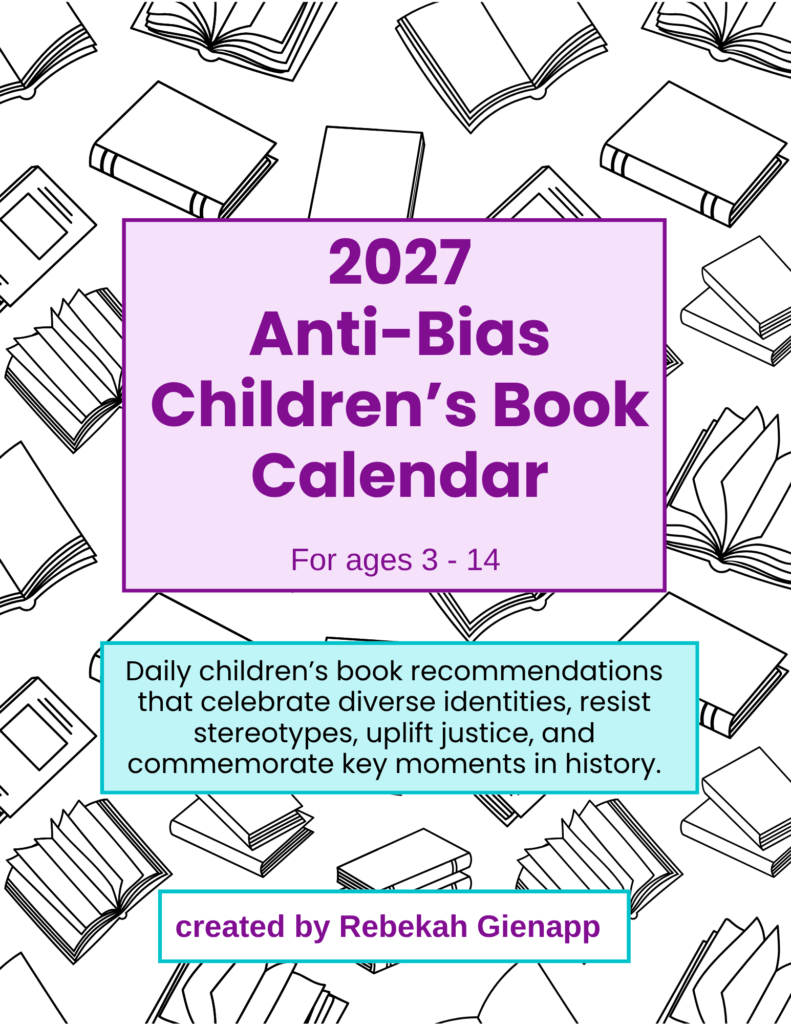
My 2027 Anti-Bias Children’s Book Calendar makes this easy for you. It also includes key moments in history, along with books to help children understand their significance.
2027 Anti-Bias Children’s Book Calendar: Daily children’s book recommendations for learning about diverse holidays, uplifting resistance to injustice, and countering stereotypes.
3. Remember that many religions and cultures’ most important holidays do not take place in December.
I’ve heard some anti-bias leaders warn educators about the “balance trap” teachers can fall into when trying to diversify their holiday learning activities. This usually involves adding in a small activity about Hanukkah as well as one about Kwanzaa to the activities they were already doing about Christmas during December.
There are two problems with this approach to holidays in the classroom. The first is that in all likelihood there are many Christmas activities or references taking place in a school. Even those that have been renamed as “winter” celebrations often use the colors and symbols of Christmas. Meanwhile, learning about Hanukkah and Kwanzaa may involve only a single activity for each celebration. That is not “balanced.”
The bigger problem is that there’s often no attention to holidays celebrated by groups outside the dominant culture during the rest of the year. If children only learn about holidays during December, this can actually strengthen the idea that Christmas is more important than any other holiday. It can also distort kids’ understandings of which holidays are most important to a faith or culture. For example, Hanukkah is not considered one of the most important holidays within Judaism. Rosh Hashanah, Yom Kippur, and Passover are all much more significant Jewish holidays.
Related post: Children’s books about Passover
4. Be mindful of the language you use to describe the meanings of a religious holiday.
At school, especially in a public school, educators’ language should explain how and why people celebrate a holiday. This is not the same as celebrating that holiday in the classroom.
In Anti-Bias Education for Young Children and Ourselves, the authors give examples of appropriate language for a preschool classroom. At Christmas a teacher might say “Christmas is special to some families because it celebrates the birthday of the God they believe in.” It would not be appropriate to say something like “Christmas is the birthday of the Lord,” even though this is how Christian families might describe it to their children at home.
There are a number of children’s books that can help you with language for a variety of holidays:
- Let’s Get Festive: Celebrations Around the World by Joanna Konczak (best for ages 7 – 12)
- Come and Join Us! 18 Holidays Celebrated All Year Long by Liz Kleinrock (best for ages 5 – 9)
- Let’s Celebrate: Special Days Around the World by Kate DePalma (best for ages 3 – 8)


My 2027 Anti-Bias Children’s Book Calendar also has many books about particular holidays that can help you describe how people of a religion observe their sacred days.
5. Connect foods, decorations, and customs to their deeper meanings
When it comes to observing both heritage months and holidays in the classroom, it can be easy to accidentally trivialize a holiday by ignoring its deeper significance.
The way that many non-Latine people approach Día de los Muertos is a prime example. Hanging papel picado and decorating sugar skulls is not sufficient if there isn’t discussion of the reasons people observe the day. As many Mexican American writers have said “Día de los Muertos is not Mexican Halloween.” The day is about connecting with and honoring ancestors, not being scared or wearing costumes.
You can deepen your learners’ understanding of why a holiday is celebrated through guest speakers, as well as children’s books and videos by people who are from the culture that celebrates the holiday.
Related post: Children’s books about Ramadan and Eid al-Fitr

6. Remember that holidays should only be one way of learning about a culture.
The authors of Anti-Bias Education for Young Children and Ourselves warn against the pitfalls of a “tourist curriculum.” When holidays are the only time we talk about a particular country, ethnic group, or faith, children are not so different from tourists who take a lovely vacation, pick up a couple of souvenirs, and soon forget about the place they visited.
Every major subject area offers opportunities to learn about people from different cultures and ethnic groups. Use an anti-bias perspective to check the books students have available to them and the leaders you teach about. Who is being left out or trivialized? Whose perspective is being used to tell stories (including the stories of history)?
Related post: 7 ways to teach for diversity in STEM subjects
7. Acknowledge the diversity within a group when it comes to how people celebrate
Children tend to default to black and white, either/or thinking, so it’s important to talk about the many different ways members of a group celebrate a holiday. It’s also helpful to acknowledge that not every member of a group takes part in a holiday at all. While Kwanzaa is a Black American holiday, not every Black family celebrates Kwanzaa.
Diwali is best known as a Hindu holiday, but it is also celebrated by many Jains, Buddhists, and Sikhs. Each group has different traditions and understandings about the holiday.
8. Consider grouping holidays by theme
In tip #3 I mentioned the December balance trap, in which Christmas gets lots of attention and Hanukkah and Kwanzaa are thrown in as a late addition. While I don’t recommend that approach, there can be value in learning about several holidays that focus on similar themes.
Harvest is one theme that has lots of possibilities. Many Native American nations have harvest celebrations, such as the Cherokee’s Green Corn Ceremony or the Ojibwe’s Wild Rice Festival. Korean Chuseok and Vaisakhi in Punjab, India are both harvest festivals, as is Crop Over in Barbados and Dozynki in Poland.
New Year offers so many possibilities and shouldn’t be confined to January 1st. Lunar New Year, Persian Nowruz, and Jewish Rosh Hashanah are just a few examples of how the new year is marked not only in different ways but on different calendars.