
For the past few years, whenever Thanksgiving approaches, I feel a bit nervous. So much of what adults teach children about Thanksgiving is historically inaccurate and perpetuates racist stereotypes about Native Americans.
Here are just a few things we typically teach kids about the so-called first Thanksgiving that are wrong:
- The English colonists who we label as the Pilgrims did not call themselves that. And the Wampanoag people did not think of themselves as Indians.
- The shared meal between the English and Wampanoag in 1621 was a harvest meal, not a religious event.
- The Wampanoag likely participated more for political reasons of keeping the peace with the English, not because of friendship.
- The English did not “find corn.” They dug and stole Wampanoag stores of corn, as well as dug up and stole items from graves.
- The “Thanksgiving meal” did not usher in peaceful relationships between the two groups. Within a generation, the English were celebrating killing Wampanoag leader Metacom during King Philip’s War.
Oyate, a Native organization that promotes accurate history, unpacks several other myths about Thanksgiving here.

Disclosure: For your convenience, this post includes affiliate links. If you purchase items through these links, I may earn a small commission at no additional cost to you. You can read my full disclosure policy here.


Then, there are the problematic Thanksgiving activities that many schools involve children in. These perpetuate racist stereotypes, confine indigenous people only to the past, and lump vastly different tribal cultures into one inaccurate category.
Related Post: Teaching about Native Americans in preschool and kindergarten: Do’s and Don’ts
The most obvious example is preschool programs where children dress up as Pilgrims and Indians. Guy W. Jones and Sally Moomaw write about this in Lessons from Turtle Island: Native Curriculum in Early Childhood Classrooms. “In addition to embedding inaccuracies firmly in children’s minds,” they write, “this gives them the impression that they can become Indians by dressing up in what is deemed Indian attire. Would teachers dream of dressing up children in blackface for Martin Luther King Day?”
The good news is that there are lots of resources to help antiracist parents and educators offer a different narrative of Thanksgiving for children of all ages.
Get my guide to evaluating children’s books for Native American stereotypes when you sign up for my free Resource Library using the form below.
Ideas for children ages 3 – 6: Focus on gratitude, not the “first Thanksgiving” story
Young children are oriented to the present. They get easily confused about the passage of time, so they sometimes think that things we tell them about the past are the way things are now.
One of the most harmful stereotypes that many non-Native people believe is that Native Americans no longer exist. Dr. Debbie Reese of American Indians in Children’s Literature often references doing a Google image search for the phrase Native Americans. Almost all the images found will be from the past, not the present. This isn’t true for any other major racial/ethnic group in the U.S.
Young children are also very sensitive to violence. If adults feel like a particular group of children isn’t old enough to learn the full truth about what happened before, during, and after the meal that’s been dubbed the first Thanksgiving, then we shouldn’t the story to them at all. (If young children ask you what Thanksgiving is about, this dialogue is a great example of age-appropriate truth telling.)
Instead we can focus on ways of showing gratitude across many cultures, and in children’s own lives. If you want to read stories about Native Americans with young children, make sure they are set in the present day and are written by Indigenous authors.
Resources and recommendations for work with young children:

- Read books about expressing gratitude such as We Are Grateful: Otsaliheliga by Traci Sorell (Cherokee). This award-winning book shows how Cherokee people express gratitude in each season of the year, and includes Cherokee vocabulary. It takes place in the present day. (Also listen to this interview that Sorrell did with WBUR, which includes suggestions on how to talk about Thanksgiving with children of different ages.)
- Avoid books and programs that purport to tell the first Thanksgiving story for young children. Oyate compiled a list of problematic books here. If you do read books about Thanksgiving, make sure they don’t reference the “Pilgrims and Indians” story. Be on the lookout for problematic holiday specials too. (I’m looking at you This Is America, Charlie Brown.)
2022 Update: Recently Wampagnoag author Danielle Greendeer has written the picture book Keepunumuk: Weeâchumun’s Thanksgiving Story. I have not yet had a chance to read it, but several people I trust recommend it.
- Look at the books you are reading year-round in your home or classroom. If you don’t have many by Native authors that are set in the present day, consider adding some from this list.
- Proceed with caution when it comes to craft activities. Many that you’ll find online for young children perpetuate harmful stereotypes or use items that are sacred to Native nations, such as feathers. If you want to do a craft, consider this activity on corn from the National Museum of the American Indian, or activities like making a gratitude tree.
- Parents, if you find out your child’s school is offering activities that cause harm, speak up! Here are two sample letters about Thanksgiving plays/skits. The first is here (I would omit the reference to the Medium article because there are some recommended books that are on Oyate’s not recommended list.) The second letter is here.
- Educators, perhaps you’ve used stereotypical activities in the past and your school is using a better approach this year. This sample letter to parents can help you explain why you’re making these changes.
Ideas for ages 7 – 12: Unpack myths about Thanksgiving that children have already learned
Once children are elementary age, they have a stronger grasp of time and are more interested in history. They have probably also been exposed to some of the myth of the first Thanksgiving from sources like school lessons, cartoons, or books.
Related Post: 15 Indigenous children’s books set in the present day
If you have an elementary age child or teach them, you know how much they like showing they are smarter than adults. So unpacking the myth of the first Thanksgiving, and encouraging them to share what they learn with adults, can be a very appealing activity.
Resources and recommendations for school age children:

- Explore gratitude through poetry books such as Thanku: Poems of Gratitude by Marlena Myles and Miranda Paul. Several of the poets included are Native American, and illustrator Myles is Dakota/Mohegan/Mucokee Creek.)
- Separate myth from fact and learn about the Wampanoag nation (past and present) in this interactive “you are the historian” resource from the Plimoth Patuxet Museums.
- Read a book which teaches accurate history about encounters between the English and the Wampanoag. Last year, we read History Smashers: The Mayflower by Kate Messner for our homeschool, and my then 8 year old was fascinated. A resource that has color photos and is a bit shorter is 1621: A New Look at Thanksgiving by Catherine O’Neill Grace and Margaret M. Bruchac.
Related Post: 20 picture books by Native American and First Nations authors
- Educators, create a lesson on how Native nations practiced gratitude for centuries before European contact. For younger children, use the Haudenosaunee Thanksgiving Address. For grades 4 – 8, use this “American Indian Perspectives on Thanksgiving” resource from the National Museum of the American Indian to get started.
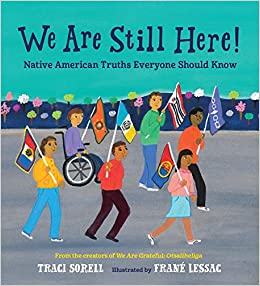
- Combat the myth that Native peoples only existed in the past by reading a book like We Are Still Here! Native American Truths Everyone Should Know by Traci Sorell or The People Shall Continue by Simon Ortiz.
- Parents, speak up about harmful activities and lessons at school. Using the sample letters above (in the ages 3 – 6 section of this post), write an email to your child’s school. Include links to a few of the recommended resources in this post that are right for your child’s age.
- Incorporate year-round learning activities about Native peoples into your classroom or home. This list of books is by Indigenous authors and set in the present day. Find chapter books for ages 8 – 12 by Native American authors here. (Some are historical and some are set in the present.) For crafts, games, and activities that explore history, use A Kid’s Guide to Native American History. Co-author Yvonne Wakim Dennis is Cherokee and Syrian. The book’s activities have been carefully selected to avoid sacred items and stereotypical ideas.
Related post: Teaching kids about gratitude with the Haudenosaunee Thanksgiving Address
Ideas for ages 13+: Explore how the “first Thanksgiving” story perpetuates harm
Teens want to be able to connect the dots between different times, places, and events to understand larger themes. They can not only unpack the myth of the first Thanksgiving, but understand how it fits into larger patterns of land theft and genocide against Native Americans.
Resources and recommendations for teens:
- Explore Native American perspectives on Thanksgiving. (Be sure to emphasize that Native people are not a monolith and there are a diversity of perspectives.) This lesson from Learning for Justice uses writings by two Native authors to examine how the Thanksgiving holiday is a painful reminder of colonization for some Indigenous people.
- Introduce the idea of the Day of Mourning. In 1970, the United American Indians of New England declared Thanksgiving Day a National Day of Mourning. They initiated the observance after the Commonwealth of Massachusetts refused to let Wamsutta James (Wampanoag) give his planned speech at an event commemorating the 350th anniversary of the Mayflower. On UAINE’s website, teens can find information on how the Day of Mourning has been observed, and how people outside of Massachusetts can participate in the day.

- Use this lesson plan that accompanies An Indigenous Peoples’ History of the United States for Young People. The lesson explores how narratives about Thanksgiving are connected to past and present day narratives about Europeans “discovering” an uncultivated “wilderness” which God entrusted them to “improve.”
Ideas for Thanksgiving family gatherings
As you prepare to attend or host Thanksgiving gatherings with family, consider ways you can not only avoid doing harm but also play a small role in repairing harm.
If your children are helping you make decorations for the Thanksgiving meal, be on the lookout for cultural appropriation. Some of these will be obvious (construction paper “Indian headdresses”), and other are more subtle (turkeys whose feather patterns bear a resemblance to those headdresses. You can see an example in the picture at the top of this post.) There are plenty of harvest/fall themed decorations that children can make that don’t perpetuate stereotypes.
Does your family usually pray or have some kind of ritual before the meal where people take turns speaking? Acknowledge that today is not a happy day for many Native peoples. If you’re white, share how you want to take a different path than your ancestors did in terms of supporting the rights of Native nations. You might use this prayer from the Kiowa nation that expresses weariness (scroll towards the bottom of the post.) Another idea is to read from Wamsutta James’ suppressed speech.
Schools for Social Justice has a parent tip sheet in both English and Spanish that includes alternate ideas for observing the 4th Thursday in November.

You could invite family members to join you in making a financial contribution to Native-led organizations that carry out mutual aid and social justice campaigns. Two of my favorites are Native Hope and NDN Collective. At the time I’m writing (2021), there is also an urgent need for bail funds and legal defense funds for indigenous protestors in the Stop Line 3 oil pipeline campaign.
Before or after the meal, make time to write letters, send emails, or sign petitions about a Native American rights issue. Ask your children if they’d like to be included by adding their names or drawing a picture to go with your letter. To find action ideas, visit:
