
The dominant culture of the United States encourages people to practice gratitude only at special times, neglecting it as a daily ritual. It’s long seemed strange to me that the Thanksgiving holiday is immediately followed by a flood of acquisitive spending, as if nothing we said thank you for actually filled us with gratitude.
I first learned about the Haudenosaunee Thanksgiving Address, which is a daily practice of six Native American nations, when I read Braiding Sweetgrass by Robin Wall Kimmerer. (Note that this ritual is not related to the myth of the first Thanksgiving between the Pilgrims and the Wampanoag.)
I immediately started thinking about how I could incorporate learning about the Haudenosaunee Confederacy, their Great Law of Peace, and the Thanksgiving Address in our homeschool learning. It is such a beautiful, comprehensive way for expressing gratitude for the natural world.
Keep reading to learn more about the Haudenosaunee Thanksgiving Address and kid-friendly resources for learning about the Haudenosaunee Confederacy.


This post may include affiliate links. If you purchase items through these links, I may earn a small commission at no additional charge to you. You can read my full disclosure policy here.
What is the Haudenosaunee Confederacy?
The Haudenosaunee Confederacy, also referred to as the Iroquois Confederacy, was formed around 900 CE. Haudenosaunee (hoe-dee-no-SHOW-nee) means “people of the Longhouse.” Its original five member nations (the Mohawk, Oneida, Onondaga, Cayuga, and Seneca) are located in what is today called New York and Ontario.
These nations had been at war with each other for many years, until a stranger from the Huron nation arrived with a message of peace. It took many trips and the support of clan mothers and respected warriors for all five nations to accept his teachings. He is so revered today that this leader is only referred to as the Great Peacemaker, not by the name given to him at birth.
The five nations, joined much later by the Tuscarora nation, lived under the Great Law of Peace for many centuries.
Get my guide to evaluating children’s books for Native American stereotypes by signing up for my free Resource Library below.
The only time any of the nations in the Confederacy have been at war with one another was during the American Revolution. The Onondaga, Seneca, and Cayuga allied with Britain, while the Oneida and the Tuscarora allied with the American colonists.
Related post: 15 Indigenous children’s books set in the present day
What is the Great Law of Peace?
The Great Law of Peace is much more than an agreement between the Haudenosaunee nations to not wage war on each other. It is a constitution that describes how these nations are governed. While each nation is in charge of its own internal affairs, the Grand Council addresses problems that affect all six of the nations.
There are fifty male leaders who are appointed to the Grand Council by clan mothers. The male leaders are hoyaneh (caretakers of the peace.) The clan mothers have the power to remove a hoyaneh if he violates the Great Law of Peace.
Children can learn more about how the Haudenosaunee model of governing influenced the women’s suffrage movement in Finish the Fight: The Brave and Revolutionary Women Who Fought for the Right to Vote by Veronica Chambers. (Black author. Recommended for ages 10+)
In matters including war, peace, and establishing treaties, their must be a unanimous decision among the hoyaneh. If there are differences of opinion, these must be worked out through discussion, rather than voting.
The story of the Great Peacemaker and how he helped establish the Great Law of Peace are beautifully told in two children’s books.

Hiawatha and the Peacemaker by Robbie Robertson
This is a poetically written, gorgeously illustrated picture book. Readers learn how Hiawatha was consumed with the desire for revenge after the evil Chief Tadodaho killed his wife and daughters in battle.
Through the Peacemaker’s healing and encouragement, Hiawatha agreed to join him in sharing the message of peace. Because the Peacemaker had a speech impairment, Hiawatha often spoke for him. Eventually the Peacemaker called on Hiawatha to help heal the man who caused him so much pain. (Mohawk/Cayuga author. Recommended for ages 6 – 10.)
Related post: Twenty picture books by Native American and First Nations authors
Related post: Eight middle grade books by Native American authors
What is the Haudenosaunee Thanksgiving Address?
The Haudenosaunee Thanksgiving Address was formulated around the same time as the Great Law of Peace. It is spoken at the beginning of each day, as well as during special ceremonies and gatherings.
I learned about the ritual through the “Allegiance to Gratitude” chapter of Braiding Sweetgrass. Robin Wall Kimmerer describes her visit to the Onondaga Nation School, where she was able to listen to a group of school children give the Thanksgiving Address at the start of the day. She contrasts it with the ritual that many American public school students start with: pledging allegiance to the U.S. flag.

Braiding Sweetgrass for Young Adults: Indigenous Wisdom, Scientific Knowledge, and the Teachings of Plants by Robin Wall Kimmerer, adapted by Monique Gray Smith.
If you have tweens or teens, I highly recommend getting a copy of this book! In the chapter dedicated to the Thanksgiving Address, Kimmerer and Smith slowly take us through each section, with reflections on how the words encourage gratitude. There’s also a gorgeous annotated illustration by Nicole Neidhardt that provides a summary of the various portions of the address.
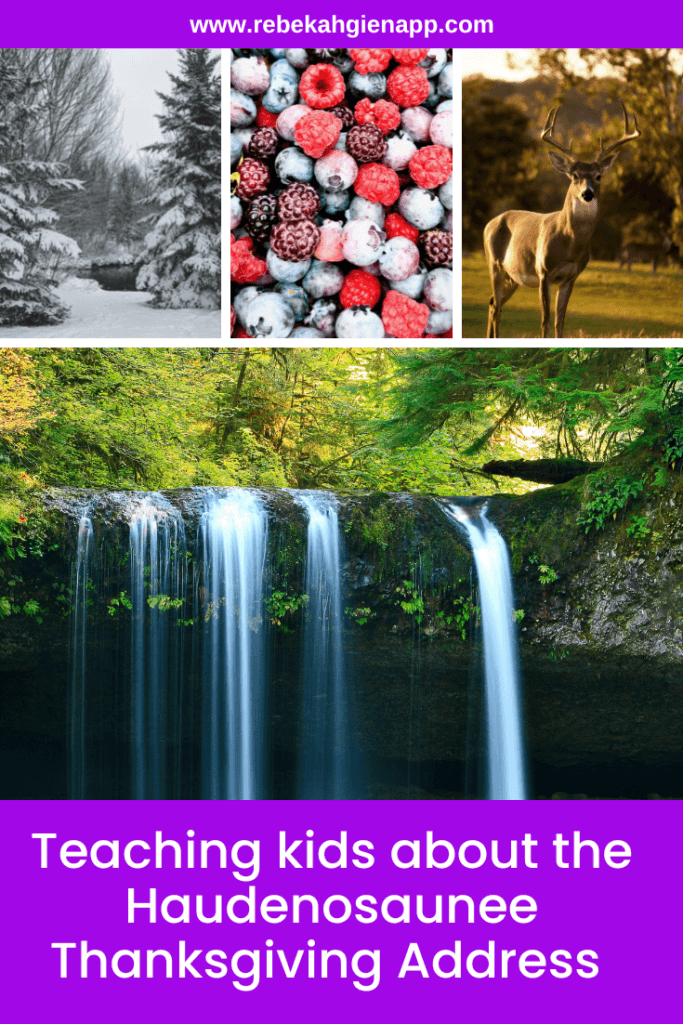
The address reflects on how the cycles of life continue, which can be seen in the faces of others. As the children recite the address, they give detailed thanks for the waters, plant life, plants that are eaten, fish, animal life, the winds, and more. The question “can we agree…” is repeated often, as well as the phrase “now our minds are one.”
Onondaga Clan Mother Freida Jacques tells Kimmerer that the Thanksgiving Address not only teaches children about the natural world, but also about leadership. “It reminds them that much is expected of them eventually. It says this is what it means to be a good leader – to have vision, to be generous, and to sacrifice on behalf of the people,” Jacques says. (Potawatomi author – Kimmerer. Cree/Lakota author- Smith. Recommended for ages 10+.)

Giving Thanks: A Native American Good Morning Message by Chief Jake Swamp. Illustrated by Erwin Printup, Jr.
Young readers can learn about the Haudenosaunee Thanksgiving Address in a simplified version in this picture book. In brightly colored illustrations, the People of the Longhouse are shown appreciating offering “thanksgiving for all the gifts of life,” because “to be a human being is an honor.” (Mohawk author. Recommended for ages 3 – 7.)
Related post: Do’s and don’ts for teaching about Native Americans in preschool and kindergarten

A Kid’s Guide to Native American History by Yvonne Wakim Dennis and Arlene Hirschfelder.
This activity guide with history and present day information about Native American nations provides another way to introduce kids to the Haudenosaunee Confederacy. While children learn how to make a Oneida cornhusk doll, they learn about the Confederacy, the Great Law of Peace, and briefly about the Thanksgiving Address.
This is the only Native American craft and activity book that I’ve come across that I recommend. The activities have been carefully selected to avoid sacred items and stereotypes. Both authors have worked closely with Native American museums, including the Smithsonian’s National Museum of the American Indian. (Cherokee/Syrian author – Dennis. White author – Hirschfelder. Recommended for ages 7 – 12.)
The National Museum of the American Indian also has an excellent guide for teachers on the Haudenosaunee Nations and their history that you can download here.
Related post: 9 ways to observe Indigenous Peoples’ Day with children
Appreciating, not appropriating, the Haudenosaunee Thanksgiving Address
As a white person, I want to say a quick word encouraging non-Native people not to appropriate the Haudenosaunee Thanksgiving Address. While I read my son the chapter in Braiding Sweetgrass for Young Adults which contains the address, I don’t think it’s appropriate for us to simply take this complex ritual and adopt it as our own.
In several places in her book, Kimmerer reflects on the importance of ritual and gratitude as we relate to the natural world. She encourages non-Native people to develop ceremony, offering this guidance:
“to have agency in the world, ceremonies should be reciprocal cocreations, organic in nature, in which the community creates ceremony and ceremony creates community. They must not be cultural appropriations from Native peoples and our ceremonies.”
People of all ethnicities and religions can find cultural and spiritual roots of gratitude, if we dig back far enough into our own traditions. These are good places to begin developing rituals of daily gratitude with our children that go beyond a once a year expression of thankfulness.
