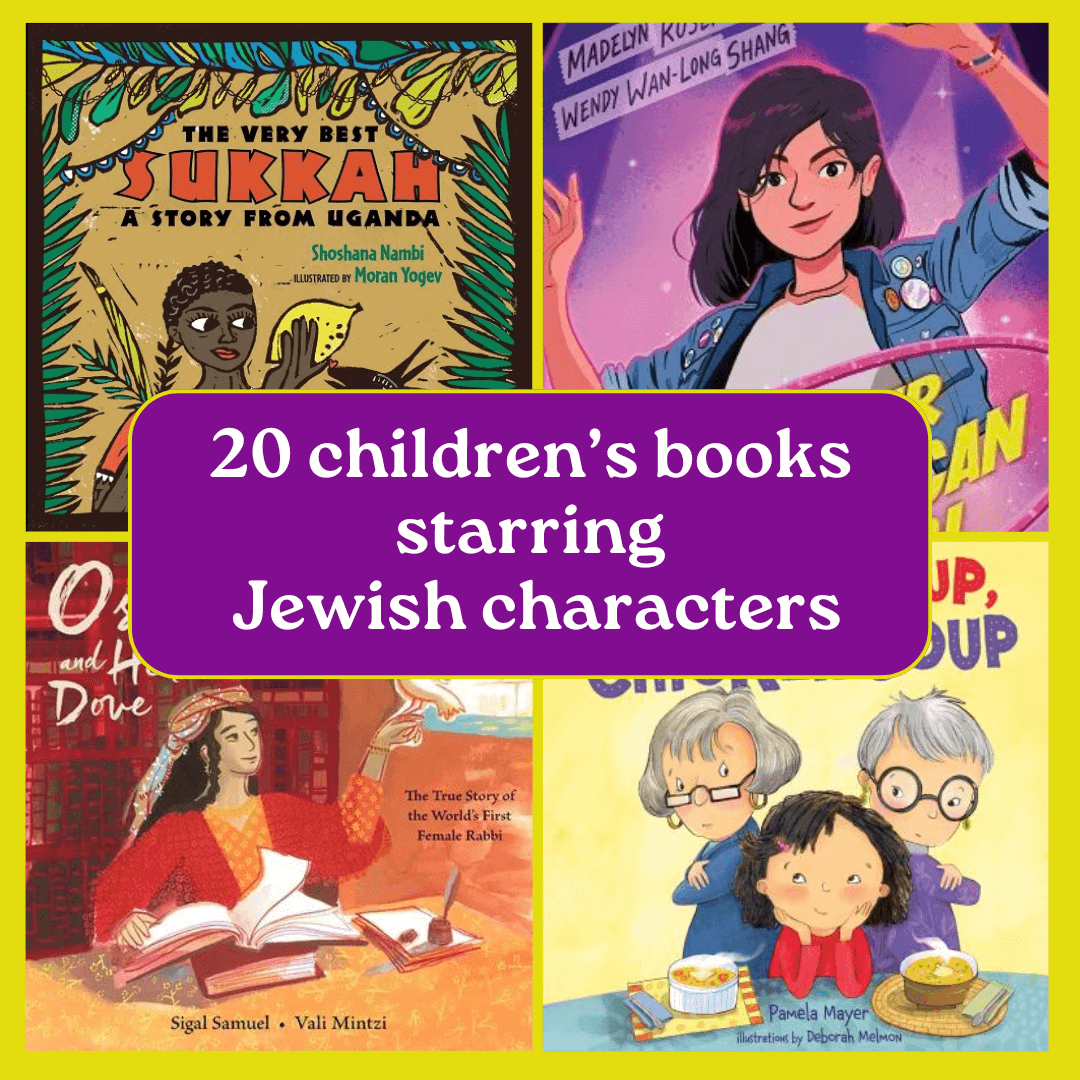
I write often about the importance of diverse children’s books that star BIPOC characters, and how these books provide important mirrors and windows for children. But kids also need to see other kinds of representation in the books they read, including religious diversity. In this post, I share 20 children’s books that star Jewish characters and provide positive representations of Judaism.
In this list, I purposefully did not share children’s books that were primarily focused on anti-Semitism or the Holocaust. You can find a list of books here that help children and teens understand anti-Semitism. First however, it’s important to lay a foundation of everyday books with Jewish characters from both the past and present.


This post may include affiliate links. If you purchase items through these links, I may earn a small commission at no additional charge to you. You can read my full disclosure policy here.
Fiction picture books starring Jewish characters

Chicken Soup, Chicken Soup by Pamela Mayer. Illustrated by Deborah Melmon.
On a rainy afternoon, Sophie’s Bubbe makes her hot chicken soup. Bubbe is aghast when Sophie says she loves chicken soup with wonton. That’s because her Jewish chicken soup is made with kreplach, not wonton!
Soon after Sophie visits her other grandmother, Nai Nai, who also invites her to enjoy some hot chicken soup. Nai Nai is not pleased when Sophie sees the soup and says “I love kreplach!” Nai Nai reminds her that this is Chinese chicken soup, made with wonton, not kreplach. It’s just the way Nai Nai’s own grandmother made it.
Sophie knows that the soups are not the same, but their ingredients, including the kreplach and wonton, are very similar. With her parents’ help she decides to show her grandmothers just how similar they are. (Recommended for ages 4 – 8. White Jewish author.)
Related post: 14 picture books about multiracial families
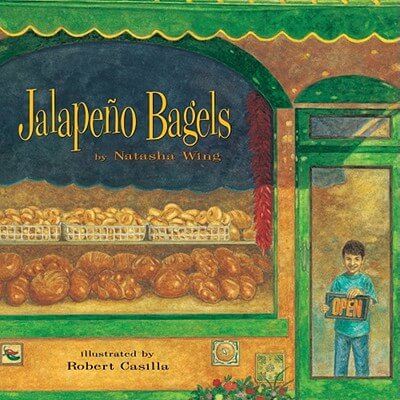
Jalapeño Bagels by Natasha Wing. Illustrated by Robert Casilla.
International Day is coming up at school, and Pablo is supposed to bring a food to share from his culture. Since his parents own a bakery, he has lots of options.
As he helps his Mama make pan dulce, empanadas de calabaza, and chango bars, each one seems like a good possibility. Then he helps Papa make the bagels and challah, and those seems like delicious options too.
Finally, when the family makes the last batch of baked goods together, Pablo knows which food best represents both the Mexican and Jewish cultures he comes from. (Recommended for ages 4 – 8. White author.)
Related post: 21 powerful books about race and racism for children and teens
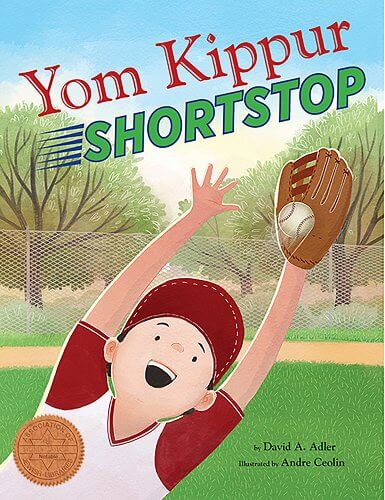
Yom Kippur Shortstop by David A. Adler. Illustrated by Andre Ceolin.
Inspired by star pitcher Sandy Koufax’s decision to sit out a 1965 World Series game because it fell on Yom Kippur, this story follows Jacob as he debates whether to make a similar decision for his Little League championship game.
Jacob’s parents let him make his own choice, only reminding him of the importance of the holiday. Readers follow Jacob to the synagogue, where he listens to the rabbi’s sermon about Jonah, joins friends in the snack room, and prays. His plan is to change into his uniform and walk over to the game when its time, as the Yom Kippur prayers continue. Will Jacob follow through with his plan? (Recommended for ages 4 – 8. White Jewish author.)

And a Cat from Carmel Market by Alyssa Satin Capucilli. Illustrated by Rotem Teplow.
Bubbe has so much to do to prepare for the Shabbat meal, so she head’s to Tel Aviv’s giant Carmel Market. She picks up delicious challah, chicken that will be perfect for her soup, a beautiful tablecloth, and an enormous number of cats.
So many in fact, that one cat rests on her head as she does her shopping. Back home, the guests are arriving and everything is ready for a peaceful Shabbat. But with so many mischievous cats around, things won’t stay tidy and quiet for long. (Recommended for ages 3 – 7. White Jewish author.)
Related post: 10 children’s books about Passover

Chik Chak Shabbat by Mara Rockliff. Illustrated by Kyrsten Brooker.
Goldie Simcha’s neighbors love Saturday afternoons. That’s because the delicious smells of her cholent waft through the apartment building (all the way down four floors!) When they join her for the Shabbat meal of cholent, each neighbor has a different theory on why it is so delicious. But Goldie doesn’t think it’s the ingredients themselves that gives the stew its taste. The taste comes from the experience of togetherness and peace that happens on Shabbat.
One Saturday, it doesn’t smell like cholent through the apartment building. But Goldie’s neighbors are determined to find a way to make it feel – and taste – like Shabbat for Goldie. (Recommended for ages 4 – 8. White Jewish author.)
Related post: 10 multicultural children’s books about generosity

A Hat for Mrs. Goldman: A Story about Knitting and Love by Michelle Edwards. Illustrated by G. Brian Karas.
Mrs. Goldman has been knitting hats for Sophia since she was a baby (and many other people) as a “mitzah” (good deed). She even tried to teach Sophia to knit, but making pom poms was the only part Sophia enjoyed.
One day Sophia realizes that Mrs. Goldman never has time to make her own hat, so her “keppie” (head) must be freezing. Can Sophia do the hard work of really learning to knit so that Mrs. Goldman’s keppie will be warm? Sweet illustrations capture the painstaking learning process, and the story encourages children to not only be generous, but to also let go of perfectionist ideas about what a gift should be. (Recommended for ages 4 – 8. White Jewish author.)
Related resource: Check out this list of Jewish folktales for kids that I’ve compiled on Bookshop.org

The Very Best Sukkah: A Story from Uganda by Shoshana Nambi. Illustrated by Moran Yogev.
Shoshi lives in a Abayudaya (“People of Judah”) Jewish community in Uganda where people have practiced Judaism for generations. Sukkot is Shoshi’s favorite holiday, when families build beautiful sukkahs (huts) for a village contest. Soshi is competitive, and hopes that she and her brothers will win this year’s contest.
When a storm destroys the sukkah that many people expected to win, the community – including Shoshi – jumps in to rebuild the sukkah. Shoshi realizes that when people work together, more than one person can “win.” (Recommended for ages 4 – 8. Ugandan Jewish author.)

Yaffa and Fatima: Shalom, Salaam by Fawzia Gilani-Williams. Illustrated by Chiara Fedele.
In this reimagining of a tale that has been told for generations in the Middle East, neighbors and close friends Fatima and Yaffa both work hard gathering and selling dates in the market. Yaffa is Jewish and Fatima is Muslim, and each page spread shows the patterns of their lives that are both similar and distinct.
When a drought arrives and ruins the date havest, both women stay up late in their separate homes worrying about how the other is faring. Despite their hardship, each plots a way to share generously with the other. (Recommended forages 3 – 7. Arab-American Muslim author.)
Related post: 12 children’s books to inspire compassion and empathy

Gershon’s Monster: A Story for the Jewish New Year by Eric A. Kimmel. Illustrated by Jon J. Muth
This retelling of an early Hasidic tale draws attention to the need to admit and make amends for the wrongs we commit.
Like all people, Gershon made mistakes, none of them particularly remarkable. Yet Gershon was unusual in that he never felt any remorse for his wrongdoings, simply sweeping up the “monsters” into the basement and throwing them into the sea on Rosh Hashanah.
Kimmel’s engaging storytelling will keep young readers in suspense over whether Gershon will learn the error of his ways, while Muth’s watercolor paintings humorously capture the heaviness of mistakes for which we don’t apologize. (Recommended for ages 6 – 10. Polish-American Jewish author.)
Non-fiction picture books starring Jewish characters

Osnat and Her Dove: The True Story of the World’s First Female Rabbi by Sigal Samuel. Illustrated by Vali Mintzi.
Nearly five hundred years ago, Osnat Barzani was born in what it today called Iraq. Osnat’s father, Rabbi Samuel Barzani, started a yeshiva where men spent their days studying the Torah. Though few girls learned to read at that time, Osnat told her father that since he didn’t have any sons to teach to read and he had a daughter who wanted to learn, why shouldn’t he teach her? Her father agreed.
When Osnat reached the age when she was expected to marry, she convinced her father that she must continue to have time to study the Torah. When he told potential suitors that Osnat would not be doing chores if they married, most quickly turned away. Her future husband Jacob agreed, and together they led and taught in the yeshiva her father had created.
After both Samuel and Jacob passed away, the community was ready to accept Osnat at their rabbi. Not only that, but stories of the miracles Osnat participated in were passed down for generations. (Recommended for ages 6 – 10. Iraqi-American Jewish author.)

The People’s Painter: How Ben Shahn Fought for Justice with Art by Cynthia Levinson. Illustrated by Evan Turk.
As a child in Lithuania, Ben Shahn shared his father’s keen sense of justice. After his Tate was banished by Czar Nicholas for demanding workers’ rights, little Ben ran into the streets shouting “down with the czar!” From a young age, Ben was also drawn to the beauty of Hebrew letters, tracing them and sketching them in the margins of his book of Bible stories.
When his father was eventually freed and the family escaped to the United States, Ben once again became fascinated by letters. He dreamed of becoming an artist, but his family needed him to work. As an apprentice lithographer, he learned skills that would become valuable to his art later.
In a time when many thought art should only be beautiful, Ben made art that told stories of injustice, from the trumped up murder charges against anarchists Sacco and Vanzetti in the 1920s to the many people who suffered through the Great Depression to brave civil rights marches of the 1960s. (Recommended for ages 6 – 10. White Jewish author.)
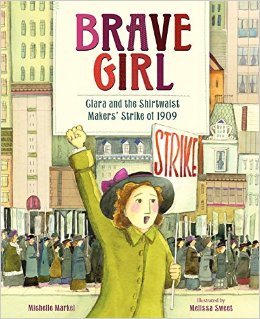
Brave Girl: Clara and the Shirtwaist Makers’ Strike of 1909 by Michelle Markel. Illustrated by Melissa Sweet.
This biographical tale tells of how Clara Lemlich, an Ukranian immigrant to the United States, became a leader of New York City’s garment workers in the early 1900s.
As a child Clara went to work sewing clothes for just a few dollars a month because no one would hire her father. Clara quickly became angry at the terrible treatment she and the other girls faced.
When some of the men at the factory talked about striking, they didn’t think the women were tough enough to participate. Clara knew that wasn’t true, and she engaged in tireless organizing that resulted in being repeatedly fired, arrested, and even beaten. At a huge union meeting, when the men were cautious, it was Clara who stood up and called for a general strike. (Recommended for ages 5 – 9. White Jewish author.)
Related post: Best children’s books about workers’ rights

Here Is the World: A Year of Jewish Holidays by Lesléa Newman. Illustrated by Susan Gal.
This warm, joyful celebration of Jewish holidays is enjoyable for both Jewish and non-Jewish kids alike. The rhyming text and playful illustrations share the important symbols and traditions of each holiday. For readers who need more background on customs and holidays, additional information is included in the endpages. (Recommended for ages 3 – 7. White Jewish lesbian author.)
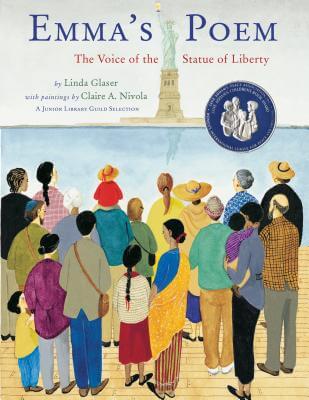
Emma’s Poem: The Voice of the Statue of Liberty by Linda Glaser. Illustrated by Claire A. Nivola.
Have you ever wondered where the words written at the base of the Statue of Liberty came from?
Emma Lazarus was already a well-known author when she first met immigrants on Ward’s Island in New York Harbor. Although many of the immigrants were Jewish like Emma, they did not have her education and wealth. Her heart went out to the many people who were hoping for a better life in the United States, and she began to directly assist immigrants in a time when many thought a lady of her status shouldn’t mix with poor people.
Emma’s poems and newspaper articles told the stories of immigrants and all the injustices they were facing, yet many people still didn’t listen. When she was asked to contribute a poem for a collection that would raise money to build the base for the new Statue of Liberty, Emma thought carefully about what she would say. At that time, people did not connect the statue with immmigrants, but when Emma imagined the statue as an actual woman, she knew just what the statue should say. (Recommended for ages 6 – 10. White Jewish author.)
Related post: 14 children’s books about immigrants and refugees

The Book Rescuer by Sue Macy. Illustrated by Stay Innerst.
As a child, Aaron Lansky’s grandmother told him how she immigrated to the United States from Eastern Europe with one cardboard suitcase filled with precious items from home, including a few books written in Yiddish. When her older brother greeted her In New York City, he threw her suitcase overboard, telling her she needed to break with her past and think only of the future.
Aaron thought often of his grandmother’s story and the distress at what she’d lost. A book lover, he studied Jewish history in college. He decided to learn Yiddish so that he could understand the novels that people of his grandmother’s generation had loved.
Though there once were as many as thirteen million Yiddish speakers, by Aaron’s time many assumed the language was dying. Aaron became determined to save as many Yiddish books as possible, even when that meant rescuing books from a dumpster right before a rainstorm. (Recommended for ages 6 – 10. White Jewish author.)
Middle grade novels starring Jewish characters
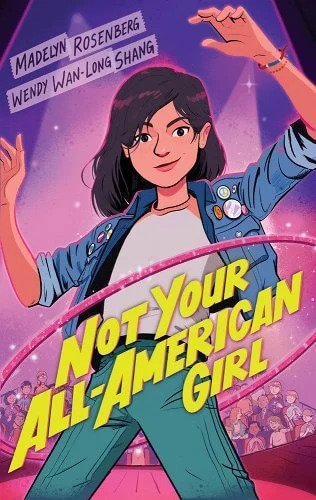
Not Your All-American Girl by Madelyn Rosenberg and Wendy Wan-Long Shang.
Lauren watches Star Search every Sunday night and dreams of joining the ultimate 1980s contest one day. Everyone says she’s one of the best singers in the school, but when she tries out for a school play set in a 1950s small town, her friend Tara gets the lead instead.
The play’s director tells Lauren, who is biracial Chinese-white, that she’s simply not “all-American” enough to be a believable lead. (She also seems surprised when Lauren mentions that she’s Jewish.) Meanwhile, Lauren hears the voice of Patsy Cline on the radio and dreams of singing just like her. Lauren assumes that Patsy’s last name is Klein, and that she’s Jewish too. She takes this as a sign that she could become the first Chinese-Jewish country singing star.
As play practice takes up more and more time, Lauren muddles along in the neglected ensemble, while Tara gets the spotlight. Lauren starts to wonder if there’s any point in her singing at all, if others will always be reminding her that she doesn’t fit in. (Recommended for ages 8 – 12. White Jewish author – Rosenberg and Chinese-American author – Wan-Long Shang.)
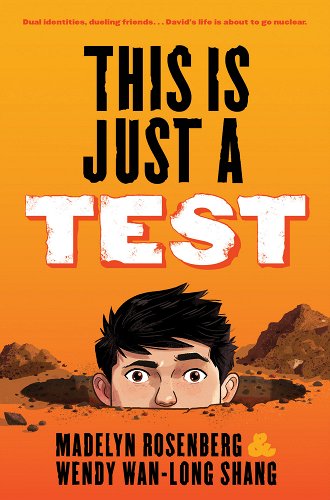
This Is Just a Test by Madelyn Rosenberg and Wendy Wan-Long Shang.
Before Rosenberg and Wan-Long Shang teamed up to bring up the story of Star Search hopeful Lauren, they wrote this equally funny and bittersweet account of her older brother David.
Set in the early 1980s, this hilarious and ambitious novel explores changing friendships, a first crush, pressure from relatives to adopt one culture more than another, and the threat of nuclear war.
David Da-Wei Horowitz is the kind of kid who likes people to get along. But as he prepares for his bar mitzvah, his Jewish and Chinese grandmothers keep escalating their cries that he needs to be more in touch with each of their cultures.
When he watches a scary movie about nuclear war at his new friend Scott’s house, Scott invites him to build a fallout shelter just for the two of him. David wants to include his best friend Hector, but Scott disagrees. David feels bad leaving out Hector, but Scott seems like the kind of guy who could teach him how to talk to his crush Kelli Ann without making a fool of himself (as he’s done so far.)
It’s hard to know which conflict is the biggest threat to David: the U.S. vs. the USSR, loyalty to Scott vs. Hector, or trying to please Safta and Wai Po equally. (Recommended for ages 8 – 12. White Jewish author and Chinese-American author.)
Related post: 12 chapter books starring biracial characters
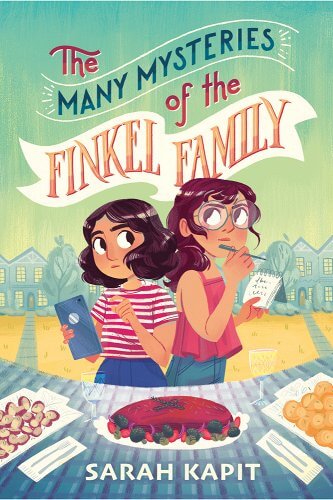
The Many Mysteries of the Finkel Family by Sarah Kapit.
Sisters Lara and Caroline are only 15 months apart, and they’ve always done everything together. But when Lara starts a detective agency, she doesn’t want Caroline involved. After all, Caroline already has her own special talent (art) and Lara is tired of feeling like the only autistic person who isn’t really good at something.
Meanwhile, Caroline wants some distance for her own reason. She’s starting middle school, and she doesn’t need bossy Lara intervening all the time just because she speaks by typing on a tablet. Kapit’s portrayal of this neurodiverse family is full of the hilarious, sticky situations tweens get themselves into, while her portrayal of Ashkenazi and Sephardic Jewish cultures will be accessible to both Jewish and non-Jewish readers alike. (Recommended for ages 8 – 12. White Jewish author.)
Related post: 20 children’s books about disability that shatter stereotypes

Starfish by Lisa Fipps
Ellie has been bullied by other kids about her weight ever since she was five years old, but the cruel words and actions that cut the deepest are those of her mother. Ellie’s written herself a list of “fat girl rules” to try to minimize the stares and jokes, but the end result is shrinking her mind and heart.
When her father takes her to see a psychologist, Ellie is at first convinced this is another effort by her family to get her to lose weight. With patience and creativity, her therapist slowly gets Ellie to open up about how all the bullying is affecting her. A new friendship with her neighbor Catalina also helps her realize that some families truly are supportive of each other.
As Ellie learns how to speak up for herself, she also embraces the image of herself as a starfish, claiming her right to take up a space in a world that says she doesn’t belong. This insightful, compelling book should be required reading for all middle schoolers and the adults who care about them. (Ages 10 – 14. White, non-Jewish author.)
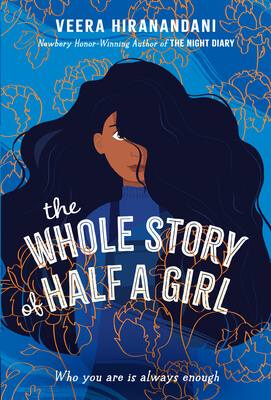
The Whole Story of a Half a Girl by Veera Hiranandani.
When Sonia leaves her tiny private school for public school, she wrestles with her identity in a way that she’s never had to do before. Everyone at school seems to be Black or white, and she’s Indian. Or is she part Indian? And is she Jewish, or part Jewish?
At home, her family is struggling to deal with her father’s job loss and his deepening depression, and Sonia’s mother seems alarmed about her new friends and the sport they’ve led her to: cheerleading. Sonia’s struggles around ethnic and religious identity, shifting friendships, and a completely new school environment are at times painfully realistic, yet this authenticity is what will make the novel so appealing to young teens. (Recommended for ages 10 – 14. Indian-American Jewish author.)
Shop this list of children’s books starring Jewish characters on Bookshop.org. Your purchase supports independent bookstores!
What are your favorite children’s books starring Jewish characters? Share in the comments!
