
In my pre-Mom life, I was a community organizer for a worker rights organization. Labor Day was one of the most important days of the year, not just a day to sleep in or barbecue. So you can bet that as a Mom, I’m always on the lookout for great children’s books that can help kids and teens understand what Labor Day and worker rights are all about!
You’ll notice that many of these books are about labor unions, especially the struggles of workers to establish unions in the face of unfair, unsafe working conditions. That’s because the history of Labor Day is closely intertwined with the struggles of unions to uphold workers’ rights going all the way back to the 1880s.
Note: Originally, this post recommend the book Side by Side: The Story of Dolores Huerta and Cesar Chavez. I have removed this recommendation after revelations that Chavez sexually assaulted multiple girls and women.
Jump to:
- Picture books about workers’ rights for Labor Day
- Chapter books about workers’ rights for Labor Day
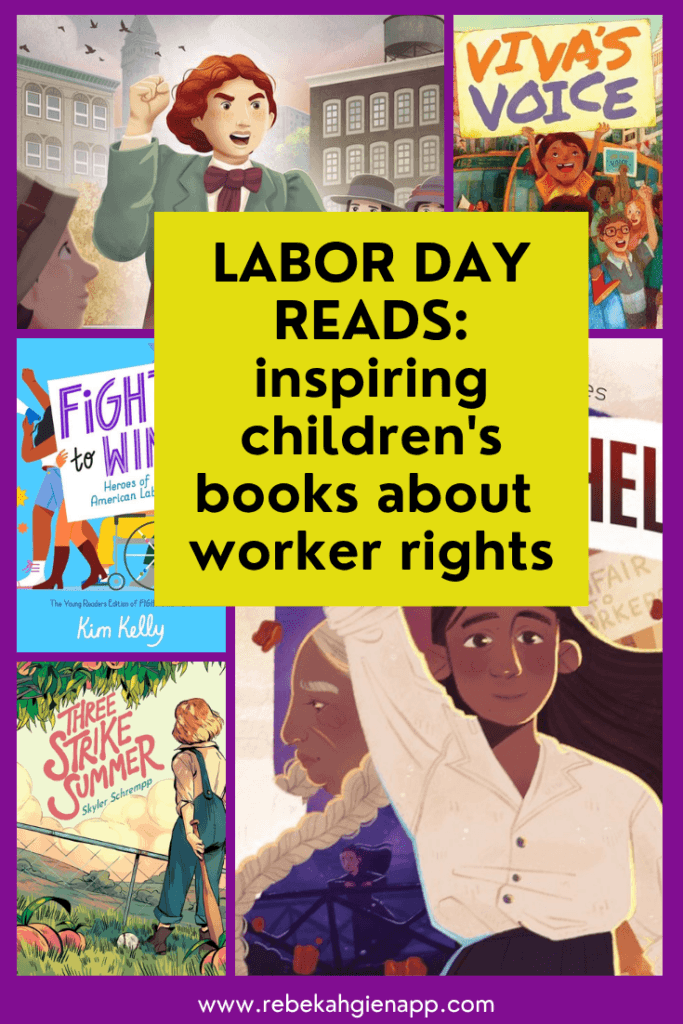
Disclosure: For your convenience, this post contains affiliate links. If you purchase items through these links, I may earn a small commission at no additional cost to you. The publisher of Thanks to Frances Perkins provided me with a free review copy of the book; all opinions are my own. You can read my full disclosure policy here.


Picture Books About Worker Rights to Read on Labor Day
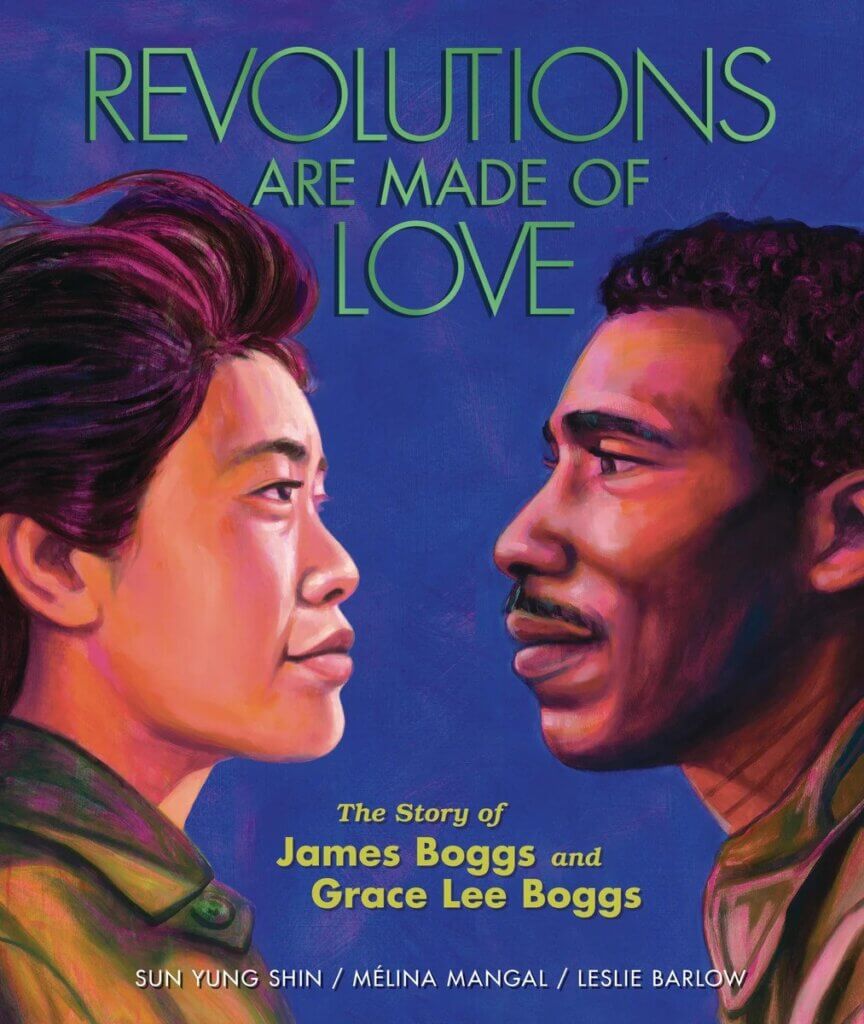
Revolutions Are Made of Love: The Story of James Boggs and Grace Lee Boggs by Sun Yung Shin and Mélina Mangal. Illustrated by Leslie Barlow.
Purchase from Bookshop.org (supports independent bookstores and my business!)
How were Grace Lee and James Boggs, two people who came from such different backgrounds, drawn together in working for liberation, and eventually into a marriage?
Through in-depth, free verse poems accompanied by detailed, emotionally evocative illustrations, this picture book for older readers explores the lives of two unsung activists and thinkers who made a major impact in their city of Detroit and beyond. For many years, each worked in their own way for workers’ rights and racial justice, matching their powerful intellectual work with on-the-ground strategic action.
In both their thinking and their lives, the activist pair made clear that “revolutions are made out of love for people and for place.” This book is a beautiful and stirring introduction to two social justice leaders whose story more of us should know. (Non-fiction picture book. Recommended for ages 8+. Korean American author and Black author.)

The Teachers March! How Selma’s Teachers Changed History by Sandra Neil Wallace and Rich Wallace. Illustrated by Charly Palmer.
Purchase from Bookshop.org (supports independent bookstores and my business!)
Often children’s books about the civil rights movement will describe an important march without describing how such a daring and complex event came to be. This unusual picture book about a little-known event in Black history, the Selma teachers’ march of 1965, explains in careful detail what teacher and pastor F.D. Reese had to do to mobilize his fellow teachers to publicly stand for voting rights.
Civil rights activists in Selma had faced violence and defeat so many times. Rev. Reese knew they needed a new approach. Teachers were seen as leaders in the community. If he could convince a group of teachers to march, it would propel others to join in. Just how he could mobilize them when so many rightfully feared losing their jobs? Answering this question would be as great a challenge as the actual march itself. (Non-fiction picture book. Recommended for ages 8 – 12. White authors.)
Related post: 11 ways to teach kids about voting and democracy (with recommended books for children and teens)
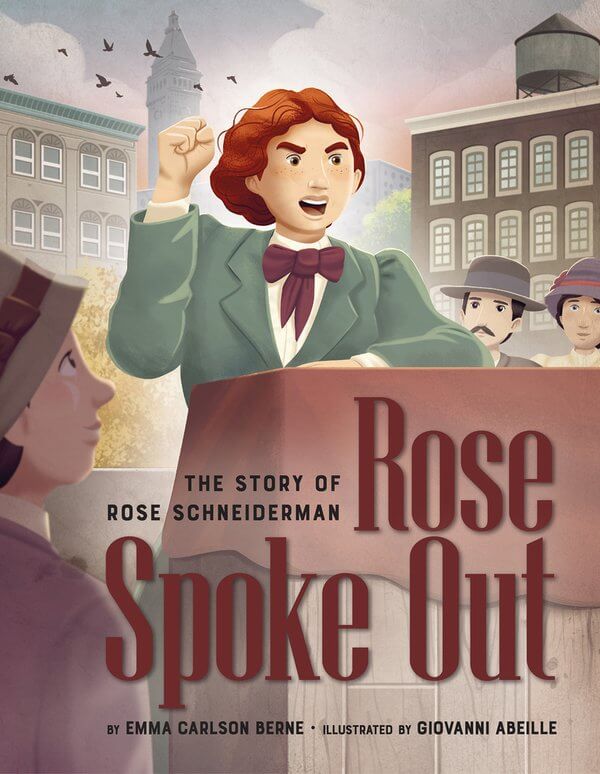
Rose Spoke Out: The Story of Rose Schneiderman by Emma Carlson Berne. Illustrated by Giovanni Abeille.
Purchase from Bookshop.org (supports independent bookstores and my business!)
This picture book biography of Rose Schneiderman, the president of the National Women’s Trade Union League, focuses on her early life as a working teen from a Polish Jewish immigrant family. Through Rose’s life story, readers see the struggles that women seamstresses faced in the early 1900s. Rose used her “big voice” to convince workers in the factory where she worked to push for pay equal to men as well as safer working conditions. Later, the book explains how Rose began to organize workers from other factories as well.
I appreciated that the book was honest about how the workers’ organizing efforts “worked, sort of.” Berne is honest with readers about the gains workers made and also which of their demands were not met by factory bosses. This is a helpful book for the younger readers because of its straightforward explanations of the struggles women workers of the era faced.
However, I was disappointed and confused that the word “union” was not used once in the main text. This is especially baffling considering Schneiderman went on to become the president of a union, and the omission contributes to the book’s overall portrayal of her as a hero separate from other workers. (Non-fiction picture book. Recommended for ages 4 – 8. White Jewish author.)

Undocumented: A Worker’s Fight by Duncan Tonatiuh.
Purchase from Bookshop.org (supports independent bookstores and my business!)
Undocumented was created in an accordion fold format, similar to an ancient Mixtec codex. It has the feel of a short graphic novel, with a relatable, conversational tone. Juan, a Mixtec man born in a small Mexican village, points out that “you don’t know our names but you’ve seen us…We may not have documents, but we all have a story and we all have a name.”
Juan scrapes by for many years working at a restaurant, where the owner tells him he’s “doing him a favor” by hiring him since he’s undocumented. But when his Chinese co-worker Li takes him out for happy hour after work, she helps him understand just how unfair their working situation is. When Juan’s wife announces a baby is on the way, he realizes that something has to change, and agrees to go with Li to a workers’ center to learn about how they can organize. (Fiction picture book. Recommended for ages 6 – 12. Mexican American author.)
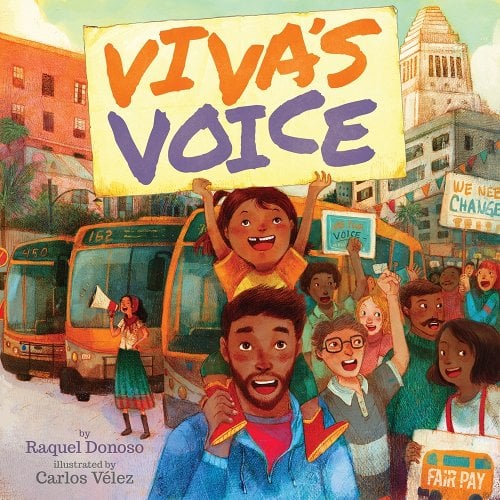
Viva’s Voice by Raquel Donoso. Illustrated by Carlos Velez.
Purchase from Bookshop.org (supports independent bookstores and my business!)
Inspired by the author’s experience of accompanying her father on the picket line, Viva’s Voice stars a child whose voice is always the “mightiest” one in the room. Papi’s voice, by contrast, is almost always quiet.
When summer break begins, Viva can’t wait to go with Papi on one of his bus routes. When she discovers that he is on strike, she begs to go with him to a protest, promising that she won’t be disruptive. He agrees, and Viva finds herself energized by the crowd. After she discovers that Papi is nervous about the big speech he’s supposed to give, Viva is ready to support him. (Fiction picture book. Recommended for ages 4 – 8. Latina author.)
Related post: Engaging picture books starring Latine characters

Thanks to Frances Perkins: Fighter for Workers’ Rights by Deborah Hopkinson and Kristy Caldwell
Purchase from Bookshop (supports independent bookstores and my business!)
This picture book begins by posing a math question to kids: “how many years will it be until you turn sixty-two?” Readers won’t find out until the end of the book why that matters, but they do get a hint that the question has something to do with Frances Perkins.
Perkins was the first woman to ever serve in a U.S. President’s cabinet. As Secretary of Labor under President Roosevelt, she pushed for many labor reforms we take for granted today.
When the President called to ask Perkins to serve as his Labor Secretary, she was ready. My favorite detail in the book comes next. Perkins had been scribbling down ideas for workers’ rights reforms on little slips of paper for years. She dumped all the slips (including one about a “rock of security” for older people who couldn’t work) onto a table and began planning how she could make life better for workers as Secretary of Labor.
There’s plenty to both inspire and inform future changemakers in this biography! (Non-fiction picture book. Recommended for ages 5 – 9. White author.)
Shop this list on Bookshop.org to support my business and independent bookstores!
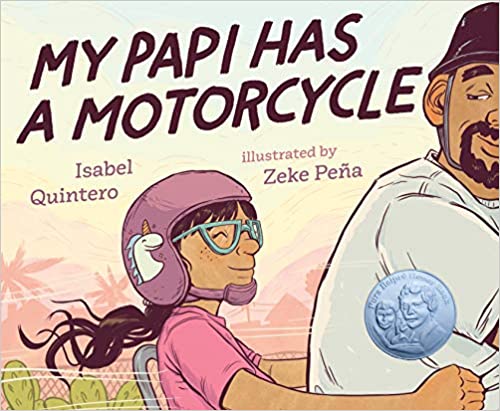
My Papi Has a Motorcycle by Isabel Quintero and Zeke Peña
Purchase on Bookshop (supports independent bookstores and my business!)
Children will love following a girl and her Papi around their working class Latinx neighborhood on the back of Papi’s motorcycle. He wants to take his daughter to see the houses he’s helping build, but there are plenty of familiar stops along the way.
I love how the text and pictures convey adventure, warmth, change, and community all at the same time. (Fiction picture book. Recommended for ages 4 – 8. Mexican American author.)

Night Job by Karen Hesse and G. Brian Karas
Purchase on Bookshop (supports independent bookstores and my business!)
While the rest of the city is asleep, a young boy accompanies his father on his school custodian job.
Even though no one is there, the child finds plenty to occupy him, from shooting baskets in the gym to eating egg salad sandwiches for dinner in the courtyard.
This quiet book conveys warmth and respect for people whose work often goes unseen. (Fiction picture book. Recommended for ages 3 – 7. White author.)
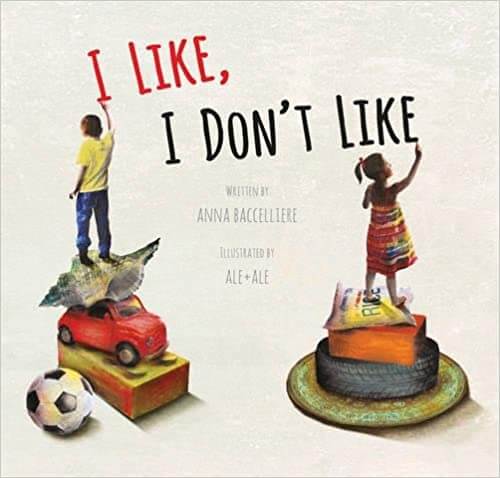
I Like, I Don’t Like by Anna Bacceliere and Ale + Ale
Purchase on Bookshop (supports independent bookstores and my business!)
This simple book introduces young children to the concept of child labor. On the left side of the page, children in wealthy countries say the things they like (shoes, soccer balls, rice, etc.) On the right side of the page a child is shown working to make the same item, saying they don’t like these things. (Non-fiction picture book. Recommended for ages 3 – 6. Italian author.)
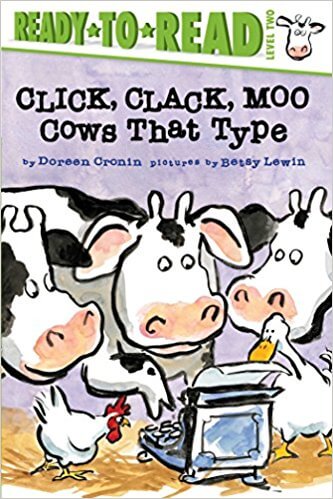
Click, Clack, Moo: Cows That Type by Doreen Cronin and Betsy Lewin
Purchase on Bookshop (supports independent bookstores and my business!)
Some of the books on this list may go over the heads of the youngest readers, but not this one! Farmer Brown’s cows have discovered a typewriter, and it’s led to nothing but trouble for him. They’ve typed up their demands for electric blankets on cold nights. When the Farmer says no way, the cows have the audacity to go on strike, typing up a notice that there will be no milk for today.
This clever, playful book is a perfect first introduction to why workers sometimes go on strike. (Fiction picture book. Recommended for ages 3 – 6)
Related post: Best children’s books about immigrants and refugees

Memphis, Martin, and the Mountaintop: The Sanitation Strike of 1968 by Alice Faye Duncan and R. Gregory Christie
Purchase on Bookshop (supports independent bookstores and my business!)
Truth? I’m pre-disposed to love this book because: 1) I’m a Memphian 2) the author is a friend, and 3) her mother was one of my best activists when I was organizing for worker rights.
I would be praising this story even without these relationships. There are many children’s books about Martin Luther King, Jr. But I’m not aware of any others that tell the story of the Memphis sanitation workers who he came to support when he was assassinated.
Duncan interviewed Dr. Almella Starks-Umoja, who as a child marched with her parents alongside the striking sanitation workers. Her accounts were used to create the narrator, a 9 year old year girl named Lorraine. Importantly, the story starts long before Dr. King first arrived, focusing on the struggles of the workers and the efforts of the local Black community to support them. (Historical fiction picture book. Recommended for ages 8+. Black author.)
Related post: Teaching truthfully about Dr. Martin Luther King, Jr.
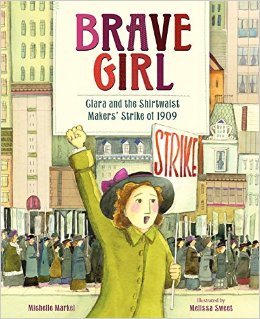
Brave Girl by Michelle Markel and Melissa Sweet
Purchase from Bookshop (supports independent bookstores and my business!)
This biographical tale tells the true story of how Clara Lemlich, a Jewish Ukranian immigrant to the United States, became a leader of New York City’s garment workers in the early 1900s. As a child Clara goes to work sewing clothes for just a few dollars a month because no one will hire her father.
Clara quickly becomes angry at the terrible treatment she and the other girls face. She hears from some of the men that they’ve been thinking of going on strike, but they don’t think the women are tough enough to participate.
Related post: 5 kid activists from American history
Through tireless organizing that results in Clara being repeatedly fired, arrested, and even beaten, Clara she shows just how brave girls can be. At a huge union meeting, when the men are cautious, it is Clara who stands up and calls for a general strike. (Non-fiction picture book. Recommended for ages 5 -9. White Jewish author.)
Teach young people that the fight for voting rights isn’t over with this activity pack for kids and teens!
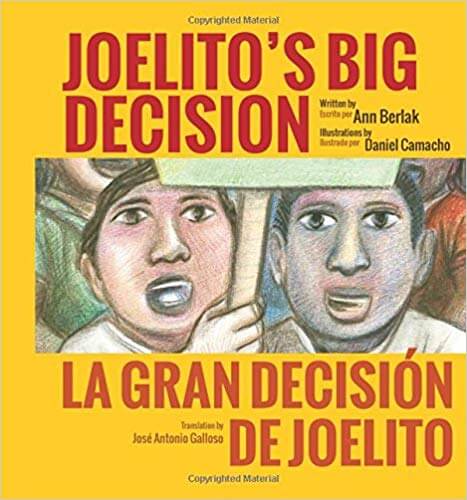
Joelito’s Big Decision/La gran decisión de Joelito by Ann Berlak and Daniel Camacho
Purchase from Bookshop (supports independent bookstores and my business!)
When talking to kids about Labor Day, it’s important to include current worker rights struggles, like the Fight for $15 fast food worker campaign told in this story. Every Friday, Joelito looks forward to having a burger with his family at the fast food chain McMann’s. But when his family arrives this particular Friday, they see crowds of people in the parking lot, holding signs that say things like “Low Pay Is Not OK.” Joelito even sees his friend Brandon protesting with his parents, who both work at McMann’s. (Fiction picture book. Recommended for ages 4 – 8. White author.)

¡Si, Se Puede!/Yes, We Can! Janitor Strike In L.A. by Diana Cohn and Francisco Delgado
Purchase from Bookshop.org (supports independent bookstores and my business!)
Carlitos’ mama is one of the many hard-working janitors who clean the tall glass office buildings of Los Angeles at night. One day, his mother sits him down to explain that she can’t take care of him and his grandmother like she wants too. That’s because even after her work as a janitor, and her weekend work cleaning houses, her wages are too little for basic necessities.
That’s why his mother is joining with other janitors to go on strike. Carlitos wants to help his mother, but he’s not sure how. At school, he discovers that there are other children whose parents are on strike. He has an idea that he shares with his teacher. Together his class makes signs for those who are on strike.
Carlitos is proud to surprise his mother with his sign: “I love my Mama! She is a janitor!” (Fiction picture book. Recommended for ages 3 – 7. White author.)

Mother Jones and Her Army of Mill Children by Jonah Winter. Illustrated by Nancy Carpenter.
Purchase from Bookshop.org (supports independent bookstores and my business!)
Real life hero of the U.S. labor movement Mother Jones comes alive in this first person narrative that captures how unflappable, bold, and persistent she was. Of all the terrible things she saw workers experience, none made her angrier than the exploitation of children in textile mills.
While Mother Jones tried a number of tactics, she eventually called on families to allow their children to march with her all the way to the President’s summer home, a distance of more than 100 miles. Though President Roosevelt refused to see them, Mother Jones emphasizes that the campaign was not a failure. This realistic look at the incredible effort it takes to strike down injustice still manages to inspire and encourage young readers. (Non-fiction picture book. Recommended for ages 6 – 10. White author.)

Which Side Are You On? The Story of a Song by George Ella Lyon and Christopher Cardinale
“Which Side Are You On?” is one of the most famous songs in U.S. labor history. This picture book’s author grew up in Harlan County, Kentucky, the place where the song was written by a coal miner’s wife. Her husband has been an outspoken union supporter and a strike leader, so he becomes a target for violence.
When he goes into hiding, the coal bosses even target his family. It’s while they are hiding in a bedroom, bullets whizzing through the house, that Florence Reece begins to write the song that will eventually mobilize millions in their struggles for justice. (Non-fiction picture book. Recommended for ages 4 – 8. White author.)

Me and Momma and Big John by Mara Rockliff and William Low
This quiet, reflective book was inspired by one of the first women stonecutters who worked to repair “Big John.” The enormous church is more formally known as the Cathedral Church of Saint John the Divine in New York City.
Her children find it hard to imagine the huge church that Momma describes, big enough than an entire apartment building could fit inside. Her son also can’t believe that in all the time she has been working, she’s only cut one stone. His mother knows that what she is doing is more than a job; it’s art. It’s only when the family goes to see her stone in person that they understand what she means. (Fiction picture book. Recommended for age 4 – 10. White author.)
Chapter Books to Read on Labor Day
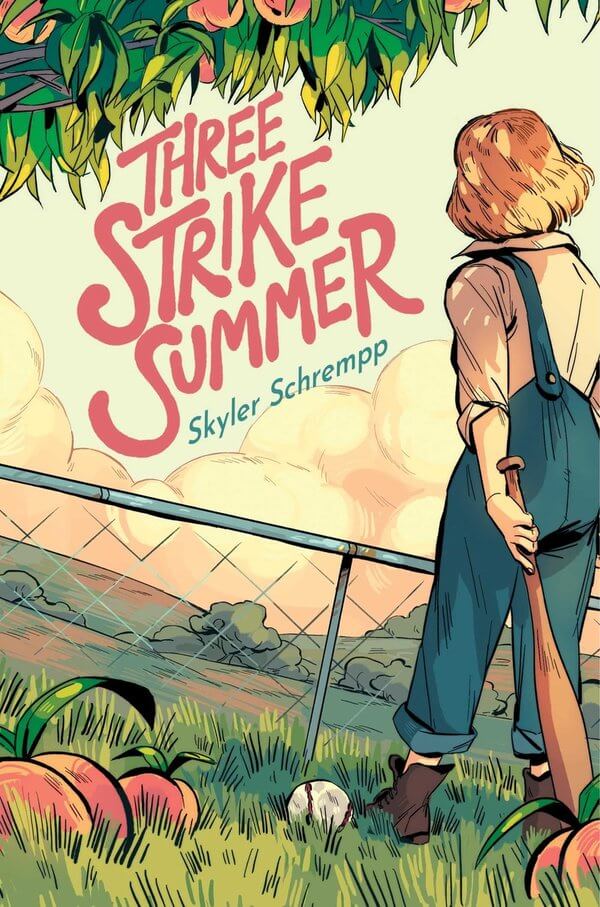
Three Strike Summer by Skyler Schrempp.
Purchase from Bookshop.org (supports independent bookstores and my business!)
When Gloria Mae’s family is forced out of their Oklahoma farm by the bank man, she can’t understand why her Pa doesn’t fight it. Her older sister Jess tells Glo she has to accept that it’s just the way things are, and that if she’d stop being so wild, things would be easier for their parents.
As they arrive in California with other destitute families looking for field work, Glo still doesn’t understand why her Pa seems so different. The foreman at the peach farm that hires them warns the family that both organizing and “filching the product” won’t be tolerated. Forced to use the company store and pay exorbitant rent for a shack, Jess knows what their parents need is for everyone to work hard and keep their heads down. Even though they’re not allowed off the property, Glo becomes obsessed with getting the migrant boys to let her join their secret baseball games against workers from a nearby apricot orchard. When another child gets hurt on the job, Ma and Pa’s attitude about organizing starts to shift.
Related post: Graphic novels about U.S. history
One of the reasons I loved this book so much is that while Glo is a fighter and notices the unfairness around her, she’s also a typical kid. She worries about her family and the injustice of their poverty wages, but Glo is most concerned about baseball and the unfairness of the boys keeping her off their team. Unlike some historical fiction that makes child characters mature far beyond their years, Glo has flaws and acts her age. This is what will likely hook young readers into the story, even if they’re not sure they’re interested in workers’ rights and labor organizing. (Historical fiction novel. Recommended for ages 8 – 12. White author. Content note: One use of mild profanity.)
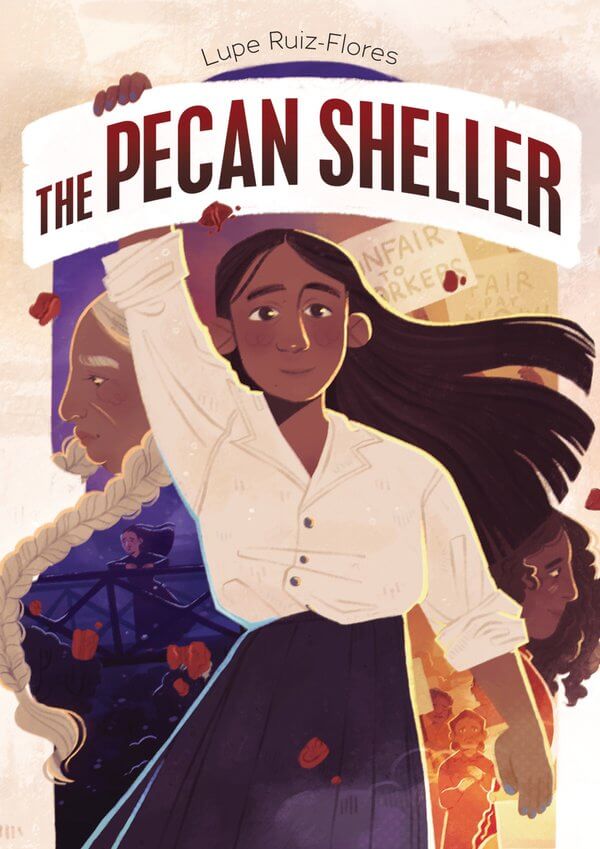
The Pecan Sheller by Lupe Ruiz-Flores.
Purchase from Bookshop.org (supports independent bookstores and my business!)
Inspired by a real 1930s pecan worker strike, this award-winning book helps today’s youth understand just how dire the Great Depression was, especially for communities of color.
Petra loves school and dreams of becoming a writer. Money has been extremely tight since her father’s unexpected death a few months before, but Papá always wanted Petra to attend high school. Her stepmother is now supporting the family on her meager wages from the pecan factory, where she earns less than $4 a week.
When Amá insists that Petra must quit school to work at the pecan factory too, she’s devastated. While Petra is angry at Amá, she also understands that they don’t have enough to eat and could lose their home. At the pecan factory, many of the workers cough constantly because of the pecan dust, and the working conditions are awful. Hardly any of the workers are willing to complain, especially since it would be so easy for Don Igancio, the boss, to replace them.
But when news travels that the pecan factories plan to cut their wages even more, Petra and some of the other workers have had enough. Despite Amá’s warning not to endanger herself or their family income by going to a worker meeting, Petra is ready to stand up for her dignity. (Historical fiction novel. Recommended for ages 10 – 14. Mexican American author.)
Related post: Middle grade books about Latine and Hispanic heritage and history
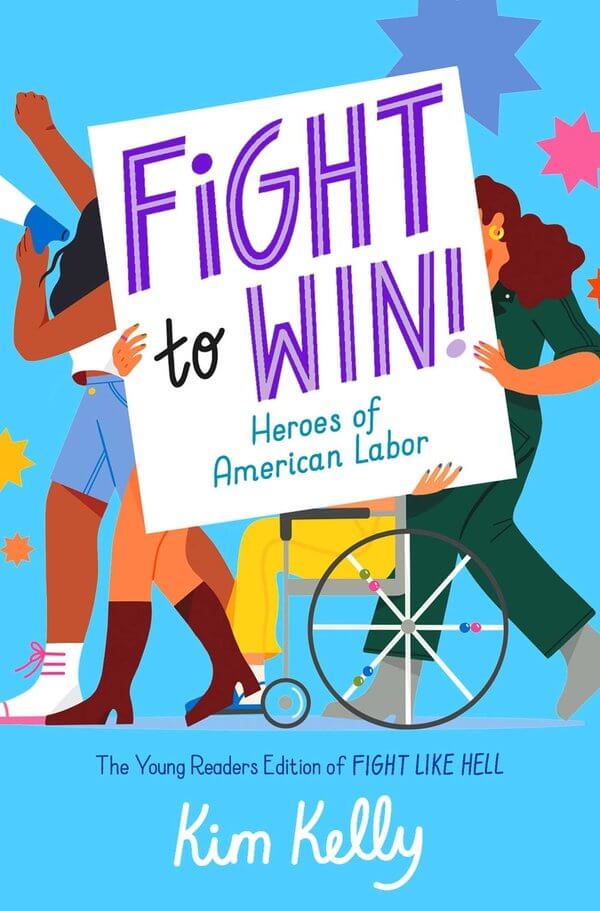
Fight to Win: Heroes of American Labor by Kim Kelly.
Purchase from Bookshop.org (supports independent bookstores and my business!)
I highly recommend this engaging young readers adaptation of Fight Like Hell! It introduces youth to an impressive array of worker rights organizers while also explaining important aspects of the larger labor movement throughout U.S. history. Kelly has chosen many leaders who pushed traditional unions to abandon racial, gender, and anti-LGBTQ biases that kept them from representing all workers. Rather than presenting them as individual icons, the author uses their work and viewpoints to explain various strategies and debates about worker organizing as well as how rank-and-file workers stood together again injustice. I particularly appreciated that the book includes a ground-breaking current labor struggle: Amazon warehouse workers fighting for union representation. (Non-fiction chapter book. Recommended for ages 12+. White author.)
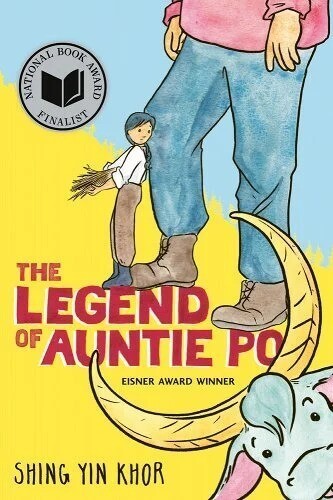
The Legend of Auntie Po by Shing Yin Khor.
Purchase from Bookshop.org (supports independent bookstores and my business!)
In this unique graphic novel, Mei spends much of her time making pies for the logging camp where her father Hao is the highly skilled head chef for all the workers, both White and Chinese. In the evenings, she often entertains the children of the camp with her imaginative stories.
When the racist effects of the Chinese Exclusion Act begin to afffect life in the camp, Mei begins telling stories about Auntie Po, whose strength exceeds that of Paul Bunyan. As she tells stories about how Auntie Po will protect them, Mei starts to actually see the god she has created in the camp.
When a dangerous logjam happens, will Auntie Po be able to save them all? (Historical fiction graphic novel. Recommended for ages 10 – 14. Queer Malaysian Chinese American author.)
Related post: Great alternatives to the Little House on the Prairie books

Silver People by Margarita Engle.
Purchase from Bookshop.org (supports independent bookstores and my business!)
The enormous feat of connecting the world’s two largest oceans was accomplished through the dangerous and back-breaking labor of “silver people.” White American interests ran the Panama Canal project, and they paid light-skinned Americans and northern Europeans in gold and decent living conditions. Meanwhile, “semi-white” Spaniards from Cuba were paid poverty wages in silver, and Jamaicans were paid only half of what Cubans earned.
In this novel in verse, Engle brings their rarely told stories to light through the voices of Mateo, Anita, Henry, and Agosto, as well as the voices of the animals whose rainforest home is being destroyed. Mateo is a Cuban teen fleeing his father’s violence, while Anita is indigenous to Panama and offers her local knowledge and herbal remedies to Mateo. Henry is Jamaican and faces particularly brutal treatment that he is determined to escape despite the threat of police violence. Puerto Rican Agosto (for a time) receives more favorable treatment because he once lived in the mainland United States. (Recommended for ages 11 – 14. Cuban American author.)

Front Desk by Kelly Yang
Purchase from Bookshop (supports independent bookstores)
Reading this book with my kid has prompted so many conversations about immigration, workers’ rights, and racism, while also being a thoroughly engaging book.
When Mia Tang’s parents get hired to manage a motel, they’re sure this will be the way they’ll finally move out of poverty. After all, the owner Mr. Yao is giving them a free place to live, plus money for every customer they check in. Plus, there’s a pool that Mia can’t wait to swim in.
It takes less than 24 hours on the new job to realize that Mr. Yao will find every opportunity he can to take advantage of them (and that Mia isn’t allowed in the pool.) But Mia is still determined to find ways to make the hotel better, so that her family can make more money. (Historical fiction chapter book. Recommended for ages 9 – 13. Chinese American author. Content note: One use of mild profanity.)

Missing from Haymarket Square by Harriette Gillem Robinet.
Purchase from Bookshop.org (supports independent bookstores and my business!)
Missing from Haymarket Square is a thoughtful introduction to the struggles of Black and immigrant laborers for unions and humane working conditions. Though she’s a child, Dinah works twelve hours a day in a Chicago sewing factory. She lives in a one room apartment not only with her father and mother, but with two immigrant families. There’s never enough money for rent and for food, especially since Dinah’s mother lost her arm due to an injury in the sewing factory and her father was blacklisted for his union activity.
When Dinah’s father goes missing, she hears a rumor that he’s been taken by the ruthless Pinkerton detectives. She and her “almost sister” Olive are determined to rescue him, while they also contend with a manager who threatens to fire them if they join the big march for the 8 hour work day that her father supported. (Historical fiction chapter book. Recommended for ages 10 – 14. Black author.)

Esperanza Rising by Pam Muñoz Ryan
Purchase from Bookshop.org (supports independent bookstores and my business!)
This middle grades novel, set in the 1930s, was inspired by the life of Muñoz Ryan’s grandmother. When her family fell on hard times, she had to leave a life of privilege as the daughter of a Mexican rancher to become a farmworker in the United States.
When Esperanza’s father is ambushed and killed by bandits, her fairy tale life quickly falls apart. Her father’s brothers, who never liked Papa or his egalitarian notions, burn down the ranch after Mama refuses one of the uncle’s marriage proposal. Through careful plans made with Alfonso and Hortensia, who are the heads of Papa’s household staff, they make plans to travel in secret to the United States.
While Mama understands that their lives must change dramatically in order to be free of the uncles, Esperanza finds change much harder. Soon though, Esperanza can see how much Mama, Alfonso, Hortensia, and the other farmworkers who befriend her need to grow up and accept her new life.
I loved the way the author weaves a compelling personal story for Esperanza, while also introducing readers to the struggles of 1930s farmworkers, including efforts to unionize and the mass deportations of U.S. citizens of Mexican descent. (Historical fiction chapter book. Recommended for ages 9+. Mexican American author.)
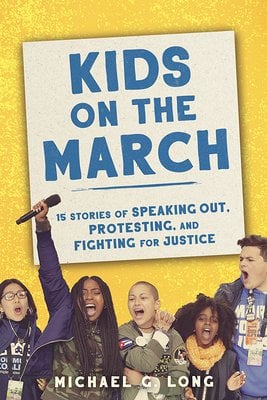
Kids on the March: 15 Stories of Speaking Out, Protesting, and Fighting for Justice by Michael G. Long.
Purchase from Bookshop.org (supports independent bookstores and my business!)
This unique volume tells the stories of 15 protest movements that involved or were led by young people in the 20th and 21st centuries in the United States. Some young readers will be familiar with the climate strike, March for Our Lives, or protests after George Floyd’s murder, but will learn new details about how and why young people marched for these causes. Earlier activists movements will be unfamiliar to most young readers, such as the child mill workers who marched to President Roosevelt’s summer home in 1903, or the Chicano student walkouts in East Los Angeles in 1968.
While individual children or youth’s stories are highlighted, one of the best attributes of the book is that it shows the power of movements, not just charismatic individuals. Long is also honest about the fact that some protests did not result in big victories, which is a welcome change from social justice children’s books that oversimplify injustice. (Non-fiction chapter book. Recommended for ages 12+. White author.)
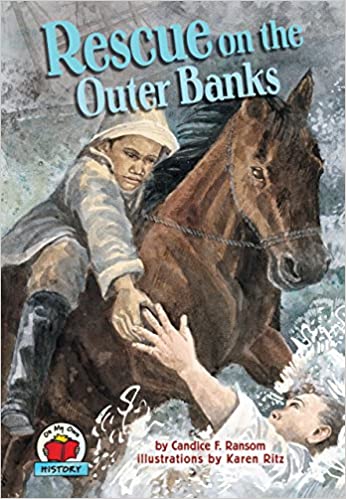
Rescue on the Outer Banks by Candice F. Ransom and Karen Ritz
Purchase from Bookshop (supports independent bookstores)
The Outer Banks of North Carolina were once known as “the graveyard of the Atlantic.” (Having spent a lot of time there at my grandparents’ cottage, I can attest to how rough the waves are!)
This account of a 10 year old boy named Sam is fictional, but it’s based on historical facts. In 1879, when Richard Etheridge was hired to be the lighthouse keeper on Pea Island, all of the white surfmen refused to work for him because he was Black. Etheridge recruited Black workers, making it the first all Black lifesaving station in America.
One stormy October night, young Sam sees a distress rocket light up the sky. As he rides along the beach on his horse Ginger, he sees that the Pea Island surfmen are struggling to rescue nine people from a shipwreck. Can Sam and Ginger help them save the people from drowning? (Historical fiction easy reader chapter book. Recommended for ages 6 – 9. White author.)

Dolores Huerta: Get to Know the Voice of Migrant Workers by Robert Liu-Trujillo
Purchase from Bookshop (supports independent bookstores)
Dolores Huerta is one of my sheroes, a passionate worker rights activist who is still campaigning for justice at the age of 90.
This short chapter book tells the story of why and how she and Cesar Chavez co-founded the United Farm Workers union. Though other labor leaders told them that there was no way they could form a union against powerful California growers, Huerta knew that “si, se puede,” (it can be done.)
As a teacher of farmworker children, Huerta also knew it had to be done. The same workers who harvested crops couldn’t afford to feed their own children.
Young readers will be inspired by Huerta’s courage and vision. (Recommended for ages 6 – 9. Afro Latino author. For a longer chapter book on Huerta’s life for kids ages 8 – 12, see Dolores Huerta Stands Strong.)
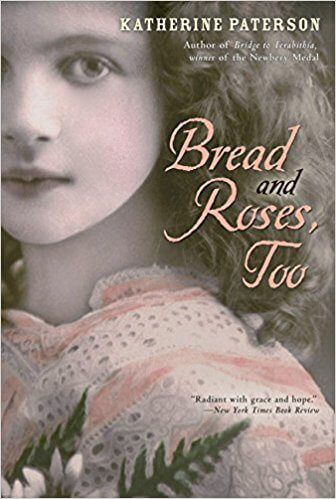
Bread and Roses, Too by Katherine Paterson
Purchase from Bookshop (supports independent bookstores)
The Bread and Roses strike was started by immigrant textile workers in 1912, and I consider it one of the most inspirational events in labor history. What I didn’t know was the full story told in Paterson’s moving chapter book. To keep children of striking workers safe, and to gain public sympathy, the union arranged for children to go “on vacation” and stay with families in New York city and other communities who could provide for them while their parents had no wages.
In the book, we follow the strike through the eyes of two children. Rosa is an Italian-American 6th grader whose mother and older sister work in the mills. Jake is a native born boy who’s never been to school and works in the mills, only to be abused by his father every day when he returns home.
Neither child is sure that the strike is a good thing. Rosa in particular is worried that her family will only bring more hardship on themselves. Yet they can also see that the mill workers’ long hours of labor aren’t even enough to put bread on their families’ tables. (Historical fiction chapter book. Recommended for ages 12+. White author. )
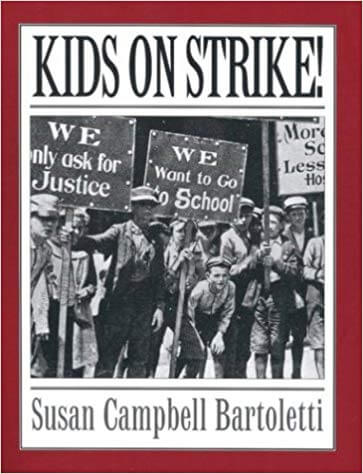
Kids on Strike! by Susan Campbell Bartoletti
Purchase from Bookshop (supports independent bookstores)
Decades before the Bread and Roses strike, girls and teens who labored as textile workers went on strike in Lowell, Massachusetts. They were tired of having their boardinghouse rents raised while their wages stayed the same. These brave young people were just one of many groups of child laborers who fought back against mistreatment.
This illustrated chapter book tells children about strikes by young people in the coal mines, the newspaper industry, and more in the late 1800s through the early 1900s . There’s a chapter about Mother Jones and the kids who stood up against child labor, as well as a chapter on the Bread and Roses strike. (Non-fiction chapter book. Recommended for ages 10+. White author.)
Related post: Marley Dias’ lessons for kid activists
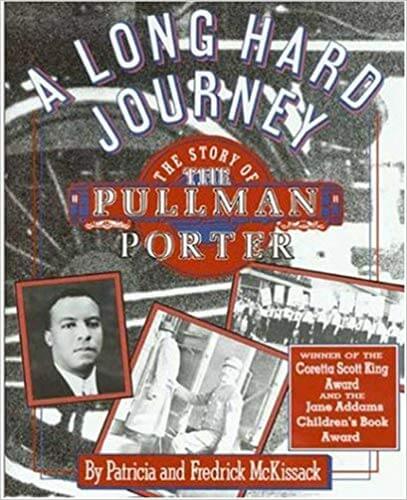
A Long Hard Journey: The Story of the Pullman Porter by Patricia and Fredrick McKissack
This important book is out of print, but currently there are still used copies available on Amazon. I was also able to locate a copy at my local library.
Long before A. Philip Randolph organized the March on Washington with Dr. King, he organized the first major union of Black workers. Starting in the 1920s, Randolph founded the Brotherhood of Sleeping Car Porters, representing Black railroad workers who often faced abuse both from their employer and passengers alike.
Unlike some of their older co-workers, younger porters were ready to push back against mistreatment. Their struggle was not easy, with even some Black community leaders being reluctant to support workers who many believed had “good jobs.” (Non-fiction chapter book. Recommended for ages 12+. Black authors.)

3 responses to “Best Children’s Books to Read on Labor Day”
What a wonderful list. May I add a few of my favorites? “Dolores Huerta – A Hero to Migrant Workers”…written by Head Start Teacher Sarah Warren, great for kids as young as four (up through eight or nine) and it breaks the idea that Cesar was the only leader of the Farm Labor Movement.
“By the Dawn’s Early Light” by Karen Ackerman – about a Mother who works the night shift in a factory. One of the rare books that show what work looks like! “A Day’s Work” by Eve Bunting – about a grandfather and grandson who are day laborers.
And two wonderful sources: http://www.childpeacebooks.org (look under “working class”) books for kids 1 – 7, and http://www.janeaddamschildrensbookaward.org/jacba/#jacbaDatabase – books for kids 6 – 14 (look under “Subjects – social issues addressed”.
Thanks so much Julie for the additional recommendations!
What a great list! Thank you!