
Graphic novels are a great way to get kids interested in history when more traditional approaches fail. (We often use them in our homeschool lessons since my kid’s neurodivergence can make focusing on long blocks of unillustrated text difficult.) They’re also excellent for kids who are history buffs and enjoy visualizing what it would be like to live through important events in U.S. history.
In this post, you’ll find a wide range of historical fiction, non-fiction, and even some historical fantasy books for both kids and teens. The graphic novels are listed in order of recommended ages, so scroll down for books for older readers.


Disclosure: For your convenience, this post contains affiliate links. If you make a purchase through these links, I may earn a small commission at no additional cost to you. You can read my full disclosure policy here.
U.S. history graphic novels for kids

The Great Explorer of Mammoth Cave: A Graphic Novel Biography of Stephen Bishop by Shawn Pryor. Illustrated by Alessandro Valorighi.
Purchase from Bookshop.org (supports independent bookstores and my business!)
Long before National Park Service employees gave tours of the incredibly long cave system in Mammoth Cave, Kentucky, an enslaved cave explorer named Stephen Bishop made their work possible.
Lowry Bishop, the private owner of Mammoth Cave, instructed Stephen to give tours of the cave to tourists. Over the years, Bishop developed an incredible amount of knowledge of the cave system and the geological processes happening there. He discovered several new areas of the system, including incredibly dangerous areas that he explored only by candlelight. He also developed a detailed map that was used for the next 40 years. Though Bishop was able to keep some of the tips that tourists gave him, he was not emancipated until 1854.
This short graphic novel is perfect for kids interested in Black U.S. history or in geology. (Non-fiction graphic novel. Recommended for ages 7 – 10. Black author.)

Black Heroes of the Wild West by James Otis Smith.
Purchase from Bookshop.org (supports independent bookstores and my business!)
This slim and action-packed graphic novel covers a little discussed subject in U.S. history: the role of African Americans in shaping the Old West. The book features three prominent leaders: Stagecoach Mary Fields, Bass Reeves, and Bob Lemmons. It also includes an in-depth essay with photographs about African Americans relationships with Native Americans, Mexican cowboys, Buffalo Soldiers, and more.
Mary Fields was known for her strength and fearlessness, taking on white men who didn’t pay their bills at her restaurant. Yet she’s also remembered for her gentle nature with the Native children at a Catholic school where she worked for many years. Her greatest fame came from being an elite stagecoach driver who delivered mail.
Bass Reeves is remembered for his clever and brave methods in capturing outlaws as a U.S. Marshall. Horse loving kids will be fascinated by the story of Bob Lemmons, who patiently tracked wild mustangs by acting like one himself, until the group accepted him as their leader. (Non-fiction graphic novel. Recommended for ages 8 – 12. Black author.)
Related post: Engaging chapter books about Black history

Turtle in Paradise: The Graphic Novel by Jennifer L. Holm. Illustrated by Savanna Gauncheau.
Purchase from Bookshop.org (supports independent bookstores and my business!)
What was life like for children during the Great Depression in a small, close-knit community? Kids can read the graphic novel adaptation of Turtle in Paradise to get a glimpse into this time period in Key West, Florida (before it became a tourist destination.)
Turtle’s mother spends a lot of time with her head in the clouds, dreaming of a Hollywood ending. Turtle, on the other hand, knows that life doesn’t work that way. (She also knows that Shirley Temple is annoying!) When Mama is hired as a housekeeper, her mean employer won’t allow Turtle to move in. Her Mama promises her that her Aunt Minerva, who Turtle’s never met, will be happy to have her stay with them.
Soon Turtle is living with her grimy boy cousins and a grouchy, overwhelmed aunt. Her two older cousins are part of the “Diaper Gang” that babysits in exchange for candy (because no one has money to pay them.) At first their coldness to her, combined with the town’s many confusing expressions and customs, make Turtle feel like an outsider. Yet over time, she finds herself fitting in, while also longing for Mama to take her back to New Jersey. (Historical fiction graphic novel. Recommended for ages 8 – 12. White author.)
Related post: Diverse graphic novels for middle grade readers

I Survived Hurricane Katrina by Lauren Tarshis. Illustrated by Alvin Epps.
Purchase from Bookshop.org (supports independent bookstores and my business!)
I Survived Hurricane Katrina follows a child named Barry and his family through one of the most destructive disasters in U.S. history. As the novel begins, Barry and his best friend Jay are busy co-creating a Akivo, a superhero who’s also caught the imagination of Barry’s little sister Cleo.
Though his family’s long history in New Orleans make them used to powerful storms, Barry’s parents agree that it would be best to evacuate the city. During the hours-long wait to get out of the city, Cleo develops the stomach flu and they have to return home.
As the storm mounts and the levees break the next morning, the family eventually ends up on their roof to escape the flooding. When strong winds knock Barry off the roof, he’s all alone in the surging floodwaters.
I recommend this book, but I also think it’s wise for adults to have conversations about all the injustice and hardships people faced (especially poor Black people) after the floodwaters subsided. The endnotes provide a bit of context but aren’t explicit about the discrimination people faced in attempting to return and rebuild. (Historical fiction graphic novel. Recommended for ages 8 – 12. White author.)
Want to offer children something better than whitewashed American history? My guide From the Margins to the Center can help!
Click on the image below to learn more.


Chickasaw Adventures: The Complete Collection by Tom Lyle.
Purchase from Bookshop.org (supports independent bookstores and my business!)
This compilation of adventure comics guides children through key events in Chickasaw history. Johnny, who lives in the present day, doesn’t understand why his grandfather tells so many stories about the Chickasaw people.
That’s before Johnny finds himself transported into the past, where he watches Chickasaw leaders shrewdly deal with the demands of Hernando De Soto. When Johnny returns to the present day, he has a new appreciation for his grandfather’s stories. Each chapter takes Johnny to a new historical event, including the battle against the French at Ackia, forced relocation to Oklahoma, and the parceling up of Chickasaw lands in Oklahoma. (Historical fantasy graphic novel. Recommended for ages 8 – 12. Chickasaw author.)
Related post: How to teach kids about the Indigenous nations whose land you live on

One Crazy Summer by Rita Williams-Garcia. Illustrated by Sharee Miller.
Purchase from Bookshop.org (supports independent bookstores and my business!)
I loved the original novel One Crazy Summer when I read it years ago, and I wondered if the graphic novel would hold up to it. I’m pleased to say it absolutely does!
Delphine, who’s almost twelve, has always had to mother her younger siblings Vonetta and Fern because their actual mother Cecile left when Fern was a baby. Big Ma (her paternal grandmother) has always made her low opinion of Cecile clear, but the girls’ father thinks it’s time for them to get to know her. That means flying from New York to Oakland on their own to spend the summer with them.
Instead of a doting mother who expresses her regret at leaving them, Cecile is distant, expecting the girls to take care of themselves. When they ask about breakfast, she tells them where to find the Black Panthers’ breakfast program. The girls decide they may as well stay for the Panthers’ summer camp too, since Cecile made it clear she doesn’t want them to come back home quickly.
Because they were raised by a southern grandmother concerned with respectability, Delphine has a lot of negative ideas about the Panthers. But as the summer progresses, her perceptions of the Panthers – and of Cecile – are challenged. (Historical fiction graphic novel. Recommended for ages 8 – 12. Black author.)
Related post: Children’s books about the civil rights movement

How to Say Goodbye in Cuban by Daniel Miyares.
Purchase from Bookshop.org (supports independent bookstores and my business!)
This gripping graphic novel is inspired by the true story of the author’s father, whose family fled Cuba after Castro’s revolution.
Living in the small rural community of Ceiba Mocha, young Carlos is happy with his life. His only complaint is how invisible he feels to his father, who is always consumed with work. When his Papi wins the lottery, his parents are excited to move to the city of Matanzas, where Papi can open a woodshop where he makes furniture. Carlos is upset to leave behind his best friend and his Abuelo, but little does he know that much bigger changes are in store.
The chapters about Carlos’ family are interspersed with updates on how Fidel Castro’s revolutionary forces are progressing. Soon, Papi has disappeared and no one will tell Carlos the truth about where he’s gone. Carlos is angry that the adults won’t discuss important things with him about Papi and about the news reports about the Revolution that he’s seeing. (Historical fiction graphic novel. Recommended for ages 10 – 14. Cuban American author.)
Related post: Children’s books about immigrants and refugees
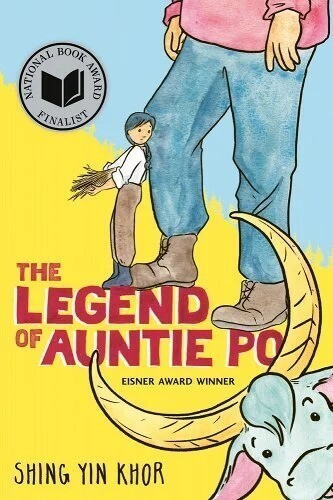
The Legend of Auntie Po by Shing Yin Khor.
Purchase from Bookshop.org (supports independent bookstores and my business!)
In this unique graphic novel set in the 1880s, Mei spends much of her time making pies for the logging camp where her father Hao is the highly skilled head chef for all the workers, both white and Chinese. In the evenings, she often entertains the children of the camp with her imaginative stories.
When the racist effects of the Chinese Exclusion Act begin to change life in the camp, Mei begins telling stories about Auntie Po, whose strength exceeds that of Paul Bunyan. As she tells stories about how Auntie Po will protect them, Mei starts to actually see the god she has created in the camp.
When a dangerous logjam happens, will Auntie Po be able to save them all? (Recommended for ages 10 – 14. (Historical fantasy graphic novel. Recommended for ages 10 – 14. Queer Malaysian Chinese American author.)
Related post: Alternatives to the Little House on the Prairie books


Paul Bunyan: The Invention of an American Legend by Noah Van Sciver, Marlena Myles, Lee Francis IV, and Deondre Smiles.
Purchase from Bookshop.org (supports independent bookstores and my business!)
This short graphic novel and accompanying essays explain the U.S. history many don’t know behind the myth of Paul Bunyan and his blue ox Babe. The truth is that they were invented as an advertising ploy for lumber companies that were rapidly clearing forests from the Midwest to the West.
The graphic novel takes place in 1914 Minnesota on a train. When the train breaks down, people begin gathering around to tell stories about famous lumberjacks. When an advertising executive begins telling tales of Paul Bunyan, many in the crowd are entertained. But a couple of people who’ve seen the harm logging has done to Minnesota call his tales hogwash.
Essays and art by Indigenous writers after the story help young people understand the larger historical context of the displacement of Native American nations and the harms that large scale logging caused. (Non-fiction graphic novel. Recommended for ages 10 – 14. White and Indigenous authors.)
Shop the full list of U.S. history graphic novels on Bookshop.org (supports independent bookstores and my business!)
Young adult U.S. history graphic novels

They Called Us Enemy by George Takei, Justin Eisinger, and Steven Scott. Illustrated by Harmony Becker.
Purchase from Bookshop.org (supports independent bookstores and my business!)
This powerful and thorough account of George Takei’s four years growing up in an incarceration camp is a must-read for anyone who wants to understand anti-Asian racism, particularly during World War II.
While most of the novel takes place when Takei was a young child in the camps, it is narrated through Takei’s public talks in the 2010s about the shameful U.S. history of imprisoning Japanese American families. Readers are given a glimpse into both his childhood perspective (when his parents were able to shield him from some of the brutal reality they experienced) and his deeper understanding as a teen and adult.
Takei’s family lived in two different camps over a four year period. At Camp Rohwer in Arkansas, George’s father became a block manager who brought concerns of his community to the officers in charge. Later, after Takei’s parents refused to sign loyalty oaths to the United States out of principal, the family was transferred to the most notorious internment camp in Tule Lake, California. Takei doesn’t end the family’s gripping story there, but shows how even after they were released, there were long term impacts to the racist wartime policy. (Non-fiction graphic novel. Recommended for ages 12+, though kids ages 10+ who are passionate about history may also appreciate it. Japanese American author.)
Content note: Repeated use of racial slur for Japanese people.
Related post: Children’s books about Asian American history and culture

Amazons, Abolitionists, and Activists: A Graphic History of Women’s Fight for Their Rights by Mikki Kendall and A. D’Amico.
Purchase from Bookshop.org (supports independent bookstores and my business!)
This ambitious graphic novel takes a group of young women on a tour of history from antiquity to the recent past in order to understand how women have impacted history and fought for their rights. As a purple-hued otherworldly figure guides them through galleries of paintings and photographs, the women are introduced to a truly global and intersectional feminist history.
Youth will likely be surprised by the sheer number of women rulers in the chapters on ancient, medieval, and early modern history. The chapter on slavery, colonialism, and imperialism introduce the first important events and people from United States history, include Cherokee negotiator Nanyehi and Elizabeth Freeman, an enslaved woman who filed a lawsuit that not only freed her but ended also slavery in Massachusetts.
Expected events like the Seneca Falls Convention are included, without varnishing the truth of how many white suffragettes betrayed Black women and men in their fights against racism. Many women who fought for rights beyond the vote during this period are also featured.
Later chapter cover the family planning movement, Black women who led anti-lynching and civil rights, Indigenous women leaders fighting colonialism, disability rights, the sexual revolution and the AIDS crisis.
Because profiles of events and people are brief, this history is a great starting point for further research into particular individuals, movements, and problems that grab reader’s attention. (Non-fiction graphic novel. Recommended for ages 13+. Black author and Queer author.)

Across the Tracks: Remembering Greenwood, Black Wall Street, and the Tulsa Race Massacre by Alverne Ball and Stacey Robinson.
Purchase from Bookshop.org (supports independent bookstores and my business!)
Across the Tracks is a gripping retelling of the 1921 Tulsa Race Massacre, but it is much more than that. Most of this stirring graphic novel focuses on the history, accomplishments, and meaning of this ground-breaking Black neighborhood in its first two decades.
The determination of Greenwood residents to rebuild after the attacks, despite the obstacles the government placed before them, are also emphasized. After the graphic novel, there’s an in-depth essay about the Indigenous and Black histories of Oklahoma. (Non-fiction graphic novel. Recommended for ages 13+. Black authors.)
Related post: The Tulsa Race Massacre and talking to kids about hard history
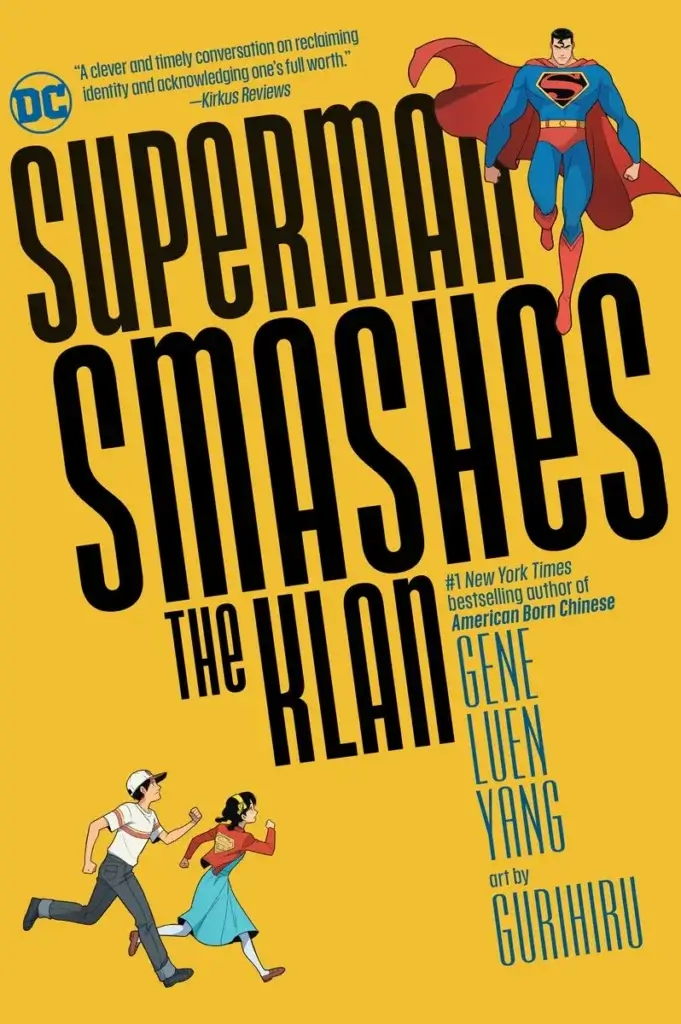
Superman Smashes the Klan by Gene Luen Yang. Illustrated by Gurihiru.
Purchase from Bookshop.org (supports independent bookstores and my business!)
Inspired by a 1946 radio series about Superman taking on the Clan of the Fiery Cross after it targeted a Chinese American family, Yang and Gurihiru have created a compelling graphic novel that teaches about the realities of racist violence in U.S. history.
It’s 1946, and the Lee family has just moved from Chinatown to the center of Metropolis. Dr. Lee has taken a new job at the Health Department and is eager for his family to assimilate. Older son Tommy also seems eager to do so and quickly makes friends. Younger daughter Roberta/Lan-Shin, on the other hand, is both introverted and embarrassed by some of the Chinese stereotypes Tommy seems to play into.
After members of the Klan of the Fiery Cross burn just such a cross on the Lee’s lawn, Clark Kent and Lois Lane arrive to cover the story. When the Lees refuse to move, the Klan escalates its violence. Superman often intervenes, but he’s also struggling with his own issues about years of minimizing his differences to fit in.
The book also includes a fascinating, wide-ranging essay about the history of Superman, anti-Chinese racism, the Klan in both the South and the West, and Yang’s family history. (Historical fantasy graphic novel. Recommended for ages 13+. Chinese American author.)
Content note: Repeated use of anti-Chinese racial slurs.

Freedom Was in Sight! A Graphic History of Reconstruction in the Washington, D.C., Region by Kate Masur and Liz Clarke.
Purchase from Bookshop.org (supports independent bookstores and my business!)
Using an expansive timeline for Reconstruction that begins during the Civil War as enslaved people freed themselves, this graphic novel covers the main aspects of this hopeful yet dangerous era by telling the history of Washington, DC and nearby communities.
While the graphic novel portion of the book is just under 90 pages, it dives into a dense amount of history, with a particular focus on politics, education, and community as experienced by Black Americans. Some of the chapters could be read independently of each other if the entire book is too long for particular readers.
There are also chapters that focus on white backlash, the setbacks Reconstruction reforms faced, and how many of the efforts begun after the Civil War continued long beyond that time. After the graphic novel, well-researched essays give a broader nationwide picture of Reconstruction. There are also primary texts included in the essays so that learners can take a deeper dive into historical analysis. (Non-fiction graphic novel. Recommended for ages 13+. White authors.)

March trilogy by John Lewis, Andrew Aydin, and Nate Powell.
Purchase from Bookshop.org (supports independent bookstores and my business!)
In this compelling graphic novel series, now available in a single volume, Congressman John Lewis tells his story of fighting for voting rights and the struggle to end segregation. Readers will learn not only about Lewis, but other key leaders involved in the Southern Christian Leadership Conference, the Student Nonviolent Coordinating Committee, and more.
Book one covers Lewis’s childhood and involvement in the Nashville lunch counter sit-in movement. The second volume focuses on the courage of the Freedom Riders as well as the brutality they faced. Book three culminates in the fight for voting rights and the ground-breaking march in Selma, Alabama. (Non-fiction graphic novel. Recommended for ages 13+. Black author.)
Content note: Repeated use of the n word.