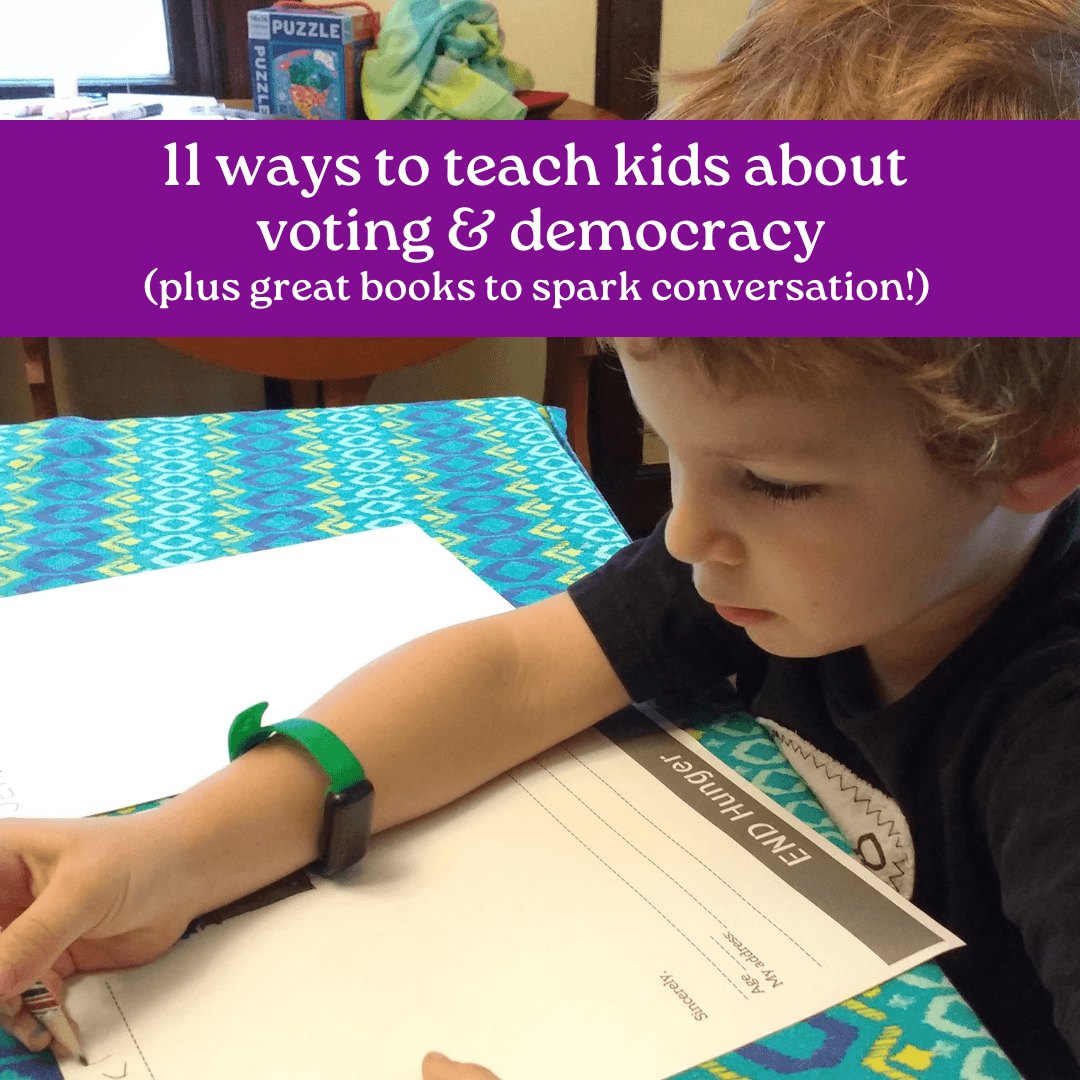
Every time a major election approaches, many parents and teachers start thinking about how to teach kids about voting. The right to vote is of course a huge part of what it means to be a citizen of a democratic country. It’s especially important to talk about in a time where voting rights are increasingly under attack.
But voting is just the start of being a responsible citizen, not the end! We should talk with kids about being active members of our communities in every season, not just election season.
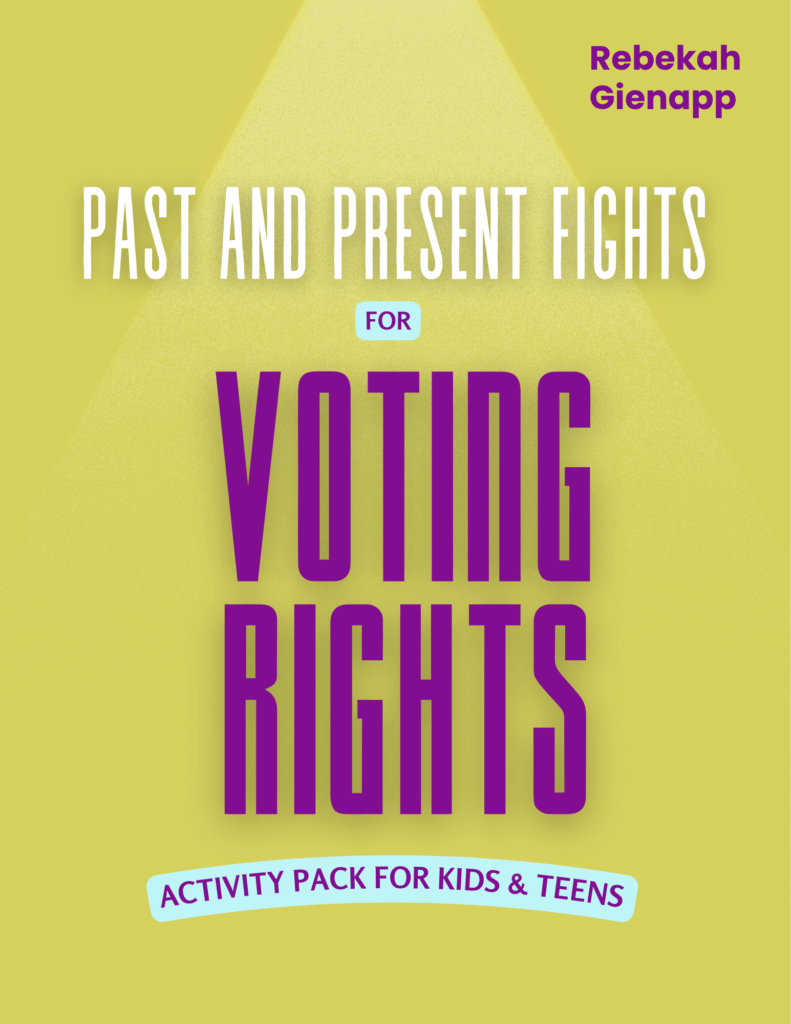
Use these tips to teach kids what it means to be part of a democracy, in the broadest sense. Be sure to check out the list of 23 great books for kids and teens about democracy, voting, and citizenship, and my activity pack Past and Present Fights for Voting Rights.
How to Teach Kids about Voting, Democracy and Responsible Citizenship
Jump to books about voting and democracy (click on the bold text):
- Picture books about voting, democracy, and citizenship
- Middle grade books about voting and democracy
- Young adult books about voting and democracy

Disclosure: For your convenience, this post contains affiliate links. If you make a purchase through these links, I may earn a small commission at no additional cost to you. You can read my full disclosure policy here.


1. Take your child with you when you vote, and talk about why you’ve chosen to vote for particular candidates
Is there a local or national election coming up? Then it’s a great opportunity to talk to your child about how ordinary people get to choose the leaders of our democracy by voting.
I recommend taking your child with you to the polls if possible. Share the candidates’ stance on issues that matter to you. Young kids can be prone to simply thinking about losers and winners in a contest, but you can encourage them to go deeper.
Don’t forget to talk about state and local races, not just the more prominent races for President and Congress.
Related post: 14 children’s books about women in politics

2. Trace the history of voting rights
In my activity pack Past and Present Fights for Voting Rights, learners can build a timeline of key events in voting rights history. The timeline activity is designed to show them that there hasn’t been a long, uninterrupted expansion of voting rights in U.S. history. Instead, there have been eras – including the one we live in now – when powerful groups have pushed policies that suppress some groups’ right to vote.
(If you’d like to see how the timeline activity works, watch this Instagram reel.)
You can also use many of the books in this blog post to trace the various fights for voting rights, and the backlash against those campaigns.
Teach young people that the fight for voting rights isn’t over with this activity pack for kids and teens!
3. Build media literacy skills and talk about disinformation
All of us, especially young people, are getting a lot of our news and information online these days. Helping children develop media literacy skills and spot disinformation will not only prepare them to be responsible citizens. It will also serve them well in many other areas of life.
Here are some resources to help you:
- Erica of What Do We Do All Day has a list of books for kids and teens about censorship, media literacy, and fake news.
- Learning for Justice has a framework for digital literacy, along with articles, videos, and activity ideas for different age groups. The video below is one example.
- Common Sense Education offers a series of lessons on media literacy and news skills for students.
4. Write a letter to an elected official as a family
This is a great, low-key way to show children what democracy in action looks like. Writing a letter is one very concrete example of how citizens not only get to elect our leaders. We also have a right and responsibility to push them to act for the good of our communities once they’re in the office.
I’ve put together a kid-friendly, step by step guide about how to write a letter to a member of Congress. It also includes a letter template with graphics that younger children can color. Just fill out the form below to download it from my free Resource Library.
If you have a teen or tween, you could also help guide them through the process of sending a message using Resistbot. Just text RESIST to 50409 and you’ll be guided step by step.
However, one of the advantages to writing a real letter is that your member of Congress will definitely send a written response back that your child can read.
5. Talk about how protest is patriotic

When there are news stories about protest, do you talk to your children about them? Whether it’s U.S. athletes taking a knee during the national anthem or protests against brutal immigration enforcement, there’s an opportunity for learning. Loving one’s country means speaking up when we disagree with its actions.
Want to give kids a hands on way of understanding protest? Participate together in a march, vigil, or rally in your community. There are more family-friendly protests than you might realize at first, like the rally for immigrant children that took place in a park in my city a few years ago. While our son mostly hung out by the swings, he still saw democracy in action.
6. Talk about voter suppression that stills exists today
We often say that in the United States, one person equals one vote. But the reality of voter suppression, the recent Supreme Court gutting of the Voting Rights Act, and how the electoral college works in presidential elections means that isn’t really true.
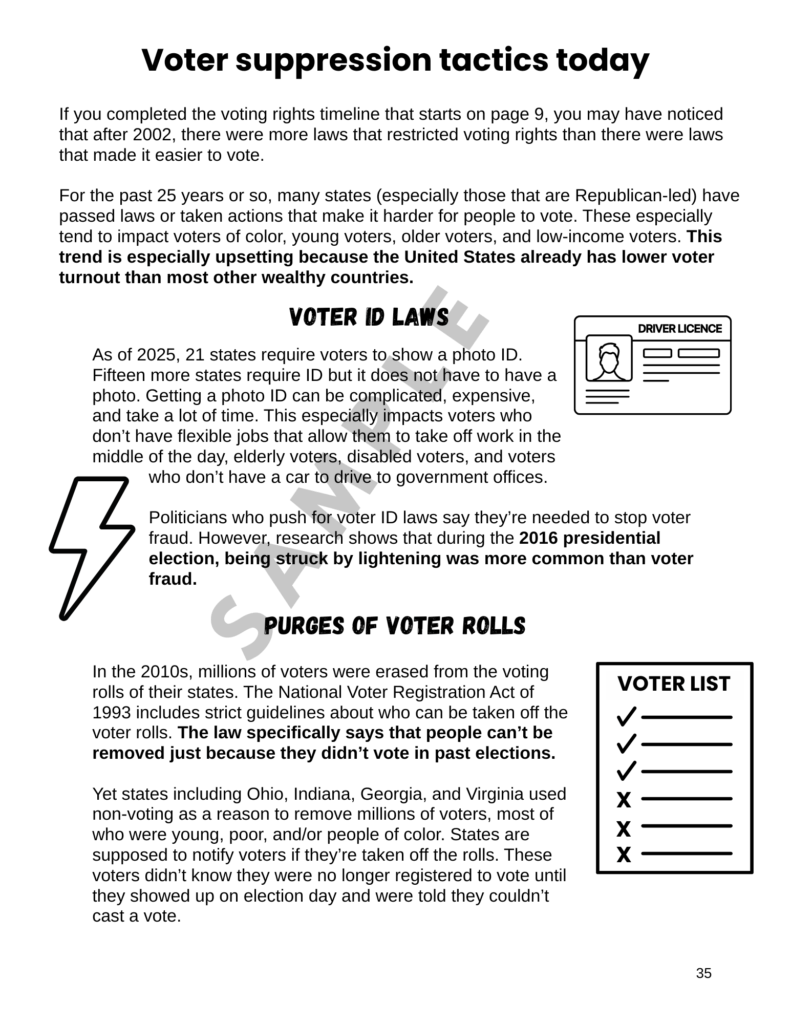
My activity pack Past and Present Fights for Voting Rights has multiple activities for elementary, middle school, and high school learners about the voter suppression methods that are used in many states today. It also unpacks why the 2026 Supreme Court voting rights decision Louisiana v. Callais is so alarming to voting rights activists.
Just a few of the activities about present day voter suppression that are included in Past and Present Fights for Voting Rights


Learning for Justice has a number of resources for the classroom about voter suppression, the history of voting rights and more. Find their resources here and here.
This article gives educators and parents background information they need to know in order to talk about voter suppression.
The young people’s edition of One Person, No Vote (see review in the book list at the end of this post) is a great resource for teens.
Related post: A playlist of kid-friendly social justice songs
Middle school and high school age students can watch the full length film Suppressed: The Fight to Vote right now on YouTube. The documentary focuses on voter suppression in Georgia during the 2018 election.
You can also print out this poster on myths about voting for your home or classroom.
7. Participate in a voter postcard campaign
Sending postcards to registered voters might sound old fashioned to young people, but they are effective! While these campaigns often target likely Democratic voters, the postcards themselves simply encourage people to remember to get out and vote.
There are a number of organizations that have campaigns encouraging voter turnout. Consider participating with Center for Common Ground in their postcard campaign, which focuses on increasing Black voter turnout in key states.
8. Encourage children to ask questions and to speak up when they don’t agree
As parents and teachers, one of the best ways to model democratic dialogue is to encourage children to respectfully question adults – including us!
Perhaps your child will tell you about a time when she didn’t like what someone else was saying. Try roleplaying with her how she could express disagreement the next time.
When a child questions your views or a decision you’ve made, encourage them to talk it through with you instead of shushing them.
Related Post: How peaceful parenting encourages kids to speak up for justice
9. Talk about times when your country has lived up to its ideals, and times when it has not
The younger a child is, the more adults seem to steer away from talking truthfully about history. You may feel like you need to wait until your child is a teen to talk about painful parts of history.
But consider how confusing it is a for a child to hear only positive stories about their country and its leaders, and then learn about topics like slavery years later.
We get more chances than you might think to naturally talk to kids about how complex history is. In her book Raising White Kids, author Jennifer Harvey gives a great example of talking to her 7 year old about George Washington.
Her child had been talking enthusiastically about all the wonderful things they were learning at school about Washington. Harvey was uncomfortable, but not sure how to respond.
One day, she had the radio on and her child overhead a story about a politician facing an ethics charge. Her 7 year old was confused about how an adult who was a leader could do something bad. Harvey expressed that unfortunately there are many times their country’s leaders have done bad things.
“Like who and what did they do?” her child wanted to know.
This gave Harvey a chance to talk about how even thought Washington fought for freedom for white people, he also owned Black people as slaves. Their conversation didn’t end there. They went on to talk about the importance of learning the whole truth about people, and how we can try to fix some of the bad things past leaders have done.
Related Resource: From the Margins to the Center: A People’s History of the United States Told Through Children’s Books
10. Learn about the debate over the electoral college
The electoral college is probably too complicated for young children to grasp, but upper elementary and middle school students can explore this topic through the lens of history, math, or civics.
This excellent video from KQED teaches kids about the history of the electoral college, shares some math about how it shapes which voters have a bigger influence on presidential elections, and explains the debate over whether the electoral college should continue. (Head to their website for additional lesson materials that go with the video.)
11. Read and discuss books about voting, democracy and citizenship

My favorite children’s books (including books for teens) about democracy are below. As you read, pause to talk about what you’re learning. Does the book leave out points that you think need to be made?
For example, a book about women winning the right to vote in the United States may not mention that most Black women and women of color weren’t able to exercise that right until decades after the 19th amendment passed.
When reading books about people facing injustice, point out the ways that oppressed people in the story are fighting back for their rights.
Picture books about voting, democracy, and citizenship
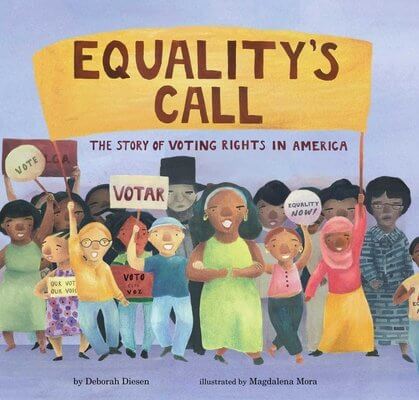
Equality’s Call: The Story of Voting Rights in America by Deborah Diesen. Illustrated by Magdalena Mora.
Purchase from Bookshop.org (supports independent bookstores and my business!)
With engaging illustrations and rhyming text, Equality’s Call helps young children understand that voting in the United States long excluded many groups of people. With the memorable refrain “A right isn’t right till it’s granted to all,” readers see how disenfranchised people fought to end voting exclusions.
Because of the structure of the book, some aspects of history are referenced but not fully explained. It would be best to use Equality’s Call as an introduction to the topic. After reading the book, have discussions or use activities that unpack the concepts. There are educational notes at the end of the book that can help with this. (Recommended for ages 4 – 8. White author.)
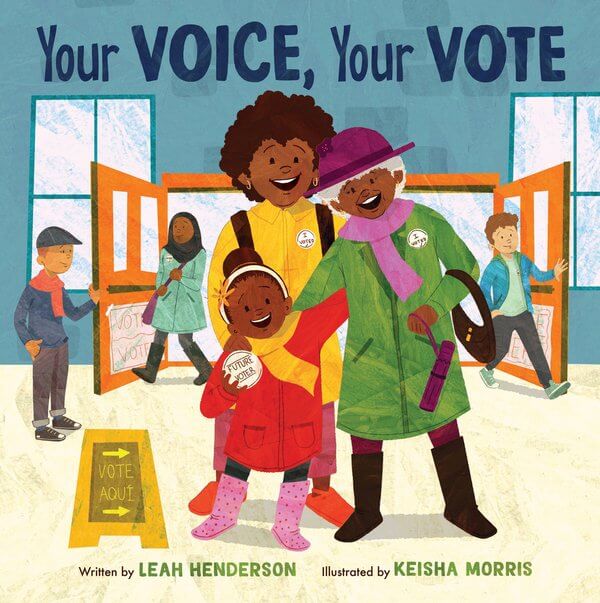
Your Voice, Your Vote by Leah Henderson. Illustrated by Keisha Morris.
Purchase from Bookshop.org (supports independent bookstores and my business!)
Quetta is so excited about going to vote with Mommy and Grandma. Grandma insists they take an umbrella even though the weather is fine, because it’s her philosophy to “always welcome sunshine, but be prepared for the rain.” This turns out to be an appropriate metaphor for the voting process, which involves long lines at their precinct filled with Black and Brown voters. When the rain begins and Quetta wants to go home, Grandma teaches her about all the ways Black people were kept from voting for many years.
This is a crucial book for sharing with younger readers what voter suppression looks like today, especially in communities of color. (Recommended for ages 4 – 8.. Black author.)
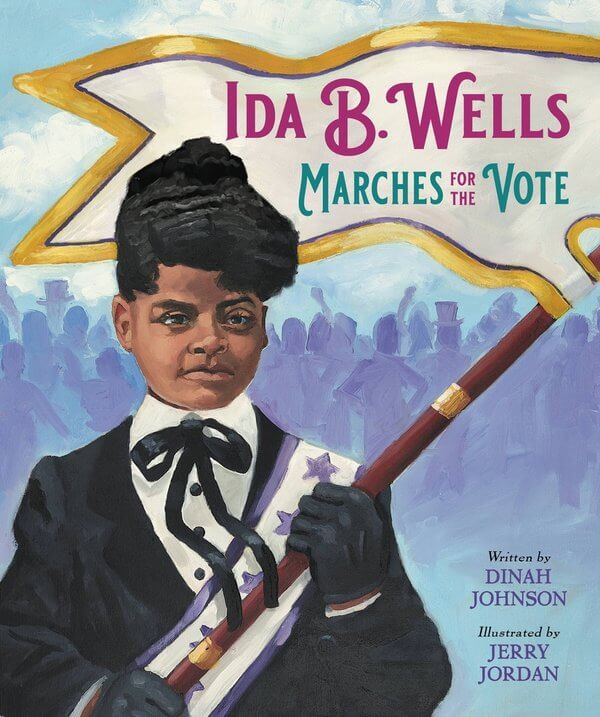
Ida B. Wells Marches for the Vote by Dinah Johnson. Illustrated by Jerry Jordan.
Purchase from Bookshop.org (supports independent bookstores and my business!)
There are several wonderful picture book biographies of Ida B. Wells, but I especially recommend this one for discussing voting. The story provides important details about Wells’ childhood (including how her father was fired for exercising his right to vote after the 15th amendment passed).
The majority of the book focuses on Wells’ work for voting rights within a movement that was dominated by white women who promoted racist policies. Wells showed great courage in refusing to go the back of the line in the 1913 national women’s suffrage parade. (Recommended for ages 6 – 10. Black author.)

Calling All Future Voters! by Laura Atkins, Rev. Edward A. Hailes Jr, and Jennifer Lai-Peterson. Illustrated by Srimalie Bassani.
Purchase from Bookshop.org (supports independent bookstores and my business!)
So often, adults tell children that voting is vitally important, without sharing honestly about the barriers that exist for many groups of potential voters.
In this energetic and relevant story, a group of kids that calls themselves the “E Squad” decides their next action project should focus on an upcoming election. With the help of Steven’s grandmother and librarian, Mama Cheryl, the group learns about the basics of how voting works and why it matters. She also gives them a quick voting rights history lesson that includes pictures of lesser known voting rights heroes.
As the enthusiastic group spreads the word about registering to vote, they find out that many people aren’t sure if they can do so. One person has a prior conviction for painting graffiti. Another neighbor isn’t confident if her English is good enough for her to understand the ballot. Long lines at the polling place are also a concern. With Mama Cheryl’s help, the children figure out how to support each of these potential voters with accurate information and solutions. (Recommended for ages 6 – 10. White, Black, and Asian American authors.)
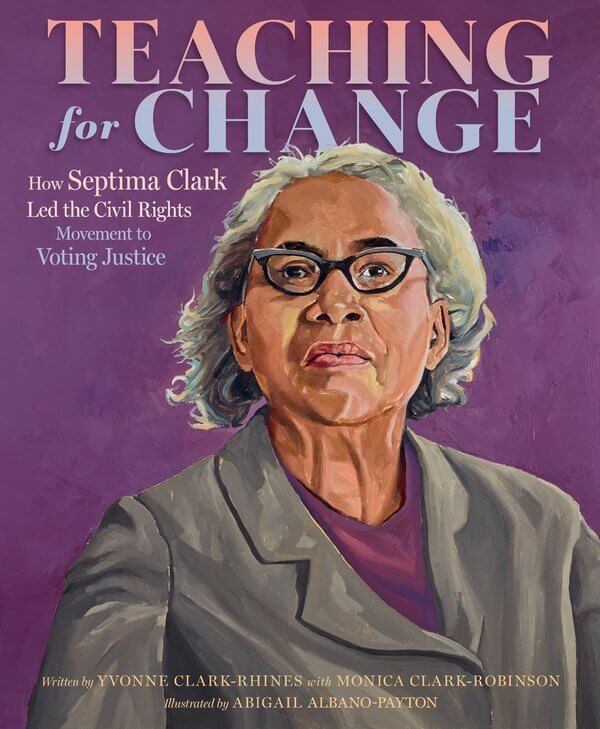
Teaching for Change: How Septima Clark Led the Civil Rights Movement to Voting Justice by Yvonne Clark-Rhines with Monica Clark-Robinson. Illustrated by Abigail Albano-Payton.
Purchase from Bookshop.org (supports independent bookstores and my business!)
Although education was difficult to come by for poor Black Southerners in the early 1900s, Septima Clark’s parents did everything in their power to provide her with it. Even as a child, Septima showed her gifts for teaching others. When she began her formal teaching work at age 18, she found creative ways to teach children to read, even when the school couldn’t afford books or paper.
Clark also became involved in the Black voting rights movement early on, and used her skill as a teacher to create “citizenship schools” that linked literacy and the fight for freedom. She was arrested for teaching at an integrated school for adults in east Tennessee during a frightening raid that shut down the school. Soon after, Dr. King recruited her to establish similar schools to help people register to vote. In a few short years, the schools equipped hundreds of thousands of Black people to register and vote.
Clark’s immense contributions to the civil rights movement deserve to be celebrated, and provide so many lessons for freedom struggles today. This beautifully illustrated book shows how the voting rights movement would not have been the same without her leadership. (Recommended for ages 6 – 10. Black author.)
Teach young people that the fight for voting rights isn’t over with this activity pack for kids and teens!

Stacey Abrams and the Fight to Vote by Traci N. Todd. Illustrated by Laura Freeman.
Purchase from Bookshop.org (supports independent bookstores and my business!)
In this unique approach to Stacey Abrams’ biography, four Black women who fought for voting rights tell her story. Through a conversation between Ida B. Wells, Septima Clark, Fannie Lou Hamer, and Sojourner Truth, young readers discover key moments in Abrams’ life that shaped her perspective on justice.
This is a great resource for helping children understand that the fight for voting rights, especially for Black voters, is not just an issue of the past. An extensive voting rights timeline is included in the endnotes. (Recommended for ages 6 – 10. Black author.)

Evicted! The Struggle for the Right to Vote by Alice Faye Duncan. Illustrated by Charly Palmer.
Purchase from Bookshop.org (supports independent bookstores and my business!)
Registering to vote was risky for all Black Southerners before the Voting Rights Act, but this was especially true for sharecroppers. That’s because they risked not only being fired from their jobs, but immediately being thrown out of their homes as well. That’s exactly what happened to a group of brave Black sharecroppers who registered in Fayette County, TN in the late 1950s.
Shephard Towles, one of the few Black landowners in the county, convinced an anonymous white merchant to donate surplus army tents that Towles pitched on his own land. Not only did the families who moved into what became “Tent City” face bitter cold, they were also targets for white terrorists who shot at their community.
Evicted! is a painstakingly researched account of how ordinary people with little formal education made history. Throughout the book, James Jr., the nephew of campaign leader John McFerren, gives readers insight into how one child experienced these events. Duncan doesn’t give the book a fairytale ending. Instead, we see how John Junior was shaped by the courage of those around him to stand up for what’s right despite persecution. Duncan’s epilogue makes crucial connections to how the struggle for voting rights continues today.
The book is not an easy read, but’s it’s a necessary one. Though Evicted! is a picture book, it’s not for young children. Both because of the length of the text and honest accounts of lynching and violence, I recommend it for ages 9 – 12. (Black author.)

Vote for Our Future! by Margaret McNamara and Micah Player
Purchase from Bookshop.org (supports independent bookstores and my business!)
The kids at Stanton Elementary School know that voting is important. Their school, a polling place, closes down on Election Day. And while kids can’t vote, they “have to live with adult choices!”
So the students decide they’ll do everything they can to educate and encourage the adults they know to vote. After doing a lot of research, they know how to answer just about every objection, from not being able to walk to the polls to not being registered. (Recommended for ages 4 – 8. White author.)

Sofia Valdez, Future Prez by Andrea Beaty and David Roberts.
Purchase from Bookshop.org (supports independent bookstores and my business!)
When Sofia’s Abuelo breaks his leg in an accident involving “Mount Trashmore”, she launches a campaign to get rid of the trash and build a park on the site. Her neighbors agree it’s a great idea, but she runs into obstacles when she takes her plan to City Hall.
This is a compelling story for young readers about the courage and persistence it takes to make change in a community. (Recommended for ages 3 – 7. White author.)

What Can a Citizen Do? by Dave Eggers and Shawn Harris
Purchase from Bookshop.org (supports independent bookstores and my business!)
Ever since we checked this book out from the library, my 6 year old has asked to read it multiple times a day! It’s a light-hearted but empowering look at the difference a citizen, especially kid citizens, can make in a community.
We can see children making laws, and then changing them because some people don’t like them. They right wrongs; they “care and care.” I especially liked the line “A citizen’s not what you are – a citizen is what you do.” (Recommended for ages 3 – 7. White author.)

Shirley Chisolm Is a Verb! by Veronica Chambers and Rachelle Baker
Purchase from Bookshop.org (supports independent bookstores and my business!)
Before reading this engaging picture book, I knew Shirley Chisolm was the first Black woman to run for President. But I didn’t know she was also the first Black women elected to Congress, or that she helped initiate important programs for children including WIC and the school lunch program.
The book emphasizes the many verbs that describe Chisolm, and how children can choose their own ways to act, from negotiating to listening to inspiring. Chambers also explains how Chisolm paved the way for other women in leadership, from Hillary Clinton to Alexandria Ocasio-Cortez. (#ownvoices, recommended for ages 6 – 10. Black author.)
Related post: 31 children’s books for Women’s History Month

Lillian’s Right to Vote: A Celebration of the Voting Rights Act of 1965 by Jonah Winter and Shane W. Evans.
Purchase from Bookshop.org (supports independent bookstores and my business!)
This picture book does a beautiful job of summing up hundreds of years of voting rights struggles through one woman’s moving story. Lillian is over 100 years old, but she’s still determined to get out and vote. On her long walk to the polling place, she remembers her ancestors’ thwarted attempts to vote.
Each of the stories has an emphasis on the pride, dignity, and agency of Black Americans who tried to exercise their right to vote, but were denied. We learn about heroes (including Lillian herself) who struggled, fought, and sometimes died in the years leading up the historic 1965 Voting Rights Act. (Recommended for ages 6 – 10. White author.)

Grace for President by Kelly DiPucchio and LeUyen Pham
Purchase from Bookshop.org (supports independent bookstores and my business!)
This book was written prior to the 2008 U.S. election, but it’s still relevant! When Grace Campbell learns that no woman has ever been president, she decides she wants to become president one day. Her teacher realizes this is the perfect opportunity for a mock election.
Another class nominates a candidate too. Since he’s a boy, he’s confident that all the boys will vote for him. While Thomas is sure he’ll win, Grace works hard at identifying issues and finding ways to improve their school.
This is probably the only (interesting) picture book that explains in kid-friendly terms how the electoral college works, as Thomas and Grace finally square off for their election (Recommended for ages 5 – 10. White author.)
Shop this list of children’s books about democracy and voting rights on Bookshop.org. Your purchase supports independent bookstores and my business!

Voice of Freedom: Fannie Lou Hamer, Spirit of the Civil Rights Movement by Carole Boston Weatherford and Ekua Holmes.
Purchase from Bookshop.org (supports independent bookstores and my business!)
Fannie Lou Hamer is one of the most inspiring and under-appreciated heroes of the civil rights movement. This book tells her life story in free form verse with stirring collage illustrations.
Hamer grew up in a sharecropping family in Mississippi, where she saw that racism meant the difference between having enough and poverty. When she asks her mother why she isn’t white, so that she could have enough, her mother tells her that being Black is not bad. Her mother soon buys her a Black doll, telling her “if you respect yourself enough, other people will have to respect you.”
As an adult, Hamer was one of the first Black Mississippians to try to register to vote. After she failed the literacy test, she and her husband were evicted from their land and home. Hamer continued her work for voter registration, and became known for the spirituals she led at meetings and marches.
She continued her work even after she was brutally beaten and imprisoned, determined that she was “marching toward the Promised Land.” When her Mississippi Democratic Freedom Party was denied seating at the national Democratic convention, Hamer made sure that the delegation didn’t give in to deals aimed to silence them. (Recommended for ages 8 – 12. Black author.)
Related post: 16 children’s books about the civil rights movement

A is for Activist by Innosanto Nagara
Purchase from Bookshop.org (supports independent bookstores and my business!)
A Is For Activist is a delightfully unusual alphabet book, introducing children to words like abolitionist, co-op, “little d democracy”, environmental justice, feminist, trans, and union. While the justice and human rights issues the book points to are quite serious, the book also has a playful tone.
Its rhymes and examples of things children will love (like the demand for healthy hot dogs) keep the book from becoming too heavy. There is also a cat hidden on each page, adding an interactive element. (Recommended for ages 3 – 7. Indonesian American author.)

Peaceful Fights for Equal Rights by Rob Sanders and Jared Andrew Schorr
Purchase from Bookshop.org (supports independent bookstores and my business!)
This is an alphabet book of sorts for ways to create change. Each page contains a series of verbs or phrases about how people can advocate for equal rights. For example, one page that’s filled with hands holding candles reminds us to “Listen. Learn. Lead. Light a candle. Write a letter. Pass laws.”
Although I wish that there was a little more explanation to the book, it does give adults the chance to choose where they’d like to lead the discussion. I absolutely love the illustrations, and the wide range of actions highlighted remind us that everyone has something different to contribute in the struggle for equality. (Recommended for ages 3 – 7. White Gay author.)
Middle grade books about voting, democracy, and citizenship
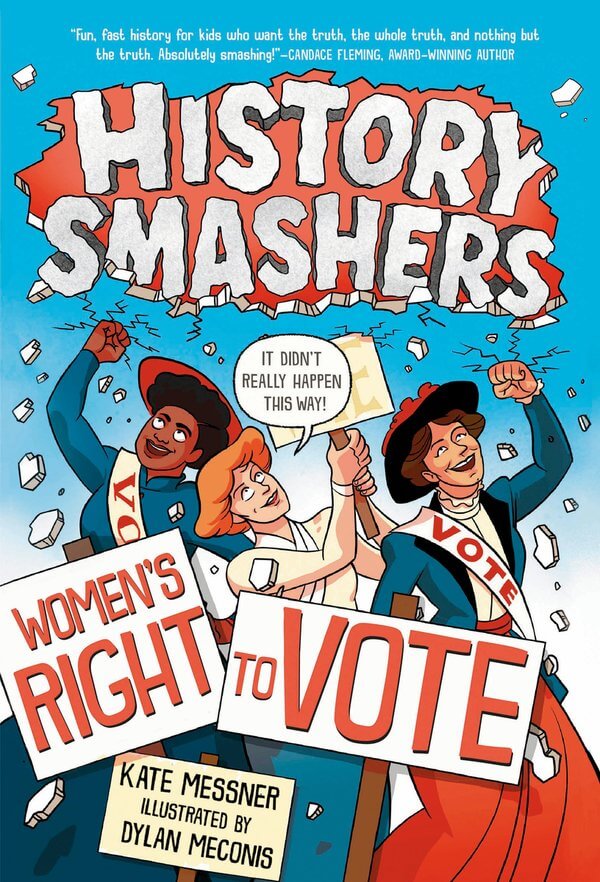
History Smashers: Women’s Right to Vote by Kate Messner. Illustrated by Dylan Meconis.
Purchase from Bookshop.org (supports independent bookstores and my business!)
We are big fans of the History Smashers series at our house, which dispels common misconceptions about history with straightforward accounts, comic strips, and historical photographs.
In Women’s Right to Vote, readers learn that the road to the 19th amendment was long, bumpy, and full of internal fighting over both tactics and who should be included. Readers may be surprised to learn that many older suffragettes actively opposed younger activists who were willing to be arrested in order to bring attention to their cause. The treatment these activists received in jail was brutal.
Messner is also honest about how racism guided many white suffragists’ actions, and includes profiles about key Black women suffragists. (Recommended for ages 8 – 12. White author.)

You Call This Democracy? How to fix our government and deliver power to the people by Elizabeth Rusch.
Purchase from Bookshop.org (supports independent bookstores and my business!)
This straightforward book explores structural problems in U.S. democracy that keep it from living up to its promise to represent all the people. There are chapters on the electoral college, gerrymandered maps, the unequal nature of the Senate, voter suppression tactics, and how felony convictions keep many people from permanently being able to register to vote. Each chapter ends with things that readers can do and policies that they can support to address these problems. (Recommended for ages 12+. White author.)

Fault Lines in the Constitution: The Framers, Their Fights, and the Flaws That Affect Us Today by Cynthia Levinson and Sanford Levinson.
Purchase from Bookshop.org (supports independent bookstores and my business!)
In contrast to whitewashed history books that hold up the founding fathers as near-perfect, this insightful guide traces many of today’s most urgent problems to the way the framers wrote the Constitution.
True stories introduce the chapters in a way that shows the impact of potentially dry concepts like the Electoral College and gerrymandering. The updated 2025 edition includes information about how some states are attempting to address excessive political gerrymandering, as well as state policies that impact how easy or hard it is to register to vote. (Recommended for ages 12+. White authors.)

Finish the Fight! The Brave and Revolutionary Women Who Fought for the Right to Vote by Veronica Chambers and the staff of The New York Times
Purchase from Bookshop.org (supports independent bookstores and my business!)
This accessible book for tweens and teens tells the complicated story of woman’s suffrage and race. After introducing how racism divided the suffrage movement, each chapter tells the story of a different BIPOC (Black, Indigenous, People of Color) or queer suffragette, and how she advanced the fight for women’s rights.
I’ve been learning just as much as my son as we read the stories of lesser known heroes including Mary Church Terrell, Mabel Ping-Hua, Jovita Idár. (Recommended for ages 10+. Black author.).

We Rise, We Resist, We Raise Our Voices edited by Wade Hudson and Cheryl Willis Hudson.
Purchase from Bookshop.org (supports independent bookstores and my business!)
Reading this book raised my spirits in more ways that one. It’s a must have for middle grade readers, especially children of color. It includes poetry and short essays by a wide variety of children’s book authors of color. The editors were inspired to create the book when their 7-year-old great niece became distraught learning about Donald Trump’s election in 2016.
Some of the contributions focus on pride in one’s culture and the history of protest. Others talk about bullying, racism, and how to respond. Still others focus on topics like kindness and mindfulness. The message of the book, expressed by Tameka Fryer Brown, that “there are more good people than not” is one that children and teens need to hear. (Recommended for ages 10+. Authors of various races and ethnicities.)
Young adult books about voting, democracy, and citizenship

Lifting As We Climb: Black Women’s Battle for the Ballot Box by Evette Dionne.
Purchase from Bookshop.org (supports independent bookstores and my business!)
This book is a must read for middle and high school students who are learning about the abolitionist, women’s suffrage, and civil rights movements.
Beginning with the movement to abolish slavery, Dionne outlines how Black women stood up for their right to vote and challenged the racist cult of true womanhood. With in-depth profiles of Black women leaders, the book details their struggles against prominent white suffragists who attempted to push them out of the movement. Readers learn how Black women’s struggle at the ballot box continued long after the 19th amendment, as they resisted Jim Crow laws, and continue to battle present day voter suppression. (Recommended for ages 12. Black author.)

March trilogy by John Lewis, Andrew Aydin, and Nate Powell.
Purchase the March trilogy from Bookshop.org (supports independent bookstores and my business!) or purchase book three only.
Graphic novels are one of my favorite ways to help reluctant readers explore history. In this compelling series, Congressman John Lewis tells his story of fighting for voting rights and the struggle to end segregation. Readers will learn not only about Lewis, but other key leaders involved in the Southern Christian Leadership Conference, the Student Nonviolent Coordinating Committee, and more.
Book Three focuses on multiple aspects of the voting rights movement, Freedom Summer, the Mississippi Freedom Democratic Party, and the Selma to Montgomery march that prompted the passage of the 1965 Voting Rights Act.
Be aware that because this is an honest account of history, the n word is used. (#ownvoices, recommended for ages 13+. Black author.)

One Person, No Vote: How Not All Voters Are Treated Equally (Young Adult edition) by Carol Anderson with Tonya Bolden.
Purchase from Bookshop.org (supports independent bookstores and my business!)
Reading this book made me so angry, and I mean that in the best way possible. It’s a featured resource for high school students in my Past and Present Fights for Voting Rights activity pack because it so clearly explains what recent voter suppression laws look like.
Anderson and Bolden challenge the idea that Black voter turnout decreased in 2016 because of a lack of enthusiasm. They make a strong case that the 2013 Supreme Court decision greatly limiting the Voting Rights Act was the more important factor affecting turnout.
This accessible book outlines how gerrymandering, closing polling sites, and requiring photo ID have been deliberately used to disenfranchise voters of color. (Recommended for ages 14+. Black author.)
