
One of the things I’ve loved best about homeschooling is learning all the history I missed out on as a child. Having the freedom to do deep dives into Black history, the history of immigration, and LGBTQ history has turned a potentially dry subject into something that helps my kid understand present-day issues and struggles.
Especially in a time when Queer communities are under increasing attack, every kid should know about LGBTQ leaders from history and the freedom struggles of Queer people. The children’s books in this list make it possible to start learning this history with kids of any age.
As pressure to censor and suppress LGBTQ voices increases, I encourage you to support their authors. Purchase books from this list, and/or file a request with your local library to carry these books.


This post may include affiliate links. If you purchase items through these links, I may earn a small commission at no additional charge to you. You can read my full disclosure policy here.
Picture books about LGBTQ history
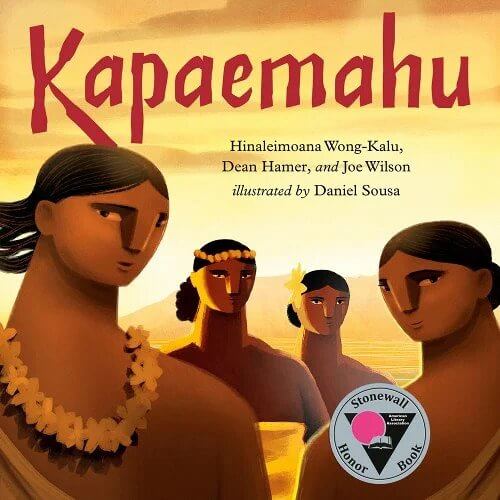
Kapaemahu by Hinaleimoana Wong-Kalu, Dean Hamer, and Joe Wilson. Illustrated by Daniel Sousa.
Purchase from Bookshop.org (supports independent bookstores and my business!)
In the 15th century, four māhū traveled from Tahiti to Waikīkī to share their gifts of healing with the people there. Māhū are neither male nor female and in Hawaiian culture hold space between kāne and wahine. The māhū who arrived in Hawaii were “deep in voice” but also “gentle and soft spoken.”
As the people experience their great healing powers, they spend an entire month erecting a great stone monument to the māhū. When the māhū were satisfied that their healing powers were stored in the stones, they were able to return to their home. The Hawaiian people kept the site as a sacred space for many centuries. Tragically, development paved over the sacred site in the 1900s. Though the stones have been recovered, the truth that the healers were māhū has been suppressed. (Recommended for ages 4 – 8. Bilingual Hawaiian-English text. Native Hawaiian māhū co-author.)
Related post: 34 children’s books for Asian Native Hawaiian Pacific Islander Heritage Month

One Day In June by Tourmaline. Illustrated by Charlot Kristensen.
Purchase from Bookshop.org (supports independent bookstores and my business!)
Bursting with the bright colors that Marsha P. Johnson loved to wear, this effusive picture book celebrates the activist’s impact on the movement for Black Trans Lives.
As children and their grownups prepare to take part in a huge 2020 march, they learn that the way people today “are exactly ourselves, no more, no less” is because of Marsha. Marsha’s generosity (even as she had few material goods), her humor, and her warmth shine through the pages. This story is not only a whole-hearted celebration of history; it is also an invitation to act today. (Recommended for ages 5 – 9. Black transgender author.)
Related post: LGBTQ-affirming picture books

Jimmy’s Rhythm and Blues: The Extraordinary Life of James Baldwin by Michelle Meadows. Illustrated by Jamiel Law.
Purchase from Bookshop.org (supports independent bookstores and my business!)
Meadows’ lyrical text and Law’s evocative illustrations guide readers through the many forces that shaped James Baldwin’s incredible career as a writer and activist. Though Baldwin’s preacher father discouraged his voracious reading, with his mother’s support he took every advantage of growing up in intellectually-rich 1930s Harlem.
His talent caught the attention of teachers and later of mentors including Countee Cullen and Richard Wright. Baldwin never hesitated to call out the racism that he and other Black people faced. His time in the U.S. civil rights movement alternated with periods of living in France, where he first fell in love and where he felt the freedom to be his entire self. (Recommended for ages 6 – 10. Black author.)
Related post: Picture books about the Harlem Renaissance

Door by Door: How Sarah McBridge Became America’s First Openly Transgender Senator by Meg Pincus. Illustrated by Meridth McKean Gimbel.
Purchase from Bookshop.org (supports independent bookstores and my business!)
Sarah McBride was drawn to politics from a very young age. She couldn’t yet find the words to explain to those around her that she was a girl, not the boy they assumed. While she struggled in private with not being able to be fully herself, she still wholeheartedly pursued politics through volunteering, running for university student government, and getting involved in election campaigns of all levels.
During her last days as president of student government, Sarah decided to share that she was transgender. Just a few years later, she ran for the state senate in Delaware, pursuing her political dreams as her full, true self. She made LGBTQ history by winning her race, becoming the first openly transgender state senator in the U.S. (Recommended for ages 5 – 9. White author.)
Related post: Children’s books starring nonbinary and transgender characters

Glenn Burke, Game Changer: The Man Who Invented the High Five by Phil Bildner. Illustrated by Daniel J. O’Brien.
Purchase from Bookshop.org (supports independent bookstores and my business!)
This lively and heartfelt biography is perfect for young baseball fans, as well as kids who want to understand a pioneer in LGBTQ history. As a player with a “five-tool talent,” Glenn Burke caught the attention of the L.A. Dodgers’ coaches soon after joining the team. Though he was a fan favorite for both his skills and warm personality, Burke soon faced anti-gay discrimination from manager Tommy Lasorda and other leaders.
In the final game of Burke’s first season, Burke congratulated his teammate with the first ever high five. Soon, this congratulatory gesture was everywhere. But that, or Burke’s incredible baseball skills, didn’t keep Dodgers’ management from trading him to one of the worst teams in baseball.
This book does not shy away from describing the harassment that Burke and other LGBTQ people experienced in the 1970s, as well as other struggles he faced. Yet it’s also clear that Burke paved the way for other openly LGBTQ athletes who played long after him. (Recommended for ages 6 – 10. Queer white author.)

A Song for the Unsung: Bayard Rustin, the Man Behind the 1963 March on Washington by Carole Boston Weatherford and Rob Sanders. Illustrated by Byron McCray.
Purchase from Bookshop.org (supports independent bookstores and my business!)
Bayard Rustin was a key leader in the civil rights movement, working as a strategist, organizer, speech writer, and more. Yet because of prejudice against Queer people, Rustin’s work was often forced into the background.
A Song for the Unsung weaves together the preparations for the 1963 March on Washington with the story of Rustin’s life. He took great risks not only for civil rights, but for peace (including imprisonment) as part of his Quaker faith.
The theme of music is present on every page spread, with suggestions of songs to sing that match the emotions and experiences of each part of the story. The bold collage illustrations give children plenty to explore even on their second or third reading of the book. (Recommended for ages 6 – 10. Black author and White Queer author.)
Related post: Children’s books about the civil rights movement

Billie Jean! How Tennis Star Billie Jean King Changed Women’s Sports by Mara Rockliff and Elizabeth Baddeley
Purchase from Bookshop (supports independent bookstores)
When Billie Jean King decided to pursue tennis with all she had, there was a lot riding against her. She was a girl, and most people didn’t think girls’ sports mattered. And her family wasn’t rich; at the time tennis was mostly played by wealthy people.
While she exceeded many of her male classmates in tennis skill, they got scholarships while she had to work two jobs to pay for college. Even after she proved herself by winning Wimbledon, reporters would ask her sexist questions like “aren’t you ready to quit tennis and have babies?” When Bobby Riggs challenged her to a national “Battle of the Sexes,” Billie Jean knew this was a match she must win.
I encourage adults to read the endnotes to this book to their children as well. It highlights the work that King went on to do for women in sports, as well as her work to fight discrimination against Queer people. (Recommended for ages 4 – 9. White author.)
Related post: Children’s books for Women’s History Month
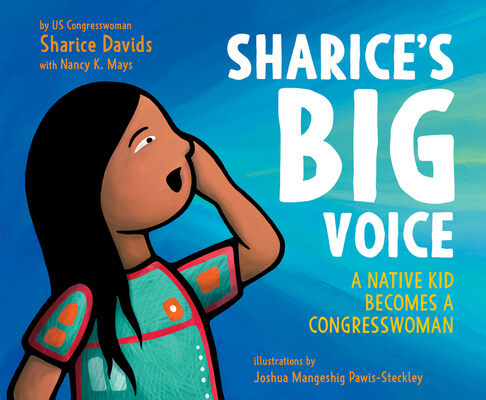
Sharice’s Big Voice: A Native Kid Becomes a Congresswoman by Sharice Davids with Nancy K. Mays. Illustrated by Joshua Mangeshig Pawis-Steckley.
Purchase from Bookshop.org (supports independent bookstores)
In this relatable autobiography, Sharice Davids shares how life prepared her to become one of the first Native American women and the first lesbian representing Kansas in Congress.
As a child Sharice loved to talk, and she was delighted to discover that her Ho-Chunk nation calls itself “people of the big voice.” But Davids also learned the power of listening to everyone, especially people whose voices were often ignored.
As a young lawyer working with Native nations, and later as a White house staffer, Davids saw how often people making laws didn’t notice their impact on ordinary people. She would use her gift of listening to people who many leaders ignored, and speaking her mind, as she made her ground-breaking run for Congress. (Recommended for ages 4 – 8. Ho-Chunk Twp Spirit author.)
Related post: Children’s books about women in politics
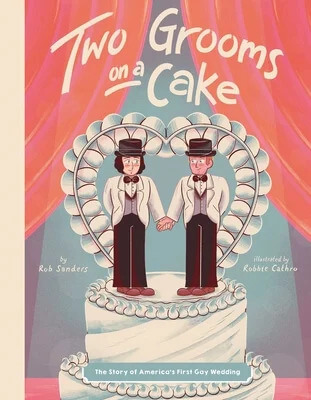
Two Grooms on a Cake by Rob Sanders. Illustrated by Robbie Cathro.
Purchase from Bookshop.org (supports independent bookstores and my business!)
This sweet picture book tells the love story of Michael McConnell and Jack Baker. They made LGBTQ history long before 2015 Supreme Court decision legalizing gay marriage.
Using baking metaphors and vintage 1970s style illustrations, Two Grooms on a Cake tells the story of how McConell and Baker were able to marry despite the law. The final page skips ahead to 50 years later, showing a now elderly couple still deeply in love. (Recommended for ages 4 – 8. Gay white author.)


If You’re a Kid Like Gavin: The True Story of a Young Trans Activist by Gavin Grimm and Kyle Lukoff. Illustrated by J Yang.
Purchase from Bookshop.org (supports independent bookstores and my business!)
Before telling children the story of how Gavin Grimm stood up for his rights as a transgender student, the authors want readers to understand what things a person can choose, and those they cannot. People can’t choose their race or their gender, including trans kids like Gavin, but they can choose whether they will speak up for themselves.
Gavin made the choice to speak up about his right to use the boys’ bathroom at school, even after a teacher started telling people Gavin was a girl. When his speech at a school meeting didn’t change the school’s policy, Gavin made the choice to speak up with others until a law in his state was changed. As they learn about how Gavin has stood up with other trans kids in other communities, readers are asked to consider how they will choose to use their voices. (Recommended for ages 5 – 9. White transgender authors.)
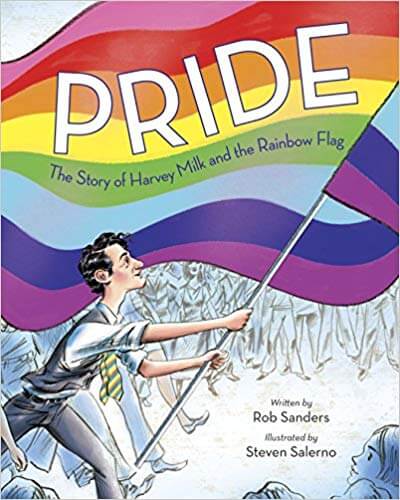
Pride: The Story of Harvey Milk and the Rainbow Flag by Rob Sanders. Illustrated by Steven Salerno.
Purchase from Bookshop.org (supports independent bookstores and my business!)
This children’s book tells the story of how the rainbow flag became a symbol that gave Queer people hope that tomorrow would be better.
When Harvey Milk was elected to be a supervisor for the City of San Francisco in 1977, he became one of the first Gay Americans to hold public office. Harvey asked artist Gilbert Baker to help him come up with a symbol that could be used at an upcoming march against laws that hurt gay people. As the story continues, children get to see how people have used the rainbow flag in many different ways, all around the world, throughout LGBTQ history.
Caregivers should be aware that while the book does not go into detail, it does mention that Harvey Milk and George Moscone were assassinated. (Recommended for ages 6 – 10)
Shop this entire list on Bookshop.org to support independent bookstores and my business!
Middle grade books about LGBTQ history

Flor Fights Back: A Stonewall Riots Survival Story by Joy Michael Ellison. Illustrated by Francesca Ficorilli.
Purchase from Bookshop.org (supports independent bookstores and my business!)
The other books in the Girls Survive series that I have read focus on a girl experiencing a disaster and struggling to reunite with her family. Flor Fights Back follows a similar plotline, except that the protagonist is trying to find her chosen Queer family rather than her biological one.
Since her kind and open-hearted mother died, Flor has struggled to live under Abuelita’s strict rules. When Abuelita punishes her for wearing girl’s clothes, she knows that she cannot keep living with her. Until now, Flor hasn’t known anyone else who is like her, but on the streets she quickly meets Tami, a teen trans girl who knows how “girls like us” can navigate Greenwich Village.
When a kind-hearted adult tells the girls to come by the Stonewall Inn, Flor and Tami soon find themselves in the midst of the 1969 riot that sparked the modern LGBTQ rights movement. (Recommended for ages 7 – 10. Transgender white author.)

A Child’s Introduction to Pride: The Inspirational History and Culture of the LGBTQIA+ Community by Sarah Prager. Illustrated by Caitlin O’Dwyer.
Purchase from Bookshop.org (supports independent bookstores and my business!)
In this survey of LGBTQ history and culture, vivid-full color illustrations accompany one to two page entries on a wide variety of topics. Young readers learn about global and U.S. LGBTQ leaders and events and will also find many entries that help them understand key terms and issues, such as decriminalization, the difference between gender and sexuality, and the history of drag and cross-dressing. (Recommended for ages 8 – 12. Lesbian white author.)
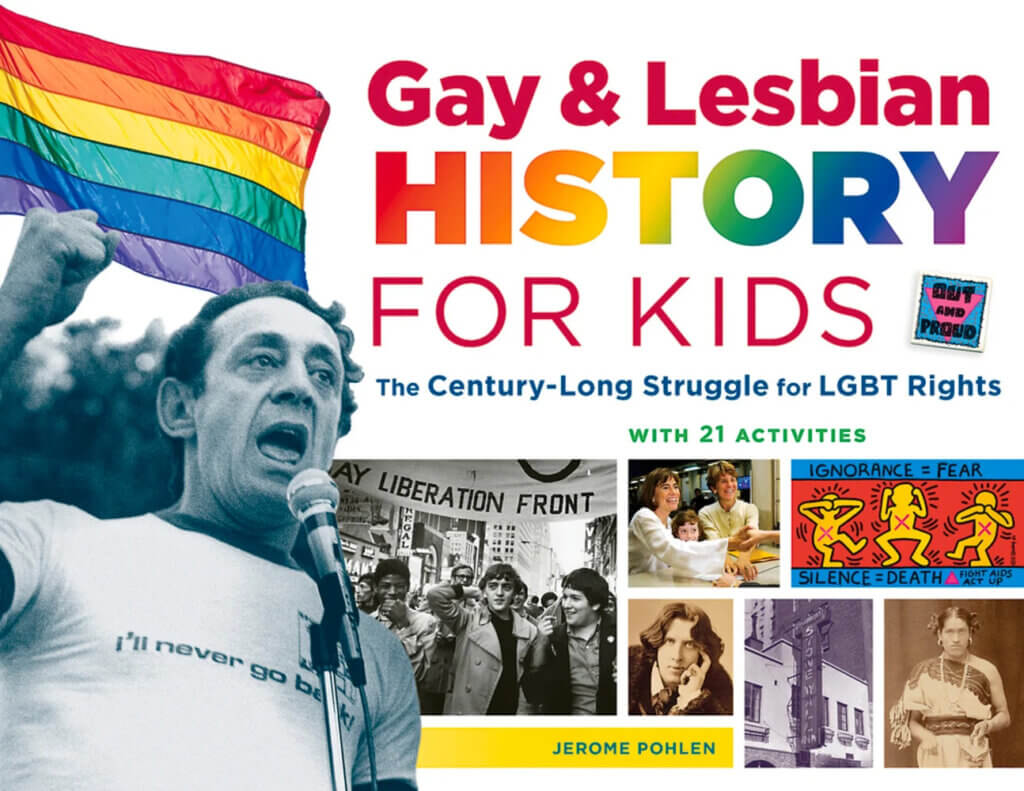
Gay and Lesbian History of Kids: The Century-Long Struggle for LGBT Rights by Jerome Pohlen.
Purchase from Bookshop.org (supports independent bookstores and my business!)
In many ways, this LGBTQ history guide is similar to the one above by Sarah Prager. Prager’s entries are shorter but wider ranging. Her book is best for children who enjoy full-color art (rather than photographs which Pohlen uses). Pohlen’s book is better for readers looking for more in-depth entries, as well as those who want to understand the chronology of how LGBTQ history has unfolded over the past 100 years or so.
In this in-depth but accessible guide, youth will learn about how World War II was a catalyst for LGBT rights, especially among gay men and lesbian women who served in the armed forces. There’s an in-depth chapter on how the AIDS epidemic and the conservative backlash to gay rights shaped the movement, as well as another that details how the movement for marriage equality has impacted U.S. history. Profiles of LGBTQ heroes are inserted throughout the book. (Recommended for ages 9 – 14. Gay white author.)
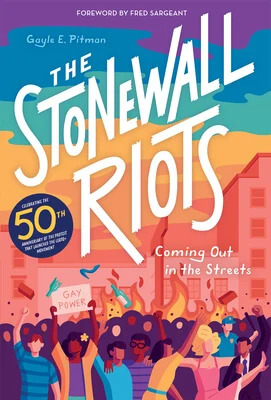
The Stonewall Riots: Coming Out in the Streets by Gayle E. Pitman.
Purchase from Bookshop.org (supports independent bookstores and my business!)
This unique account of the Stonewall riots not only helps teens understand how severe the attacks on Queer people were at that time. It also shows young people just how complex reconstructing history can be.
There was little serious media about the 1969 police raid at a gay bar that turned into a riot when bar patrons resisted arrest. Many of those who were there that day are no longer living and did not leave written accounts of what happened. Therefore, there are many disagreements about who was there that night and what they did. Pitman offers a series of visual items such as photographs, flyers, and physical objects that provide different insights into what is known (and what is unclear) about that night. Many of the chapters outline events that happened the year after Stonewall in the burgeoning LGBTQ rights movement, including conflicts within the movement.
Content note: Because Pitman quotes anti-gay sources from the 1960s, several slurs for LGBTQ people are used, though she makes clear why they are offensive. (Recommended for ages 12+. Lesbian white author.)
