
The past couple of months, I’ve been intentionally having more conversations about racial injustice with our youngest child.
At age 6, I can already see the ways that society’s stereotypes about people of color are shaping him. I knew I needed to do more if he’s going to grow into the kind of person who will confront racism and use his white privilege for good.
I decided to start by talking more about police brutality. Soon after those conversations, horrifying stories about refugee parents and children being thrown into detention hit the mainstream news. So, there were also many opportunities to talk about a second form of racial injustice.


Disclosure: I was given a free review copy of Something Happened in Our Town by the authors. All opinions are my own. For your convenience, this post includes affiliate links. If you make a purchase through these links, I may earn a small commission at no additional cost to you. You can read my full disclosure policy here.
Talking with My Child about Racial Injustice and Police Brutality
There had already been a couple of occasions when I’d talked to our son about police violence and what the phrase Black Lives Matter means. But I suspected those conversations were so few and far between that he might not remember them.
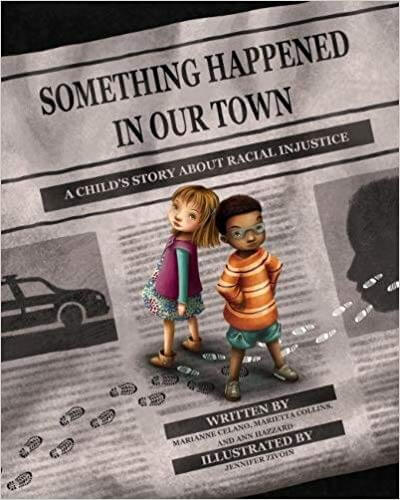
I decided I needed some resources that would help me have a more direct conversation. I was lucky to be offered a review copy of Something Happened in Our Town: A Child’s Story about Racial Injustice. I highly recommend this picture book. It was written by a team of three child psychologists to helps kids ages 4 to 8 understand both bias and systemic injustice against Black people in America.
The story focuses on two children, one white and one Black, who are in the same class at school. All the adults in town have been talking about a police shooting of a Black man. Kids have overheard their conversations, and have questions.
Related Post: Why I talk with my white children about racism
Something Happened in Our Town
Emma, who is white, wants to know why the man was shot. Her parents answer that the shooting was a mistake. They tell her the police thought he had a gun. But Emma’s teenage sister insists that it wasn’t a mistake, and that he was shot because he was Black.
I was impressed with what happens next. Her parents briefly explain slavery to Emma.
When she asks whether their family did “those bad things a long time ago,” Emma’s mother answers with a honest yes. They talk about about unfair patterns, with an example that Emma can understand: who gets invited to a birthday party.
Next, we meet Josh and his family, who are Black. Josh wants to know if the police officer who shot the man will go to jail. His older brother Malcolm is sure that he won’t. He knows that “cops stick up for each other, and they don’t like Black men.”
Josh expresses confusion, because some cops, including his Uncle James, are Black. His father tells him that “there are many cops, Black and White, who make good choices. But we can’t always count on them to do what’s right.”
Related Post: 6 Meaningful Ways Kids Can Celebrate Martin Luther King Jr., Day
As Malcolm and Josh express their anxiety and frustration, their parents give them examples of Black leaders who’ve resisted racial injustice. His father talks about using our anger to make things better.
Josh thinks about how can use his power, just like his brother does when kids tease Josh.
When Emma and Josh return to school, there’s new child in their class. His name is Omad and he’s just starting to learn English. At recess, the other children don’t pick him for a soccer team. Both Josh and Emma think about the conversations they had with their parents, and they insist that Omad is included.
My son’s response to Something Happened in Our Town
Our six year old didn’t ask a lot of questions about the book. But he did ask to read it several nights in a row. There were many parts of the book that built on conversations we’d already had about issues like slavery and responses like protesting. But I could tell that he was processing the story over several days.
Lately, I’ve noticed him being hesistant and even fearful around Black men he doesn’t know. A few months ago when we sat next to a Black man on an airplane, he told me he was going to be sure not to talk to him because he might not be a good person.
So, when we read the conversation Emma’s family had, I made sure to pause when they talked about how many white people hold untrue stereotypes about Black men and boys being dangerous.
When Josh’s father expressed anger, I wanted to make sure my son understood why, so we paused to talk about that too.
Related Post: Best Children’s Books about Black Women Leaders
His favorite part of the book was when Josh and Emma welcomed Omad to the soccer game. I know that this was probably much easier for him to grasp than some other parts of the book.
But it’s important to talk about these big issues early and often, even if he can’t fully understand them yet.
As Jennifer Harvey outlines in her book Raising White Kids, waiting until kids are older or teens doesn’t mean they’ll be any less prepared to have conversations about race and racial injustice.
Talking with my Child about Racism Towards Immigrants
When the Families Belong Together marches and rallies were scheduled for June 30th, I thought it would be easy to get my son excited about participating.
After all, we’d been reading La Frontera: My Journey with Papa over and over, and he loved the book. It’s a true story about a child named Alfredo who made a frightening journey with his Dad through the desert because they were hungry and his father desparately needed work. We’d talked about how there are families just like Alfredo making that journey now, and how hard it is.
Related Post:11 Children’s Books about Immigrants and Refugees
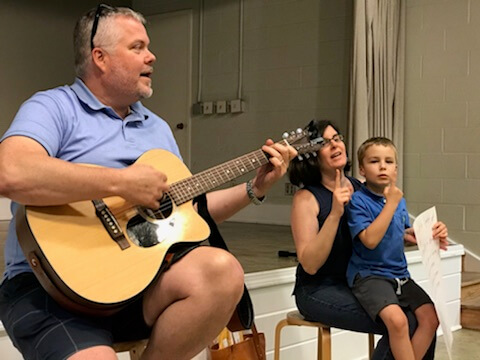
The week before, our church’s Vacation Bible School focused on compassion. As the children’s minister, I made sure that we talked often about immigration. The kids raised money for the San Fernando Valley Refugee Children’s Center, and my son wanted to do chores to earn money to donate.
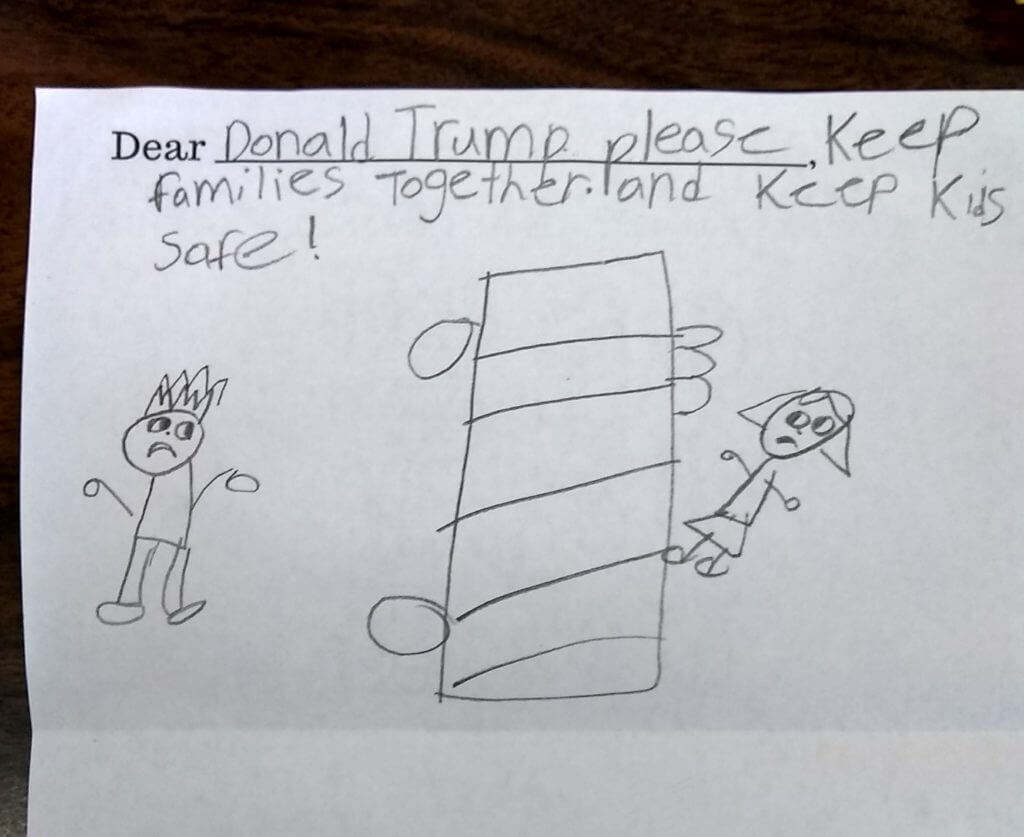
In the past, he’s drawn pictures and dictated a letter to me to send to our Senator about immigration reform and keeping families together. At Vacation Bible School, he and his classmates had sent drawing and letters to President Trump about an end to family separation. (You can see his 7 year old friend’s letter below.)
“Those things are bad Mommy, but I don’t want to go the rally”
So, I told him that our family would be going to a rally on Saturday because people all over the country were standing up and saying it’s wrong to put children in jail, and it’s wrong to take kids away from their parents.
He asked “but I don’t have to go right?”
“We’re going together as a family,” I responded.
“But why do I have to go?”
“Because sweetheart, it’s a terrible thing, an evil thing, that’s happening to these families. They came here looking for a safe place to live, and instead the mommies and daddies and children are being put in jail. And the children are being sent far away from their parents. I don’t know what I would do if I couldn’t be with you. Think about how those mommies and daddies and kids feel.”
“Yes, those things are bad Mommy. But I don’t want to go to the rally.”
“But if people like us, who are citizens, don’t use our power and speak up, things aren’t going to change. And we don’t want anyone to suffer this way.”
He didn’t say that he wanted to go, but he didn’t protest anymore either.

Fortunately, the rally was taking place at a park so that it could be a family friendly event. He asked if he could play instead of going to the rally. I told him as long as he was close by, he could.
And that’s what he did. My husband supervised him on the playground while we rallied nearby.
Related Post: How to Stand Up for Immigrant Rights with Your Kids
Was there a point to taking him to the rally?
I think so. He saw that there were hundreds of people there, and he knew why.
We talked on the way there and the way back about what we were doing, and how people all over the country were doing the same thing. I viewed it as one of many experiences that will help him gradually develop more empathy, and a desire to act from that empathy.
We’ll keep talking, and I’ll make sure he sees me taking action. I’ll keep looking for ways for him to participate in resisting racial injustice. It’s a skill that he is building, just like any other.

3 responses to “Talking about racial injustice with my 6 year old”
Thanks for all you are doing to make Memphis and beyond the best community it can be. We, too, attended the rally at Gaisman Park and had children playing on the playground while parents rallied.
I serve the Church of the River, First Unitarian Church of Memphis, as the Director of Religious Education and Family Ministry Team. I’ve used your Barefoot Mommy materials here, especially the Outreach/Social Justice two-step illustrations, as we move from charity only to more social justice efforts. I’ve been asked by my Family Ministry Team, and Laura McArtor in particular, to reach out to see if we could meet with you sometime to collaborate. We are on “summer mode” right now but will reconvene in August. Our Unitarian Universalist faith calls us to engage in justice making at all stages of Faith Formation. I believe your values are closely aligned with ours and we could do more together than either of us alone.
Blessings, Cindy
Thank you so much Cindy for your kind words! Yes, I’d be happy to meet with your team once summer wraps up.
Don’t make your son feel guilty for being white. I’m Hispanic ( family is immigrants ) and while family separation is wrong , you need to understand that people need to come here legally . Stop using your child As a token for your own political views .