
Incidents of antisemitism have tragically been on the rise in the United States for the last few years. When talking to children about Jewish history, culture, and faith, it’s important to start with positive, everyday experiences that are not primarily about oppression. (My list of children’s books starring Jewish characters is a great place to start for both picture and chapter books.)
That doesn’t mean parents and educators should avoid talking about antisemitism, both in history and the present day, with children. Young people who don’t know the history of persecution that Jewish people have faced for centuries can be particularly vulnerable to antisemitic messages and memes.
In this post you’ll find 16 books for children and teens that address antisemitism, including, but not limited to, books about the Holocaust.


This post may include affiliate links. If you purchase items through these links, I may earn a small commission at no additional charge to you. You can read my full disclosure policy here.
Picture books that address antisemitism

A Poem for Peter by Andrea Davis Pinkney. Illustrated by Lou Fanchier and Steve Johnson.
When Ezra Jack Keats wrote and illustrated The Snowy Day, main character Peter was one the first non-caricatured Black characters in a children’s book. Keats, unlike Peter, was white. Yet, as Andrea Davis Pinkney implies in A Poem for Peter, Keats’ experiences of antisemitism likely made him more sensitive to the exclusion of children of color from children’s books.
When his parents immigrated from Poland, fleeing Jewish persecution, his name was Jacob (Jack) Ezra Katz. By the time Jack was looking for artist jobs in a post World War II era, there were many “no Jews need apply” signs hanging in business windows. So, Jack changed his name to Ezra Jack Keats.
While at first he illustrated other writers’ children’s books, years later he received an invitation to both write and illustrate a book. A Poem for Peter celebrates the joy and lessening of prejudices that Keats sparked by introducing the world to a young Black boy fascinated by the blanket of snow covering his urban neighborhood. (Recommended for ages 5 – 9. Black, non-Jewish author.)
Related post: 11 diverse poetry books for kids

Dear Mr. Dickens by Nancy Churnin. Illustrated by Bethany Stancliffe.
Eliza Davis loved the work of Charles Dickens, who was the most famous British writer of her day. He inspired empathy for vulnerable people, like orphans and poor families. When Davis read Oliver Twist, she was disheartened to find a character described as “an old shriveled Jew” who taught Oliver to steal. Over and over again, Dickens referred to this character as “the Jew” rather than using his actual name of Fagin.
As a Jew, Davis knew that how much discrimination and bias her people faced. She also perceived how characters like Fagin contributed to a pattern of antisemitism. So even though she wasn’t a particularly powerful person, Davis decided she must write to him about this.
Dickens wrote Davis back, defensively stating that Davis was being unfair to him. Undaunted, Davis wrote to him again, pointing out that all of the Jewish characters in his books were portrayed negatively. She urged him to think about how future generations would judge him and his work. Would her words persuade him to take his Jewish characters in a new direction? (Recommended for ages 6 – 10. White Jewish author.)
Related post: 21 powerful books for children and teens about race and racism

Mrs. Katz and Tush by Patricia Polacco.
In this account that mirrors the diverse neighborhood she grew up in, Larnel’s mother befriends their neighbor Mrs. Katz after her husband dies. Mrs. Katz’s talks about how she’ll be all alone, so Larnel surprises her with a kitten that’s the runt of the litter.
She agrees to take the kitten, which she names Tush, only if Larnel will help her learn how to care for her. During his daily visits, Mrs. Katz shares stories of her life in Poland and the U.S., along with telling him about the common hardships and resilience that the Jewish and African-American peoples share. (Recommended for ages 5 – 9. White, non-Jewish author.)
Related post: 15 picture books about social justice and human rights

I Dissent: Ruth Bader Ginsburg Makes Her Mark by Debbie Levy. Illustrated by Elizabeth Baddeley.
This picture book biography of Ruth Bader Ginsburg is as spirited as the Supreme Court Justice was herself. Readers learn how childhood experiences of antisemitism and sexism sharpened Ruth’s sense of justice. Her mother was determined to surround young Ruth with examples of women who made their mark on the world.
When Ruth found situations that were unfair, she protested. Sometimes she was successful, like when she insisted she be allowed to write with her left hand after a poor penmanship grade. Other times, such as when she wanted to take shop instead of home economics, she was not.
As Ruth’s law career begins to take off, Levy shows both the barriers she faced as a Jewish woman and the ways the rest of her family challenged gender roles alongside Ruth. Finally, young readers learn how Bader Ginsburg’s dissent arguments on key cases shaped the legal landscape. (Recommended for ages 5 – 9. White, Jewish author.)
Related post: 31 children’s books for Women’s History Month

The Christmas Menorahs: How a Town Fought Hate by Janice Cohn. Illustrated by Bill Farnsworth.
This true story details how the community of Billings, Montana responded to a rise in antisemitism and other acts of hatred in 1993.
One night someone throws a rock through the window of Isaac’s bedroom, knocking his Hanukkah menorah to the floor. When his parents explain that the culprit targeted the family because they are Jewish, Isaac isn’t sure they should display their menorahs anymore. What if the hateful people come back?
Isaac’s mother is determined to speak out, and she’s joined by Christians who want all to know that hatred will have no home in Billings. Soon, a holiday plan that invites all of Billings to stand with the city’s Jewish residents is underway. (Recommended for ages 6 – 10. White Jewish author.)

Always an Olivia by Carolivia Herron. Illustrated by Jeremy Tugeau.
Based on her own family’s history, Always An Olivia traces a Jewish family’s lineage from a Gullah Geechee community in the United States all the way back to Spain the 16th century.
As the book opens, a child asks her Great Grandma Olivia if it’s true that she really remembers when enslaved people in the United States were empancipated. She affirms that is true, though her own family was already free. As Olivia traces their family’s Jewish lineage, the child learns of the antisemitism and violent persecution that her ancestors had to flee from in Spain, Portugal, and Italy.
In the early 1800s Olivia’s ancestors escape to the United States and settle among a Gullah Geechee community off the coast of Georgia. As their descendants marry into the Gullah community, each generation always names one child Olivia as a testament to peace. (Recommended for ages 7 – 11. Black Jewish author.)
Related post: The definition of race (for kids!)

Nicky and Vera: A Quiet Hero of the Holocaust and the Children He Rescued by Peter Sis.
As antisemitic persecution and the rise of Nazism loomed over Europe, a young Englishman named Nicholas Winton travelled to Prague at a friend’s invitation. He knew that England would allow child refugees to come to his country, but only if they had travel arranged and adult caretakers to welcome them.
In just a few short months, Nicky did everything he could to help Jewish children like Vera escape from Czechoslovakia. Vera boarded a train with seventy-six other children, but none of her family, that took her to London. Before Germany attacked Poland, Nicky was able to help 669 children safely reach London.
Vera’s parents did not survive the Holocaust, and she built a life in England. Nicky went about a typical life, not talking to anyone about what he’d done. But one day, when both Nicky and Vera were old, they received phone calls inviting them to meet each other.
With sparse text and evocative illustrations, Nicky and Vera shows children the power of human goodness in the midst of evil. (Recommended for ages 7 – 10. Czech-American author.)

Passage to Freedom: The Sugihara Story by Ken Mochizuki. Illustrated by Dom Lee.
This remarkable book tells the true story of Chiune Sugihara, a Japanese consul serving in Lithuania during World War II. With the encouragement of his wife and children, Sugihara disobeyed his superiors’ orders so that he could write thousands of visas for Jewish refugees fleeing Nazi violence.
The story is told from the perspective of 5 year old Hiroki (who also offers an afterword to the book.) As a child, Hiroki was confused when one day there were suddenly hundreds of people, including many children, standing outside their gate. When his mother explained that they needed his father’s assistance or they may be killed, Hiroki pled with his father to help.
Several times, his father asked his superiors to allow him to write visas for all the refugees, but he was refused. Chiune brought his entire family together to ask what he should do. Once they all agreed that he must help despite the orders he was given, Chiune began writing hundreds of visas, and eventually, thousands. When the family was forced to leave Lithuania by train because of the Soviet takeover, young Hiroki saw crowds of refugees watching him, promising to never forget his father or what he did. (Recommended for ages 6 – 10. Japanese-American, non-Jewish author.)
Related post: 29 children’s books about Asian American history

The Grand Mosque of Paris by Karen Gray Ruelle. Illustrated by Deborah Durland DeSaix.
This little-known true story of how Parisian Muslims protected Jews during the Holocaust is one that children and adults alike should hear.
During the Nazi occupation of Paris, few Parisians were ready to risk their lives by harboring Jewish people. Many Jews and escaped prisoners of war found refuge in the Grand Mosque of Paris, a place of worship and a community center that made an ideal temporary hiding place.
The rector of the mosque went to great lengths to protect Salim Halali, an Algerian Jew, even making a false certificate of conversion to make the Nazis believe Halali had converted to Islam. A stonecarver went so far to inscribe the family name on an unmarked tombstone to show further “proof” that Halali was Muslim. Halali was just one of the many people who survived the war because of the Grand Mosque. (Recommended for ages 6 – 10. White author.)
Chapter books that address antisemitism

Across So Many Seas by Ruth Behar.
Because we’re studying medieval world history in our homeschool this year, I’ve been on the lookout for resources that talk about Spain’s expulsion of Jews in 1492. So you can imagine my appreciation learning that Ruth Behar had written a novel that begins with exactly this event!
This moving work of historical fiction traces a family’s ancestry through the lives of four family members across centuries: Benevenida, Reina, Alegra, and Paloma. All four women are connected by a song sung in Ladino. Readers meet Benevenida in 1492, where she and her family members must make a terrible journey out of Toledo, Spain after the Christian King’s cruel expulsion. They eventually land in Turkey, where centuries later we meet Reina.
Reina’s free spirit and the sexism of the time result in her being sent to Cuba to live with her aunt in 1923. Reina’s daughter Alegra ends up fleeing from Miami to Cuba after Castro’s revolution. Forty years later, Alegra plans a trip to Spain with her daughter Paloma as well as her now aged mother. Though the women know they have Sephardic heritage, there they will learn far more about their family’s connection to the country than they expected.
As with all of Behar’s books, she beautifully captures the commonalities and connections between people of different ethnicities and religions who live in a community, as well as the bold spirit of girls and women who refuse to “know their place.” (Recommended for ages 10 – 14. Cuban-American Jewish author.)

Max in the House of Spies by Adam Gidwitz.
Adam Gidwitz has a unique gift for blending humor and imagination with painful history, and this gift shines through once again in the World War II themed novel Max in the House of Spies.
As Max’s parents send him to England on the Kindertransport, he’s desparate to get back to Germany. Max has always felt that he’s more able to protect his parents than they are able to protect him, but now he won’t be able to help them navigate the violent antisemitism that’s gripped his country
On the boat to England, Max discovers that he has two new invisible companions on his shoulders: a kobold named Berg nad a dybbuk named Stein. These bickering creatures certainly don’t seem to be there to make Max’s life easier, but they still provide him company.
Max discovers that his new foster family is both Jewish and has a connection to the top levels of British espionage. He knows that the only way he can protect his parents is to get UK authorities to send him back to Germany as a spy. (Recommended for ages 10 – 14. White Jewish author.)
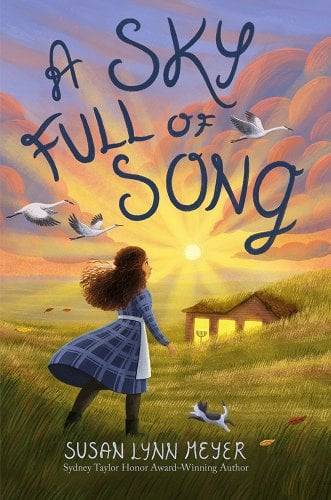
A Sky Full of Song by Susan Lynn Meyer
Purchase from Bookshop.org (supports independent bookstores and my business!)
Shoshana’s Papa and older brother left Ukraine for the American prairie nearly three years ago. Now that the antisemitic violence of the Russian pogroms has become stronger, Mama has decided it’s time for the family’s four girls and her to make their home in North Dakota as well.
There are so many changes to get used to in their new home. First, there’s life in the cramped dirt-packed dugout home that will have to do until they can afford lumber for a wood house. Second, Shoshana must figure out how to make friends at school and speak English at the same time. The family’s nearest Jewish neighbors live many miles away, and they likely won’t see them until the high holidays.
As Shoshana and her older sister Libke discover that their new classmates’ attitudes about Jews range from “friendly” pressure to convert to Christianity to hateful stereotypes, the two sisters have different responses. Libke is determined not to betray her religious and cultural traditions, while Shoshana wonders if she should try to fit in more by minimizing how she’s different. Soon the sisters aren’t speaking to each other, even as Shoshana needs her sister most. (Recommended for ages 10 – 14. Jewish author.)

Letters from Cuba by Ruth Behar.
Inspired by events in the life of the author’s grandmother, Letters from Cuba begins in Poland, as Jewish people are facing increasing economic hardship and hatred. Eleven-year-old Esther’s father has already been in Cuba for three years and has saved up enough money to bring one of his five children to Cuba. Esther convinces him that even though she’s a girl, as the eldest she will be the most help to him in earning more money.
Through letters to her sister Malka, readers experience the harshness of her journey, which is tempered by great kindness by one of her fellow refugee passengers. Once she is settled in the small Cuban town her father lives in, Esther shows a remarkable gift for bringing people together who previously would not have socialized because of class, ethnicity, and religion.
While most of those Esther and her father meet are generous and encouraging, the Nazis’ antisemitic hatred has caught on with some Cuban elites. As the political situation worsens for Jews in Europe, Esther and her father work as fast as they can to bring the rest of their family across the sea to Cuba. (Recommended for ages 8 – 12. Cuban-American, Jewish author.)
Related post: My favorite metaphor for explaining racism to children

Broken Strings by Eric Walters and Kathy Kacer.
In the months after the September 11th attacks, Shirli is glad to have something distracting to dive into: the school play, Fiddler on the Roof. Between anxiety over her father working in Manhattan and the recent death of her Bubbe, times have been hard for Shirli and her whole family. She especially worries about her Zayde, who has been withdrawn ever since Bubbe’s death.
Shirli has won the female lead in Fiddler, but she’d rather play one of the young daughters than an old woman. A trip into Zayde’s attic to look for props and old clothes reveals an old family picture and a broken violin than Shirli’s never seen before. At first, her beloved Zayde, who is never harsh, seems angry when Shirli asks about the picture and violin.
Gradually, over several months, Zayde opens up to her about his life before and during the Holocaust. He also becomes increasingly interested in Shirli’s play, which reflects his parents’ experiences during the Russian pogroms, and his granddaughter’s musical gifts. Zayde and Shirli’s conversations not only help her understand the pain of the antisemitism her family has experienced. They also shine a light on how religious hatred is not a thing of the past. (Recommended for ages 10 – 14. White authors. Kacer is Jewish.)
Related post: Uplifting resistance to injustice when we talk to children about hard history

The Blackbird Girls by Anne Blankman.
Valentina and Oksana attend the same school, and both of their fathers work at the Chernobyl nuclear power plant. But that doesn’t mean the girls have anything important in common. Oksana often picks on Valentina and is one of several students who aim antisemitic taunts at her.
Though Valentina has never even met her grandmother, her mother decides she must travel all the way to Leningrad to live with her in the aftermath of Cherynobyl’s explosion. When Oksana’s mother becomes sick with radiation posioning, she must go with Valentina. After years of hearing her father’s anti-Jewish tirades, Oksana is at first angry and afraid of how Valentina’s grandmother will treat her.
But as Valentina’s grandmother generously welcomes them with the little she has, Oksana’s assumptions are up-ended, and the girls gradually develop a friendship. Meanwhile, there is so much Valentina doesn’t know about her grandmother’s life, including why she chooses to celebrate Shabbat in secret despite the retaliation she could face from the Russian government. (Recommended for ages 10 – 14. White, non-Jewish author.)

Penina Levine Is a Hard-Boiled Egg by Rebecca O’Connell. Illustrated by Majella Lue Sue.
Most of the examples of anti-Semitism in the other books on this list are quite overt, from job discrimination to violence. Yet more subtle examples of anti-Jewish discrimination, such as privileging Christian culture and holidays in public schools, are also important to talk about with children.
Penina is a headstrong child who’s often in trouble for yelling at or about her annoying little sister Mimsy. She also has a strong reaction to assignments at school that treat them as if they’re babies. But that’s not the biggest reason she opposes Ms. Anderson’s latest assignment to write a letter to a kindergartner as if she’s the Easter bunny.
She tries to tell Ms. Anderson that celebrating Easter is against her beliefs, but when the other Jewish child in the class doesn’t seem to mind, everyone acts as if Penina is being too sensitive. Penina’s afraid if she tells her parents what happened she’ll get in trouble (especially since she’ll earn a zero on the assignment.) But when Penina tells grandmother what she’s done, her grandmother compliments her for being like a hard-boiled egg that gets tough under pressure, as many Jews before her have done. (Recommended for ages 8 – 12. White, Jewish author.)
Related post: 10 children’s books about Passover

The Assignment by Liza Wiemer.
This nuanced young adult novel was inspired by a recent real-life school assignment about the Holocaust, and two students’ decision to protest the project.
Mr. Bartley is Logan’s favorite teacher, and his passion for history and creative approach to teaching inspire her. She’s understandably baffled and alarmed when he announces that the class will be holding a debate imitating the 1942 Wansee Conference, in which the Nazi party decided to adopt the “final solution” of mass murder of the Jews.
Logan and her best friend Cade can’t believe Mr. Bartley would ask them to justify the Nazis’ actions. When a handful of students immediately begin engaging in anti-Semitic acts like doing the heil Hitler salute, Mr. Bartley swifly comes down on them. But he also seems incapable of understanding how his assignment tacitly gives encouragement to engage in anti-Semitism.
Logan and Cade try speaking to Mr. Bartley in class, privately, and with the principal. When they’re offered the change to do an alternate project they’ve proposed, the principal and Mr. Bartley think it’s fine for the debate itself to continue. Cade and Logan know that this “compromise” isn’t enough, and they must decide what they’ll do to try to stop the debate. (Recommended for ages 13+).
Additional resources for talking with children about antisemitism
Guidelines for teaching about the Holocaust from the United States Holocaust Memorial Museum
This article from Logan Levkoff for Kveller has suggestions for how Jewish families can talk to their children about antisemitism
This article from Julia Delitt for The Every Mom is about how to talk to children about antisemitism and is mostly geared to non-Jewish families.
Shop this list of books that help children and teens understand antisemitism on Bookshop.org. Your purchase supports independent bookstores, and this blog!

2 responses to “16 books that help children and teens understand antisemitism”
Thank you for this post! It’s so important to help kids understand antisemitism, which on the one hand is a unique form of conspiracy-theory based hatred, and on the other hand is at the root of all kinds of white supremacy and racism.
Very true about those connections Heidi!