
When’s the last time you read a poem with your children? Before you answer “we don’t really read poetry,” think about the rhyming picture books on your shelf, or a silly limerick you rattled off to make your kiddo laugh. Poetry is a wonderful way to play with language and experience emotions of all kinds. Poems can also help us envision things that do not yet exist, which is why I love social justice poetry in particular.
Poetry doesn’t have to be formal or stiff, as I think you’ll see in the list below of eleven of my favorite illustrated social justice poetry collections that have been written with kids in mind.
Another great thing about poetry is you don’t need to read an entire book at once! Try sprinkling in one poem a day at bedtime or when you sit down for a snack with your child.


This post may include affiliate links. If you purchase items through these links, I may earn a small commission at no additional charge to you. You can read my full disclosure policy here.
Social justice poetry collections that teach about history

Dreams from Many Rivers: A Hispanic History of the United States Told in Poems by Margarita Engle
This wide-ranging volume begins with poems that imagine the lives of Indigenous peoples before the disastrous arrival of Europeans in present-day Puerto Rico. The poems are written in the voices of an incredible variety of people, including Black enslaved and free people, Indigenous people, Spanish colonizers, mestizos, and Latino immigrants to the United States of many races.
Poetry set in the 1900s cover the exploitative Bracero farmworker immigration program, scientific discoveries made by Latinos, Central American refugee stories and much more. So many different themes of social justice are covered in these moving narrative poems. (Recommended for ages 10+. Cuban-American author.)
Related post: 9 ways to celebrate Indigenous Peoples Day with children

Legacy: Women Poets of the Harlem Renaissance by Nikki Grimes.
Nikki Grimes is one of my favorite poets for children. In this unique collection, she first presents a poem by a Harlem Renassiance woman poet with one or more lines presented in bold text. On the following page, Grimes writes a poem on a similar theme, using a word from the bolded text of the Renaissance poem in each line.
A variety of outstanding Black women illustrators, including Ekua Holmes, Elizabeth Zunon, and Vanessa Brantley-Newton bring the poems to life with their pictures. Some of the poems are celebrations of nature and family, while others cry out against injustice, racism, and sexism. (Recommended for ages 8 – 12. Black author.)
Related post: Best children’s books about Black women leaders

Voices of Justice: Poems About People Working for a Better World by George Ella Lyon. Illustrated by Jennifer M. Potter.
In this remarkably broad collection of poems, young readers meet people from the past and the present who have campaigned for workers’ rights, environmental justice, peace, racial justice, women’s rights, and more.
Several of the justice seekers are youth, including the students of Marjory Stoneman Douglas High School and Indigenous activist Xiuhtezcatl Martinez. Vibrant illustrations bring each leader’s personality into focus. Several of the poems are concrete poems (written in the shape of an object related to the poem), adding visual interest for reluctant readers. (Recommended for ages 8 – 14. White author.)
Related post: 20 children’s books about disability that shatter stereotypes
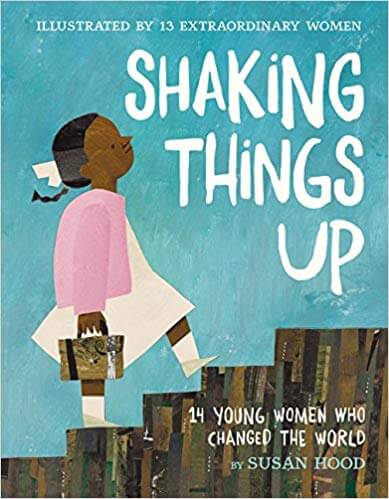
Shaking Things Up: 14 Young Women Who Changed the World by Susan Hood.
There are many remarkable women’s history stories told in this book, including several social justice activists. The one I was surprised and delighted to find was Frances Moore Lappé. Lappé is an anti-hunger activist who made a big impact on my life when I was a college student. Reading her book Diet for a Small Planet was one the first things that nudged me toward a life of activism.
Hood also tells the story of Molly Williams, the first known woman firefighter in America. A cook for the fire crew, she never expected to save an entire street of homes when the firefighters were sick with the flu. There are also stories of most recent women’s history, such as Angela Zhang’s cancer research that won her awards at the age of 17. (Recommended for ages 6 – 10. White author.)
Related post: 31 children’s books about women’s history

Calling the Doves/El canto de las palomas by Juan Felipe Herrera. Illustrated by Elly Simmons.
Herrera remembers his childhood as a migrant farmworker in this collection of lushly illustrated poems in Spanish and English.
While adults are likely to notice the hardships and poverty his family faced, Herrera’s perspective as a child is somewhat different. The dirt patio where he takes outdoor baths “was a sand colored theater where I learned to sing.” He remembers his parents’ talents, from his father’s ability to draw doves to him with song, to the lengthy poems his mother recited. (Recommended for ages 6 – 10. Mexican-American author.)
Social justice poetry books set in the present day

A Place Inside of Me: A Poem to Heal the Heart by Zetta Elliott. Illustrated by Noa Denmon.
In this heartfelt poem, a young Black boy explores the complexity of his emotions after police kill one of his loved ones. In “a space deep down inside of me where all my feelings hide” there is “joy, sorrow, fear, anger, and a hunger to be free.”
Incredibly detailed illustrations show the many ways he and people in his community resist and mourn this injustice, while also evoking key leaders from Black history. By tending to that place inside of him, the child “remember[s] to love myself most of all.” (Ages 6 – 10. Black author.)
Related post: 15 books that help children and teens understand Black Lives Matter

Woke: A Young Poet’s Call to Justice by Mahogany L. Browne with Elizabeth Acevedo and Olivia Gatwood. Illustrated by Theodore Taylor III.
Woke is an essential social justice poetry collection that urges young people to “never sleep on what’s at stake.” The poems urge readers to speak up about issues that affect them: racism, ableism, narrow definitions of gender, immigration, and more. Addressing topics ranging from stereotypes to allyship to body image, the poems are a clarion call to not only be aware of how oppression works, but to resist it as well.
Rich metaphors offer new perspectives, such as people being like flowers who sometimes immigrate because “the places we live/do not have enough to water us all/ or they have enough sunlight/but it’s being used to scorch us.” Another poem unpacks intersectionality, explaining that “intersectionality means/paths crossing one another with respect.” (Recommended for ages 8 – 12. Black author: Mahogany Browne; Afro-Dominican author: Elizabeth Acevedo; White author: Olivia Gatwood.)
Related post: 7 inspiring young activists for social justice

When We Say Black Lives Matter by Maxine Beneba Clarke.
This powerful poem, accompanied by bold artwork, unpacks the many meanings of the phrase “Black Lives Matter” for children. The phrase is sometimes sobbed because “trouble still stalks us to this day.” Other times it’s said as a reminder that “Black people are wonderful-strong.”
Black Lives Matter can even be laughed, the phrase activated by ancestors who encourage with thundering djembe drums. Above all, the book reminds Black children that their “Black-child-magic, your radiant Black shine” is seen! (Recommended for ages 5 – 9. Black author.)
Related post: 21 powerful books for kids and teens about race and racism

Yes! We Are Latinos by Alma Flor Ada and F. Isabel Campoy. Illustrated by David Diaz.
In these engaging story poems, young readers meet Latino/a children and teens living across the United States, whose ethnic roots are from many different countries and cultures.
There is Juanita, who is delighted when an old friend from home, who speaks Mixtec like her, shows up at her school in New York. Gladys, who is Puerto Rican, is excited to dance at her older sister’s upcoming quinceañera. The greatest gift that her parents could give her for her own 15th birthday is not a big party, though. It’s their support of her dream of going to college. Cuban José Miguel thinks he may have finally made his teacher understand he doesn’t want to be called “Mike” or “Joe” by telling him to look up famous poets and authors named Miguel.
In between the poems are short but powerful prose accounts of key themes in Latin American history that will help readers understand the children’s stories. (Recommended for ages 8 – 12. Cuban-American author: Alma Flor Ada. Spanish-American author: F. Isabel Campoy.)
Related post: 12 chapter books that explore Latino cultures and histories

No Voice Too Small: Fourteen Young Americans Making History edited by Lindsay H. Metcalf, Keila V. Dawson, and Jeanette Bradley.
There are so many things children can learn from this unique illustrated volume of social justice poetry. They’ll meet 14 young activists, from six-year-olds to teens who have tackled a variety of issues using their particular talents and strengths.
From combatting bullying through music to suing the government over the effects of climate change to protesting unjust immigration laws in a quinceañera dress-themed protest, young readers will see there are many creative ways to work for change. The poems are by a variety of talented children’s writers such as Joseph Bruchac, Nikki Grimes, and Lesléa Newman, and they are written in many different forms of poetry, making the book a great starting point for arts and social justice projects. (Recommended for ages 8 – 12. Poets are of many different races and ethnicities.)
Related post: 8 ways to teach children about democracy and active citizenship

Dictionary for a Better World: Poems, Quotes, and Anecdotes from A to Z by Irene Latham and Charles Waters.
To be able to dismantle racism, foster peace, and meet huge challenges like climate change, children need more than factual information. They need inspiration that grows their hearts and minds, and Latham and Waters’ poems, stories, and quotes do just that.
One of my favorites is “(Epitaph for) Hate,” which is accompanied by George Washington Carver’s quote that “hate within will eventually destroy the hater.” This poem and quote alone can start many conversations abandoning white supremacy, as will “Respect,” (a tribute to Aretha Franklin) and “Xenial” (which replaces xenophobia with welcome.) (Recommended for ages 8 – 12. White author: Irene Latham. Black author: Charles Waters.)
Shop this list of social justice poetry books for children at Bookshop.org. Your purchase supports independent bookstores.
