
I believe that one of the most important tasks I have as a parent is helping our children understand that it’s everyone’s job to serve their communities, and yes, even serve the world. I believe part of my role is to help them exercise their heart muscles, so that they become more loving and compassionate.
I also think it’s really important that we begin helping children understand the importance of social justice, and not just charity, from a young age. That can be tricky, especially since many of us as adults have some difficulty understanding the difference between the two.
Almost all of the service project ideas I have seen for children and youth are acts of charity. I think that starting there is important, but there are also many things children can do that contribute to social justice.
Related Post: Marley Dias’ lessons for kid activists
Today I’m sharing a concept that was introduced to me by a Catholic monk when I was a college student, seeking my path to serving the world. It’s a simple way to help your children understand both what charity is and what justice is. You can also use it to guide them in service that incorporates both of these principles.


Disclosure: This post contains affiliate links. If you purchase items through these links, I earn a small commission at no additional charge to you. You can read my full disclosure policy here.
Definitions: Charity versus Social Justice
First, we need to make sure that we as adults really understand the distinction between charity and justice. We can’t teach kids something we don’t know ourselves, right?
Charity is meeting people’s immediate individual needs, on a short-term basis. Most of the the things we think about as “community service” or “giving back” are acts of charity. Donating food to a food bank, serving at a homeless shelter, tutoring children, or assisting a refugee family are all examples of charity.
Social justice is getting to the root, structural causes of issues like homelessness, poverty, or the refugee crisis. Rather than just looking at the individual who has needs, social justice takes a step back to look at the social, political, or economic factors that are affecting whole groups of people in crisis. Examples of acts of social justice are lobbying lawmakers to provide more affordable housing, calling on employers to a pay a living wage, or working to improve your local school system.
Related Post: 5 Kid Activists in American History
Showing Kids What Loving Charity Looks Like
Before we go further, I want to address something. Among activist types like me, I’ve noticed that charity is often a dirty word. I think that’s because so often, charity is the only thing because offered to people in need. Perhaps that’s because justice requires change that can be costly, financially and emotionally. It’s also because too often, people who are offering charity do it in a way that is not fully respectful to the people who are receiving it.
When considering what charity should look like, I like to go back to the Latin word for charity: caritas. In Christian history, it was identified with selfless love and compassion for our neighbors. Regardless of your faith tradition, I think caritas offers important guidance. Charity should not be our cast off items. It should be given with our deepest compassion and love, without seeking something for ourselves.
Related Post: La Frontera Book Review: Understanding the Journey Immigrant Families Take
One simple thing that you can do to practice loving charity is to talk about helping other people, not “the needy” or “the less fortunate.” Do everything you can to speak and act respectfully about the people you are seeking to serve. I like to talk about how “we all need help some time” with our children, so that they won’t look down on others.
Teaching Kids to Use Both Their Feet to Serve the World
So, back to this Catholic monk that I met in college. I had recently gotten involved in social justice efforts around the issue of world hunger, through a fantastic organization named Bread for the World. He introduced me to the concept of “The Two Feet of Christian Service.” I’ve also heard it called “The Two Feet of Love in Action.” It’s a great tool, whether or not you are Christian, or of any faith tradition at all.
The two feet concept stresses that acts of loving charity and acts of social justice complement each other, but they are different. If we want to walk a path of serving our world, we must use our foot of social justice, as well as our foot of charity.
Teach kids about the history of the voting rights struggle – and that the struggle isn’t over yet!
The more you can be specific with the children as you talk with them about this, the more likely they will be able to understand it. For example, you could talk about a family who doesn’t have enough money to buy all the food they need. An act of charity would be providing them with groceries, or organizing a food pantry that can help families in their situation.
Related Post: 12 Children’s Books that Inspire Compassion and Empathy
Continue the conversation by talking about how it could be that the parents in this family are working, but they aren’t paid a wage that’s high enough to buy all the basic things their family needs. An act of social justice could be working to get minimum wage laws changed, so that people earn enough to be able to buy their own groceries. Depending on your child’s age and interest in the conversation, you could talk about how many times, it takes a long time to get new laws passed.
You could sum up this example by saying something like, “So of course we want to give right now so that this family will have enough food for this week. But we also want to do what we can to make this situation fair, so that they won’t have to ask for help with groceries.”
I’ve created a free printable activity that allows kids to explore this concept of the Two Feet of Serving the World. Download it here (you’ll also get access to my resource library full of activities, tip sheets, and discussion guides.)
Related Post: 4 inspiring groups that teach kids about justice and activism
Examples to Show Children What Social Justice Means
Your children will likely to be able to easily understand what charity is, even if they are young. After all, it’s easy for them to conceptualize what it means to give a person food, or a place to stay for the night.
Kids’ hearts are so big! When a homeless man recently asked me for money to stay in a shelter (there’s no free shelter in our city, which is a justice issue in and of itself), I gave him a dollar. My 4 year old said “and now he’ll have a place to live because you gave him the money?” I explained that no, he was just trying to get enough money for a place to stay tonight. “Oh,” my little guy said. “It’s too bad you didn’t give him enough money to buy a house.”
It can be tough not to be able to tie up things in a neat package for our children. But that’s part of the process of learning about hurt and pain in the world, and how we cope with it.
Related post: Talking about racism with my white children
One act of charity that has meant a lot to our youngest was making snack bags for guests at Room in the Inn, a movable homeless shelter of sorts that rotates between different churches during cold months.
Helping children understand what social justice looks like can be more challenging, especially if they are in preschool or the early elementary years. Here are some ideas to help:
Explore Fair Trade with Global Guardian Project
What kid doesn’t like to help the family shop? Introduce them to the concept of fair trade, and ask them to help you find fair trade products for your family to use or give. This video from Global Guardians does an excellent job of concisely explaining what fair trade is, and it’s narrated by a child!
Little Change Maker Series FAIRTRADE from Global Guardian Project on Vimeo.
The Global Guardian Project also offers fantastic digital learning capsules on topics related to caring for the earth. This is not an affiliate link; I just think they’re wonderful!
Once you’re ready to start shopping fair trade, two of our favorite sources are Equal Exchange (for coffee, tea, and chocolate) and Ten Thousand Villages (for gifts, housewares, and Christmas decorations.)
Read Books About Social Justice
Reading picture books together about people who have stood up for human rights is sure to spark conversations with your child. Start with this list of 15 Picture Books About Social Justice and Human Rights. Be sure to take time to talk about the books after reading them. With our four year old, I’ve often found that it’s not until the second, third, or fourth read that we start talking more about how this relates to us and what we can do.
Related Post: Worker Rights Reads: Best Children’s Books to Read for Labor Day
Take Your Child to a March or Vigil with You
What issue keeps you up at night? If you’re not already doing so, find a way to connect with others who are taking action by calling on elected officials or business leaders for change.
If you’re new to activism, the idea of attending a vigil, march, or rally might be a bit intimidating.
As someone who’s been taking part in actions like this for 18 years, I can tell you that the vast majority of them are very tame affairs. Some are even downright boring (please don’t tell the organizers I said that!) If you’re not sure if this a particular event would be appropriate to bring a child to, just ask. Most events these days are listed on Facebook, which is a great way to connect with the people organizing them.
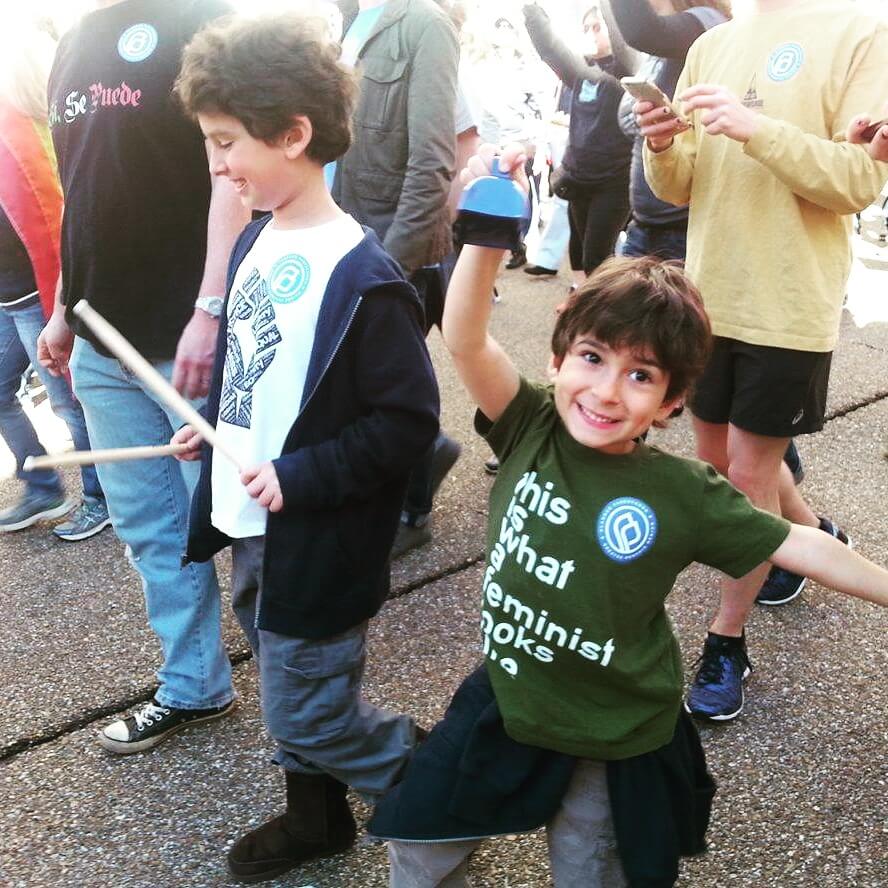
If there’s not anything happening in your community soon, but you want to introduce the concept of protest to your children, show them this round up of the best photos of children who participated in the Women’s March.
Related Post: Trying to be the perfect activist was too painful
Inspire Them With Examples of Kids Acting for Justice
Social justice doesn’t always have to be about something that has an enormous scale, like getting a law passed by Congress. Often times, the best place to start making change, especially for kids, is at the local level.
When 10 year old twins Henry and Henriet James started thinking about their school’s policy that girls and boys could not sit together at lunch, they didn’t like it. They decided to write an article about it in their school’s newspaper, and the advisor for the paper told them to “go for it.” Their article was so well written that over the summer, it convinced the school to change their policy.
Related Post: 5 Young Activists Who Will Inspire Kids
How do you help the kids in your life understand the difference between charity and justice? Share in the comments!

4 responses to “Social justice for kids: teaching the difference between charity and justice”
I just love this article – thank you for putting this all together. A friend of mine and I are sharing this and discussing it with a group of activist parents tonight. We look forward to passing on more of your helpful resources and ideas. Thank you for your big heart and all of your hard work!
Sarah, you have no idea how happy this makes me! If there are other resources you’d like me to consider creating, please let me know!
Hello Rebekah,
This article is truly inspiring. I work at 4 Catholic Primary Schools and a couple of the schools are in need of a little support and suggestions and possibly a presentation on Social Justice and Charity. Do you mind if I use some of your information above. I am located in Australia. Our schools and especially our students are very committed to helping others.
Thank you!
Wendy
Wendy, I’d be happy for you to share the info in the post! If you’re not already on my email list, be sure to subscribe by clicking on one of the Kid Activists 101 link. I regularly put out new posts and resources on social justice for children.