
locaIn the midst of the coronavirus pandemic, Asian Americans are facing racist attacks, both verbal and physical. Anti Asian racism is nothing new (including myths about Asian people spreading disease more than other groups.)
It’s important for us to talk to our children about racism that Asian Americans are experiencing now, as well as the history of discrimination they’ve faced in the United States.
How to equip kids to speak out against anti Asian racism

Disclosure: For your convenience, this post includes affiliate links. If you purchase items through these links, I may earn a small commission at no additional cost to you. You can read my full disclosure policy here.


1. Be proactive in addressing racist talk about the coronavirus pandemic
We talk a lot about race and racism in our house. Until recently I hadn’t spoken much to my 7 year old about racism that Asian Americans face.
This week, my husband and I talked with him about the dangerous rhetoric that Trump is using. We discussed how Chinese Americans are being blamed for the virus, and how that’s racism. Since then, our son has said things like “just because somebody is Asian doesn’t mean they have coronavirus” and “China can’t help it that the disease started there.”
Even though our kiddo is not having much social contact right now, I want him to be prepared for what he might hear. He’s ready to speak up if he hears anyone calling coronavirus the “China flu” or other racist, inaccurate terms.

2. Challenge the model minority myth
White children are likely to believe the model minority myth. This is especially for kids who are in honors classes and see that many of their classmates are Asian American.
In my ebook Raising Antiracist Kids: An age by age guide for parents of white children, I talk about ways to challenge the stereotypes that academic tracking encourages.
The model minority myth is harmful to both Asian Americans and to non-Asian people of color. That’s because white people point to the success of some Asian Americans as “proof” that racism doesn’t exist.
It’s harmful to Asian American children because it can prevent them from getting the academic services they need. The model minority myth leads to underfunding of programs like English as a Second Language classes.
As educator Sarah-Soonling Blackburn describes, it can lead teachers to assume students will excel in subjects like math. Blackburn’s math teacher didn’t help her as she struggled with his class, because he assumed she had a natural aptitude.
The model minority myth also disguises the different experiences of particular Asian American communities. While some Asians have had above average economic success, Asian Americans have the largest income gap of any racial group.
Related Post: Overcoming anxiety so that you can talk with children about race effectively
What does all this mean for talking to children? For younger kids, we need to talk about not making assumptions about what someone’s life is like because of their race. Some Asian Americans are wealthy. Others are middle class, while some are poor. Some Asian American students excel at math, while others struggle.
Kids need to know that race is not real in the biological sense. Our bodies and brains do not work any differently across racial groups. (This doesn’t mean telling kids that race doesn’t matter. Race is a made up idea that has very powerful social consequences, including discrimination.)
For older children, we can expand the conversation by learning alongside them about how structural racism works.
3. Talk about common microaggressions that Asian Americans experience
Microaggressions are the the everyday slights, snubs, insults, and backhanded compliments that communicate hostile, derogatory, or negative messages about a person based on their membership in a marginalized group. They occur between individuals (which is why they’re called “micro.” It’s not because they are small or insignificant.) Children are frequent recipients and perpetrators of microaggressions.
One of the most common anti Asian microaggressions implies that Asian Americans are always foreign. When preschool teacher Elena Jaime heard a child tell her Chinese American co-worker “wow, you sound American,” she knew it was time to stop and talk with the kids.
It’s also crucial to intervene when we hear children using gibberish language to imitate Chinese. Shaming children could backfire and lead to them hiding this kind of play in the future. But we must take advantage of the teachable moment in front of us.
We can start by asking children if they’re trying to imitate a language they heard someone else speak. We can ask them if were curious about what was being said.
Then, we can continue by saying something like “I’m afraid if a Chinese person heard you speaking this way, they might think you were making fun of them. It might make them not want to speak their language in public anymore.”
Related post: Talking with kids about microaggressions
Another very common anti Asian microaggression that children use is stretching their faces into slant eyes.
Just this week, my 7 year old (who’s very bored now that school is cancelled) was stretching his face into different shapes. I laughed at several of them, but when he pulled his eyelids to the side, I didn’t. He noticed right away and asked why I didn’t laugh.
I explained to him that even though I knew he was not making fun of Asian people, that other people used this gesture to make fun of them. We talked about how bad it would feel to have someone make fun of the your appearance.
4. Surround Asian American children with positive messages about their identity
Sadly, children and adults alike are already targeting Asian American kids with racist attacks spurred by the coronavirus pandemic. Parents and teachers can reduce the long-term impact of this racism by surrounding Asian children with positive messages about their histories, communities and identities.
Parents can adapt the reading circle model created by Sadaf Siddique to support Muslim children’s positive identity development.
Once schools are back in session, teachers and administrators could start identity affirmation groups to provide students with peer support.
Educators and families can read children’s books that star Asian American children and affirm their experiences. In the next section, you’ll find some of my favorite books that include themes about resisting anti Asian racism.
But it’s almost important to read “everyday” books with Asian American kids who are just being kids. Some of my favorites are:
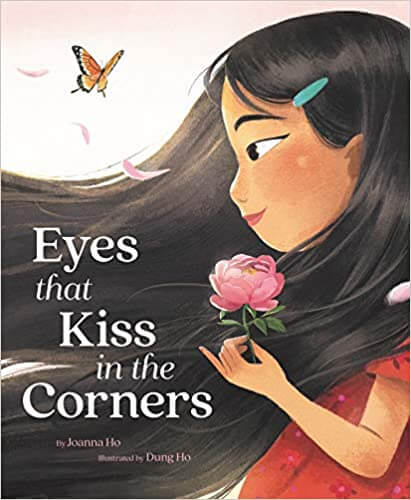
Eyes that Kiss in the Corners by Joanna Ho and Dung Ho (for ages 4 – 8)
Pepper Zhang, Artist Extraordinaire! by Jerry Zhang (for ages 3 – 7)
The Jasmine Toguchi series by Debbie Michiko Florence (for ages 7 – 10)
Dear Juno by Soyung Pak (for ages 3 – 7)
Big Red Lollipop by Rukhsana Khan (for ages 4 – 8)
The Alvin Ho series by Lenore Look (for ages 7 – 10. Skip book 3 about birthday parties and science projects. It’s full of racist Native American pretend play.)
5. Learn about Asian American history, including anti Asian immigration laws
Some of the books in the next section are about Asian American leaders who experienced and resisted racism. Reading and talking about these books can open children and teens’ eyes to how racism has shaped Asian Americans opportunities and experiences.
The Zinn Education Project has a wealth of lessons and resources about Asian American history, developed with a social justice perspective.
Related Post: How kids think about race: what research says
6. Read children’s books that include themes of anti Asian racism and Asian American resistance
The myth of Asian Americans as “model minorities” has many harmful consequences. One is that it minimizes the racism that Asian Americans have experienced. The model minority myth also paints Asian Americans as passive and accepting, so reading stories that show how people have resisted their oppression is key.

The Name Jar by Yangsook Choi
Purchase from Bookshop (supports independent bookstores)
The Name Jar explores the pain that many Asian American immigrants experience when it others don’t take the name to learn the correct way to say their names. Unhei is an immigrant child who has just moved to the U.S. from Korea. After she’s teased about her Korean name on the first day of school, she becomes anxious about fitting in.
Unhei decides that she should choose a new name, and her friends offer her many suggestions that they place in her name jar. But then a friend shows intense interest in Korean characters. Unhei’s mother tells her how her name was chosen, and she has second thoughts about changing her name. (Recommended for ages 4 – 9)
Related Post: 18 Powerful Books about Race & Racism for Children & Teens

The Favorite Daughter by Allen Say
Purchase from Bookshop (supports independent bookstores)
Yuriko used to love art class and her name. But after the new art teacher calls her “Eureka,” all the kids call her that too. When blond Yuriko shows them a baby picture where she is wearing a kimono, the other kids insist that Japanese dolls have black hair. (Yuriko’s father is Japanese and her mother is white.)
It’s time for an “American” name, Yuriko tells her father. Father doesn’t tell her what to do. He does, however, know the places to take her that will help her remember what she loves about her Japanese heritage. (Recommended for ages 5 – 9)

American Born Chinese by Gene Luen Yang
Purchase from Bookshop (supports independent bookstores)
American Born Chinese is a perfect example of how complex graphic novels can be, even though the whole book can be read in a couple of hours. Yang intertwines multiple story lines that eventually come together. There’s Jin, a Chinese American student in love with an “all American” white girl. We meet the Monkey King, who’s rejected by the immortal gods in heaven, even though he’s been mastering the heavenly disciplines for thousands of years. And there’s Danny, who hates it when his cousin Chin Kee comes to visit each year, ruining his relationships at school.
The book helps us understand the impact that racism has on identity and self-esteem. Many teens will need some help from a knowledgeable adult to be able to unpack the themes of the book, especially understanding the role of an over the top stereotypical character. (Recommended for ages 13+)
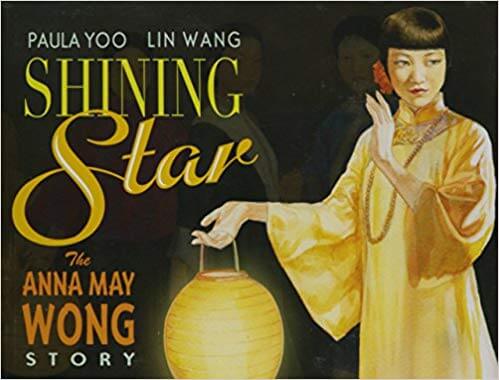
Shining Star: The Anna May Wong Story by Paula Yoo and Lin Wang
Purchase from Bookshop (supports independent bookstores)
As a child, Anna May Wong dreamed of becoming an actress. Despite initial opposition from her family, she began her career in the 1930s as an extra, gradually working her way into larger roles. While she loved being an actress, she was also troubled by racist policies on the movie sets. Almost all the roles available to Asian Americans were based on stereotypes or were demeaning to her people.
After a lengthy visit to China and conversations with her father about his experience of being an immigrant in America, Anna May vowed that she would only take on roles in which Chinese people were shown in a positive light. (Recommended for ages 7 – 12).

A Different Pond by Bao Phi and Thi Bui
Purchase from Bookshop (supports independent bookstores)
While other children might go fishing with their parents for fun, a young Vietnamese American boy wakes early to help his father fish for food. They leave far before dawn because his father has to go to work his second job later (even though it’s a Saturday.)
This picture book sensitively captures the earthy moments of the fishing trip, while also revealing details about what the boy’s father has been through as a refugee. It also addresses anti Asian racism when a boy at school tells the main character that his Vietnamese father’s English “sounds like a thick, dirty river.” But to the little boy, his Dad’s English sounds like “gentle rain.”
This book totally absorbed my 7 year old. He especially enjoyed when the boy’s mother refers to him as the “baby brother.” He may be the youngest, but the boy thinks “I am not a baby…I helped catch dinner!” (Recommended for ages 4 – 10)
Related Post: 11 Children’s Books about Immigrants and Refugees
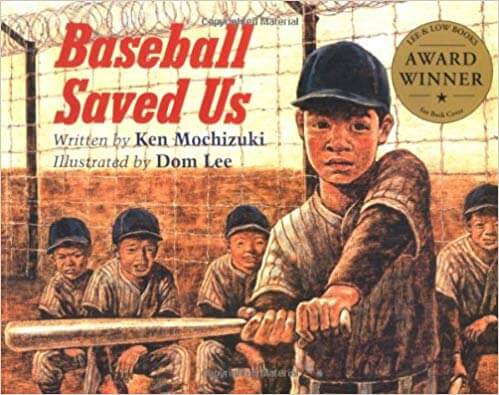
Baseball Saved Us by Ken Mochizuki and Dom Lee
Purchase from Bookshop (supports independent bookstores)
When the government sends Shorty and his family to an internment camp during World War II, everything in his life changes. After his older brother is disrespectful to his father, Shorty’s dad realizes they need to find something positive to do in the camp. All of the camp joins together to make a baseball field, bleachers, and uniforms – seemingly out of nothing.
At home, Shorty never considered himself much of a ball player. But being surrounded by people who look like him helps. So does channeling his anger at the guard in a high tower who never stops watching them. Wanting to hit the ball past the guardhouse, Shorty completes his first home run ever.
The book doesn’t end there, though. Once Shorty is back home, there are still problems, including being called a racial slur by his classmates. But will his experience in the camp make him a better player on this baseball field this time? (Recommended for 6 – 12)

Journey for Justice: The Life of Larry Itliong by Dawn B. Mabalon, Gayle Romasanta, and Andrew Sibayan
Learning about Larry Itliong’s brave farmworker organizing challenges stereotypes about Asian American being passive in the face of racism and economic exploitation.
Many people know about United Farm Workers co-founder Cesar Chavez, but don’t know that Filipino American Larry Itliong was also a co-founder. Larry arrived in the United States, dreaming of becoming a lawyer. But he soon learned that brown skinned immigrants were usually relegated to the worst jobs, including farm work.
His groundbreaking work with Dolores Huerta organizing farmworkers eventually convinced Cesar Chavez that Filipino and Mexican American farmworkers must strike together.

Amina’s Voice by Hena Khan
Purchase from Bookshop (supports independent bookstores)
Since Amina started middle school, so much seems to be changing. Her best friend Soojin is hanging out with Emily, who used to make fun of the girls’ Pakistani and Korean lunches. Soojin even wants to change her name to something “American” when her family becomes citizens, a desire Amina can’t understand.
When Amina’s uncle arrives for a long visit from Pakistan, she overhears him questioning her love of pop music to her father. Her parents have always said that music pleases God, but Thaya Jaan thinks otherwise.
When someone carries out an attack on the community’s mosque, Amina wonders how her voice can help her community. (Recommended for ages 8 – 12)

Surfer of the Century: The Life of Duke Kahanamoku by Ellie Crowe and Richard Waldrep
Purchase from Bookshop (supports independent bookstores)
Olympic swimmer and legendary surfer Duke Kahanamoku lived an amazing life. This in-depth picture book teaches kids about as many aspects of his life as possible. His skill and persistence, combined with the striking paintings in the book, are sure to inspire some kids to learn how to surf and swim in the ocean.
Duke learned to swim at age 4 in the same way that many Hawaiians learned in the late 19th century: tied to an outrigger canoe, with the ocean as his swimming pool. As a teen, he knew he was an excellent swimmer. He longed to compete against swimmers from the American mainland.
When a Honolulu lawyer and swim coach timed Duke’s races, he was flabbergasted at his speed. Duke agreed to take him as his coach. This started his long and twisting path to competing in the 1912 Olympics. It was a journey filled with obstacles, including needing funds to travel to the Olympic trials, and facing racial discrimination. Yet even the crowds who had jeered at him because of his skin color were soon cheering him when they saw how fast he swam. (Recommended for ages 7 – 12)
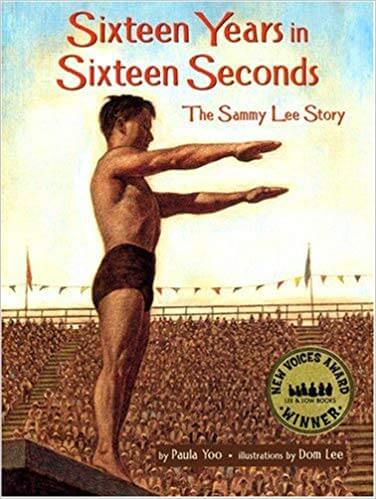
Sixteen Years in Sixteen Seconds: The Sammy Lee Story by Paula Yoo and Dom Lee
As a young teen, Sammy Lee longed to learn to dive. But it was the 1930’s, and local government only let people of color use the public pools one day a week. Sammy, a Korean-American, taught himself to dive, practicing on that one day each week, with the help of his friend Hart, who was Black.
Sammy’s father thought he should spend less time on sports and focus on becoming a doctor. His father believed deeply in the American dream, but Sammy’s experiences of discrimination gave him doubts. After all, he’d been elected Most Likely to Succeed by his classmates, but as an Asian American, he wasn’t even able to attend his own prom.
After asking his father why he put up with racist treatment, Sammy finally understood that his father believed Sammy would earn respect if he became a doctor. So they both agreed that if he kept up his grades enough to get into medical school, he could also keep diving. Sammy continued to train, not knowing the 1940 Olympics would be cancelled because of World War II. Even after becoming a doctor, he never let go of his dream. (Recommended for ages 7 – 12)
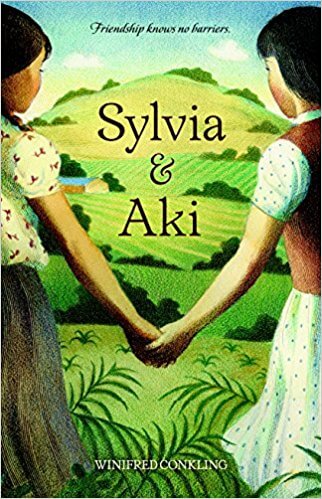
Sylvia and Aki by Winifred Conkling
Purchase from Bookshop (supports independent bookstores)
This moving chapter book, based on a true story, examines discrimination against both Japanese Americans and Mexican Americans during the World War II era. The U.S. government forced Aki Munemitsu from her home into a relocation camp, like 100,000 other Japanese Americans. The Mendez family leased the Munemitsu’s farm while they were interned. The Mendez family tried to enroll their daughter Sylvia in the local school, but education leaders said she had to go the Mexican school. (She became a plaintiff in a ground-breaking school desegregation lawsuit.)
Aki, who once attended the Westminster School that Sylvia was being denied admittance to, now must live in a crowded tar-paper building in a camp bordered with razor wire. Conkling tells Sylvia and Aki’s stories side by side, including how they became pen pals until the Munemitsu family was released at the end of the war. (Recommended for ages 10+)

Fred Korematsu Speaks Up by Laura Atkins, Stan Yogi, and Yutaka Houlette
Purchase from Bookshop (supports independent bookstores)
Fred Korematsu’s life was turned upside down in 1942 when the government ordered him to report to an internment camp. But Korematsu knew that the internment order was morally wrong, so he went into hiding.
He was caught, jailed, and then sent to the same internment camp where the rest of his family had been forcibly relocated. He continued his resistance to this injustice by suing the government. His case went all the way to the Supreme Court. Korematsu lost, but decades later this social justice activist was a leader in winning restitution for Japanese Americans who were interned.
This book tells Korematsu’s story through a combination of poems, photographs, paintings, and informational text. The book also asks children questions that help them identify with his story. (Recommended for ages 9+)