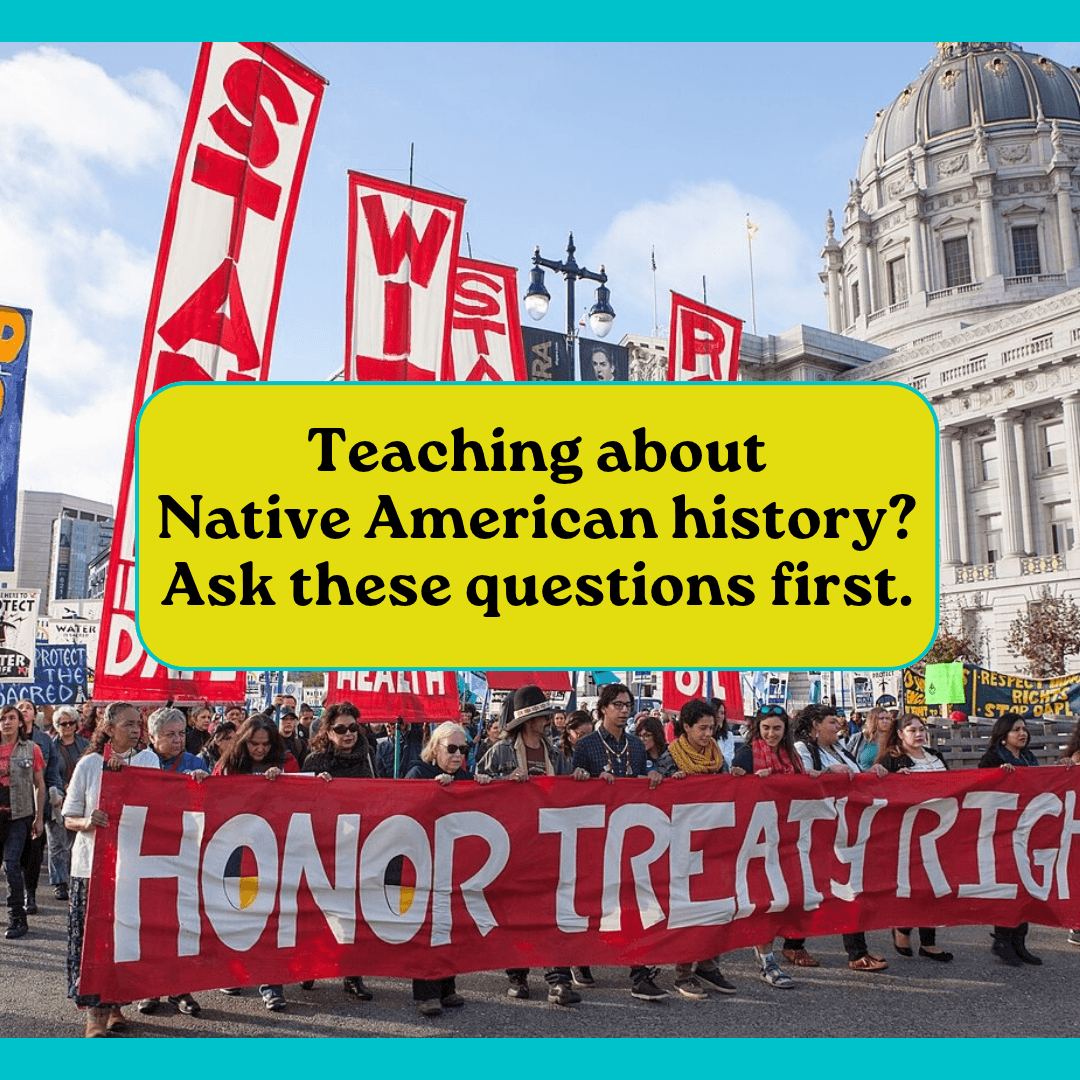
I’m writing this post during Native American Heritage Month. In many classrooms this may be the only time of year Native American history is addressed. Because accurate, non-Eurocentric resources about Indigenous nations are hard to find, it’s important to pause before diving into your lesson plans.
This post offers six questions to help educators consider their approach to Native American history. The questions can also guide caregivers as you think about your discussions at home and what books you offer your children.
My goal is NOT to make you think your lesson needs to be perfect. All of us who are committed to unlearning bias are on a lifelong journey. No matter how much you know, there will always be more to learn. You will make mistakes, and what matters is what you do after you’ve realized you’ve made that mistake. I hope the questions and the resources I point you towards can help you improve and develop your skills for evaluating lessons and student resources.


Disclosure: For your convenience, this post may include affiliate links. If you purchase items through these links, I may earn a small commission at no additional cost to you. You can read my full disclosure policy here.
#1 Have you talked about how Native nations and people are present today?
Right now I’m taking a class for adults from Kelly Reagan Tudor (Lipan Apache) on Teaching about Native Americans. During one of our classes, I told Kelly about an experience in my son’s Cub Scout troop several years ago. Our pack leaders invited a group from the Mississippi Band of the Choctaw to give a cultural presentation to our scouts.
We hadn’t provided any kind of context for the kids ahead of time. The Choctaw presenters shared games, tools, culture practices, and weapons from Choctaw history. At the end of the presentation, one of the children earnestly asked the presenter “do you use a tomahawk?” The presenter explained that tomahawks were never used among the Choctaw. My bigger concern walking away from the presentation was that this child (and probably many others of the group) assumed that Choctaws were not a modern people who, in many ways, lived similarly to them.
In response to my awkward story, Kelly shared that many years ago, she and her children had a similar experience when doing dance demonstrations at a cultural center. Children (and sometimes adults) asked her family questions like “do you live in a tipi?”
On the second day of offering dance demonstrations, Kelly gave groups a quick 5 minute introduction sharing how Native Americans are modern people. She explained that the regalia she was wearing that day is only worn for special occasions and that she drove to the event in her car. Kelly also shared that each feather in her regalia had been earned, as well as other relevant information. After that, she said, the questions her family was asked were completely different and pointed toward what she wanted participants to understand.
Related post: Indigenous children’s and young adult books set in the present day
Note: I highly recommend Kelly for both adult and children’s classes. She also offers continuing education for teachers/schools. Find her Outschool classes here and her curriculum review blog here.
At a small museum about the Mississippian civilizations run by our local university, the end of the exhibit has pictures and information about the Chickasaw and Choctaw nations today. This helps combat the idea of the “vanishing Indian” that many adults still accept as true.
Anti-Bias Children’s Book Calendar: Daily children’s book recommendations for learning about diverse holidays, uplifting resistance to injustice, and countering stereotypes.
Unless you’ve already done separate lessons on Native nations today, I highly recommend prefacing your history lessons with a brief introduction on relevant information today. History lessons should be tribally specific (see question #2 below). That makes it easy to talk about where this tribal nation is located today and what issues are important to their communities. Search for the tribal nation’s official government website as a starting point for your learning. If the resource you are offering is written by a Native author, tell learners what tribe they belong to.
#2 Is your lesson tribally specific?
Today there are 574 federally recognized American Indian and Alaska Native tribal nations. When the first Europeans arrived on Turtle Island, there were thousands of nations. Then and today, these nations were incredibly diverse in terms of language, diet, economy, dress and other aspects of culture, religion, and governing structure. There is no one “Native American history” that can be lumped together. A better title for my post would be “Teaching about Native American histories?”
Make sure that your lesson uses accurate name and spelling for the tribal nation(s) you are teaching about. Explain to students that while there are patterns and relationships that can be seen across some tribal nations’ histories, what you’re teaching them doesn’t necessarily apply to other nations.
Related resource: Books for young people about Indigenous residential schools
#3 Will you be covering Native American histories past the year 1900? What about before European contact?
A 2015 study by scholars from Pennsylvania State found that 87 percent of Native American k-12 content includes only pre-1900 history. This contributes to the false belief that colonization led to the end of Native nations and peoples.
There are so many important topics to Native American history that take place after 1900, including:
- Native American boarding schools (which lasted until the 1930s)
- The Indian New Deal during the Great Depression
- Termination of Native nations’ governments and the Indian Relocation Act of the 1950s, resulting in huge shifts of Native populations into major cities. (Read Indian No More by Charlene Willing McManis for ages 8 – 12.)
- Native activism in the 1960s and 1970s, including the American Indian Movement.
- Indian Child Welfare Act, protecting Native children from being adopted out of their cultures when possible.
- American Indian Religious Freedom Act of 1978 and later Supreme Court decisions.
- Economic development and pushes for tribal sovereignty to be recognized from the 1980s to the present.
- The revival of teaching Indigenous languages.
- Water protector movements, especially Standing Rock in 2016. (Read Young Water Protectors by Aslan Tudor for ages 5 – 10 or the conclusion of An Indigenous Peoples’ History of the United States for Young People for ages 13+).
For children ages 8 – 12, the thorough picture book We Are Still Here! by Traci Sorell and Frané Lessac provides a quick introduction to many of these topics.
Boarding Schools and the Indigenous Story by Ashley Fairbanks is an excellent resource for ages 10 – 14 (and it covers more history than boarding schools alone.)
Related post: Eight middle grade books by Indigenous authors
It’s also important to cover Indigenous history before European contact. Students are taught extensively about European histories before these nations began colonizing the Americas. Children and teens should also learn about Native histories from ancient through medieval history.
One useful resource for pre-contact history is Turtle Island: The Story of North America’s First People by Eldon Yellownhorn and Kathy Lowinger (ages 8 – 12.) The People Shall Continue by Simon Ortiz is an excellent shorter picture book (suitable for ages 6+).
Related resource: Teaching kids about the Haudenosaunee Thanksgiving Address
#4 Are you aware of inaccurate and offensive terms that are still used in many Native American history texts?
Some commonly used words are inaccurate because they lump together all tribal nations by using a word that is specific to one tribe or a small group or tribes. Some are simply not true for any Native nation. Other words are offensive because they perpetuate racist stereotypes.
Watch out for the uncritical use of these and other related terms. Terms with stars included are considered slurs so I have not typed out the entire word. Bolded words include a linked article to learn more.
- squ*w
- s*v*ges
- warlike
- primitive
- discovered/discovery (when referring to European contact/colonization)
- New World
- Indian princess (when used in a historical context. Some powwows have contests where the winner is crowned “princess.”)
- chief (while this term may sometimes be correct, nations had specific words for their government leaders. The term chief is also gendered and ignores the role clan mothers played in some nations’ governance.)
- r*dsk*n
- Esk*mo (the term Inuit should be used instead.)
- papoose (depending on the context cradleboard may be the appropriate term).
If you are required to teach a text using any of these terms, be sure to point out to students that they are inaccurate an/or offensive.
#5 How will you check the text for Eurocentric bias?
This question could be a lengthy article on its own! In Kelly Tudor’s class on Teaching about Native Americans, we’re spending two weeks on it.
First, if you’re using a world history or U.S. history textbook, compare the amount of attention that is given to European (or in later U.S. history white) leaders, governments, and topics versus Indigenous nations. Is there adequate information about Native nations before European contact and colonization?
Second, check the language and overall tone of the resource. Even if Native and other histories are given equal “air time,” Native histories and cultures may be framed through a Eurocentric lens. Are Native peoples portrayed as less sophisticated or “advanced” than Europeans? Are Turtle Island’s lands described an “uncultivated” before Europeans arrived (which is definitely not true. Read Before Columbus by Charles Mann with ages 9+ or research the history of how corn was cultivated, Native roads built for trading, or the management of prairie grasses.)
Related post: Picture books by Native and First Nations authors
Third, do a gut check. Not to sound like a Stephen Colbert caricature, but do the descriptions or wording of the resource feel off-putting? Which aspects of a nation’s culture or history are the focus, and is that focus intended to “fascinate” or shock readers? For example, even brief examinations of the Aztec empire often focus on human sacrifice, while children’s history texts generally ignore the practice’s existence in other parts of the world.
Say goodbye to whitewashed history with my people’s history children’s literature guide!

#6 Is the author of the resource Native, and if not, how much in-depth research or collaboration have they done?
I am not Native, which is why I try to point you to resources that are created by or have been vetted by Indigenous people whenever possible. As Debbie Reese (Nambe Pueblo), a scholar of children’s literature, explained in an EmbraceRace webinar:
“I’d like you to look for books by Native writers. There is no guarantee that a Native writer is going to do better in telling a story about his or her own tribal nation than a white person would. But it stands to reason that they likely will, especially if that’s a part of where they grew up.”
Even if you’re required by your school district to use certain texts, you can use resources by Native authors to expand your knowledge. That prepares you to help your learners spot inaccuracies and stereotypes.
Here are a few recommended resources for history and literature:
Native Knowledge 360, an incredible searchable hub of lesson plans and learning resources from the Smithsonian Museum of the American Indian.
“Resources for Teachers” on Debbie Reese and Jean Mendoza’s blog American Indians in Children’s Literature.
Native American Curriculum Review by Kelly Tudor
Worksheet for selecting Native American Children’s Literature
Heartdrum Press (a great resource for contemporary Native reads for children and young adults)
A Kid’s Guide to Native American History by Yvonne Wakim Dennis and Arlene Hirschfelder (ages 6+).
Mint and Bloom Learning (creators are not Native but Kelly Tudor has collaborated with/reviewed some of their Native-specific resources before they were published.)
Related post: Do’s and don’ts for teaching young children about Native Americans
