I already have a popular blog post about great books for kids and teens about race and racism. So, why am I adding a list of children’s books about white supremacy and books that help white kids grapple with their own racial identity?
Through the years of doing antiracism work with my fellow white people, I’ve noticed something. Most of us who are white, at some point, have thought about race as something that affects People of Color, not us. It can take a lot of work, questioning, and reflecting before white folks begin to see how we also live lives that are deeply shaped by the made-up concept of race.
That matters for a whole bunch of reasons. It’s one of the things folks learn about in-depth in my Nurturing Antiracist White Kids course.
For now, I’ll just say that white children and teens need to understand how white people in the past and present have upheld racism. They need chances to wonder about how dismantling racism could free both People of Color and white people. Racism harms all of us, though in very different ways.
White kids also need to see white people grappling with racism. They need examples of white people working to stop racism and unlearn white supremacy. And these examples need to include people who make mistakes and have to work to repair them.
Related post: The definition of race for kids (plus 7 more terms related to race and racism)
One note about this list: many of the books on this list are written by BIPOC (Black, Indigenous, and People of Color) authors and star People of Color. They have the added benefit of helping white young people think about what it means to be white, but they’re great reads for kids of all races. However, if a book is primarily geared to white kids, I indicate that at the end of the book’s review.


This post may include affiliate links. If you purchase items through these links, I may earn a small commission at no additional charge to you. You can read my full disclosure policy here.
Picture books for young children that address white supremacy and white privilege

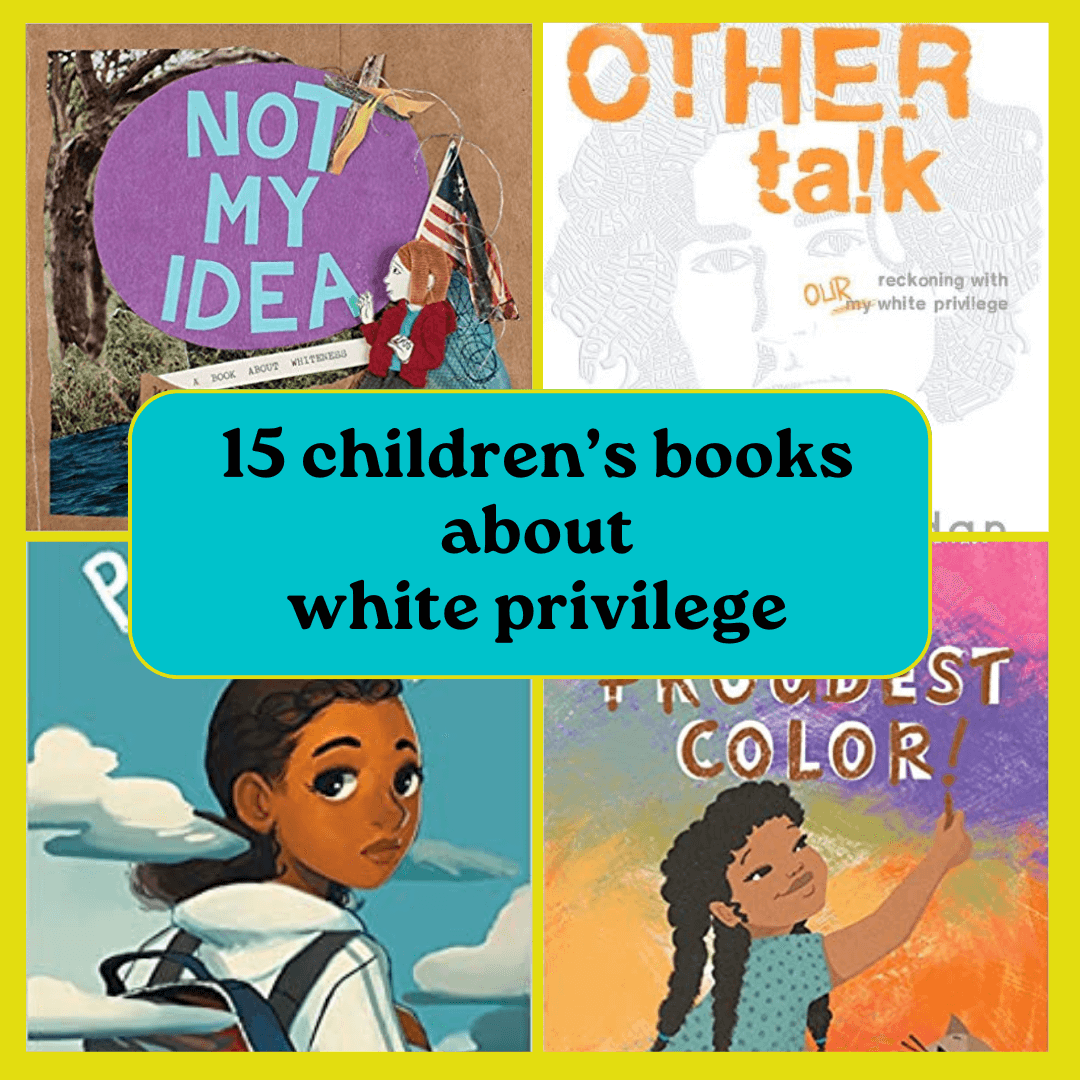
The Proudest Color by Sheila Modir and Jeffrey Kashou. Illustrated by Monica Mikai.
Purchase from Bookshop.org (supports independent bookstores)
As she prepares for her first day of school, Zahra thinks about all the colors she uses to express herself. Most of all she loves the warmth and glow of brown, which is also the color she sees when she looks in the mirror. At school, though, most of the children do not look like her, and her white classmate Zoe loudly notes “you’re so dark. I don’t like brown” during recess.
Back home, Zahra’s family members remind her of all the people who share her brown skin (in different shades and from different ethnicities) who are in her life or have made important contributions to the world. At the close of the book, Zoe and Zahra exchange letters where Zoe apologizes for her remarks and Zahra reminds her of all the beautiful things that are brown. This model of repair and accountability is an important one for white children to see. (Recommended for ages 3 – 7. Middle Eastern American authors.) Note that the electronic edition of the book may not include Zoe and Zahra’s letters to each other.
Related Post: 14 anti-bias books for preschool and kindergarten

Our Skin: A First Conversation about Race by Megan Madison, Jessica Ralli, and Isabel Roxas
Purchase from Bookshop.org (supports independent bookstores)
This first book about race covers a breathtaking amount of topics over a short time, starting with identifying and loving your own skin tone. Children also learn why we have different skin tones, and some of the racial labels, including white, that people use to correlate with all those shades of skin.
What really sets this book for young children apart is how it explains that the made up idea of race was used to fuel racism. The authors talk about racism not as just individual people being mean, but as a way that white people get power. The book gives children relatable examples of racism that are likely to happen in young children’s worlds. Finally, children are encouraged to challenge racism by speaking up, changing unfair rules, and learning. (Recommended for ages 3 – 7. Black author (Madison). White author (Ralli). Filipina illustrator.)
Related Post: Talking about skin tone with children

Eyes That Speak to the Stars by Joanna Ho. Illustrated by Dung Ho.
Purchase from Bookshop.org (supports independent bookstores)
In this follow-up to the stellar book Eyes That Kiss in the Corners, a young Chinese-American boy is hurt by a white friend’s drawing of him that gives him slits for eyes. In poetic language and imaginative glowing illustrations, his Baba shows him all the promise and beauty that the boy’s eyes, and the eyes of all the men in his family, hold.
While the primary audience for this book is East Asian children, it can also be a valuable conversation starter about white supremacy. Why does Kurt (the white child who makes the drawing) draw the main character this way? What is hurtful about it, and how does it differ from how the boy actually looks? What can we say when someone believes that a particular eye shape, hair texture, or skin tone is better or worse than others? (Recommended for ages 4 – 8. Chinese/Taiwanese-American author. Vietnamese illustrator.)
Related Post: 15 children’s books about beauty that challenge stereotypes

Something Happened In Our Town: A Child’s Story about Racial Injustice by Marianne Celano, Marietta Collins, and Ann Hazzard. Illustrated by Jennifer Zivoin.
Purchase from Bookshop.org (supports independent bookstores)
When learning about white supremacy and white privilege, we can’t ignore police violence. This engaging and important children’s book about race was written by three child psychologists. It’s an excellent resource that helps caregivers talk to children about police shootings. The story follows two children, one white and one Black, who are in the same class at school. All the adults in town have been talking about a police shooting of a Black man. Kids have overheard their conversations, and have questions.
The children’s questions prompt responses from their parents that unpack the legacy of racism in the United States, as well as Black resistance to racism. I particularly appreciate the healthy conflict that’s shown in the white family between the teenage daughter and her parents. She believes that are minimizing what the police officer did.
The book also includes extensive notes for parents on countering racism, including resources specifically designed for Black families. (Recommended for ages 5 – 9. White authors (Celano and Hazzard). Black author (Collins.)
Related Post: 15 books to help kids and teens understand that Black Lives Matter

The Name Jar by Yangsook Choi.
Purchase from Bookshop.org (supports independent bookstores)
Unhei is preparing for her first day of school. It was only a short while ago that she and her parents said goodbye to her grandmother in Korea. At the airport, her grandmother gave Unhei a special gift: a little block of wood that she soon learns is a name stamp.
But when Unhei tells the kids on the school bus her name, some of them say it wrong. Others start making nonsense rhymes. When her teacher asks her to share her name with the class a little later, Unhei says that she’s going to pick an “American” name soon.
Classmates offer to help her find a new name, filling up a jar with suggestions. It’s only when Joey, a white classmate, asks her about her Korean name stamp that Unhei begins to think about her name differently.
This story can provoke all kinds of conversations about whiteness with some adult guidance. Why does Unhei think of her name as “not American” while names like Grace and Amanda are “American?” What do racism and not pronouncing people’s names correctly have to do with each other? (Recommended for ages 5 – 9)
Related Post: 29 children’s books about Asian American history and culture
Children’s books for upper elementary and middle school that address white supremacy and white privilege

A Kids Book About White Privilege by Ben Sand
This book helps white children think about something that is usually hidden from them by society: the unfair privileges they have because of being white. Sand uses practical examples kids can relate to, such as imagining that their favorite movie doesn’t have a single character that looks like them, or not being able to find a Band-Aid that’s close to their skin tone.
Sand goes on to talk about ways to use white privilege to speak up against racism, helping white children move beyond knowledge into action. (Recommended for ages 7 – 10. White author. Primarily geared to a white audience.)
Related Post: 7 tips for talking to kids about tough topics

Dictionary for a Better World: Poems, Quotes, and Anecdotes from A to Z by Irene Latham and Charles Waters. Illustrated by Mehrdokht Amini.
Purchase from Bookshop.org (supports independent bookstores)
To be able to dismantle racism, foster peace, and meet huge challenges like climate change, children need more than factual information. They need inspiration that grows their hearts and minds, and Latham and Waters’ poems, stories, and quotes do just that.
One of my favorites is “(Epitaph for) Hate,” which is accompanied by George Washington Carver’s quote that “hate within will eventuallly destroy the hater.” This poem and quote alone can start many conversations abandoning white supremacy, as will “Respect,” (a tribute to Aretha Franklin) and “Xenial” (which replaces xenophobia with welcome.) (Recommended for ages 8 – 12. White author (Latham.) Black author (Waters). Iranian-English illustrator.)

She Stood for Freedom: The Untold Story of a Civil Rights Hero, Joan Trumpauer Mulholland by Loki Mulholland and Angela Fairwell. Illustrated by Charlotta Janssen.
Purchase from Bookshop.org (supports independent bookstores)
As a white child growing up in the South, Joan Trumpauer Mulholland realized Black people weren’t treated as equal to white people. She promised herself she would do something about that. She joined the civil rights movement while in college, and quickly had to leave segregated Duke University because of it.
Joan knew that many of her family members might cut her out of their lives because of her activism, but she joined the lunch counter sit-ins anyway. Even after Joan was sent to the notorious Parchman Prison for participating in the Freedom Rides, she continued to speak up and take action. Trumpauer’s story provides a powerful model of a white person who challenged white supremacy and who saw that she was not free until she began resisting its power. (Recommended for ages 8 – 12. White authors. White illustrator. Primarily geared to a white audience.)
Related Post: Talking to kids about antiracist allies and accomplices

Not My Idea: A Book About Whiteness by Anastasia Higginbotham.
Purchase from Bookshop.org (supports independent bookstores)
Although this is a picture book, it is by no means simple and is best suited for older elementary children. Higginbotham made this book for her white children to help them grapple with how they can dismantle white supremacy.
The graphic novel style illustrations show a young child who hears about a police shooting of a Black person on the news. But when they wants answers from the adults around them, they’re told that color doesn’t matter. This child already senses how their whiteness protects them in everyday interactions.
The book lets children know that they can face the truth about racism. While many white people participated in or ignored racism, the book also gives kids examples of white people who took action to support Black liberation. (Recommended for ages 8 – 12. White author. Primarily geared to a white audience.)
Related Post: A white parents’ guide to talking to kids about race

The Talk: Conversations about Race, Love, and Truth, edited by Wade Hudson and Cheryl Willis Hudson.
Purchase from Bookshop.org (supports independent bookstores)
This excellent volume includes talks about race between parents and children of many races and ethnicities. Many white parents neglect to have any type of direct conversation about race with their children, but Adam Gidwitz’s essay “Our Inheritance” provides a powerful example for white families to read together. When his fourth grade daughter expresses doubt that they could be friends with anyone who is racist, Gidwitz goes deeper into their family story than ever before.
He shares how her great-great-grandfather Jake faced discrimination as a Jewish immigrant living in Mississippi, yet as a white person also profited from racism through the sharecropping system. Before long, father and daughter are sitting with uncomfortable truths about what it means to be a white person becoming antiracist who also still profits from racism. (Recommended for ages 8 – 12. Black editors (Hudson & Hudson), essay authors are of many different races.)

Partly Cloudy by Tanita S. Davis
Purchase from Bookshop.org (supports independent bookstores)
Starting at a new school where you don’t know anyone is hard for any child. But for Madalyn, it also means moving in with Papa Lobo, her kind but odd great uncle, for most of the year. Meanwhile her father finds work in another city and her mother is putting in so many hours at work that there’s not enough time for the heart-to-heart conversations Madalyn wants to have.
As a newcomer and the only Black girl in her class, Madalyn is trying to navigate the waters of middle school friendship. When her new friend Natalie, who is white, makes assumptions about a Black boy based on racial stereotypes, Madalyn must decide whether their friendship is worth being honest or not.
For white children, Natalie’s fears and stereotyping are a important conversation starter. Through the story, white readers can also catch a glimpse of just how much pain Natalie’s assumptions cause Madalyn. (Recommended for ages 8 – 12. Black author.)
Related Post: 13 children’s books about courage and bravery

The Journey of Little Charlie by Christopher Paul Curtis.
Purchase from Bookshop.org (supports independent bookstores)
Christopher Paul Curtis is one of my favorite authors of historical fiction because of his knack for telling painful truths while speaking through the voices of children who are hilarious and quirky. While his novels usually star Black children, this story set during enslavement features a white Southern working class boy named Charlie. When Charlie’s father Pa dies suddenly, a man named Cap’n Buck appears and claims Pa owed him a large sum of money.
To save his Ma from disaster, Charlie agrees to accompany Cap’n Buck on a journey North to track down a family who escaped from slavery. Charlie doesn’t see much wrong with this mission until he gets to know the people he’s supposed to re-enslave, including a young man named Sylvanus who’s about Charlie’s age.
This is an excellent book that provoked so many good conversations with my son about how difficult it is to be brave and go against the system, even when you realize it’s wrong. Because a couple of the scenes of enslavement are realistic in their violence, I recommend that young people read this book together with an adult. (Recommended for ages 10 – 14. Black author.)
Related Post: How should we talk with children about enslavement?

The Insiders by Mark Oshiro.
Purchase from Bookshop.org (supports independent bookstores)
I’ve previously recommended The Insiders because of the incredibly engaging story it tells about queer kids becoming comfortable with who they are, even when other people aren’t. (And it has plenty of thrilling magical realism worked into the story!)
I’m highlighting the book now because a subplot about racial microaggressions in the story. Through a magical janitor’s closet, Héctor who is Latino, meets queer kids from other cities: Juliana who is Chinese and Black, and Sal who is white and Filipino.
When Sal makes a negative assumption about Juliana’s school based on the fact that most students there are Black, Juliana is deeply hurt. Héctor helps Sal think through what was messed up about his remarks, and how to make amends in a way that focuses on Juliana’s needs, not Sal’s feelings. These are fantastic, non-preachy scenes that show kids how to recover from racist mistakes. (Recommended for ages 10 – 14. Latine non-binary queer author. )
Young adult books that wrestle with white supremacy and white privilege

All American Boys by Jason Reynolds and Brendan Kiely
Purchase from Bookshop.org (supports independent bookstores)
Told in two voices, All American Boys chronicles a week in the life of two boys involved in an incident of police brutality. Rashad, who is Black, is the victim, and Quinn who is white, is a witness. Both teens attend the same school and have friends in common. While Rashad recovers from broken ribs and is monitored for internal bleeding in the hospital, his older brother and Dad have very different reactions to what happened. When video of the police officer beating him shows up online, Rashad has to relive what happened again and again, and not just inside his head. He also has to decide whether to publicly protest and talk about being beaten.
Meanwhile, Quinn is freaking out not only because of the violence he saw Rashad experience, but because the police officer who beat Rashad is Quinn’s best friend’s Guzzo’s older brother Paul. He’s soon wrestling with loyalties, because Paul has always stood up for Quinn, but he knows in his gut that what was he saw was just wrong. While Quinn wishes he could melt into the background (few people know he was a witness), he soon realizes that he can’t stay silent, even if it costs him. (Recommended for ages 13+. Black author (Reynolds.) White author (Kiely).)

The Other Talk: Reckoning With Our White Privilege by Brendan Kiely
Purchase from Bookshop.org (supports independent bookstores)
If you are raising or teaching white teens, this accessible and frank non-fiction guide is a must have. Part “how to,” part historical survey of racism in the United States, and part memoir, Kiely uses these tools to help white youth think about how being white is shaping their lives and the world around them.
Kiely goes in depth about how white privilege shows up in particular lives (including his own) and uses research to show broader patterns. Even as someone who’s read many books about racism, I learned new information, yet his tone and examples make the book useful even for a beginner. Finally the book is valuable because it’s not only about understanding white privilege, but also about how to move beyond silence into antiracist action. (Recommended for ages 12+. White author. Primarily geared to white audiences.)
